Please be patient while the page loads – there are over 900 images on this page!
Best viewed (and fully text-searchable) on a computer.
Below are the complete set images for RagingRiver’s special 2020 project honoring Spectral Chaos.
If you’d like to download high-resolution copies of any of these images, you can do so at my Ko-fi page.
Solely for fun, I took the extra step of creating “rulings/errata” for certain cards where I thought it helpful to clarify how that card would be meant to function, had it ever been printed. I am not a Magic rules expert or a judge, so these are only unofficial interpretations. If you are a judge and believe there are better ways to clarify how a card or ruling should be worded, feel free to contact me.
The Spectral Chaos Project is unofficial Fan Content permitted under the Fan Content Policy. Not approved/endorsed by Wizards. Portions of the materials used are property of Wizards of the Coast. ©Wizards of the Coast LLC. By downloading any images on this page, you agree you will not attempt to create and sell any cards or otherwise violate Wizards’ Fan Content Policy.

JUMP TO SECTION:
- Basic Lands (#1-5)
- Commons (#6-66)
- Uncommons (#67-187)
- Rares (#188-308)
- Very Rares (#309-429)
- Specials (#S1-S9)
- Cycles
BASIC LANDS (5):
Click here to download high-resolution copies of the Spectral Chaos Basic Lands at Ko-fi.
001 – Island
(Very Common Basic Land)
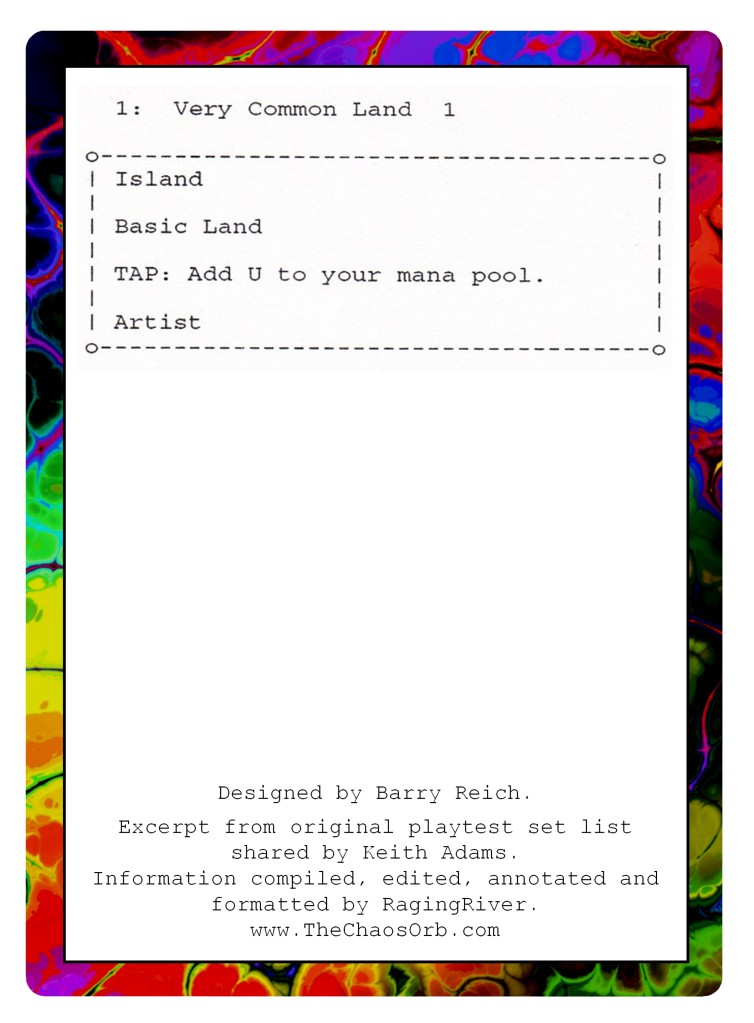
Original Playtest 
Realized (Version A) 
Realized (Version B) 
Realized (Version C)
002 – Mountain
(Very Common Basic Land)

Original Playtest 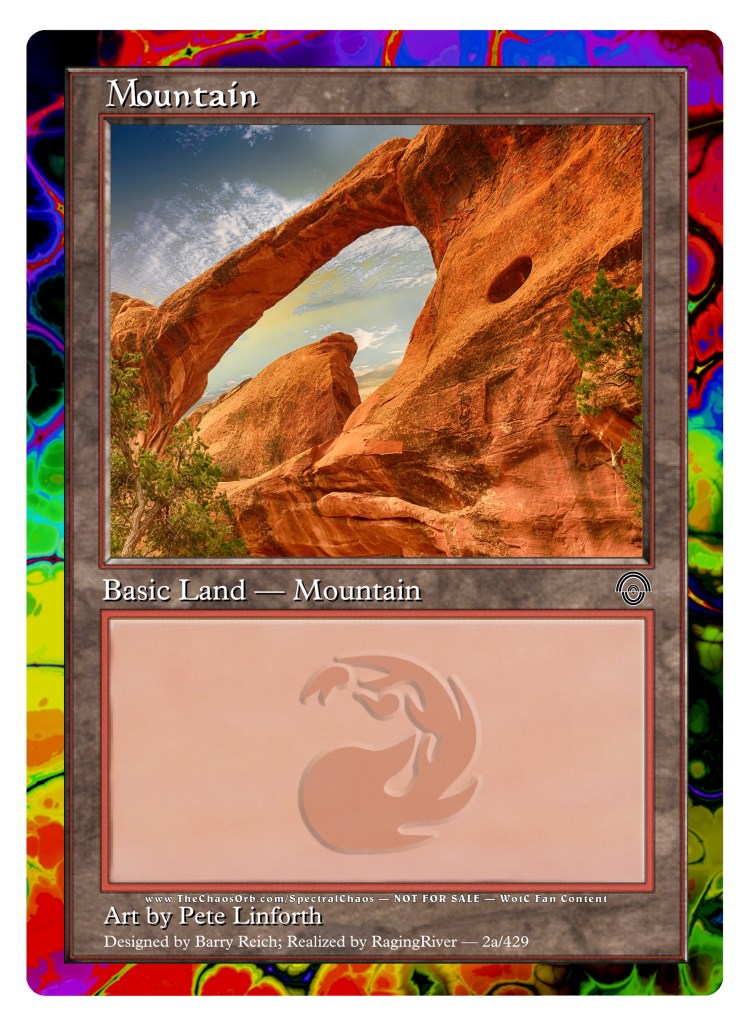
Realized (Version A) 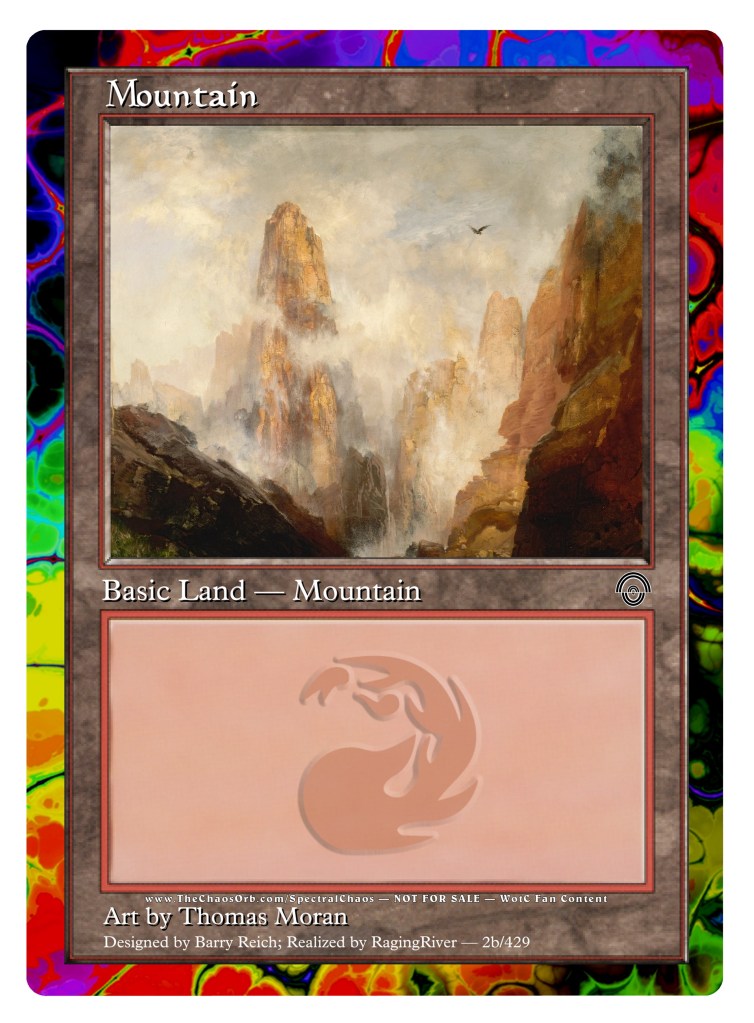
Realized (Version B) 
Realized (Version C)
003 – Plains
(Very Common Basic Land)

Original Playtest 
Realized (Version A) 
Realized (Version B) 
Realized (Version C)
004 – Swamp
(Very Common Basic Land)
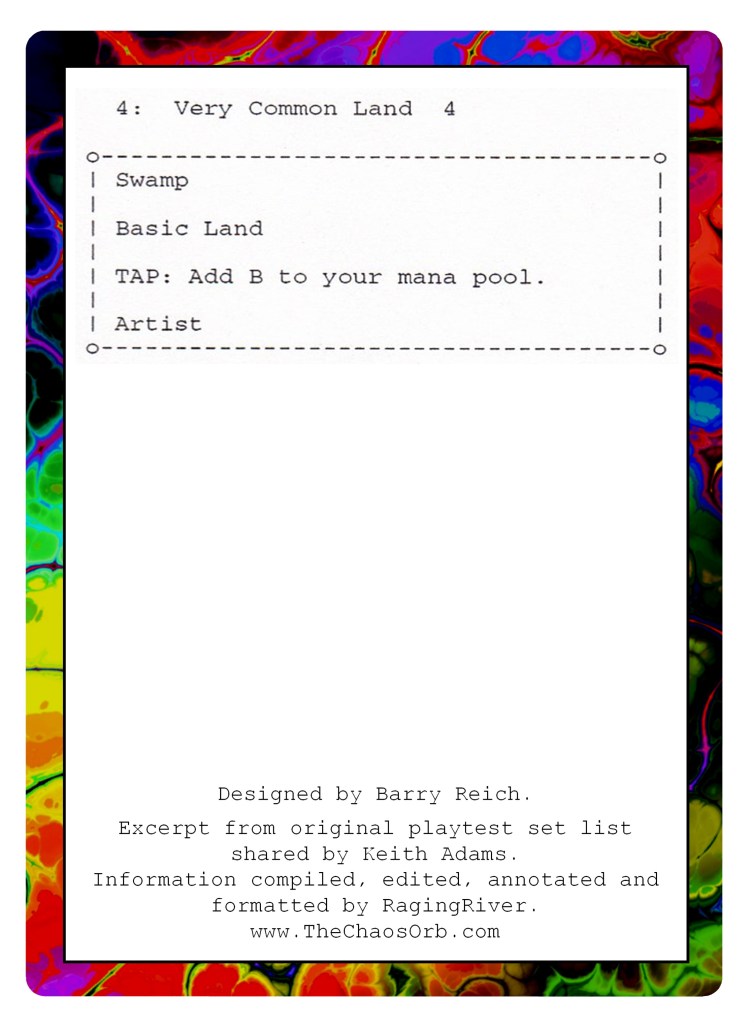
Original Playtest 
Realized (Version A) 
Realized (Version B) 
Realized (Version C)
005 – Forest
(Very Common Basic Land)
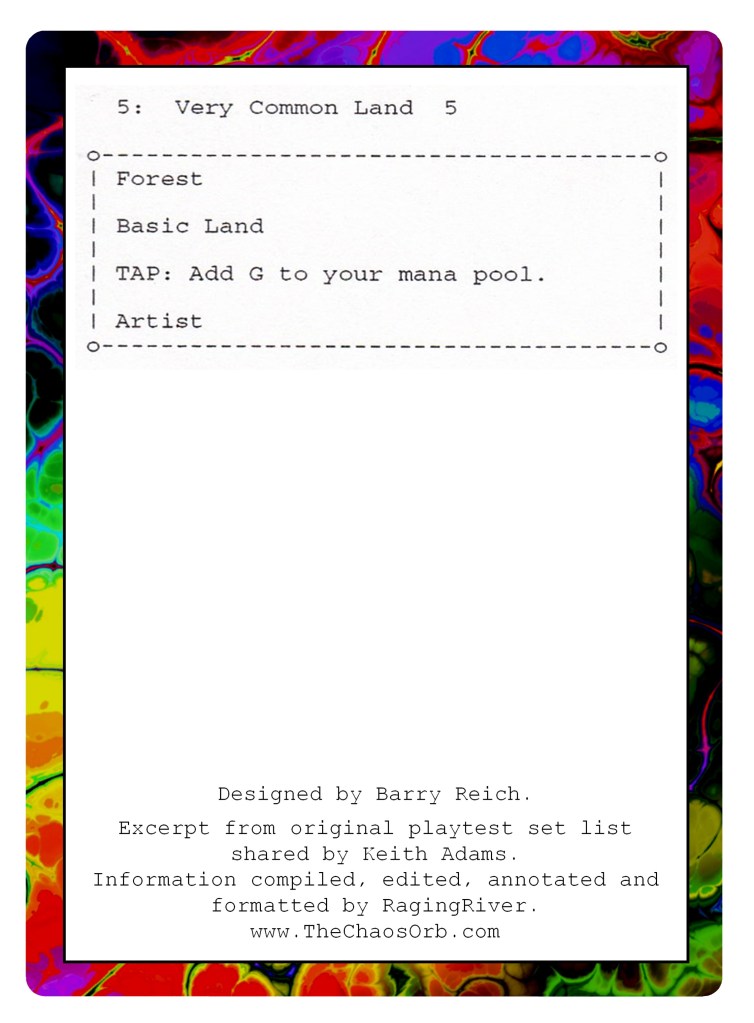
Original Playtest 
Realized (Version A) 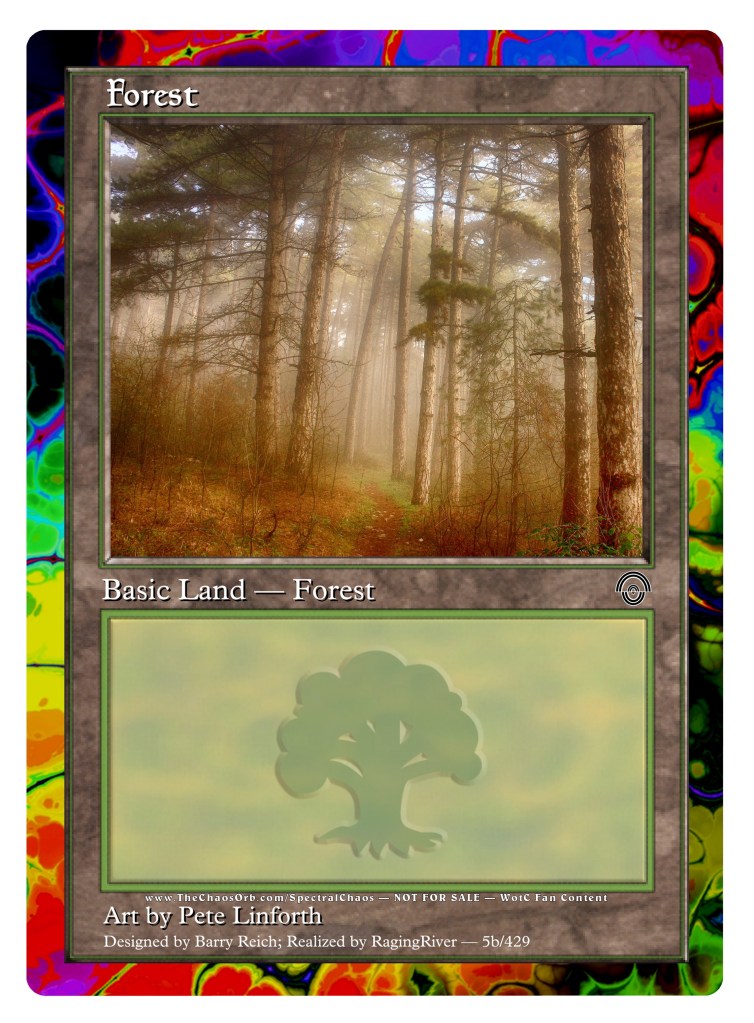
Realized (Version B) 
Realized (Version C)
COMMONS (61):
Click here to download high-resolution copies of the Spectral Chaos Commons at Ko-fi.

006 – Terramorph
(Common Land)
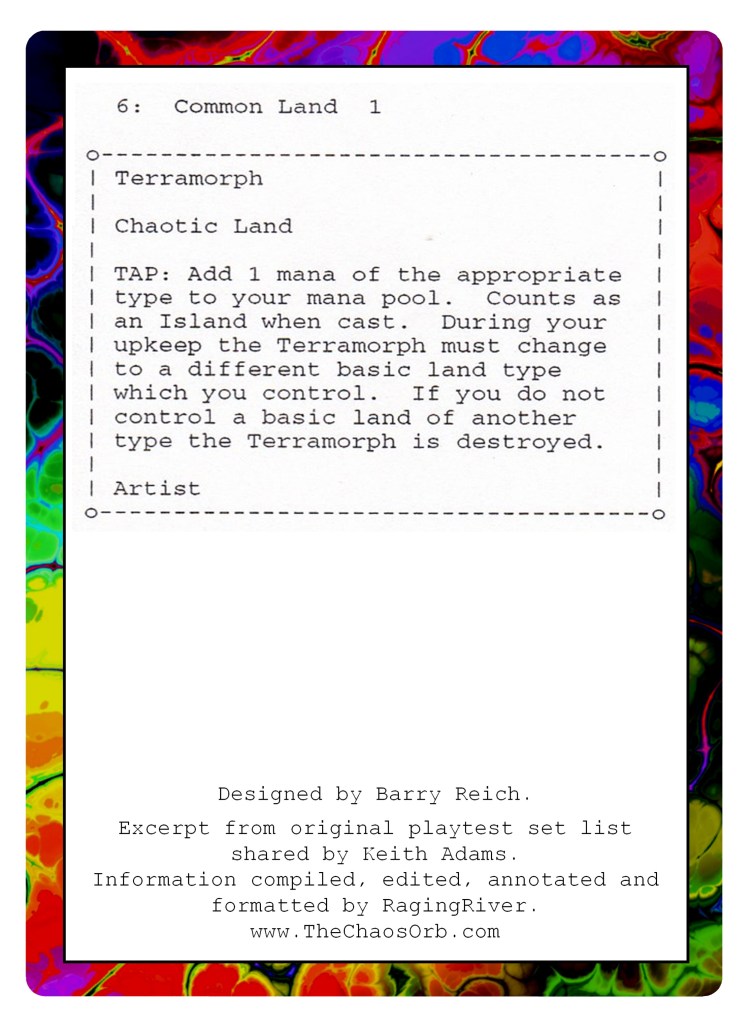
Original Playtest 
Realized
Terramorph
Land
Terramorph enters the battlefield as an island.
At the beginning of your upkeep, choose a basic land you control with a type different than Terramorph. If you can’t, sacrifice Terramorph. If you do, Terramorph gains that basic land’s type and loses all other basic land types.
- Terramorph‘s upkeep triggered ability only affects land types. If Terramorph somehow gains a supertype (such as legendary, chaotic or snow), or a non-land type (for example, it also becomes a creature), that won’t be affected when Terramorph changes basic land type.
- Terramorph‘s upkeep triggered ability doesn’t target, so you can choose a basic land with shroud. You choose a basic land you control when the triggered ability resolves. Although you must choose a basic land, the ability will see and copy that land’s basic land type, it doesn’t care about the name of the land you choose; this means, for example, if you choose a basic Forest you control that has become an island because it’s enchanted by Spreading Seas, then Terramorph will gain the basic land type of island, not forest. If you choose a basic land that somehow has obtained more than one basic land type (for example, if Urborg, Tomb of Yawgmoth is in play), Terramorph will become all of the chosen basic land’s basic land types. In this unusual scenario, the next upkeep you would need to choose a basic land with at least one different basic land type to avoid sacrificing Terramorph.
- Terramorph is a non-basic land. Gaining a basic land type doesn’t change Terramorph‘s name or turn it into a basic land.
007 – White Dolphin
(Common Creature (Blue))
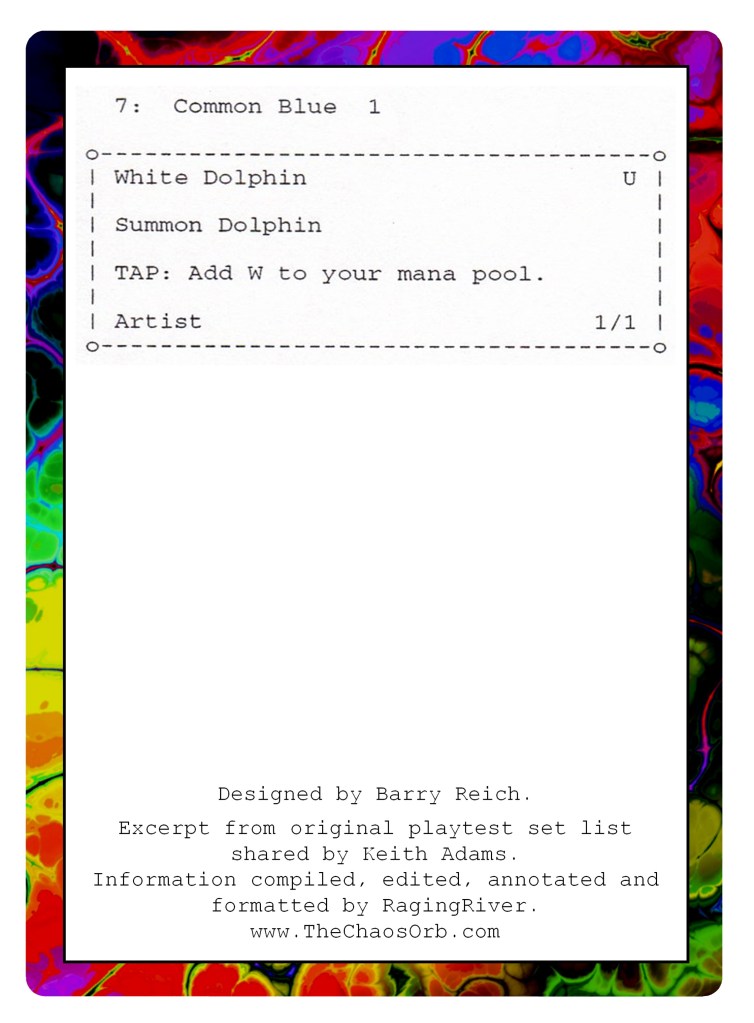
Original Playtest 
Realized
White Dolphin – {U}
Creature – Dolphin
{T}: Add {W}.
1/1
008 – Storm Cloud
(Common Creature (Blue))
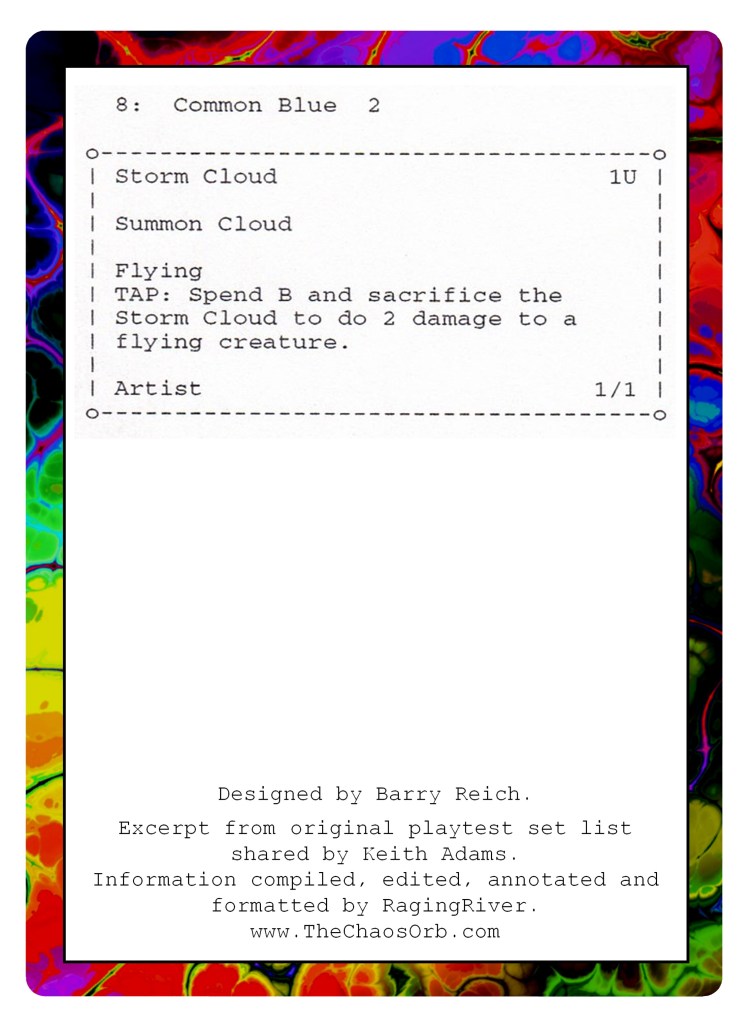
Original Playtest 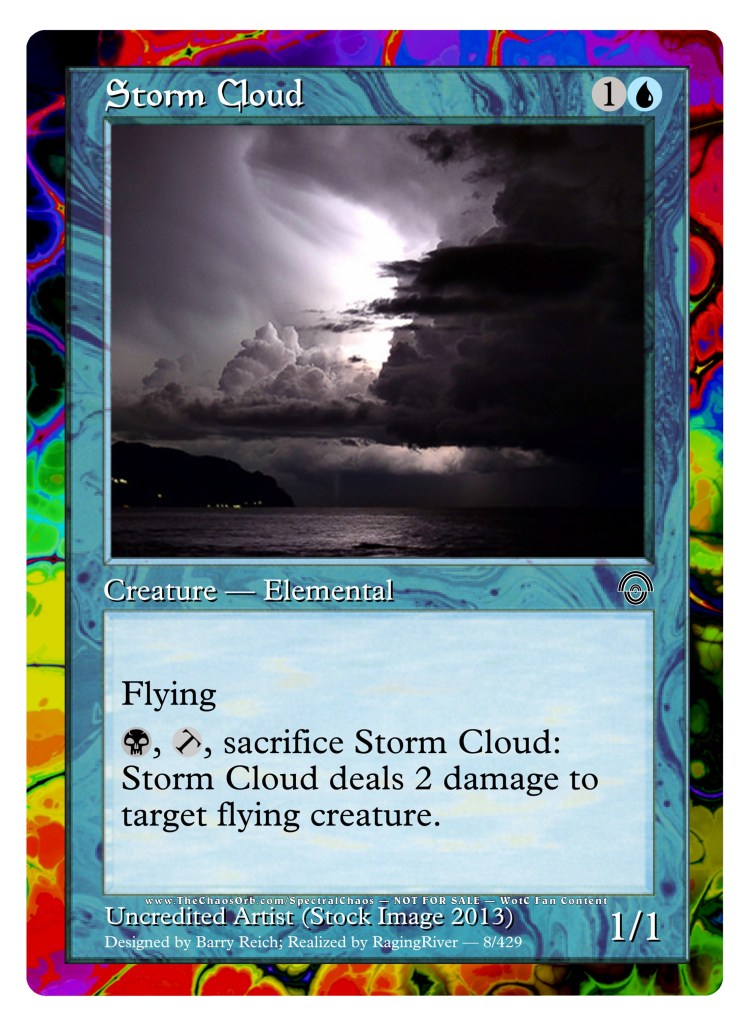
Realized
Storm Cloud – {1}{U}
Creature – Elemental
{B}, {T}, sacrifice Storm Cloud: Storm Cloud deals 2 damage to target flying creature.
1/1
009 – Phantasmal Terrain
(Common Enchantment (Blue))

Original Playtest 
Realized
Phantasmal Terrain – {U}
Enchantment – Aura
Enchant land
As Phantasmal Terrain enters the battlefield, choose a basic land type.
Enchanted land is the chosen type.
ChaosHistory: This colored mana fixer/hoser from Alpha was playtested at a lower casting cost to encourage multicolored decks.
- Doesn’t affect the land’s name, its supertypes (such as whether or not it’s legendary, snow, chaotic or basic), or its other (non-land) types (if it’s also a creature, for example), but it will cause the land to lose all of its printed abilities and gain the ability of the chosen basic land type.
010 – Illusion
(Common Enchantment (Blue))
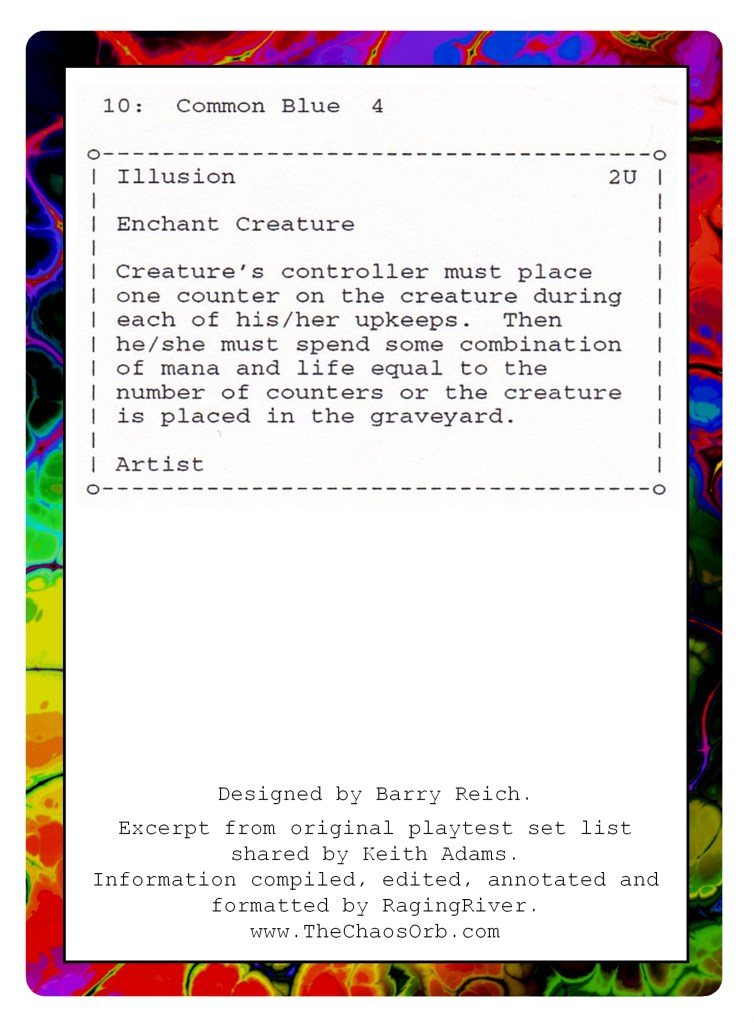
Original Playtest 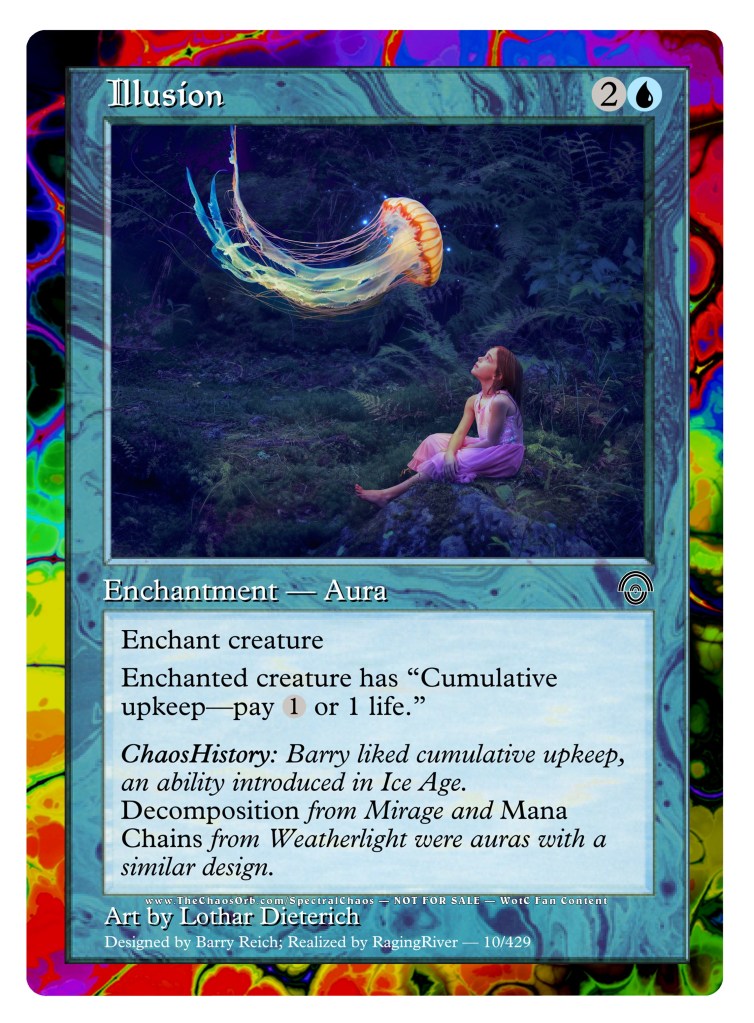
Realized
Illusion – {2}{U}
Enchantment – Aura
Enchant creature
Enchanted creature has “Cumulative upkeep – pay {1} or 1 life.”
ChaosHistory: Barry liked cumulative upkeep, an ability introduced in Ice Age. Decomposition from Mirage and Mana Chains from Weatherlight were auras with a similar design.
- If a permanent has multiple instances of cumulative upkeep, each triggers separately. However, the age counters are not connected to any particular ability; each cumulative upkeep ability will count the total number of age counters on the permanent at the time that ability resolves.
011 – Rapid Flight
(Common Enchantment (Blue))

Original Playtest 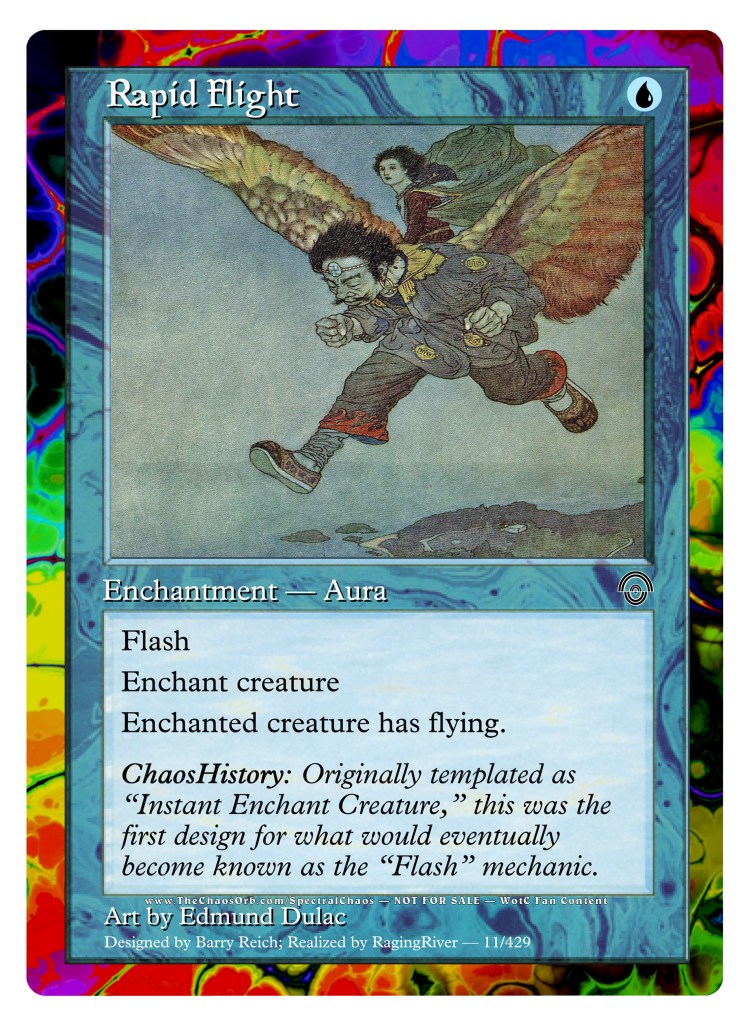
Realized
Rapid Flight – {U}
Enchantment – Aura
Enchant creature
Flash
Enchanted creature has flying.
ChaosHistory: Originally templated as “Instant Enchant Creature,” this was the first design for what would eventually become known as the “Flash” mechanic.
012 – Sylvan Adder
(Common Creature (Blue))

Original Playtest 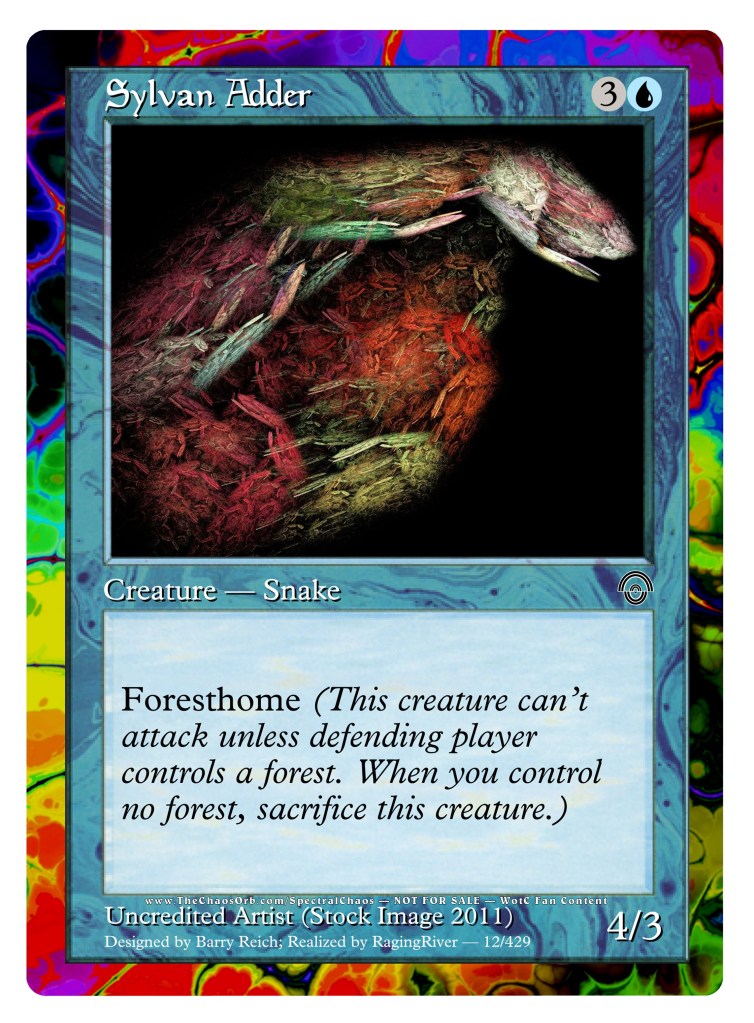
Realized
Sylvan Adder – {3}{U}
Creature – Snake
Foresthome
4/3
013 – Ravenous Shark
(Common Creature (Blue))
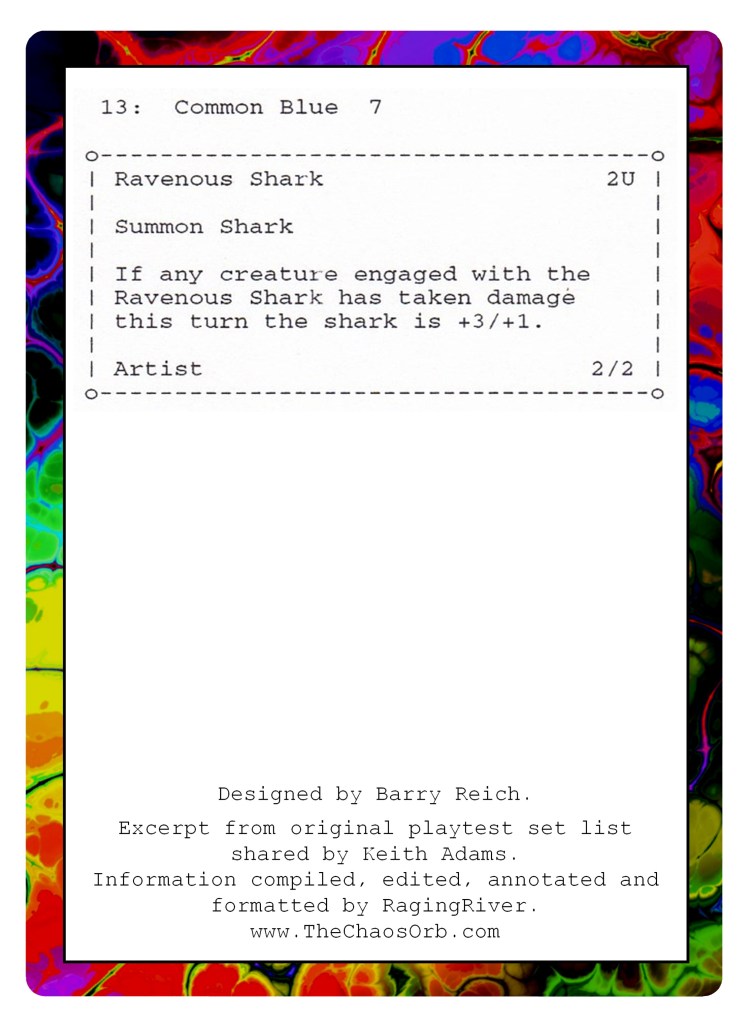
Original Playtest 
Realized
Ravenous Shark – {2}{U}
Creature – Shark
Whenever Ravenous Shark blocks or becomes blocked by a creature that has been dealt damage this turn, Ravenous Shark gets +3/+1 until end of turn.
2/2
(Note: Rulings last updated Feb. 1, 2021)
ChaosHistory: A similar design was used for Giant Shark, released in The Dark.
- Ravenous Shark only gains its bonus (and it will only trigger) if the attacking or blocking creature was damaged before blocking was declared. If the creature doesn’t have damage marked on it when it blocks or becomes blocked by Ravenous Shark, the ability won’t trigger at all.
- The bonus happens when a previously damaged creature becomes a blocker and the bonus is not removed if that creature is removed from the blocking situation by any means.
- A damaged creature that’s part of an attacking band will still give the bonus if Ravenous Shark blocks the band.
- Ravenous Shark‘s bonus will trigger once for each creature it blocks or is blocked by that meets the criteria. This includes if it blocks an attacking band containing multiple damaged creatures.
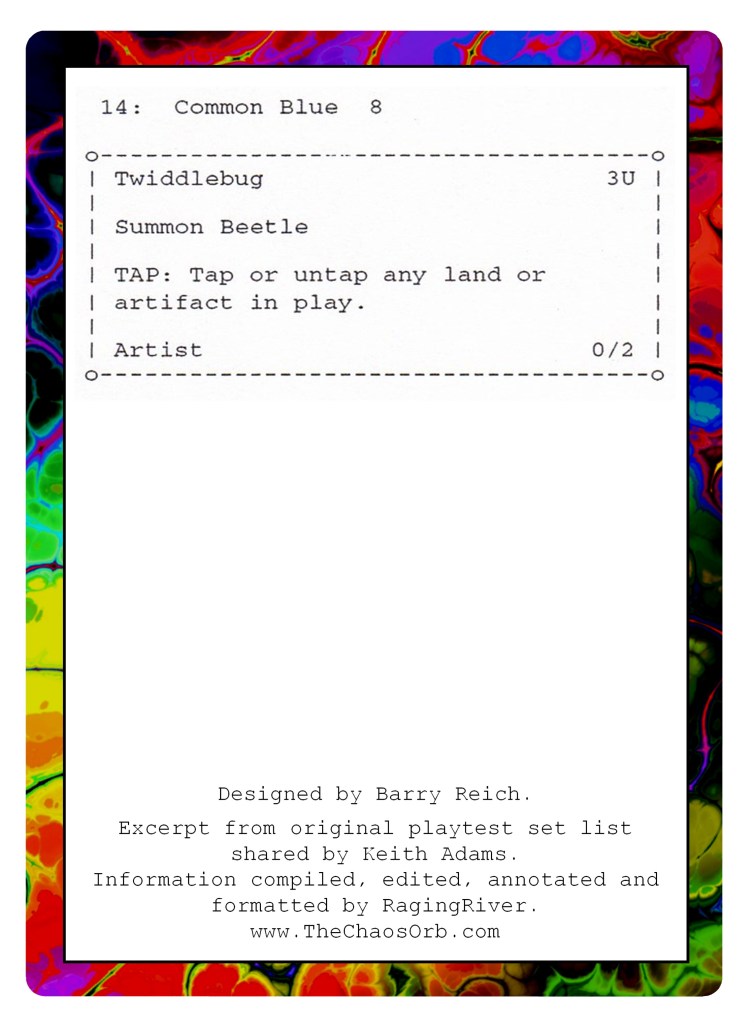
014 – Twiddlebug
(Common Creature (Blue))
Original Playtest 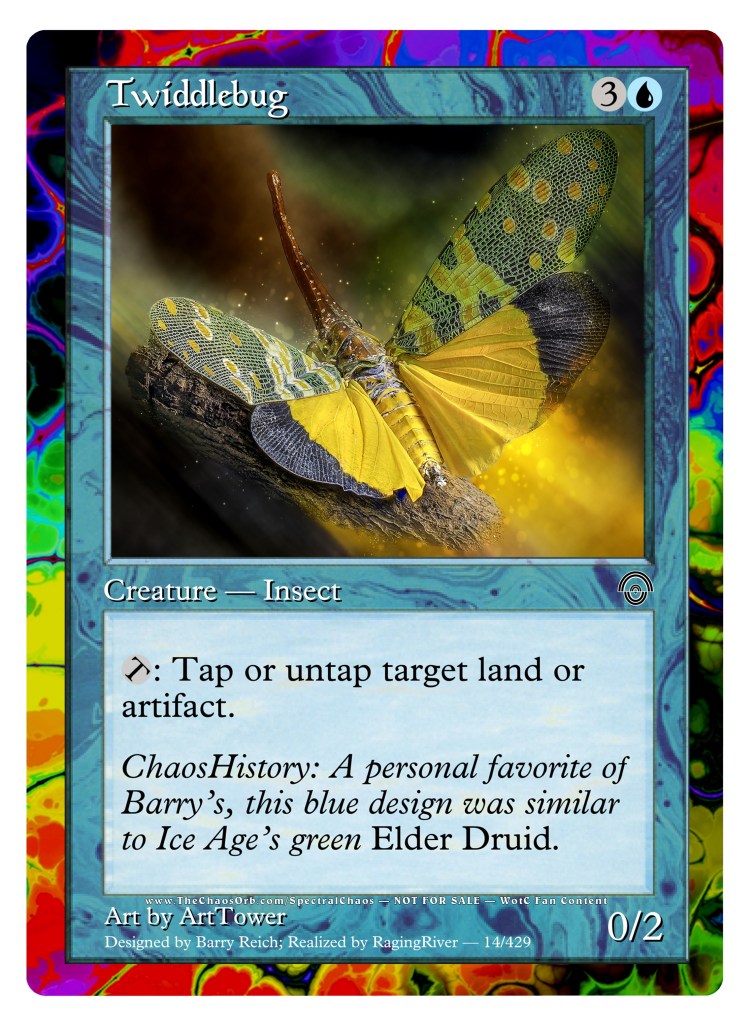
Realized
Twiddlebug – {3}{U}
Creature – Insect
{T}: Tap or untap target land or artifact.
0/2
ChaosHistory: A personal favorite of Barry’s, this blue design was similar to Ice Age’s green Elder Druid.
015 – Power Sink
(Common Instant (Blue))

Original Playtest 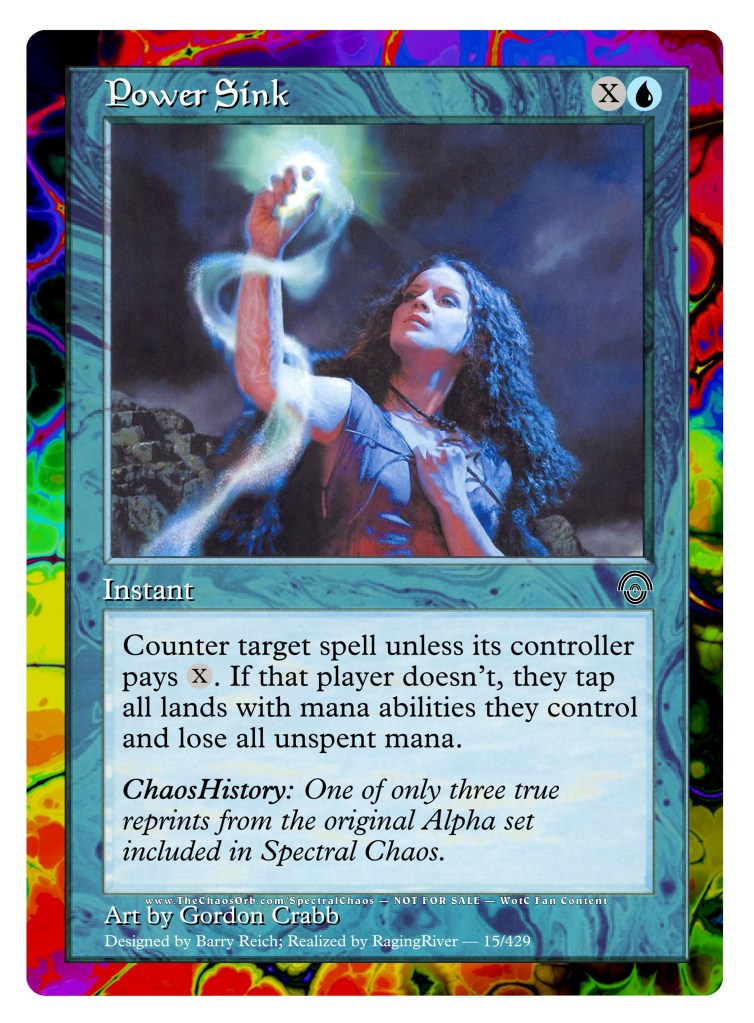
Realized
Power Sink – {X}{U}
Instant
Counter target spell unless its controller pays {X}. If that player doesn’t, they tap all lands with mana abilities they control and lose all unspent mana.
ChaosHistory: One of only three true reprints from the original Alpha set included in Spectral Chaos.
- Does not increase the mana cost of the spell. It just requires a separate expenditure in order for it to succeed.
- When this spell resolves, you either pay X mana or let your lands become tapped. The lands that become tapped are not “tapped for mana”. If you choose to pay, you may pay the X mana using whatever mana abilities you want to use.
- Only lands that actually have mana abilities will get tapped. This includes basic lands and lands with mana abilities printed on them, as well as lands which have been granted a mana ability by some effect.
016 – High Treason
(Common Instant (Multicolor))

Original Playtest 
Realized
High Treason – {U}{R}
Chaotic Instant
Cast High Treason only during an opponent’s declare attackers step.
Target attacking creature is now attacking its controller instead of you. (During the declare blockers step, the creature’s controller may block it with other non-attacking creatures that player controls if able.)
(Note: Rulings last updated Feb. 9, 2021.)
- Before anyone gets priority in the declare blockers step, the controller of the target attacking creature first declares if and how it will block that creature, then the (normal) defending player(s) assign blockers as usual.
- Only a non-attacking creature can be assigned to block the target creature. If a creature with vigilance is attacking, it cannot also be assigned to block the target creature. All blocks must be legal.
- The controller of the attacking creature is both an “attacking player” and a “defending player” during this combat phase. Casting High Treason doesn’t make you an “attacking player.”
- During the combat damage step, all combat damage is assigned and dealt, and all lethally damaged creatures will die, simultaneously.
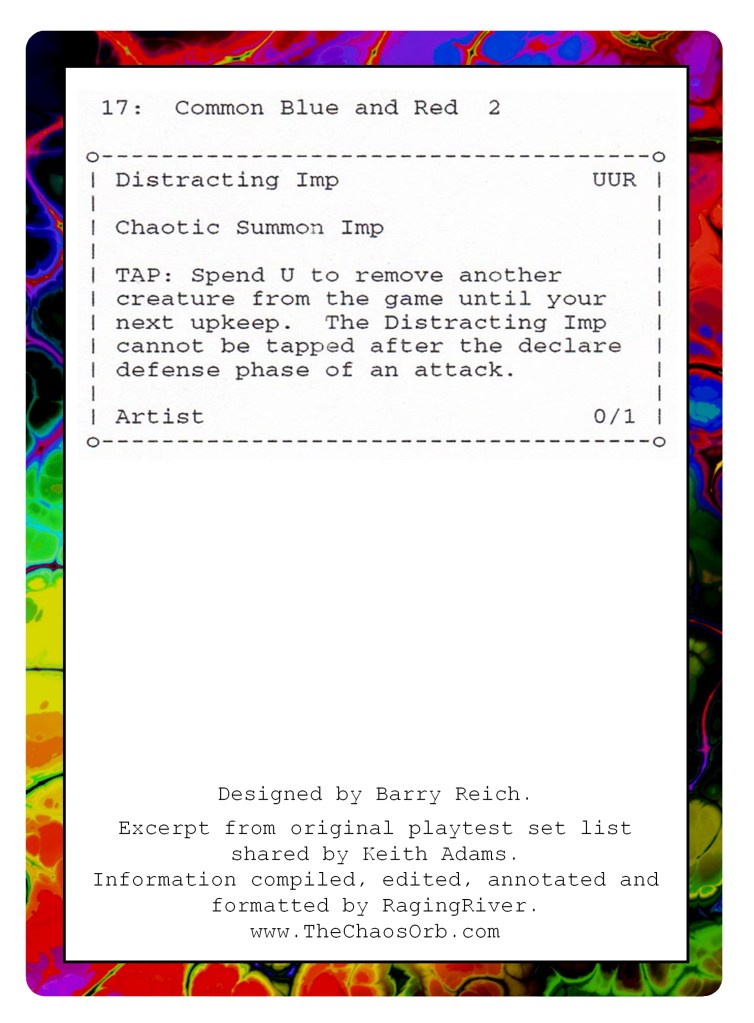
017 – Distracting Imp
(Common Creature (Multicolor))
Original Playtest 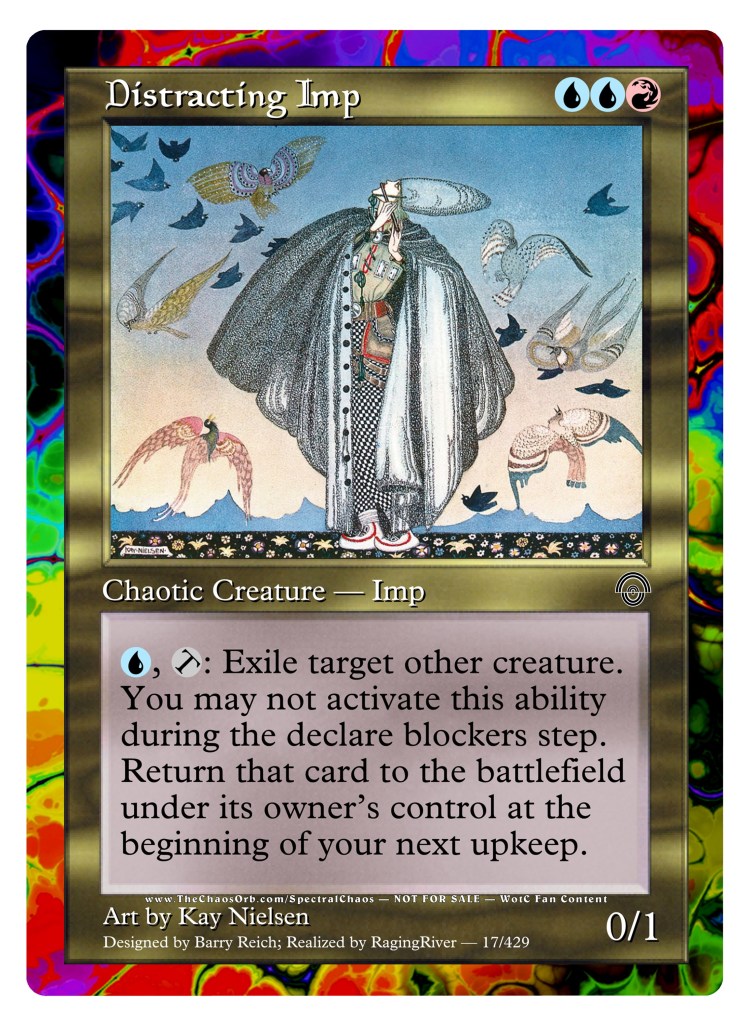
Realized
Distracting Imp – {U}{U}{R}
Chaotic Creature – Imp
{U}, {T}: Exile target other creature. You may not activate this ability during the declare blockers step. Return that card to the battlefield under its owner’s control at the beginning of your next upkeep.
0/1
(Note: Text and rulings last updated Jan. 31, 2021.)
- Permanents exiled with Distracting Imp will return at the beginning of your next upkeep, even if Distracting Imp is no longer on the battlefield. However, if for some reason an effect prevents that permanent from returning to the battlefield at the beginning of your next upkeep (for example, if this delayed trigger is Stifle‘d), then the permanent would stay exiled forever. If an effect replaces that permanent’s entering the battlefield with some other action (for example, due to Containment Priest), the permanent won’t “remember” that it was originally exiled by Distracting Imp‘s ability; it won’t keep trying to come back during each of your upkeeps.
- Auras attached to the exiled permanent will be put into their owners’ graveyards. Equipment attached to the exiled permanent will become unattached and remain on the battlefield. Any counters on the exiled permanent will cease to exist. Once the exiled permanent returns, it’s considered a new object with no relation to the object that it was.
- If a token is exiled this way, it will cease to exist and won’t return to the battlefield.
- If the permanent that returns to the battlefield has any abilities that trigger at the beginning of your next upkeep, those abilities won’t trigger that turn.
- You could activate the ability during the combat damage step if you want. It’s too late at that point to target a creature that received lethal combat damage (because it would already have died), but you could activate the ability in response to anything that triggered on damage being dealt.
018 – Goblin Foresters
(Common Creature (Red))

Original Playtest 
Realized
Goblin Foresters – {R}
Creature – Orc
{T}, sacrifice a forest: Add {B/R}{B/R}.
1/1
ChaosHistory: It’s unclear whether this colorshifted version of Ice Age’s Orcish Lumberjack would have ended up as a goblin or an orc.
019 – Dragon Pup
(Common Creature (Red))

Original Playtest 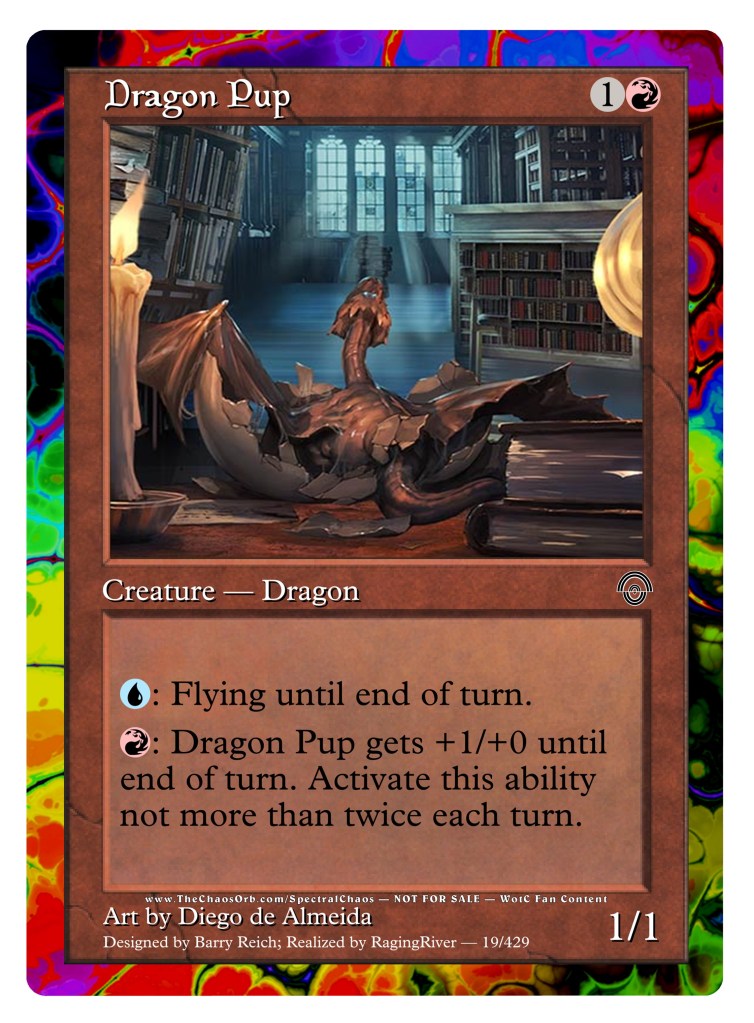
Realized
Dragon Pup – {1}{R}
Creature – Dragon
{U}: Flying until end of turn.
{R}: Dragon Pup gets +1/+0 until end of turn. Activate this ability not more than twice each turn.
1/1
020 – Killer Bee
(Common Creature (Red))
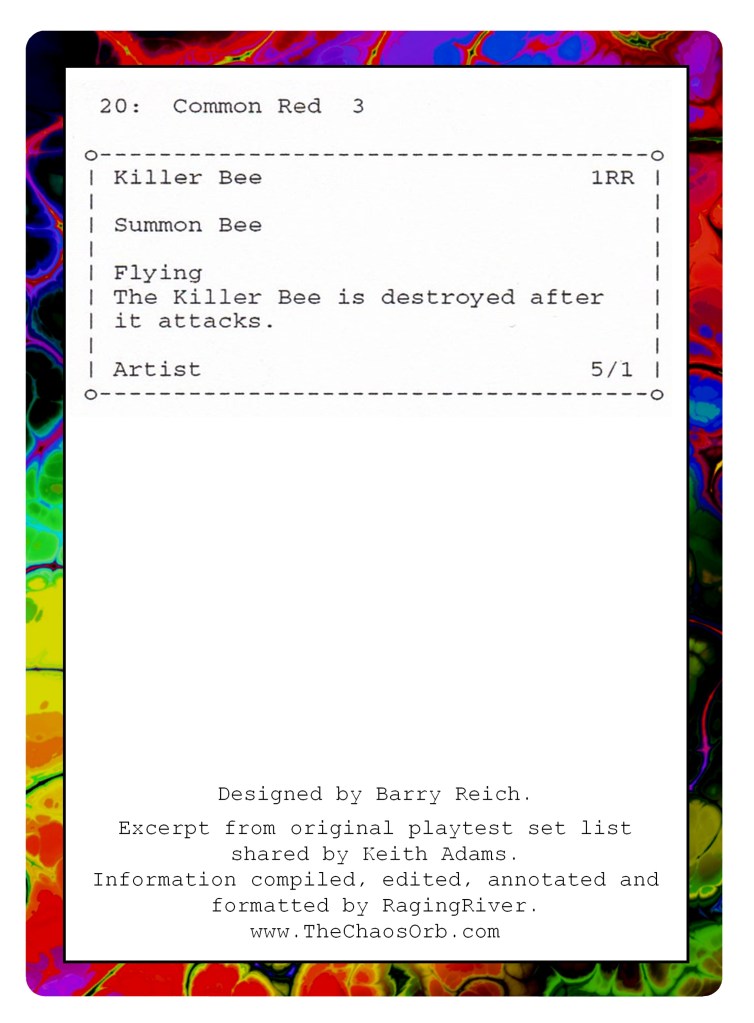
Original Playtest 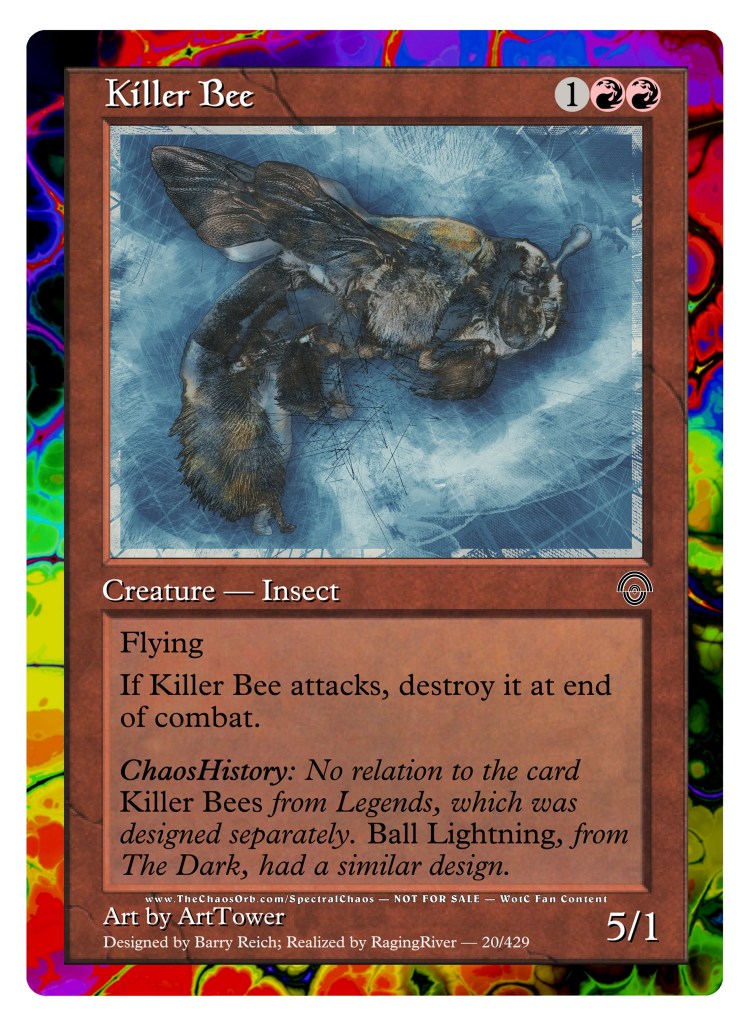
Realized
Killer Bee – {1}{R}{R}
Creature – Insect
Flying
If Killer Bee attacks, destroy it at end of combat.
5/1
ChaosHistory: No relation to the card Killer Bees from Legends, which was designed separately. Ball Lightning, from The Dark, had a similar design.
021 – Bog Orcs
(Common Creature (Red))

Original Playtest 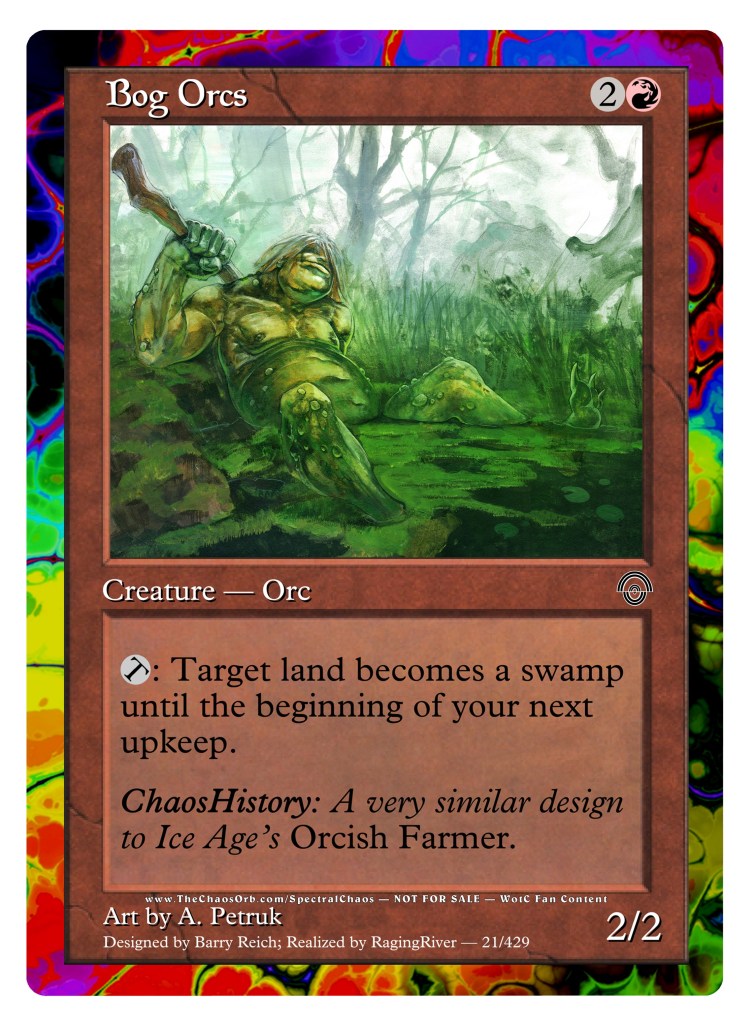
Realized
Bog Orcs – {2}{R}
Creature – Orc
{T}: Target land becomes a swamp until the beginning of your next upkeep.
2/2
ChaosHistory: A very similar design to Ice Age’s Orcish Farmer.
- This ability changes the targeted land’s land types to swamp. It doesn’t affect its name, its supertypes (such as whether or not it’s legendary, snow, or basic), or its other (non-land) types (if it’s also a creature, for example), but it will cause the land to lose all of its printed abilities and gain the ability of a swamp.
022 – Apprentice Swordsman
(Common Creature (Red))
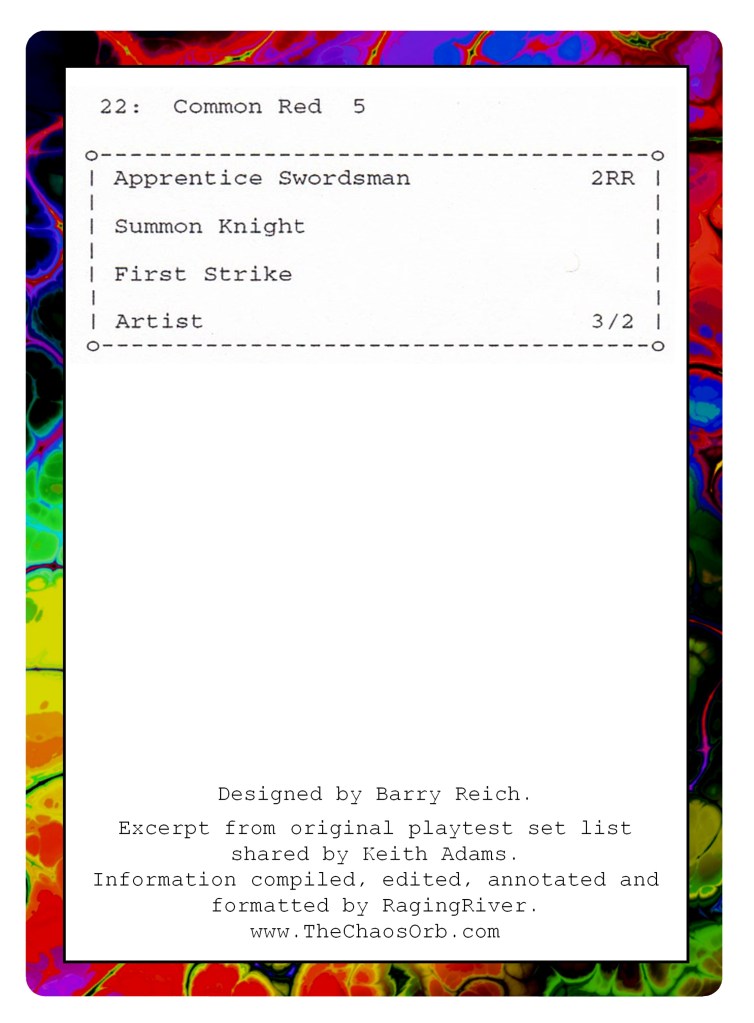
Original Playtest 
Realized
Apprentice Swordsman – {2}{R}{R}
Creature – Human Knight
First Strike
3/2
023 – Fireblast
(Common Sorcery (Red))

Original Playtest 
Realized
Fireblast – {X}{R}
Sorcery
Spend only red or green mana on X.
Fireblast deals X damage to any target. If it’s a creature, it can’t be regenerated this turn.
024 – Air Turbulence
(Common Enchantment (Red))

Original Playtest 
Realized
Air Turbulence – {R}
Enchantment – Aura
Flash
Enchant flying creature
Enchanted creature loses flying.
When Air Turbulence enters the battlefield, Air Turbulence deals 2 damage to enchanted creature.
ChaosHistory: A strictly better version of Alpha’s original Earthbind.
025 – Plasma Balls
(Common Sorcery (Red))

Original Playtest 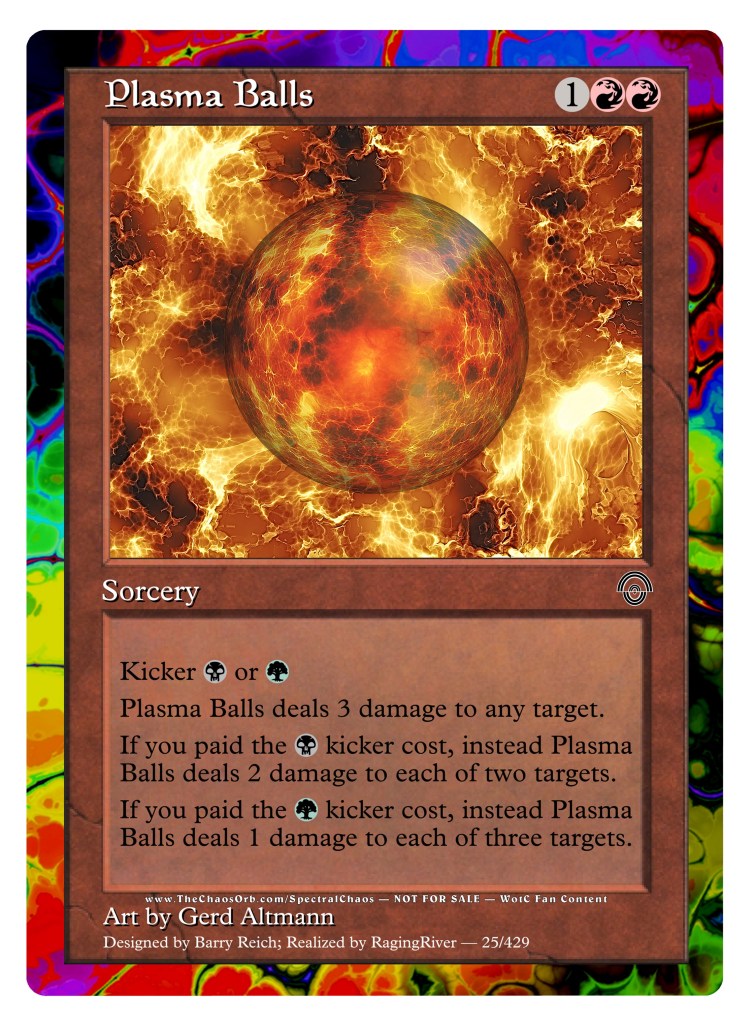
Realized
Plasma Balls – {1}{R}{R}
Sorcery
Kicker {B} or {G}
Plasma Balls deals 3 damage to any target.
If you paid the {B} kicker cost, instead Plasma Balls deals 2 damage to each of two targets.
If you paid the {G} kicker cost, instead Plasma Balls deals 1 damage to each of three targets.
026 – Dwarven Ritual
(Common Instant (Red))

Original Playtest 
Realized
Dwarven Ritual – {R}
Instant
Add {B}{B}{B}.
027 – Wailing Banshee
(Common Creature (Multicolor))
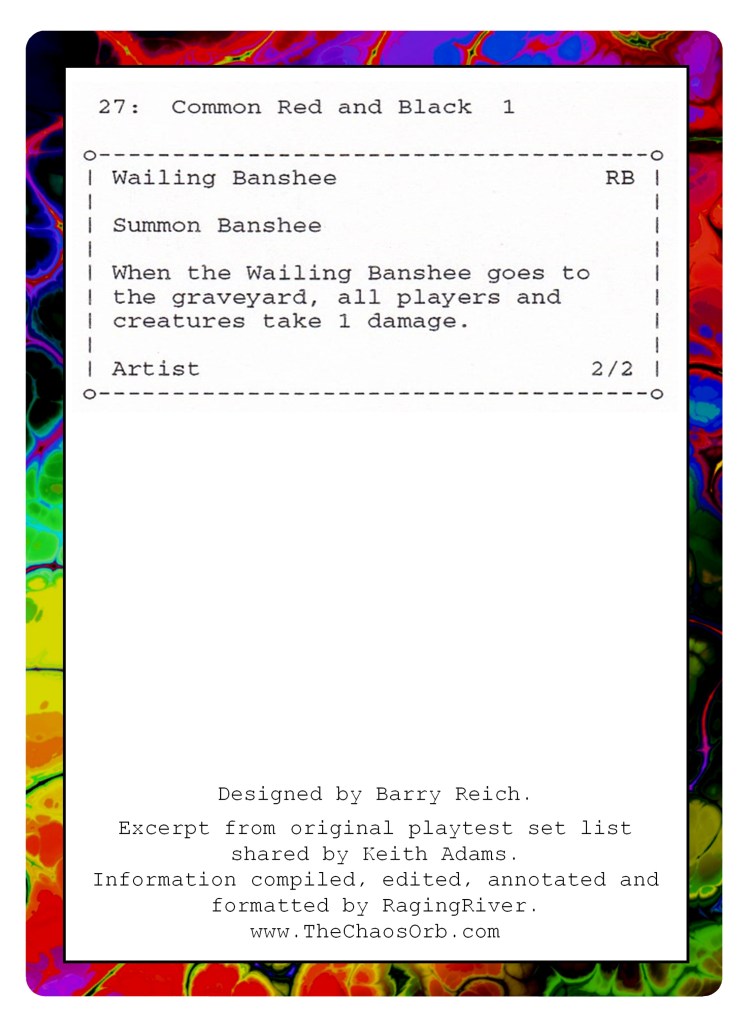
Original Playtest 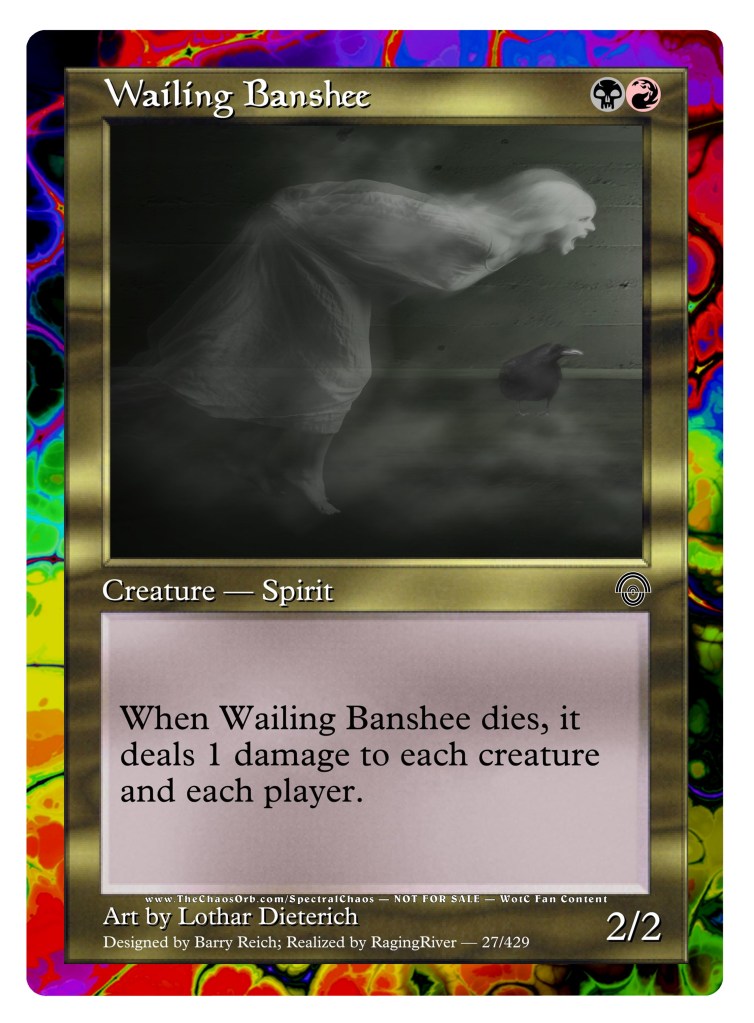
Realized
Wailing Banshee – {B}{R}
Creature – Spirit
When Wailing Banshee dies, it deals 1 damage to each creature and each player.
2/2
028 – Mildeworm
(Common Creature (Multicolor))

Original Playtest 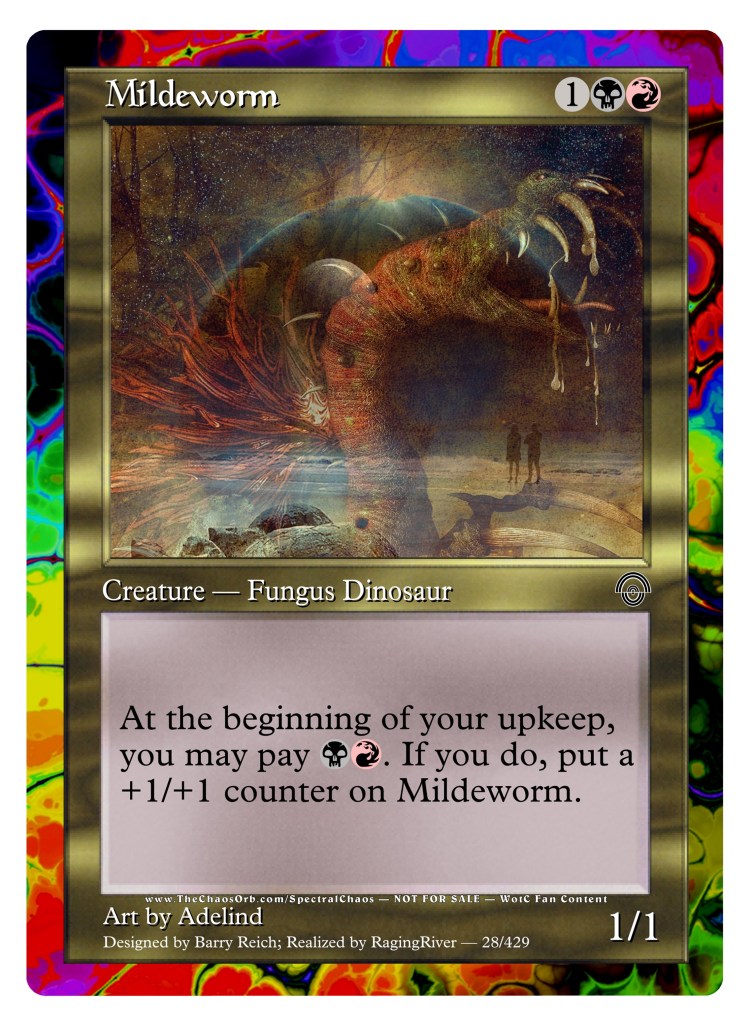
Realized
Mildeworm – {1}{B}{R}
Creature – Fungus Dinosaur
At the beginning of your upkeep, you may pay {B}{R}. If you do, put a +1/+1 counter on Mildeworm.
1/1
029 – Greisen Ibex
(Common Creature (Multicolor))
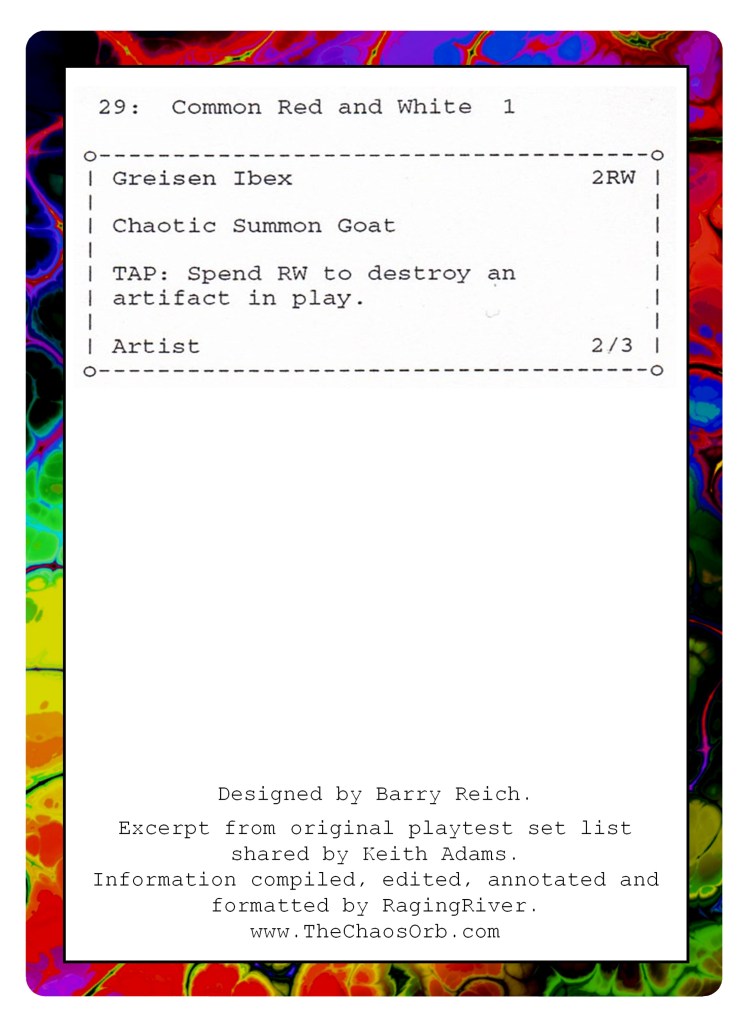
Original Playtest 
Realized
Greisen Ibex – {2}{R}{W}
Chaotic Creature – Goat
{R}{W}, {T}: Destroy target artifact.
2/3
030 – Ghost Rider
(Common Creature (White))

Original Playtest 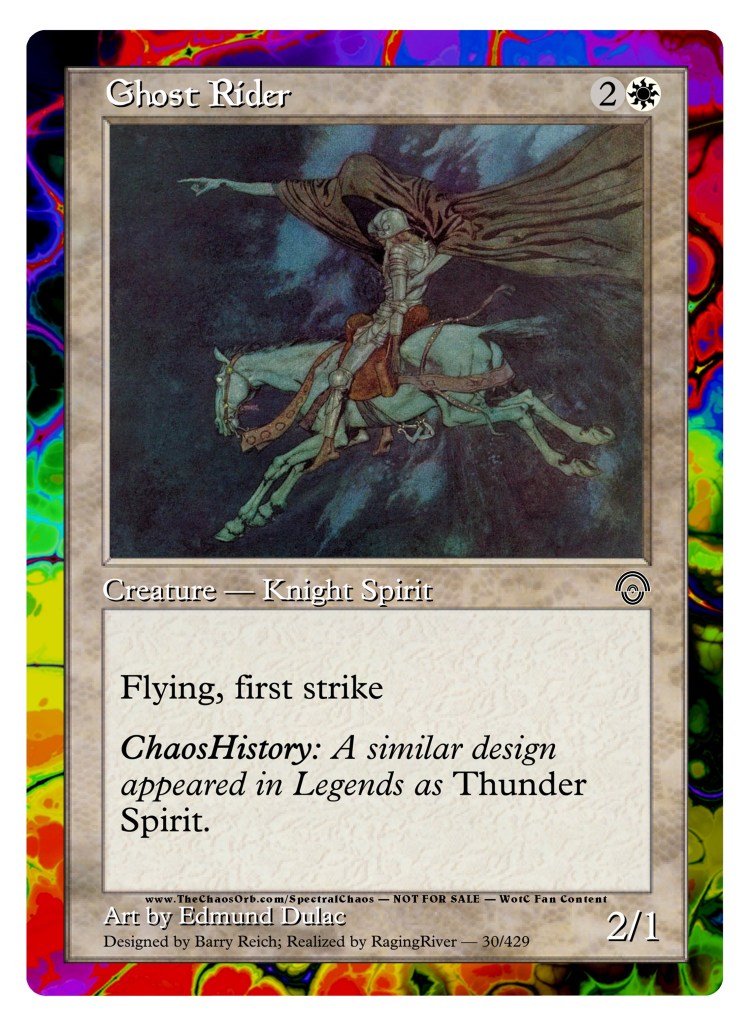
Realized
Ghost Rider – {2}{W}
Creature – Knight Spirit
Flying, first strike
2/1
ChaosHistory: A similar design appeared in Legends as Thunder Spirit.
031 – Crimson Acolyte
(Common Creature (White))
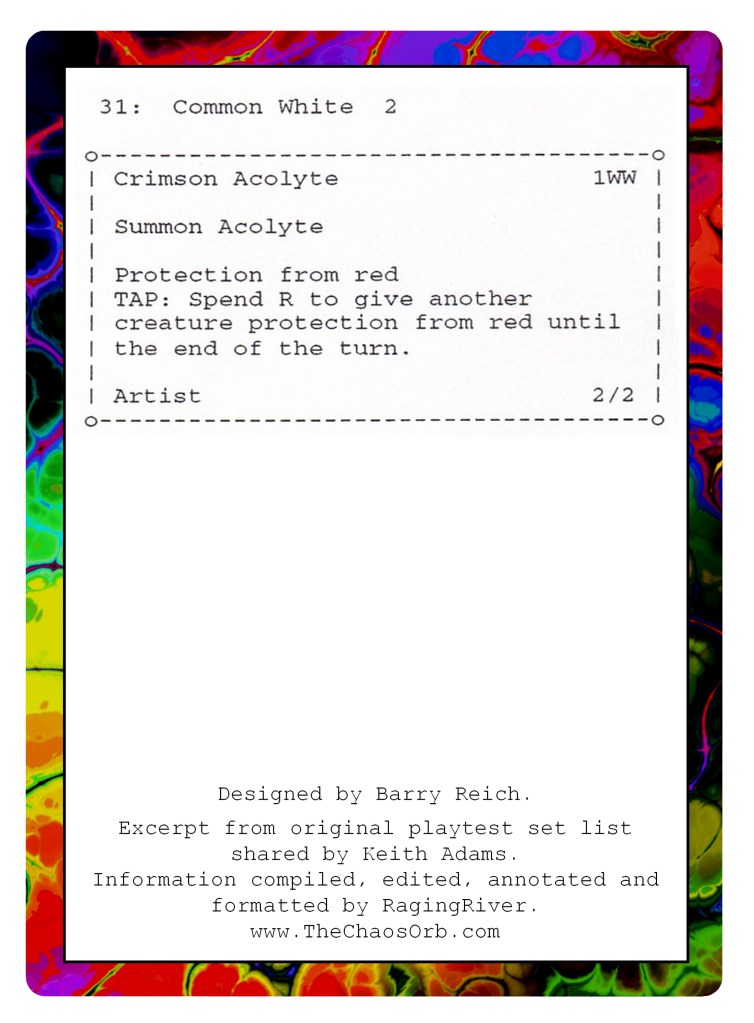
Original Playtest 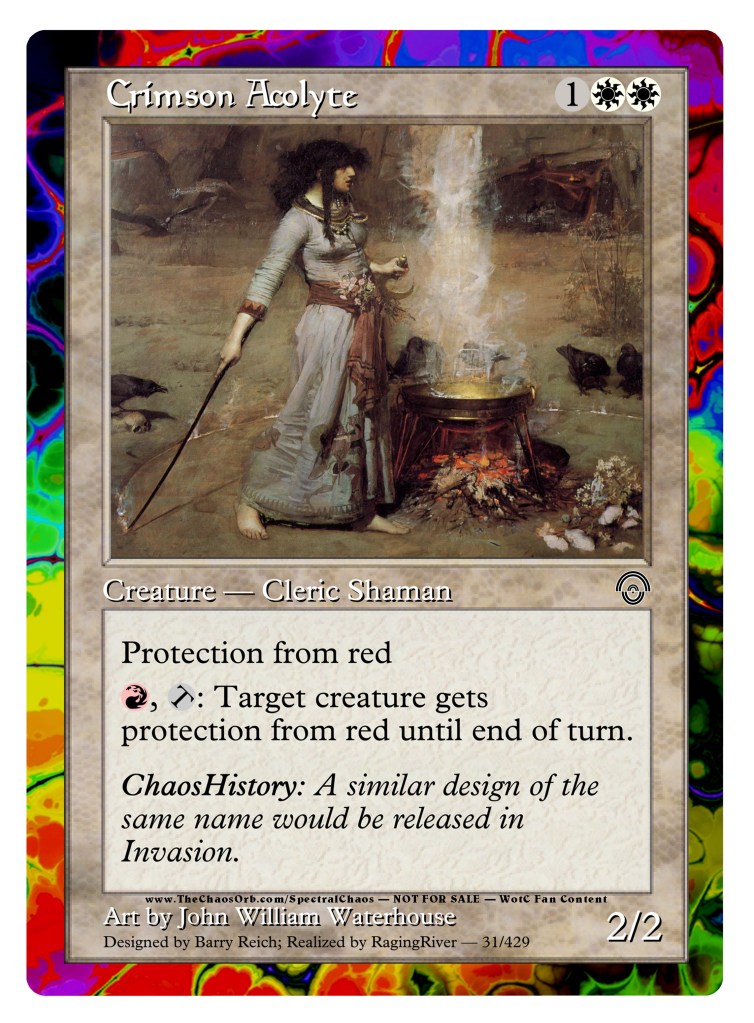
Realized
Crimson Acolyte – {1}{W}{W}
Creature – Cleric Shaman
Protection from red
{R}, {T}: Target creature gets protection from red until end of turn.
2/2
ChaosHistory: A similar design of the same name would be released in Invasion.
032 – Obsidian Acolyte
(Common Creature (White))

Original Playtest 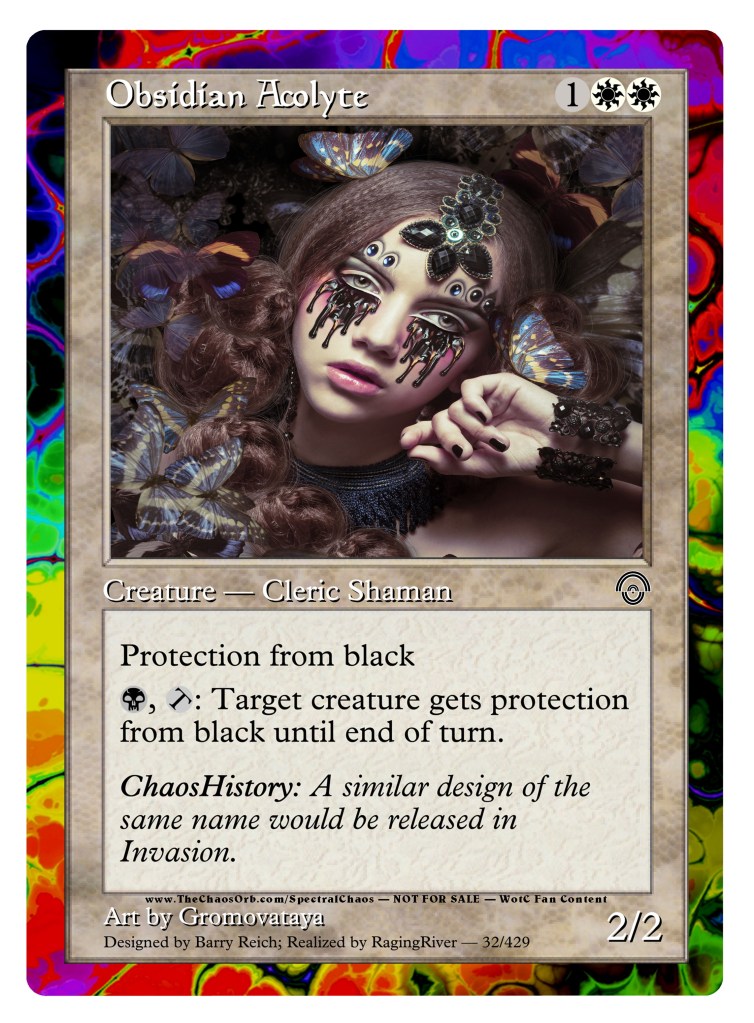
Realized
Obsidian Acolyte – {1}{W}{W}
Creature – Cleric Shaman
Protection from black
{B}, {T}: Target creature gets protection from black until end of turn.
2/2
ChaosHistory: A similar design of the same name would be released in Invasion.
033 – Disenchant
(Common Instant (White))

Original Playtest 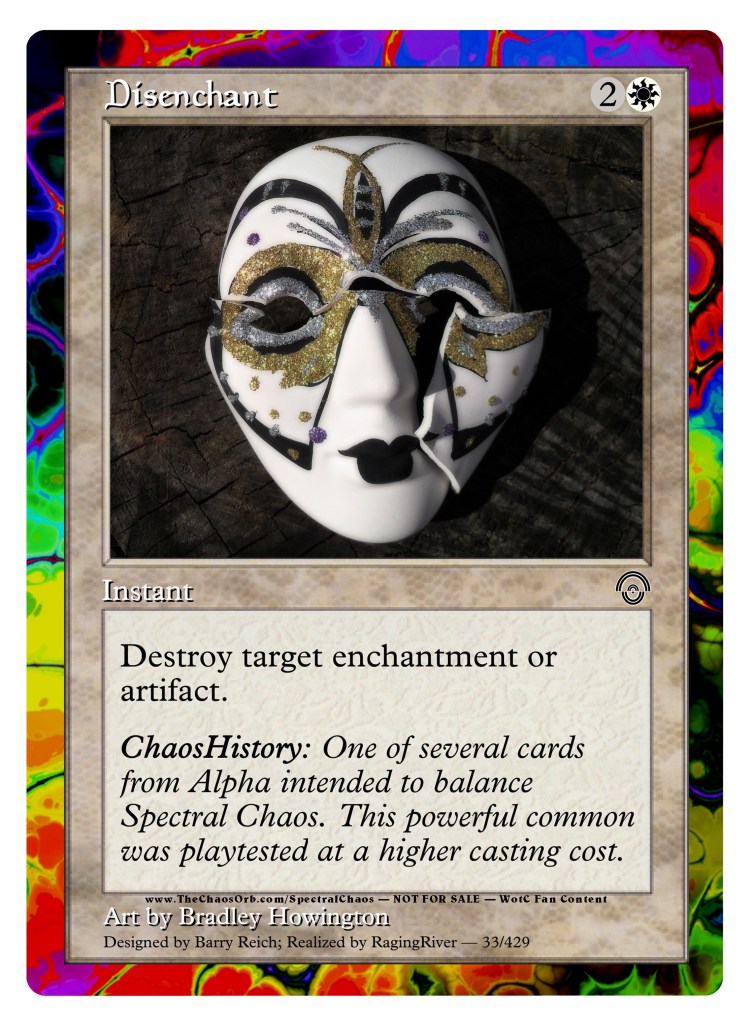
Realized
Disenchant – {2}{W}
Instant
Destroy target enchantment or artifact.
ChaosHistory: One of several cards from Alpha intended to balance Spectral Chaos. This powerful common was playtested at a higher casting cost.
034 – Telmarian Ambassador
(Common Creature (White))
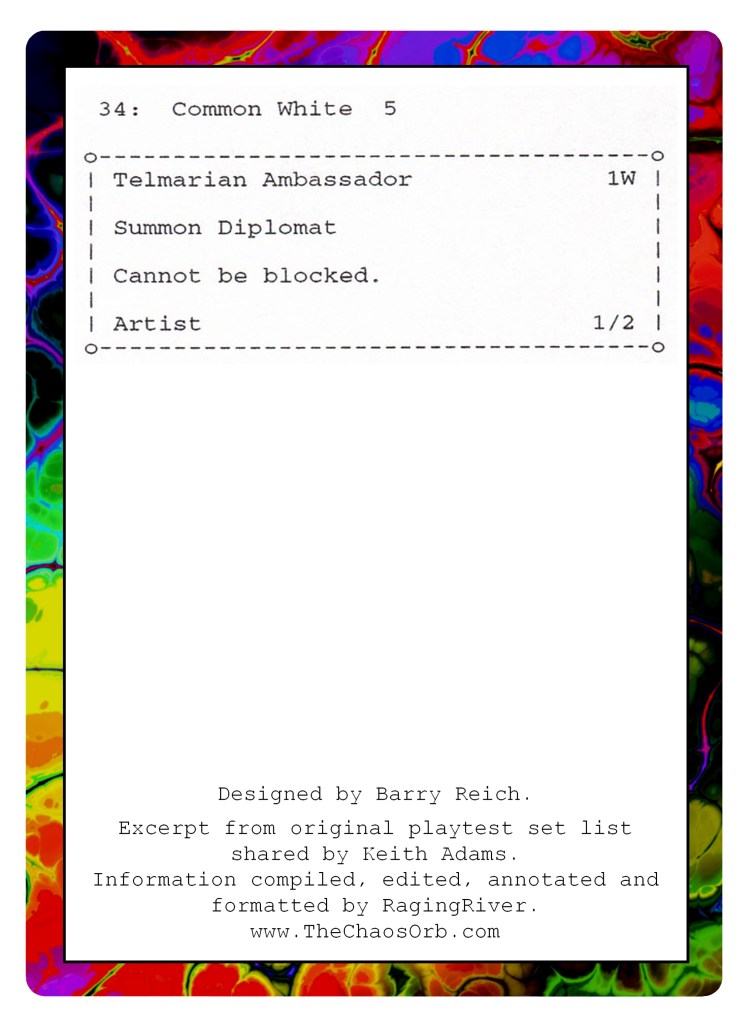
Original Playtest 
Realized
Telmarian Ambassador – {1}{W}
Creature – Goblin Advisor
Unblockable
1/2
035 – Floraticum
(Common Instant (White))
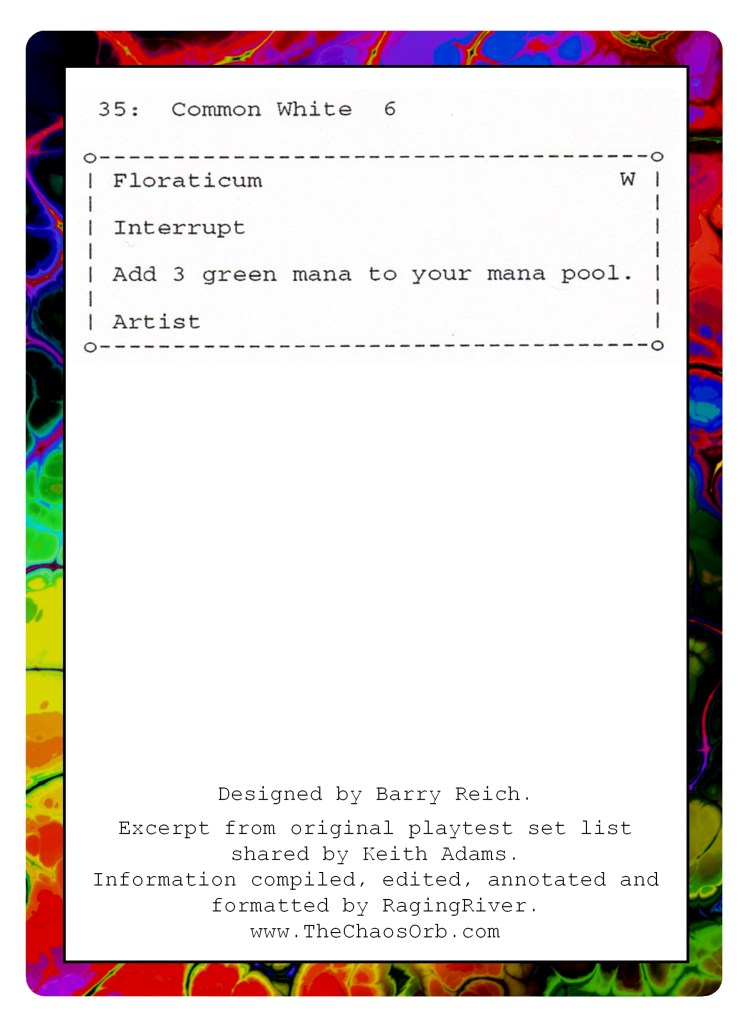
Original Playtest 
Realized
Floraticum – {W}
Instant
Add {G}{G}{G}.
036 – Blessed Land
(Common Enchantment (White))

Original Playtest 
Realized
Blessed Land – {W}
Enchantment – Aura
Enchant land
Enchanted land has indestructible, cannot be enchanted (other than by Blessed Land) and cannot be the target of enchantments.
Whenever enchanted land is tapped for mana, its controller adds an additional {1}.
- The additional mana is not an ability of the land and is not something the land can produce.
037 – Natural Defenses
(Common Instant (Multicolor))

Original Playtest 
Realized
Natural Defenses – {G}{W}
Instant
Target creature gets +1/+X until end of turn, where X is its toughness.
038 – Cleric of Amon-Ra
(Common Creature (Multicolor))

Original Playtest 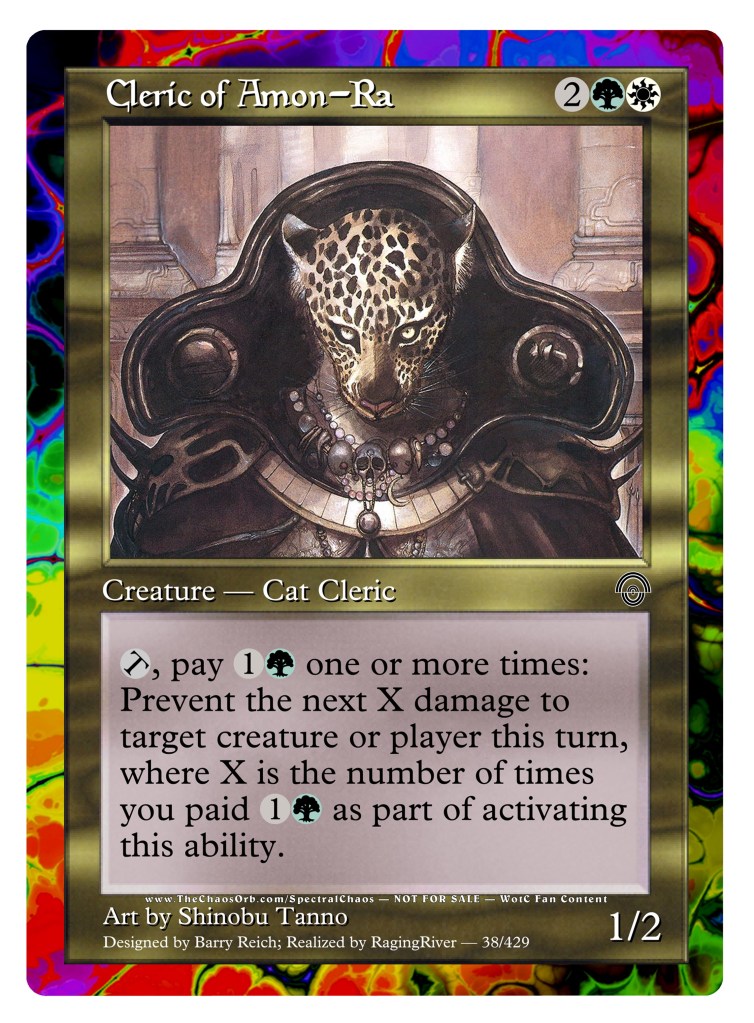
Realized
Cleric of Amon-Ra – {2}{G}{W}
Creature – Cat Cleric
{T}, pay {1}{G} one or more times: Prevent the next X damage to target creature or player this turn, where X is the number of times you paid {1}{G] as part of activating this ability.
1/2
- You pay all the mana as you activate this ability. Conceptually, you can think of it like multikicker, although it isn’t exactly the same thing.
- The source of the damage doesn’t matter. It will prevent however much damage you pay for whenever it next occurs this turn to that target, regardless of whether that damage comes from one source or multiple sources, all at once or at different times during the turn.
039 – Golden Fleece
(Common Enchantment (Multicolor))
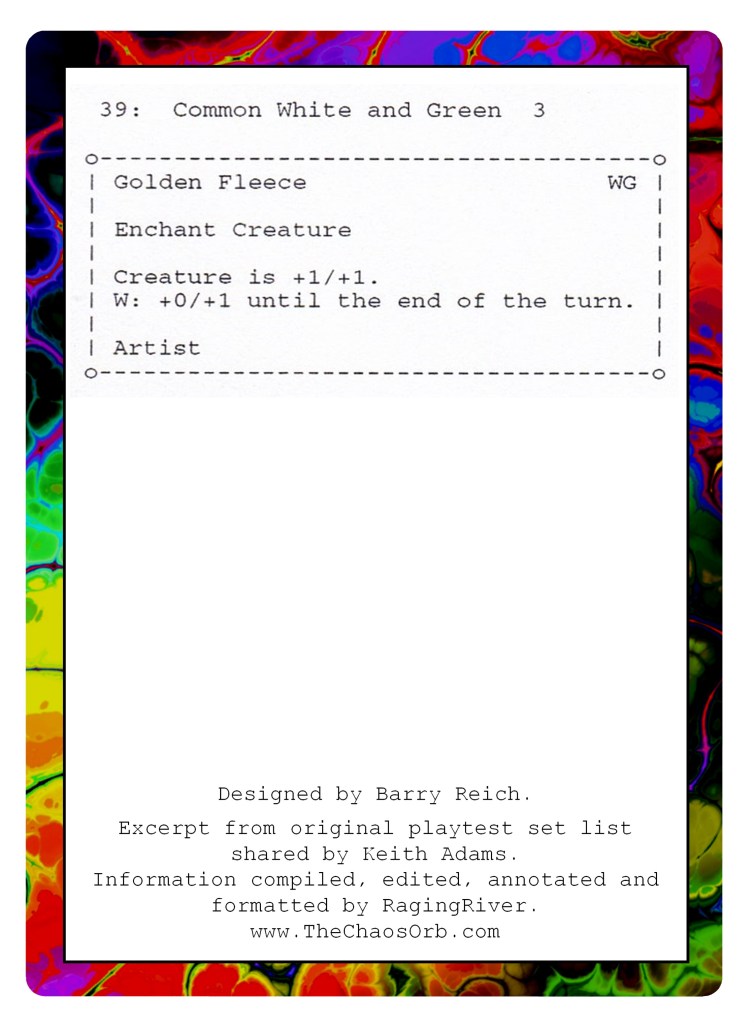
Original Playtest 
Realized
Golden Fleece – {G}{W}
Enchantment – Aura
Enchant creature
Enchanted creature gets +1/+1.
{W}: Enchanted creature gets +0/+1 until end of turn.
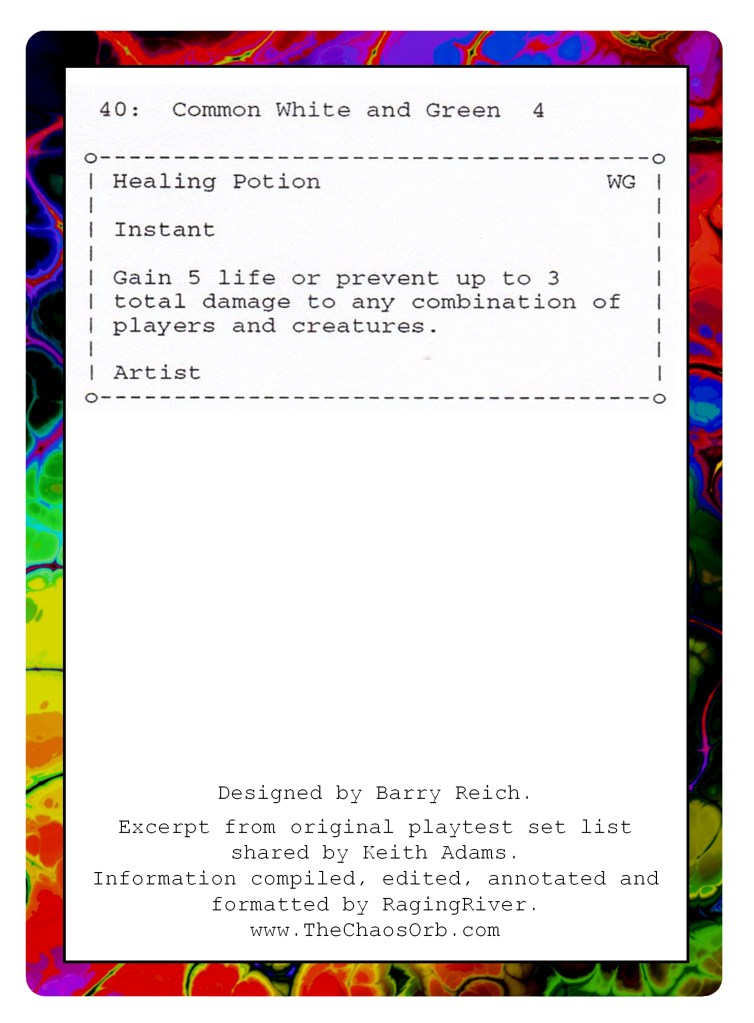
040 – Healing Potion
(Common Instant (Multicolor))
Original Playtest 
Realized
Healing Potion – {G}{W}
Instant
Choose one –
– You gain 5 life.
– Prevent the next 3 damage that would be dealt this turn to any number of target creatures and/or players, divided as you choose.
041 – Werewolf
(Common Creature (Multicolor))

Original Playtest 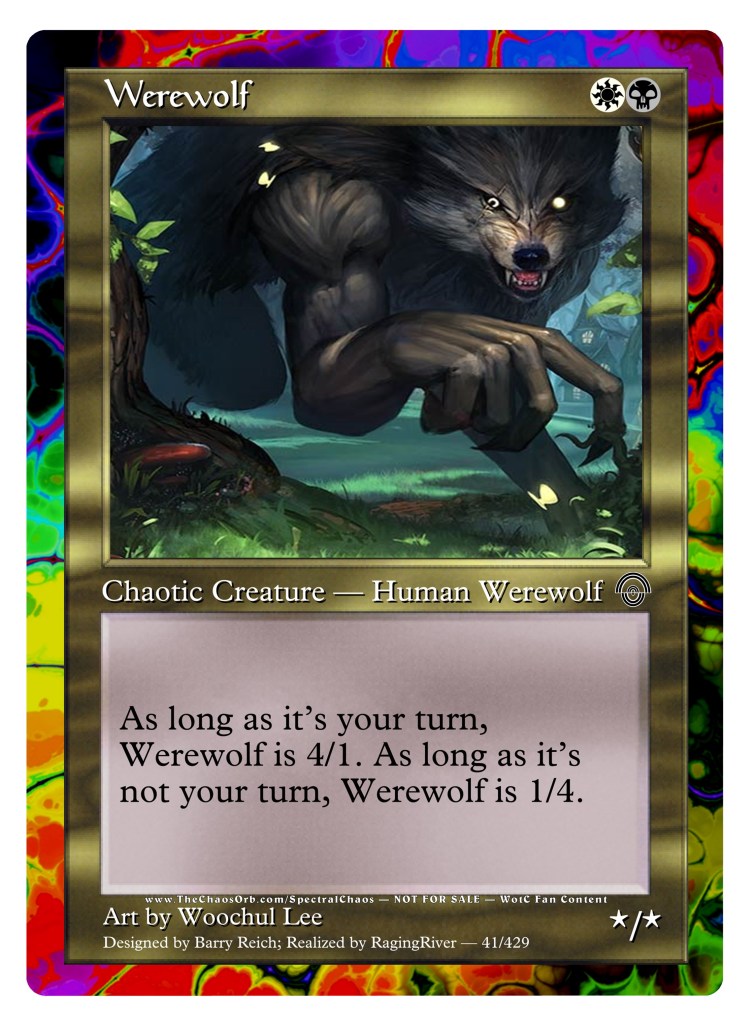
Realized
Werewolf – {W}{B}
Chaotic Creature – Human Werewolf
As long as it’s your turn, Werewolf is 4/1. As long as it’s not your turn, Werewolf is 1/4.
*/*
042 – Shadow
(Common Creature (Black))

Original Playtest 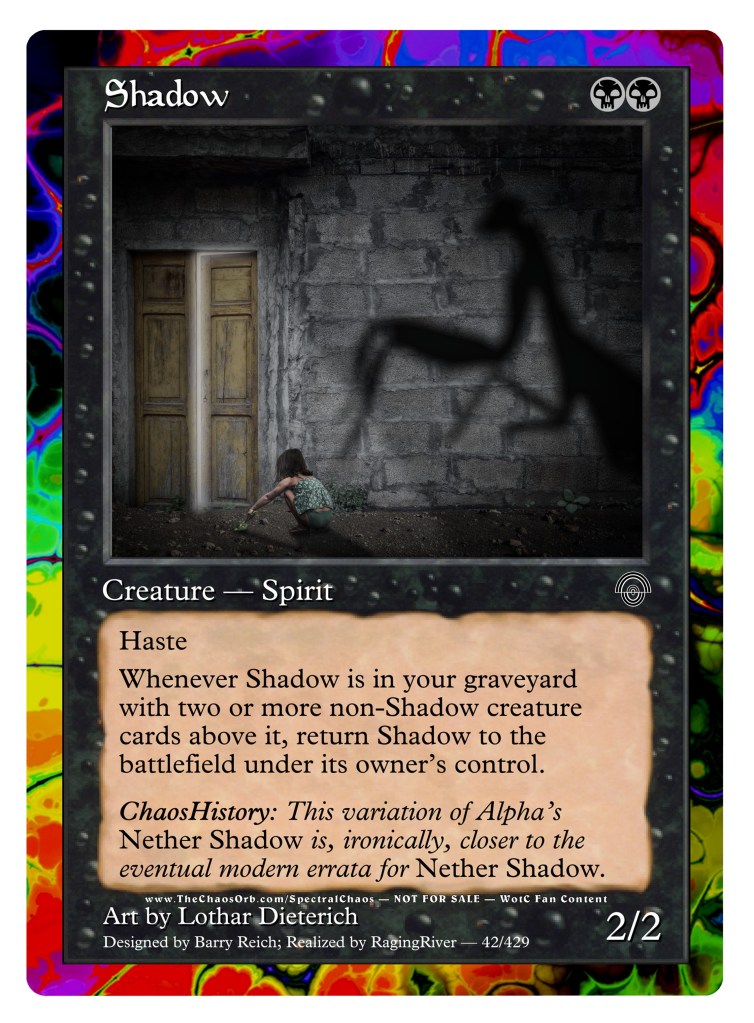
Realized
Shadow – {B}{B}
Creature – Spirit
Haste
Whenever Shadow is in your graveyard with two or more non-Shadow creature cards above it, return Shadow to the battlefield under its owner’s control.
2/2
ChaosHistory: This variation of Alpha’s Nether Shadow is, ironically, closer to the eventual modern errata for Nether Shadow.
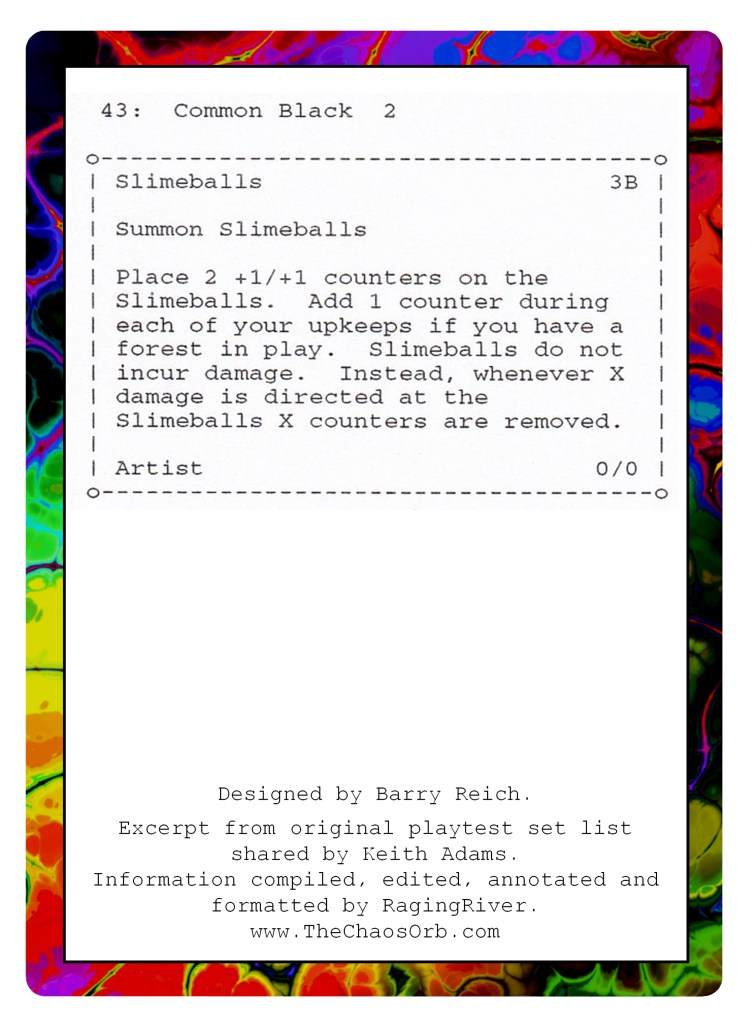
043 – Slimeballs
(Common Creature (Black))
Original Playtest 
Realized
Slimeballs – {3}{B}
Creature – Ooze
Slimeballs enters the battlefield with two +1/+1 counters on it.
At the beginning of your upkeep, if you control a forest, put a +1/+1 counter on Slimeballs.
For each 1 damage that would be dealt to Slimeballs, if it has a +1/+1 counter on it, remove a +1/+1 counter from it and prevent that 1 damage.
0/0
044 – Fire Shade
(Common Creature (Black))

Original Playtest 
Realized
Fire Shade – {2}{B}
Creature – Shade
{R}: +1/+1 until end of turn.
1/1
045 – Vampire Bat
(Common Creature (Black))

Original Playtest 
Realized
Vampire Bat – {B}{B}
Creature – Bat
Flying
At end of combat, if Vampire Bat blocked or was blocked this combat, put a +1/+1 counter on it.
1/3
- The ability doesn’t trigger until the end of combat step, but it will look back and see whether Vampire Bat blocked or was blocked at any point during that combat phase, even if it was removed from combat before this ability triggers.
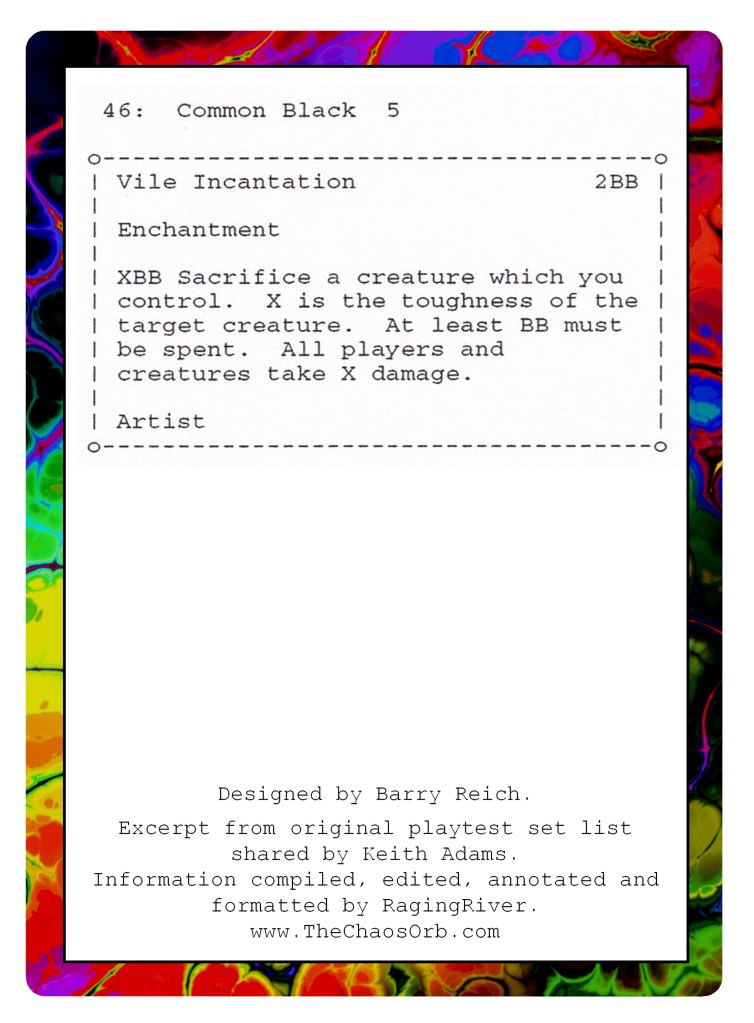
046 – Vile Incantation
(Common Enchantment (Black))
Original Playtest 
Realized
Vile Incantation – {2}{B}{B}
Enchantment
{X}{B}{B}, sacrifice a creature with toughness X: Vile Incantation deals X damage to each creature and each player.
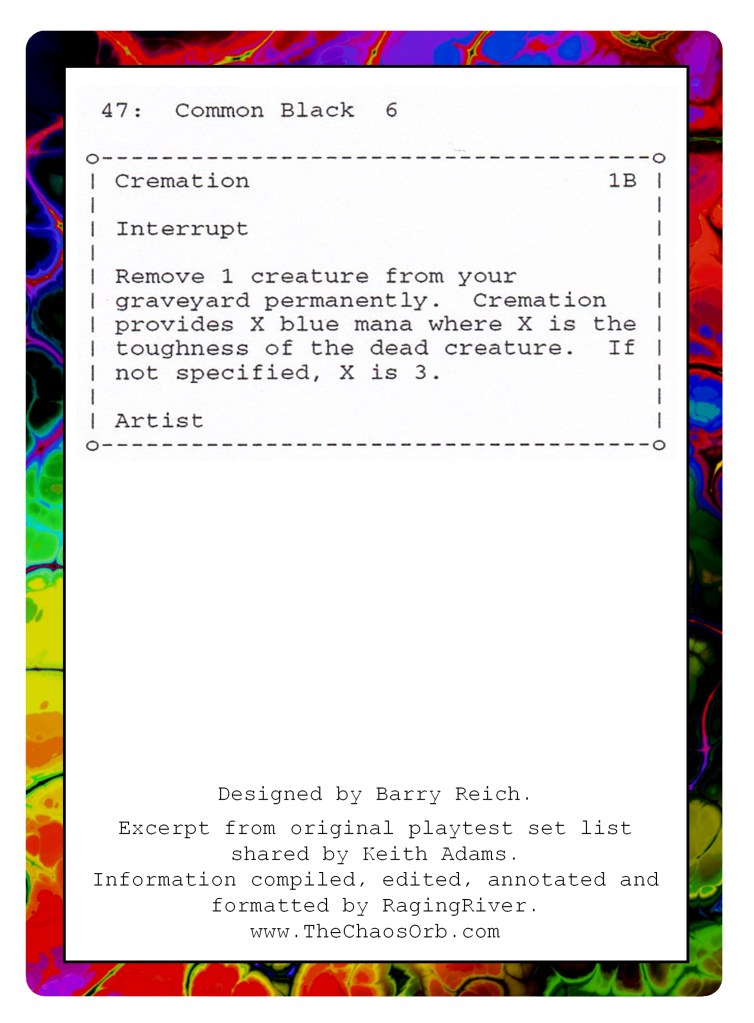
047 – Cremation
(Common Instant (Black))
Original Playtest 
Realized
Cremation – {1}{B}
Instant
As an additional cost to cast Cremation, exile a creature card from your graveyard.
Add an amount of {U} equal to the base toughness of the exiled card. If the base toughness of the exiled card was not a printed number (for example, X or *), then add {U}{U}{U}.
(Note: Rulings added Feb. 10, 2021.)
- Players can only respond once this spell has been cast and all its costs have been paid. No one can try to otherwise remove the creature card you exiled in order to prevent you from casting this spell.
048 – Injury
(Common Enchantment (Black))

Original Playtest 
Realized
Injury – {B}
Enchantment – Aura
Enchant creature
When Injury enters the battlefield, tap enchanted creature.
Whenever enchanted creature becomes untapped, put a -1/-1 counter on it.
049 – Elbis’ Meditation
(Common Instant (Black))

Original Playtest 
Realized
Elbis’ Meditation – {B}
Instant
Add {U}{U}{U}.
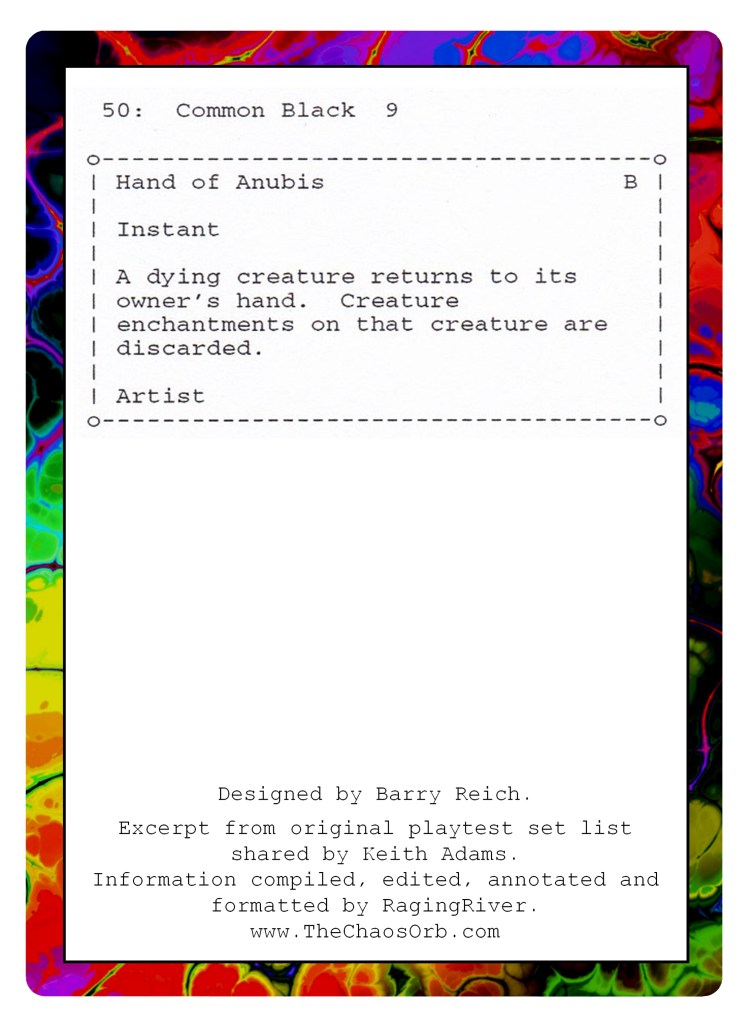
050 – Hand of Anubis
(Common Instant (Black))
Original Playtest 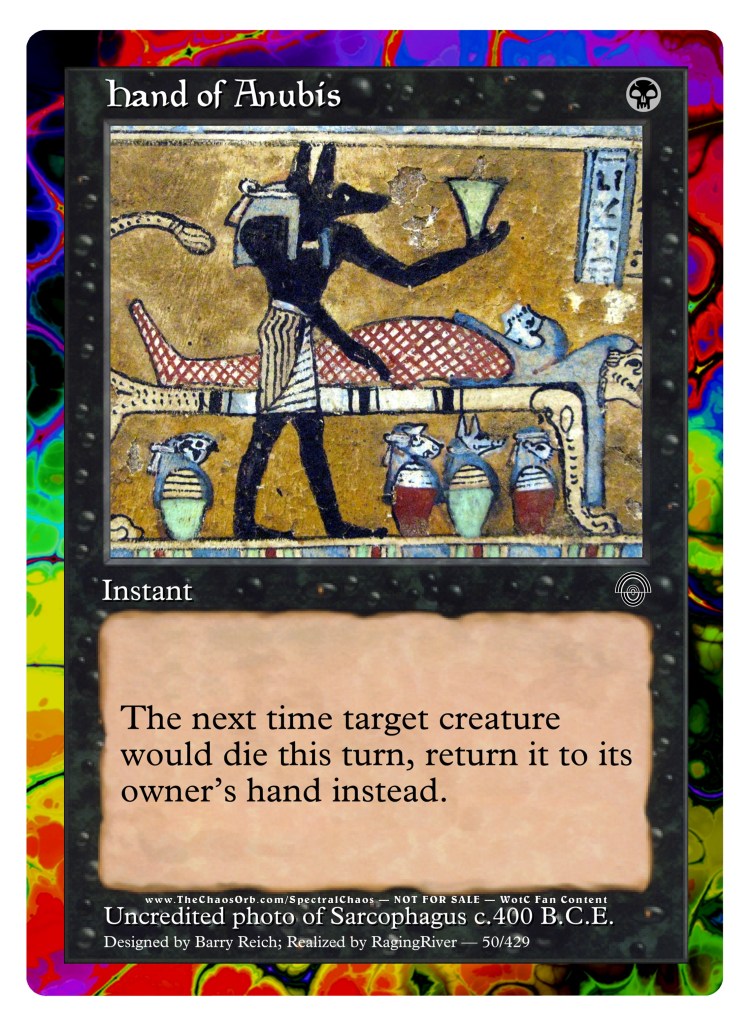
Realized
Hand of Anubis – {B}
Instant
The next time target creature would die this turn, return it to its owner’s hand instead.
- This sets up a replacement effect. If more than one replacement effect would replace that creature’s death (for example, it has a regeneration shield on it), the creature’s controller decides which event replaces the death.
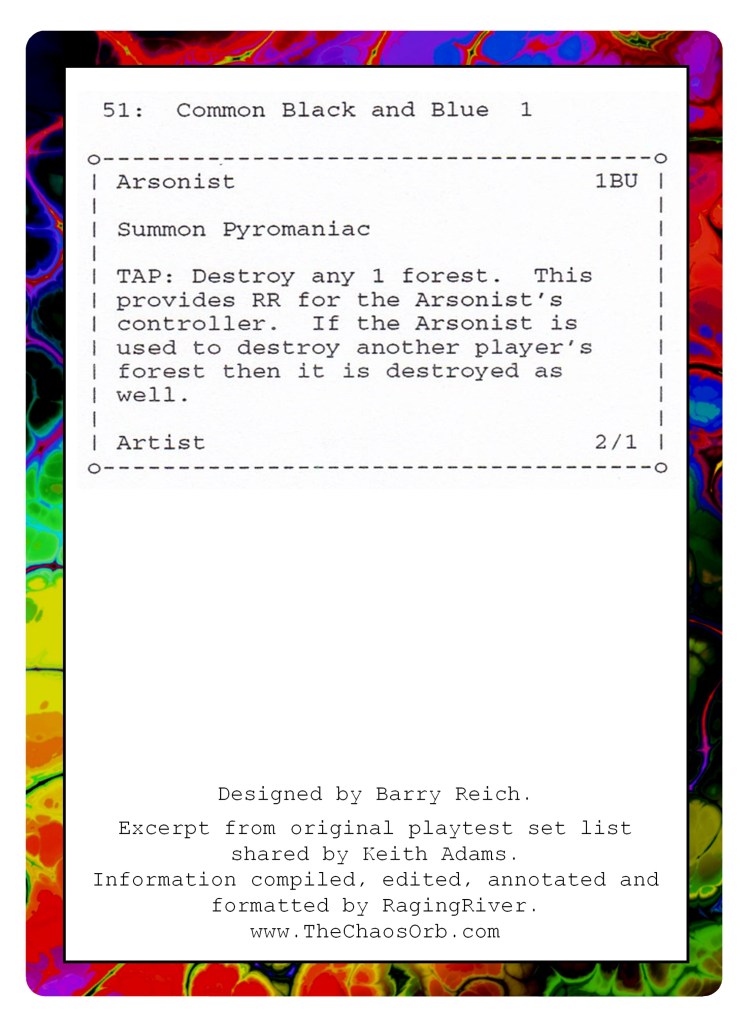
051 – Arsonist
(Common Creature (Multicolor))
Original Playtest 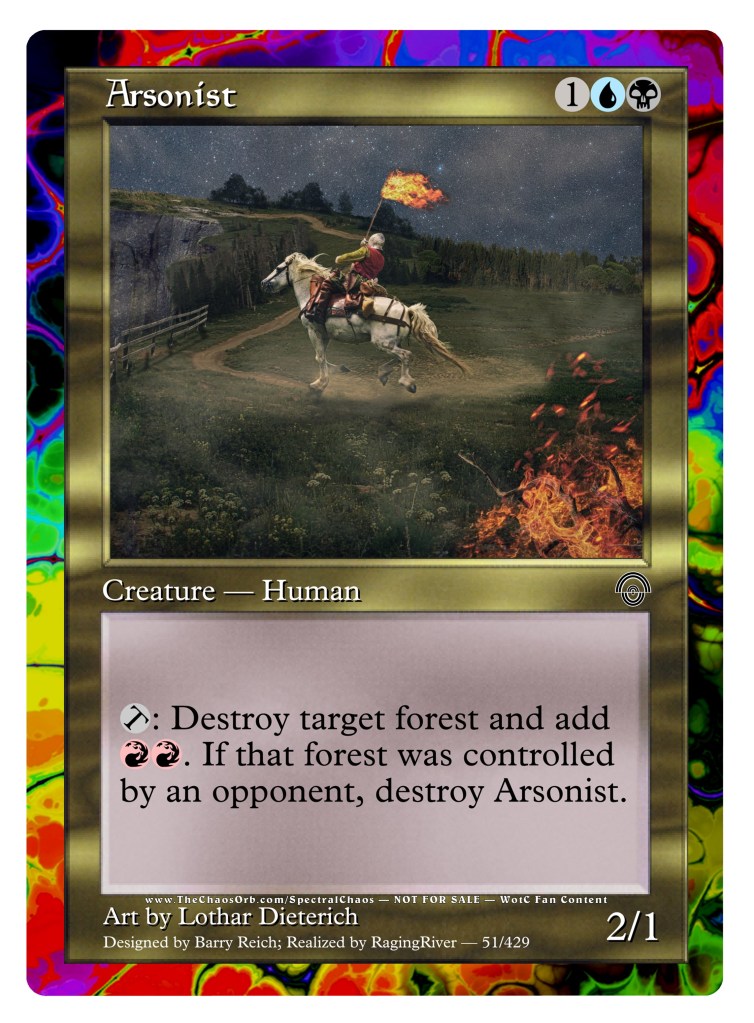
Realized
Arsonist – {1}{U}{B}
Creature – Human
{T}: Destroy target forest and add {R}{R}. If that forest was controlled by an opponent, destroy Arsonist.
2/1
- Whether the targeted land is a forest is checked when you activate the ability and again on resolution. If the land is no longer on the battlefield (or it’s no longer a forest, or it can’t be destroyed for some reason) when the ability resolves, it won’t be destroyed and you won’t add mana, and Arsonist won’t be destroyed. If you control the forest when the ability resolves, Arsonist won’t be destroyed.
052 – Fidget
(Common Creature (Multicolor))

Original Playtest 
Realized
Fidget – {U}{B}
Creature – Gremlin
At the beginning of your upkeep, Fidget deals 1 damage to you if it was untapped at the beginning of this turn.
4/2
053 – Screaming Meemies
(Common Creature (Multicolor))

Original Playtest 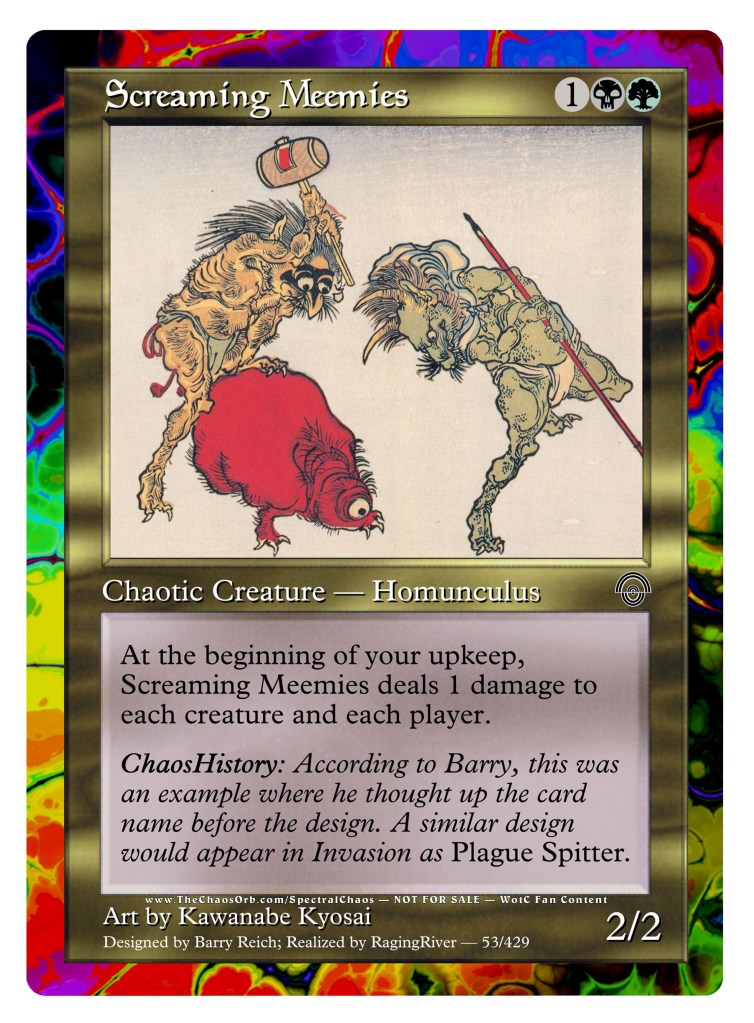
Realized
Screaming Meemies – {1}{B}{G}
Chaotic Creature – Homunculus
At the beginning of your upkeep, Screaming Meemies deals 1 damage to each creature and each player.
2/2
ChaosHistory: According to Barry, this was an example where he thought up the card name before the design. A similar design would appear in Invasion as Plague Spitter.
054 – Leigh Druid
(Common Creature (Green))

Original Playtest 
Realized
Leigh Druid – {1}{G}
Creature – Druid
{T}: Untap target land.
0/1
ChaosHistory: The smaller cousin of Alpha’s Ley Druid.
055 – Earth Priest
(Common Creature (Green))

Original Playtest 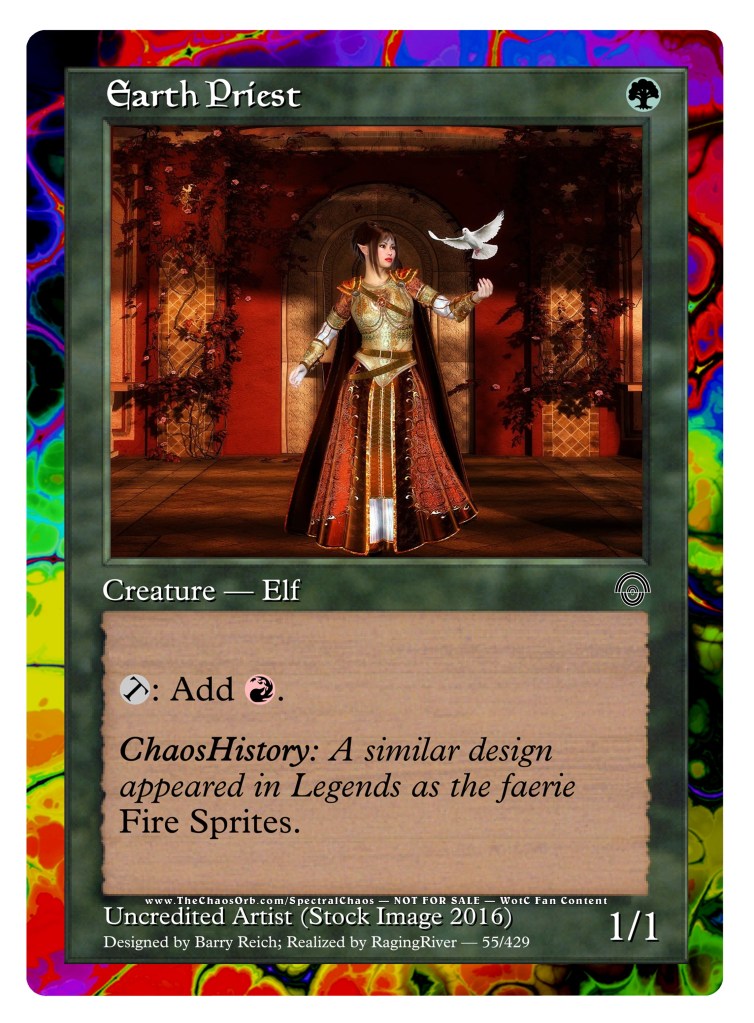
Realized
Earth Priest – {G}
Creature – Elf
{T}: Add {R}.
1/1
ChaosHistory: A similar design appeared in Legends as the faerie Fire Sprites.
056 – Snapping Turtle
(Common Creature (Green))

Original Playtest 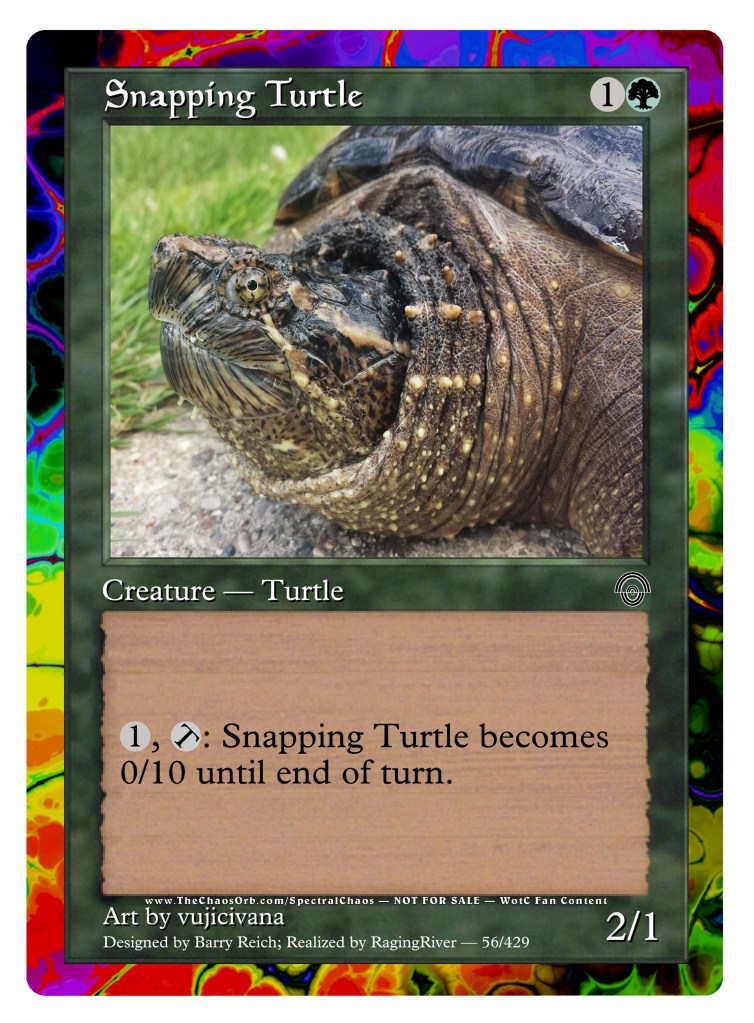
Realized
Snapping Turtle – {1}{G}
Creature – Turtle
{1}, {T}: Snapping Turtle becomes 0/10 until end of turn.
2/1
057 – Caterpillar // Moth
(Common Creature (Green))

Original Playtest 
Realized (Front) 
Realized (Back)
Caterpillar – {3}{G}
Creature – Insect
{T}: Transform Caterpillar.
3/3
Moth (Transformed from Caterpillar)
Creature – Insect
Flying
2/2
ChaosHistory: A similar design would be used for Giant Caterpillar, released in Visions.
- For more information on double-faced cards, see the Shadows over Innistrad mechanics article (https://magic.wizards.com/en/articles/archive/feature/shadows-over-innistrad-mechanics).
058 – Frinn-Jee Archer
(Common Creature (Green))

Original Playtest 
Realized
Frinn-Jee Archer – {1}{G}{G}
Creature – Human Knight
{T}: Frinn-Jee Archer deals 1 damage to any target.
0/2
ChaosHistory: Frinn-Jee is an anagram of the name of Barry’s sister Jennifer.
059 – Craw Chameleon
(Common Creature (Green))

Original Playtest 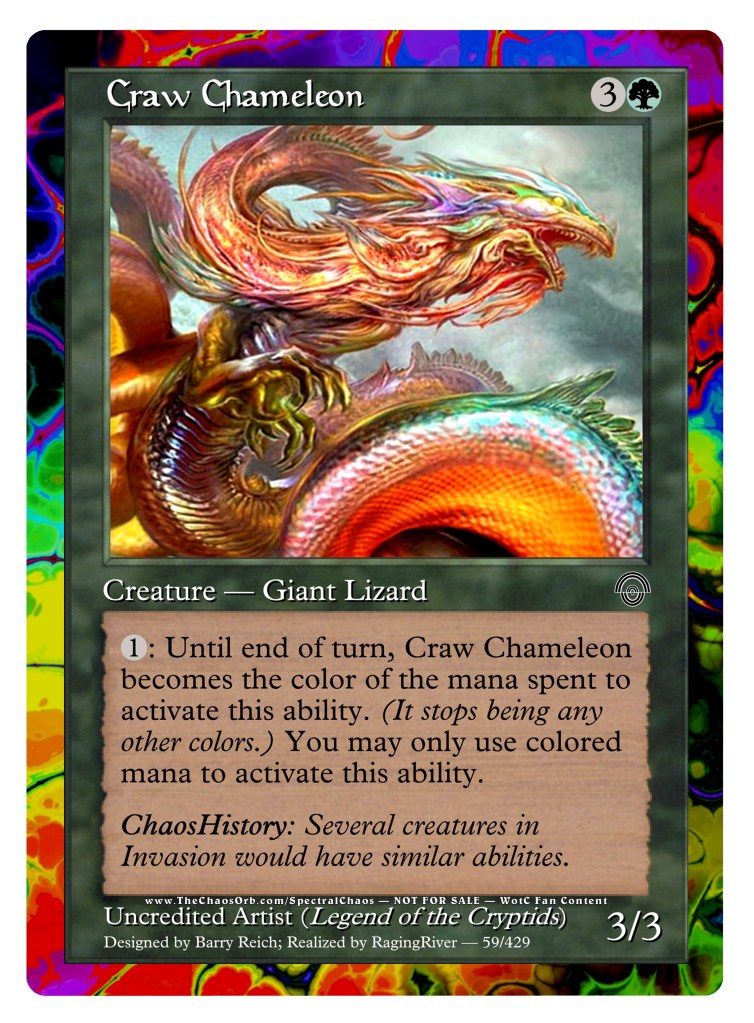
Realized
Craw Chameleon – {3}{G}
Creature – Giant Lizard
{1}: Until end of turn, Craw Chameleon becomes the color of the mana spent to activate this ability. (It stops being any other colors.) You may only use colored mana to activate this ability.
3/3
ChaosHistory: Several creatures in Invasion would have similar abilities.
060 – Immense Spider
(Common Creature (Green))
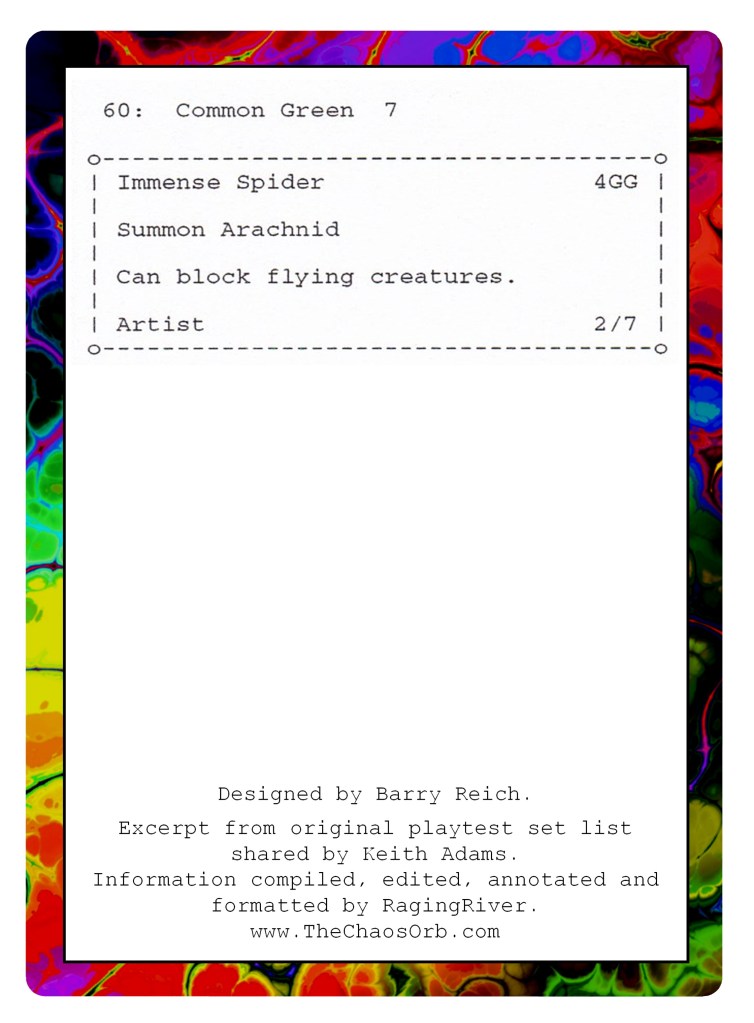
Original Playtest 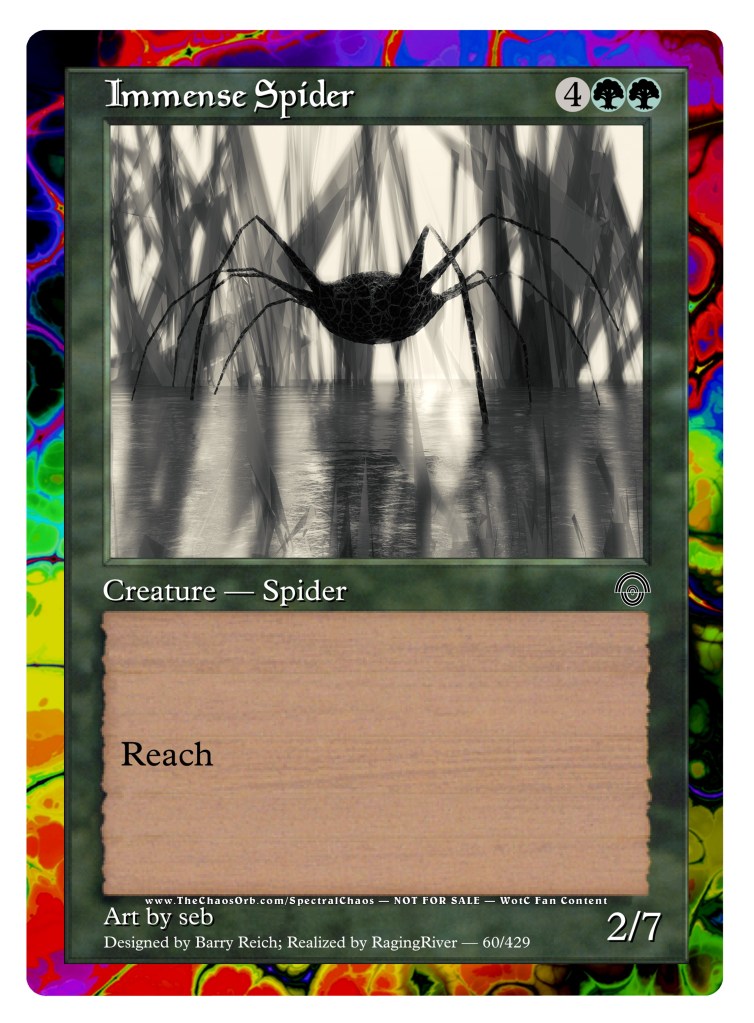
Realized
Immense Spider – {4}{G}{G}
Creature – Spider
Reach
2/7
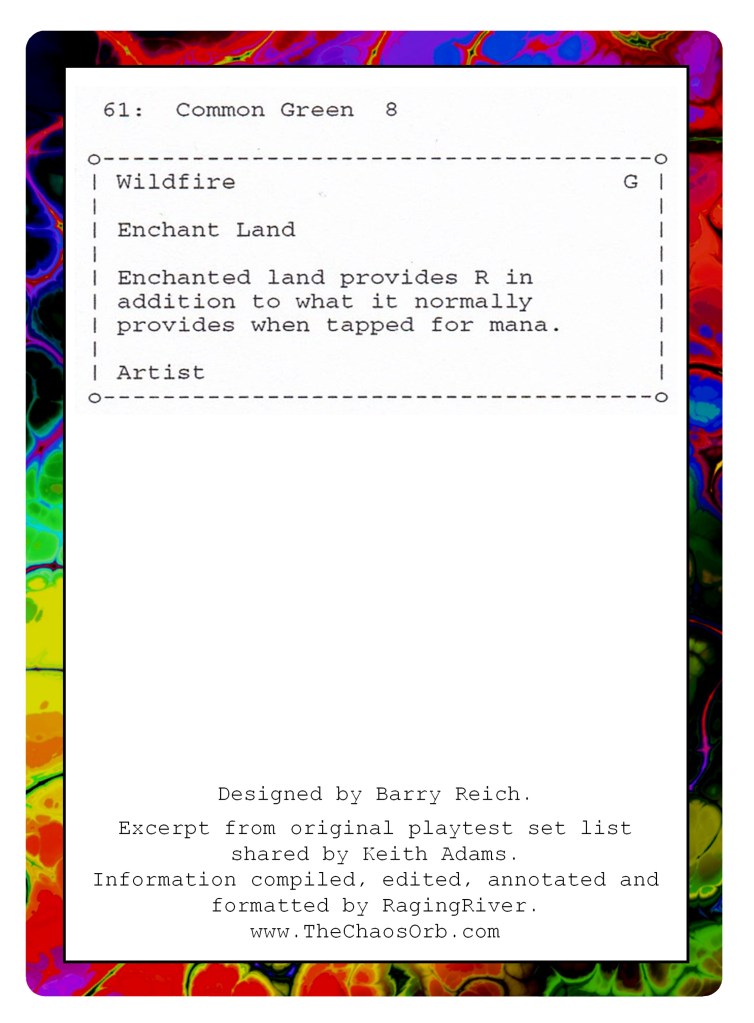
061 – Wildfire
(Common Enchantment (Green))
Original Playtest 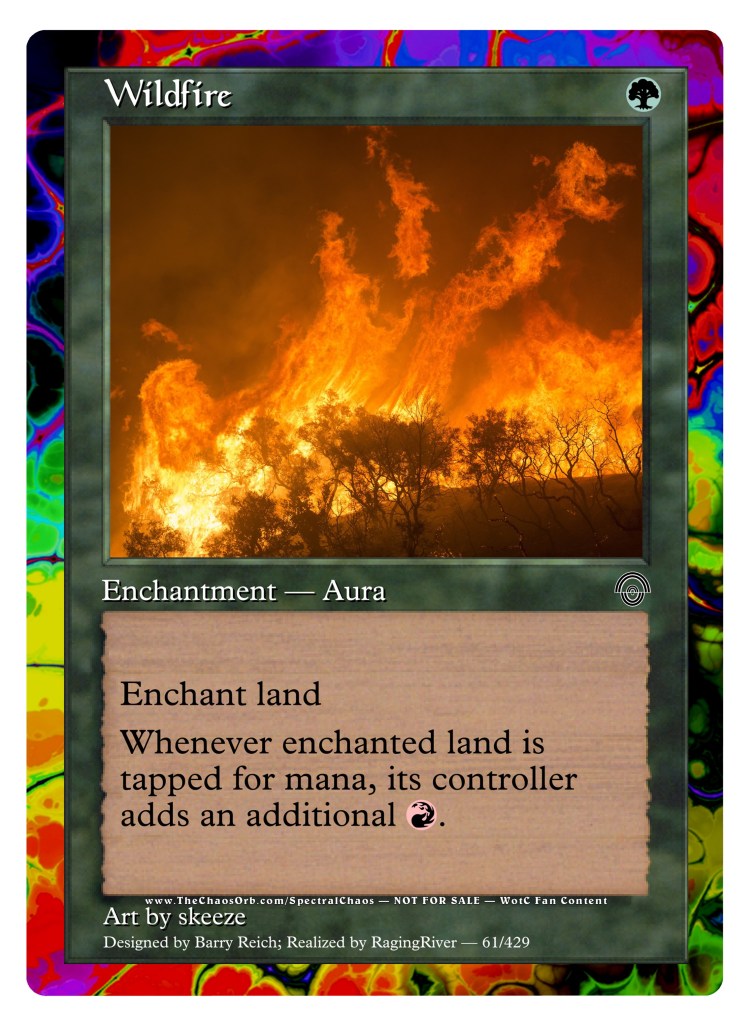
Realized
Wildfire – {G}
Enchantment – Aura
Enchant land
Whenever enchanted land is tapped for mana, its controller adds an additional {R}.
- The additional mana is not an ability of the land. Wildfire produces the mana, not the land.
062 – Fizzle
(Common Sorcery (Green))

Original Playtest 
Realized
Fizzle – {X}{G}
Sorcery
Destroy X target enchantments. Sacrifice X enchantments. (If you control fewer than X enchantments, sacrifice all of them).
- You can target your own enchantments if you want, but that won’t reduce the number you’ll then need to sacrifice.
- You choose the target enchantments to destroy as you cast Fizzle. However, you don’t decide which enchantments to sacrifice until Fizzle resolves.
- You don’t need to control X enchantments to cast this. Whatever enchantments you control after destroying the target enchantments, you’ll choose X of those and sacrifice them. If you control fewer than X enchantments after the targeted enchantments are destroyed, sacrifice all of them.
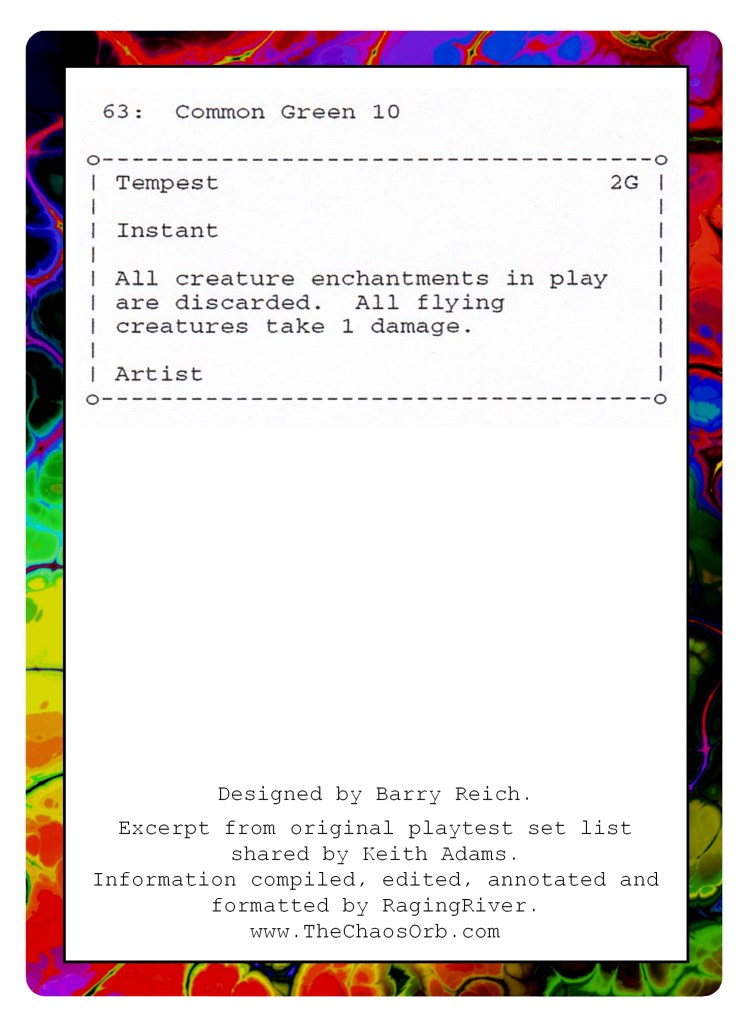
063 – Tempest
(Common Instant (Green))
Original Playtest 
Realized
Tempest – {2}{G}
Instant
Destroy all auras attached to creatures.
Tempest deals 1 damage to each flying creature.
(Note: Rulings last updated Feb. 1, 2021.)
- If a creature only had flying because of an aura, which Tempest now destroys, it won’t have 1 damage dealt to it.
- If something prevents the auras from being destroyed, damage will still be dealt to the creatures. If something prevents damage from being dealt to the creatures, the auras will still be destroyed.
064 – Pax Oliphant
(Common Creature (Green))

Original Playtest 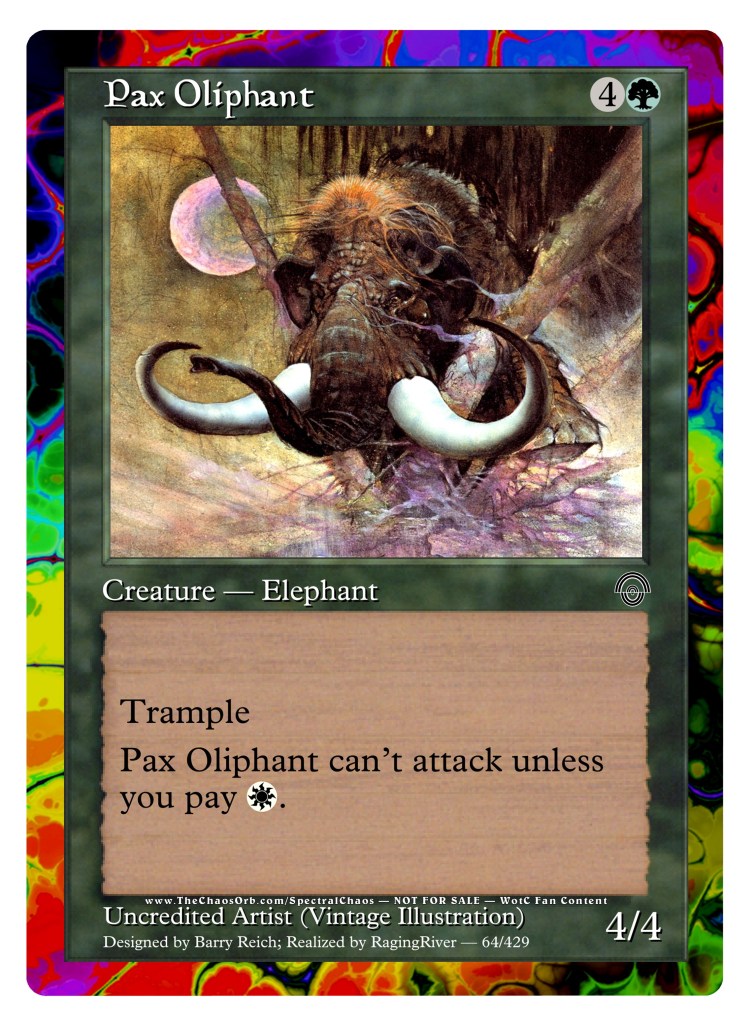
Realized
Pax Oliphant – {4}{G}
Creature – Elephant
Trample
Pax Oliphant can’t attack unless you pay {W}.
4/4
- This ability is paid for during the declare attackers step of the combat phase. Paying this cost is not any kind of ability, it is an additional cost on the declaration of the attacker.
- If there are multiple combat phases during the turn, the attack cost must be paid each time if you want to attack with the creature.
065 – Resummon
(Common Enchantment (Green))

Original Playtest 
Realized
Resummon – {G}
Enchantment – Aura
Enchant creature
{U}: Regenerate enchanted creature.
066 – Scroll of Parchment
(Common Artifact)
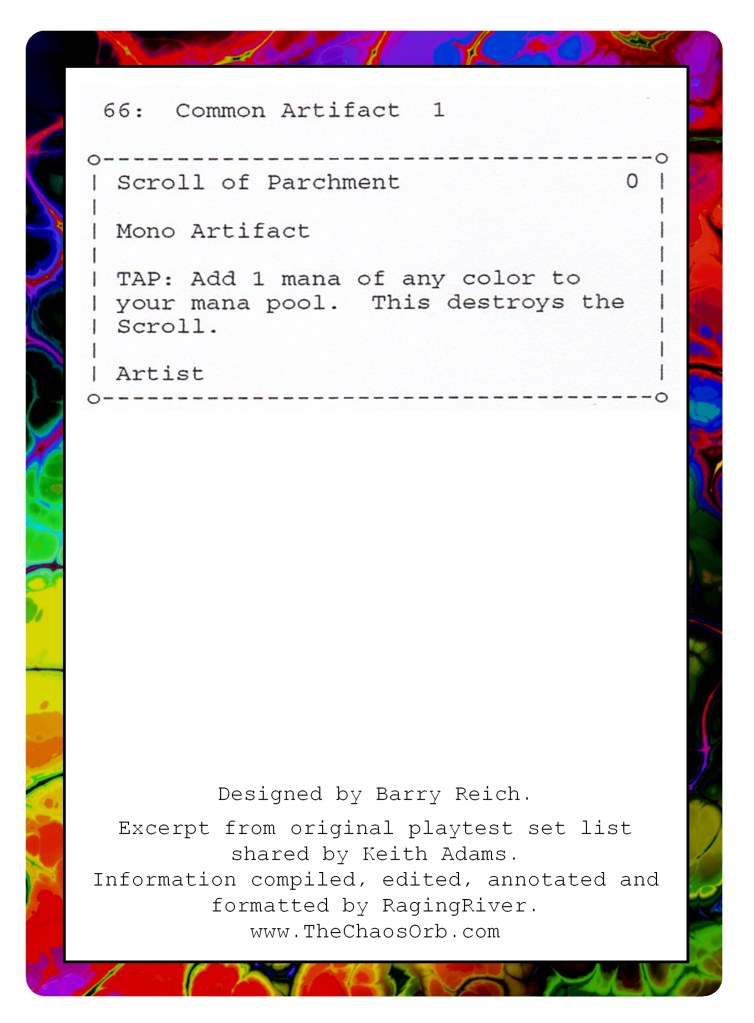
Original Playtest 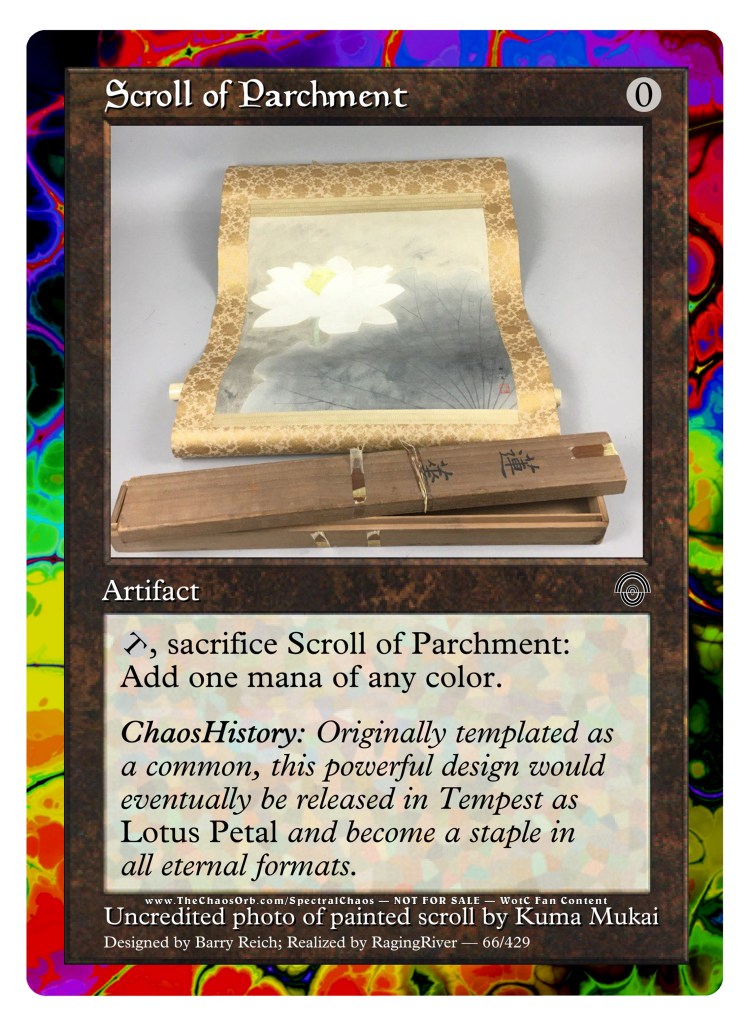
Realized
Scroll of Parchment – {0}
Artifact
{T}, sacrifice Scroll of Parchment: Add one mana of any color.
ChaosHistory: Originally templated as a common, this powerful design would eventually be released in Tempest as Lotus Petal and become a staple in all eternal formats.
UNCOMMONS (121):
Click here to download high-resolution copies of the Spectral Chaos Uncommons at Ko-fi


067 – Promontory
(Uncommon Land)

Original Playtest 
Realized
Promontory
Chaotic Land – Island Mountain
Play Promontory only if you control no Promontory.
ChaosHistory: The first attempt at a “fixed” enemy-color dual land. Had it been designed after Legends, it may have been “legendary.”
- This has the mana abilities associated with both its basic land types.
- It’s not a basic land. Things that affect basic lands don’t affect it, but things that affect its basic land types do.
- If you can find a way to do so, you could still put this onto the battlefield even if you already control one. You just can’t play it.
068 – Mesa
(Uncommon Land)
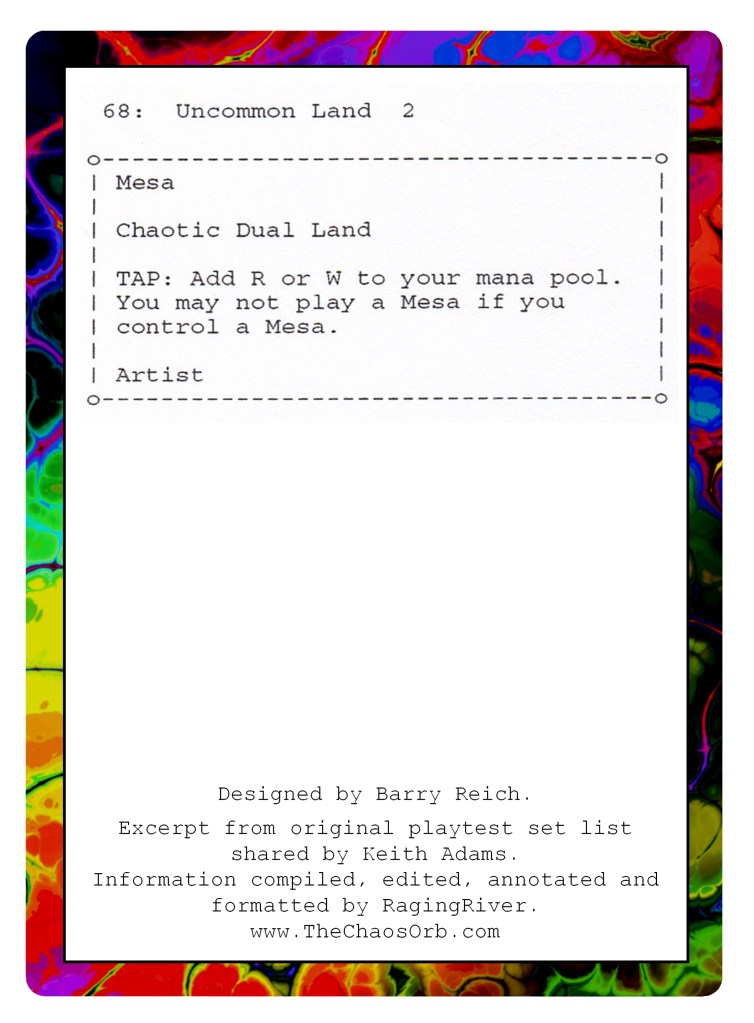
Original Playtest 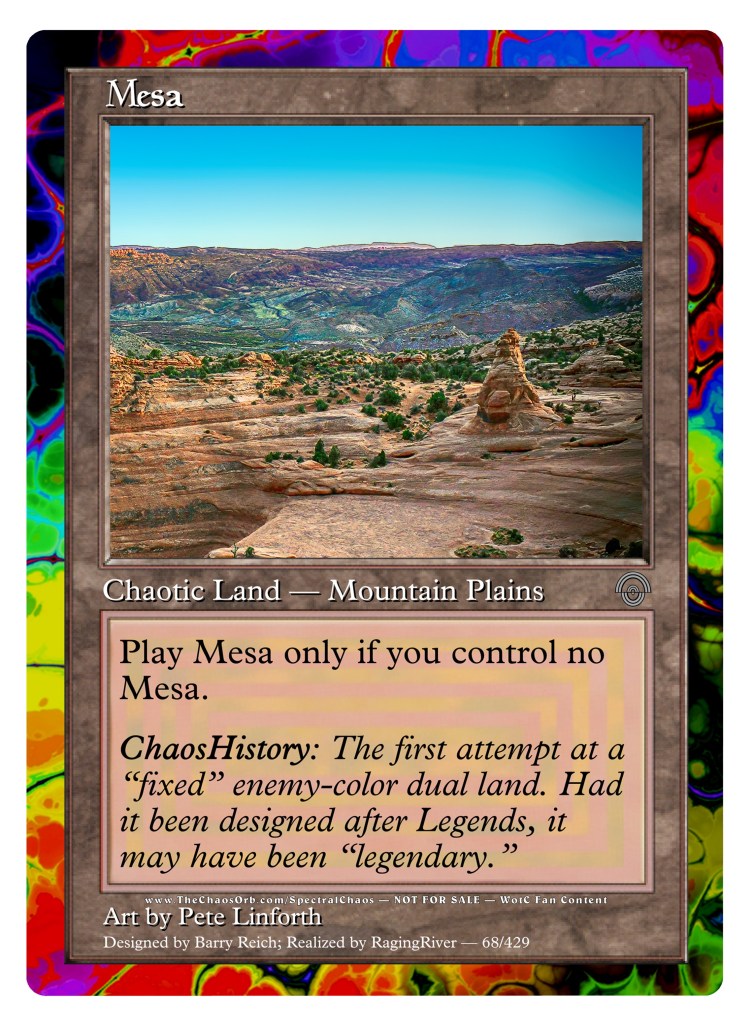
Realized
Mesa
Chaotic Land – Mountain Plains
Play Mesa only if you control no Mesa.
ChaosHistory: The first attempt at a “fixed” enemy-color dual land. Had it been designed after Legends, it may have been “legendary.”
- This has the mana abilities associated with both its basic land types.
- It’s not a basic land. Things that affect basic lands don’t affect it, but things that affect its basic land types do.
- If you can find a way to do so, you could still put this onto the battlefield even if you already control one. You just can’t play it.
069 – Fen
(Uncommon Land)

Original Playtest 
Realized
Fen
Chaotic Land – Plains Swamp
Play Fen only if you control no Fen.
ChaosHistory: The first attempt at a “fixed” enemy-color dual land. Had it been designed after Legends, it may have been “legendary.”
- This has the mana abilities associated with both its basic land types.
- It’s not a basic land. Things that affect basic lands don’t affect it, but things that affect its basic land types do.
- If you can find a way to do so, you could still put this onto the battlefield even if you already control one. You just can’t play it.
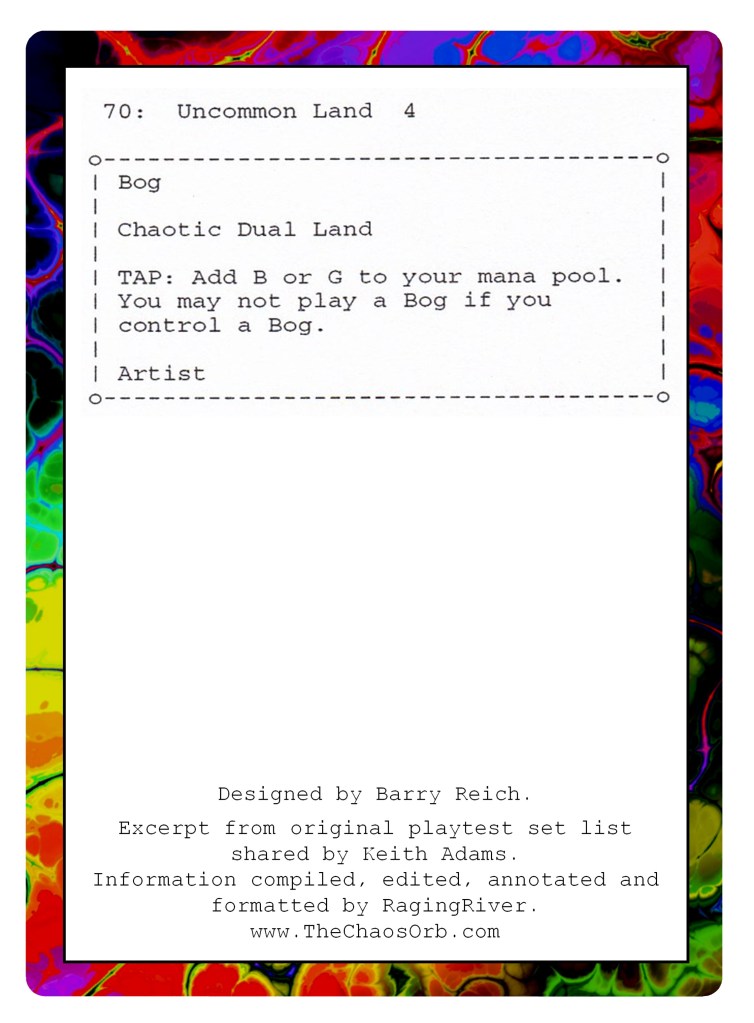
070 – Bog
(Uncommon Land)
Original Playtest 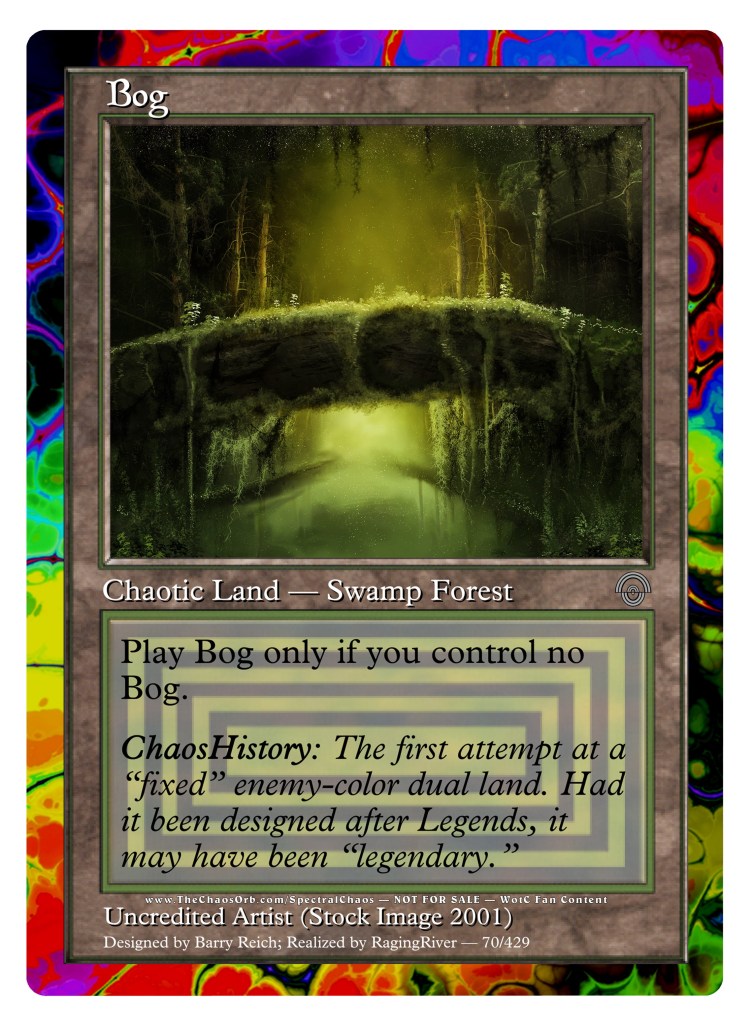
Realized
Bog
Chaotic Land – Swamp Forest
Play Bog only if you control no Bog.
ChaosHistory: The first attempt at a “fixed” enemy-color dual land. Had it been designed after Legends, it may have been “legendary.”
- This has the mana abilities associated with both its basic land types.
- It’s not a basic land. Things that affect basic lands don’t affect it, but things that affect its basic land types do.
- If you can find a way to do so, you could still put this onto the battlefield even if you already control one. You just can’t play it.
071 – Coral Reef
(Uncommon Land)

Original Playtest 
Realized
Coral Reef
Chaotic Land – Forest Island
Play Coral Reef only if you control no Coral Reef.
ChaosHistory: The first attempt at a “fixed” enemy-color dual land. Had it been designed after Legends, it may have been “legendary.”
- This has the mana abilities associated with both its basic land types.
- It’s not a basic land. Things that affect basic lands don’t affect it, but things that affect its basic land types do.
- If you can find a way to do so, you could still put this onto the battlefield even if you already control one. You just can’t play it.
072 – Mage of the White Lodge
(Uncommon Creature (Blue))

Original Playtest 
Realized
Mage of the White Lodge – {3}{U}
Creature – Pegasus Cleric
{T}: Target white creature gets flying until end of turn.
1/3
- The creature is checked for color when it is targeted, and again when this ability resolves.
- The creature will still have flying even if its color changes later in the turn, after this ability resolves.
073 – Corrupt Sorcerer
(Uncommon Creature (Blue))

Original Playtest 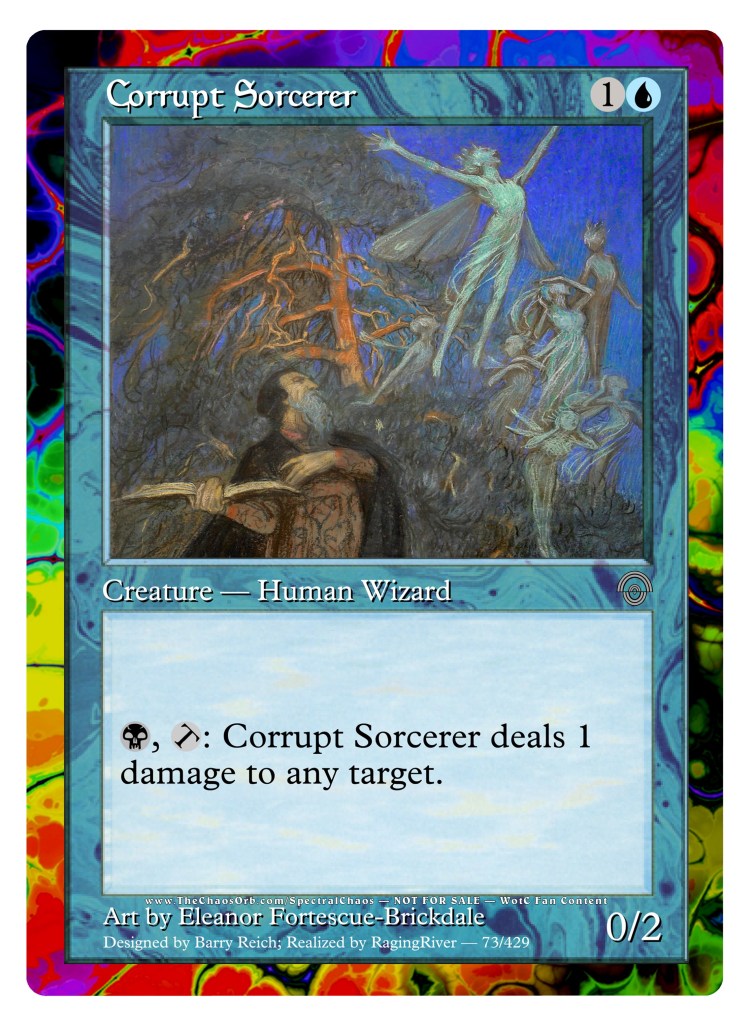
Realized
Corrupt Sorcerer – {1}{U}
Creature – Human Wizard
{B}, {T}: Corrupt Sorcerer deals 1 damage to any target.
0/2
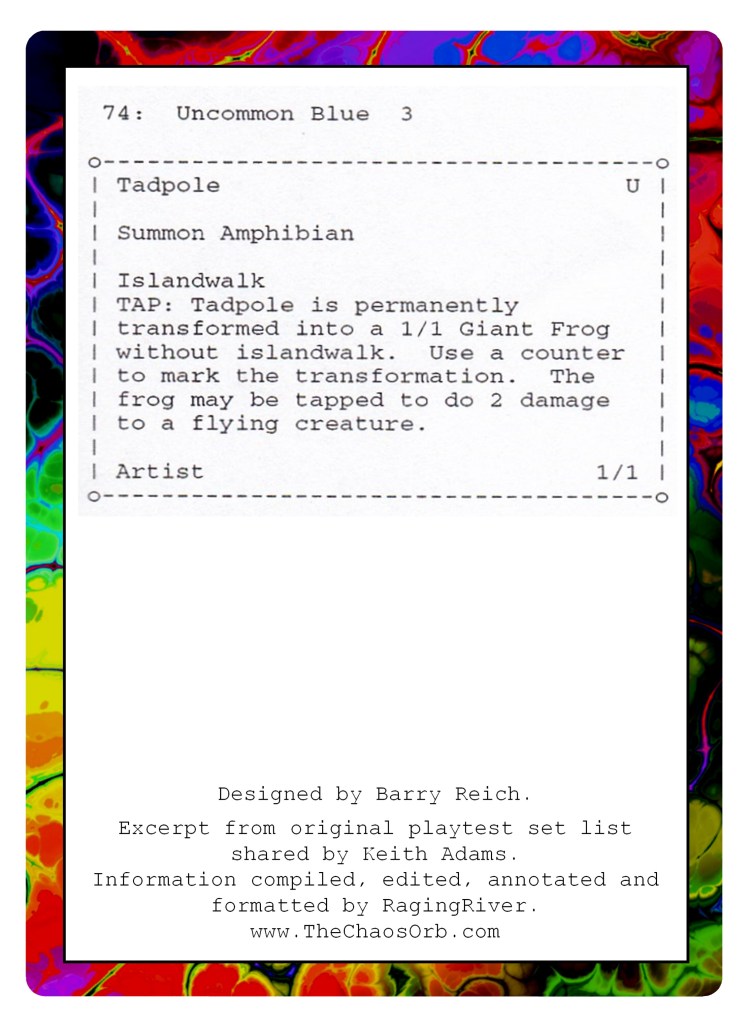
074 – Tadpole // Giant Frog
(Uncommon Creature (Blue))
Original Playtest 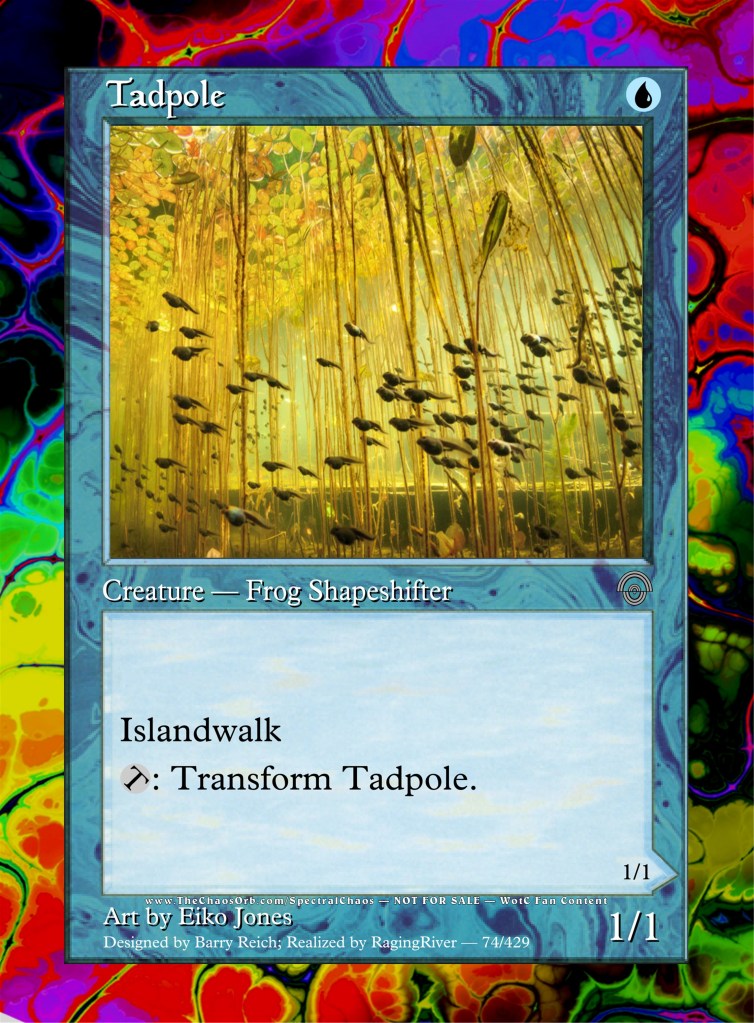
Realized (Front) 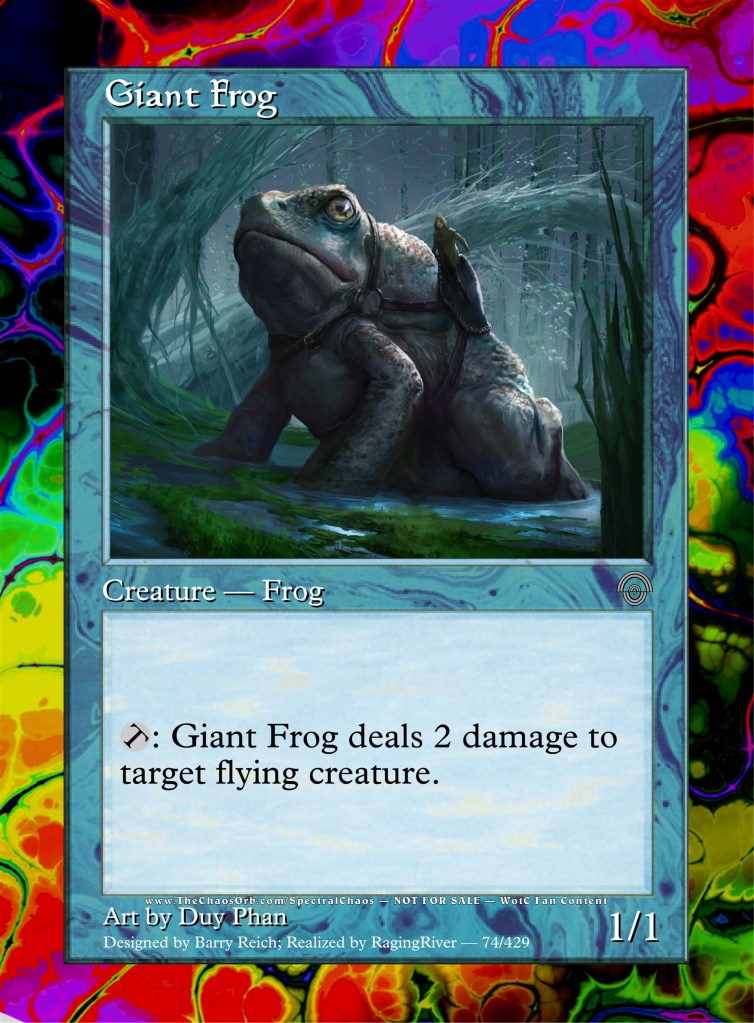
Realized (Back)
Tadpole – {U}
Creature – Frog Shapeshifter
Islandwalk
{T}: Transform Tadpole.
1/1
Giant Frog (Transformed from Tadpole)
Creature – Frog
{T}: Giant Frog deals 2 damage to target flying creature.
1/1
- For more information on double-faced cards, see the Shadows over Innistrad mechanics article (https://magic.wizards.com/en/articles/archive/feature/shadows-over-innistrad-mechanics).
075 – Mental Agility
(Uncommon Enchantment (Blue))

Original Playtest 
Realized
Mental Agility – {1}{U}
Enchantment
As an additional cost to cast Mental Agility, pay {U} for each card named Mental Agility on the battlefield.
When Mental Agility enters the battlefield, draw a card.
At the beginning of each player’s draw step, that player draws an additional card.
076 – Refraction Beast
(Uncommon Creature (Blue))

Original Playtest 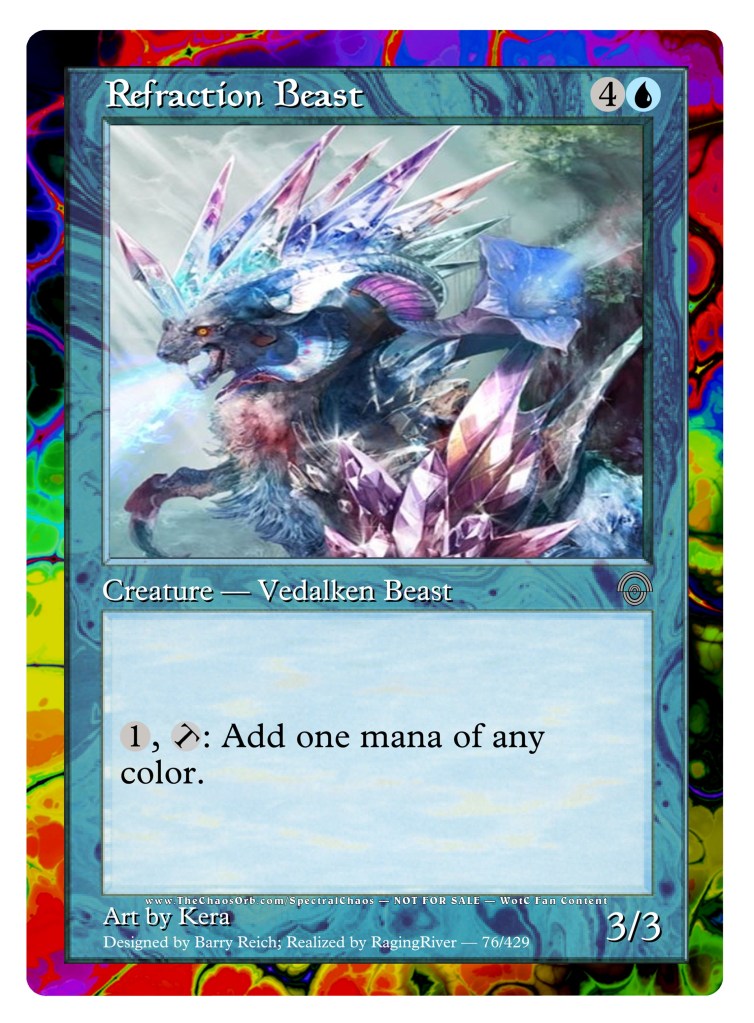
Realized
Refraction Beast – {4}{U}
Creature – Vedalken Beast
{1}, {T}: Add one mana of any color.
3/3
077 – Sidewinder
(Uncommon Creature (Blue))

Original Playtest 
Realized
Sidewinder – {5}{U}
Creature – Snake
Plainshome
5/5
078 – Mist
(Uncommon Creature (Blue))

Original Playtest 
Realized
Mist – {2}{U}
Creature – Elemental Wall
Defender
Whenever Mist blocks or is blocked by a red creature, Mist gets +1/+1 until end of turn.
{U}: +1/+0 until end of turn.
{W}: +0/+1 until end of turn.
0/2
- If somehow Mist blocks or becomes blocked by multiple red creatures, Mist will get +1/+1 until end of turn for each one.
079 – Psychic Ripple
(Uncommon Sorcery (Blue))

Original Playtest 
Realized
Psychic Ripple – {1}{U}
Sorcery
Psychic Ripple deals 2+X damage to target player, where X is equal to the number of enchantments that player controls.
- X is determined based on how many enchantments the target player controls when this resolves.
080 – Copy Enchantment
(Uncommon Enchantment (Blue))

Original Playtest 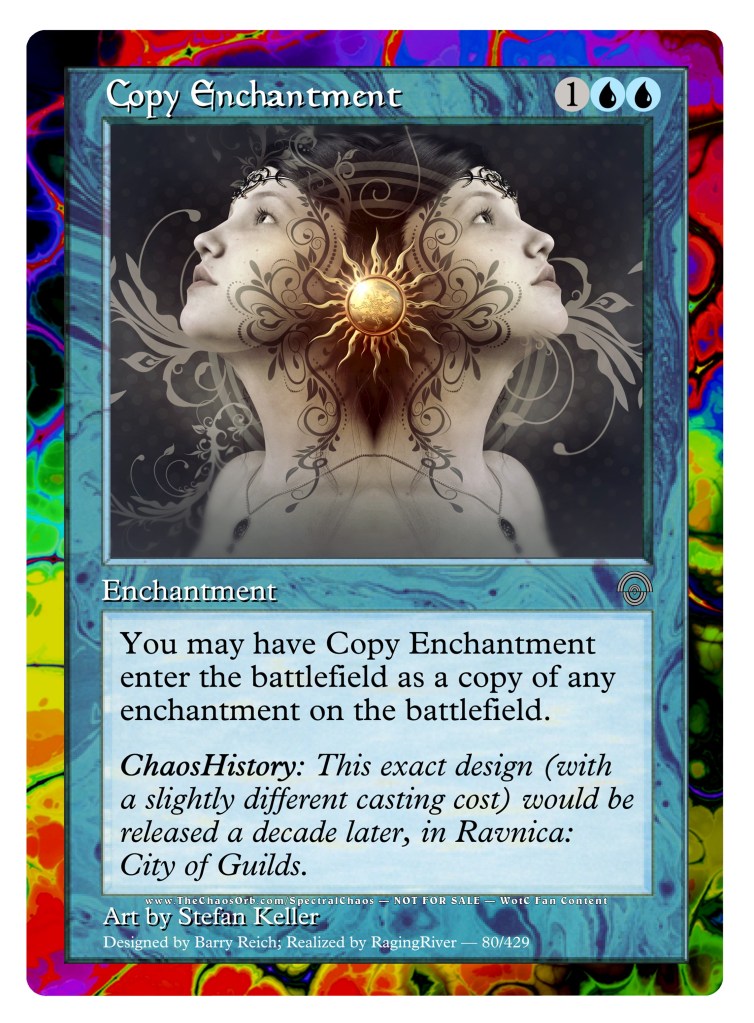
Realized
Copy Enchantment – {1}{U}{U}
Enchantment
You may have Copy Enchantment enter the battlefield as a copy of any enchantment on the battlefield.
ChaosHistory: This exact design (with a slightly different casting cost) would be released a decade later, in Ravnica: City of Guilds.
- If you choose an aura, you also choose a legal permanent for the Copy Enchantment copy of it to enchant. Copy Enchantment doesn’t target that permanent, however, so it can enter the battlefield attached to an untargetable creature.
- If you choose an aura and there isn’t a legal permanent for it to enchant, you put Copy Enchantment into your graveyard. It never enters the battlefield.
- If you don’t choose an enchantment, Copy Enchantment enters the battlefield without copying anything, and it sits there with a useless ability.
081 – Imprison
(Uncommon Enchantment (Blue))
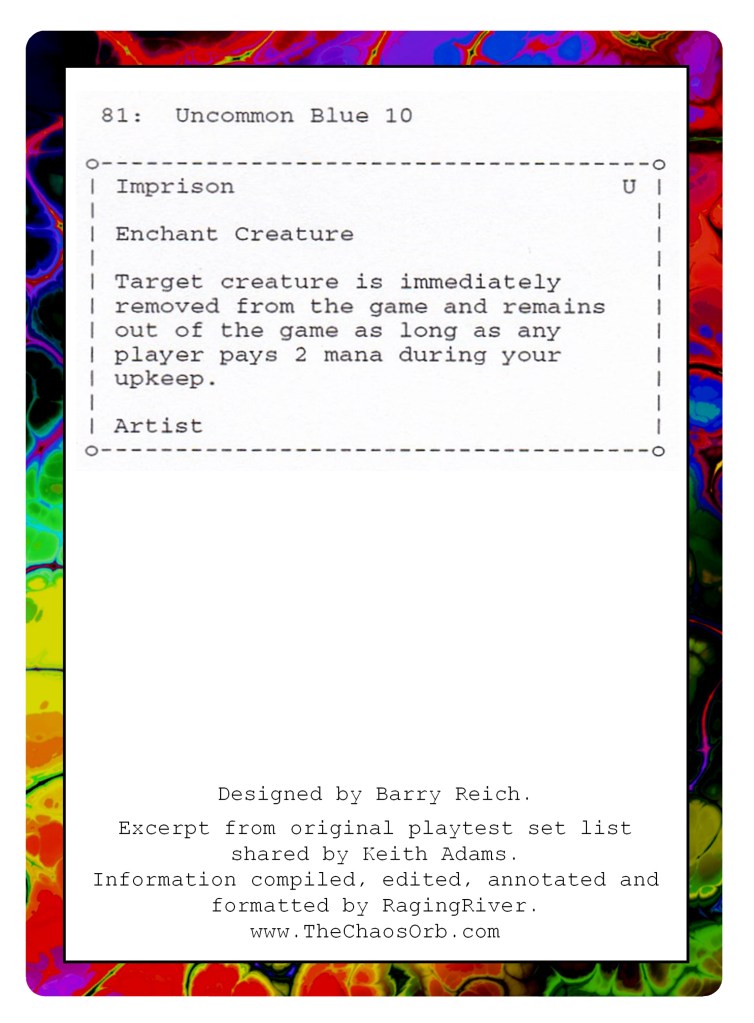
Original Playtest 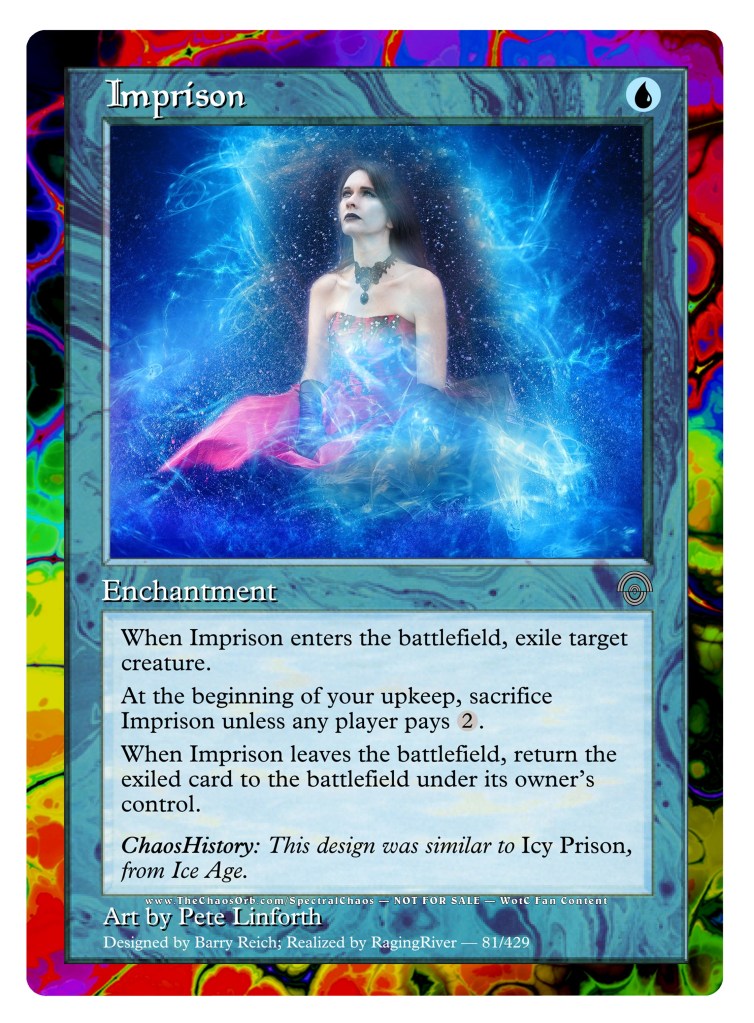
Realized
Imprison – {U}
Enchantment
When Imprison enters the battlefield, exile target creature.
At the beginning of your upkeep, sacrifice Imprison unless any player pays {2}.
When Imprison leaves the battlefield, return the exiled card to the battlefield under its owner’s control.
ChaosHistory: This design was similar to Icy Prison, from Ice Age.
- Each player (starting with the current player and going in turn order) gets the option to pay when the upkeep ability resolves.
- If Imprison leaves the battlefield before its first ability has resolved, its third ability will trigger and do nothing. Then its first ability will resolve and exile the targeted creature forever.
082 – Daydream
(Uncommon Sorcery (Blue))
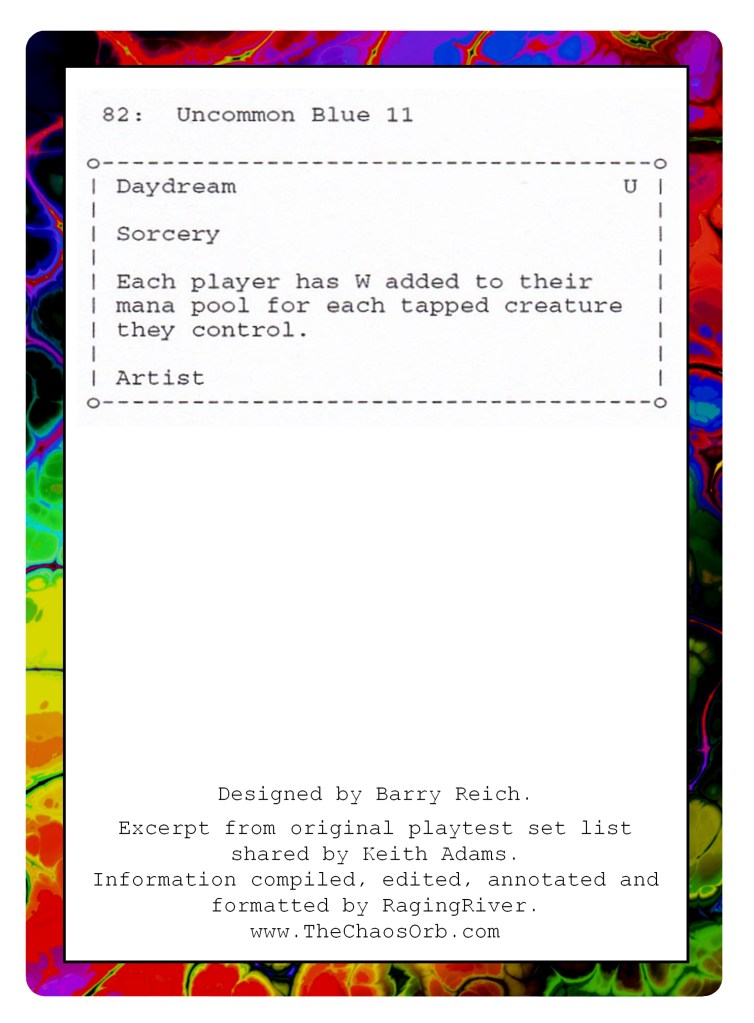
Original Playtest 
Realized
Daydream – {U}
Sorcery
Each player adds {W} for each tapped creature they control.
- The amount of mana each player gets is determined based on how many of their creatures are tapped when this resolves.
083 – Psionic Surge
(Uncommon Sorcery (Blue))

Original Playtest 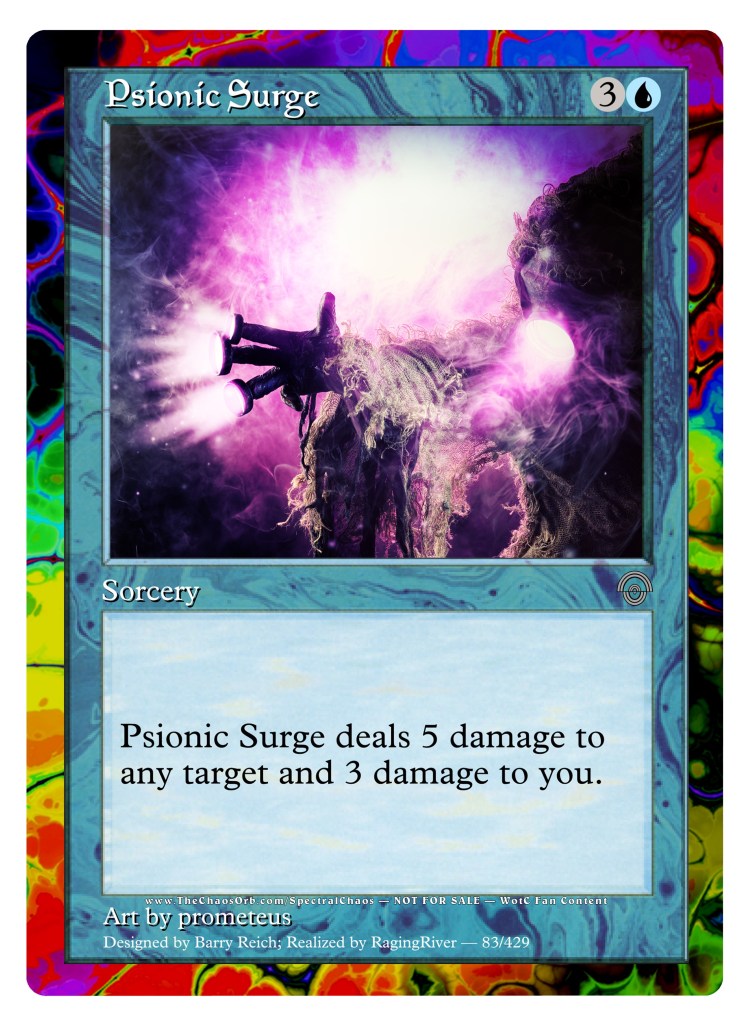
Realized
Psionic Surge – {3}{U}
Sorcery
Psionic Surge deals 5 damage to any target and 3 damage to you.
084 – Spell Blast
(Uncommon Instant (Blue))

Original Playtest 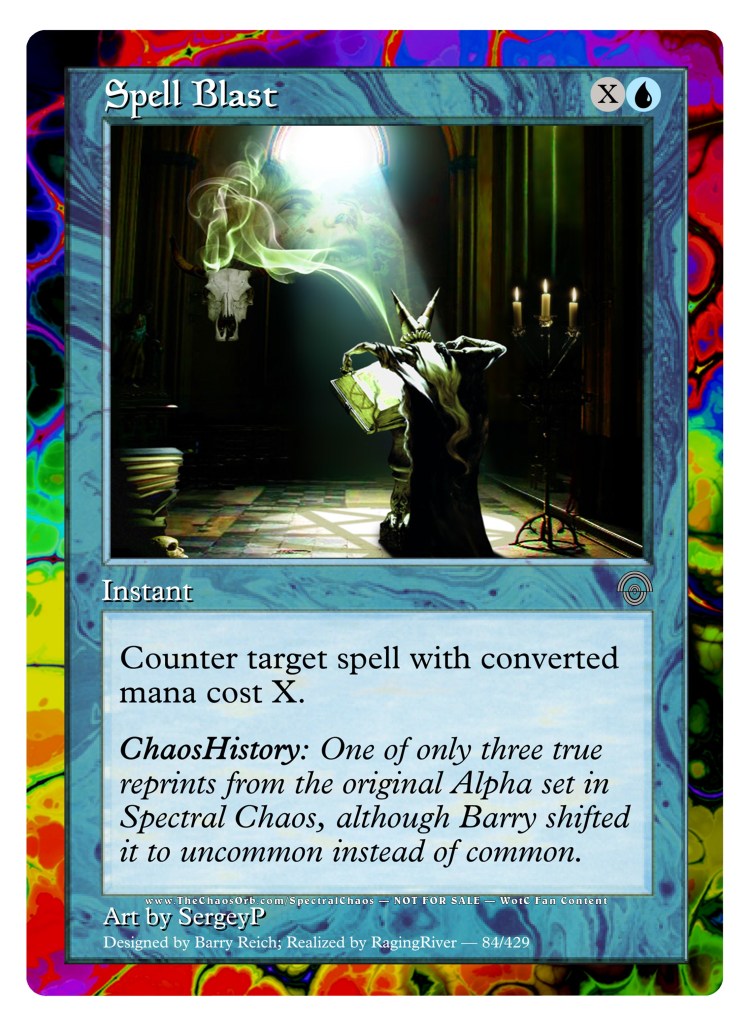
Realized
Spell Blast – {X}{U}
Instant
Counter target spell with converted mana cost X.
ChaosHistory: One of only three true reprints from the original Alpha set in Spectral Chaos, although Barry shifted it to uncommon instead of common.
- Alternative costs, additional costs, cost increases, and cost reductions don’t affect a spell’s converted mana cost.
- If the target spell has X in its mana cost, include the value chosen for that X when determining the value of the X in Spell Blast’s mana cost.
085 – Negate
(Uncommon Instant (Blue))
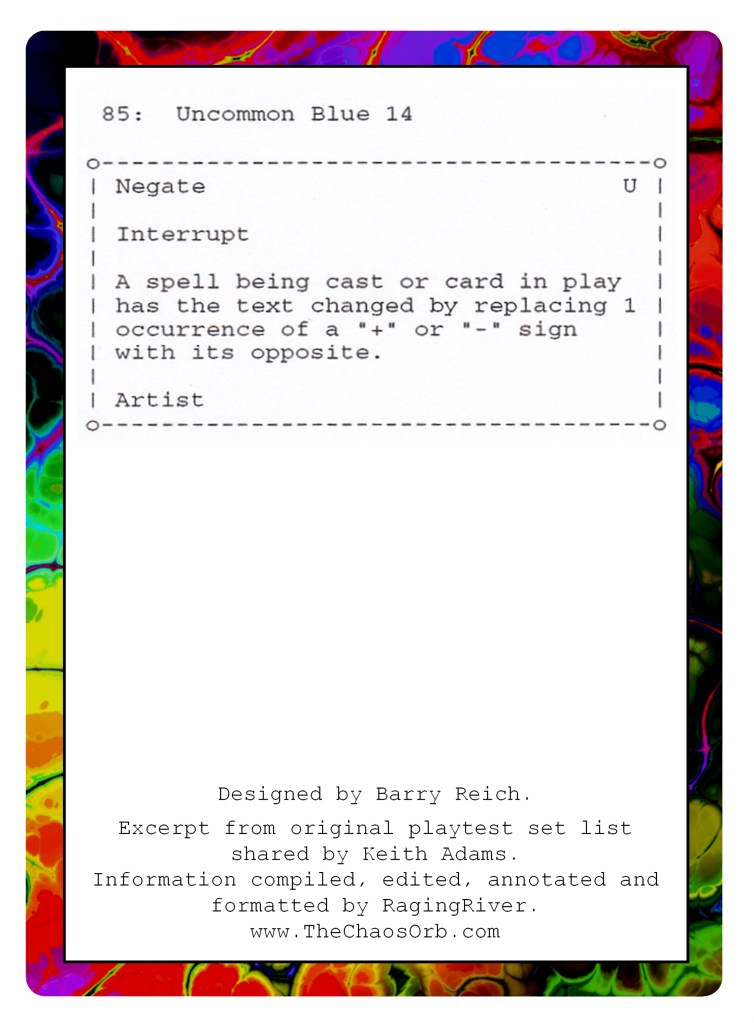
Original Playtest 
Realized
Negate – {U}
Instant
Change the text of target permanent or spell by replacing a single instance of “+” with “-” or vice versa. (For example, you can change “+1/+1” to “-1/+1,” or “X-3” to “X+3.” This cannot change counters already on a permanent. This effect lasts indefinitely.)
- It only changes what is printed on the text of a card (or set on a token when it was created or set by a copy effect). It will not change any effects that are on the permanent. For example, if a creature is enchanted by Holy Strength, you can’t use Negate on the creature to modify the power or toughness pumping; however, you could do so by using Negate on the Holy Strength itself.
- Alters one single instance of the chosen word or mana symbol in the text box of the given card. Words that simply refer back to that changed word or mana symbol are deemed to be part of a single “instance” to the extent necessary to make the change “work.”
- Can target a card with no “+” or “-” on it, or even one with no text at all.
- It only changes what is printed on the card (or set on a token when it was created or set by a copy effect). It will not change any effects that are on the permanent.
- You choose which instance of “+” or “-” to change on resolution.
- If the text change increases the number of targets needed for a spell (for example, you change “X-1 targets” to “X+1 targets”), it will (probably) cause the spell to be countered since insufficient targets were chosen as part of casting that spell. However, if you did the reverse and decreased the number of targets needed, it might not do anything (because sufficient targets were already chosen when the spell was cast). If this occurs, the controller of the spell whose targets were reduced would choose which target is “dropped out” of that spell.
- If you change the text of a spell which is to become a permanent, the permanent will retain the text change.
086 – Mystic Spirit
(Uncommon Creature (Multicolor))

Original Playtest 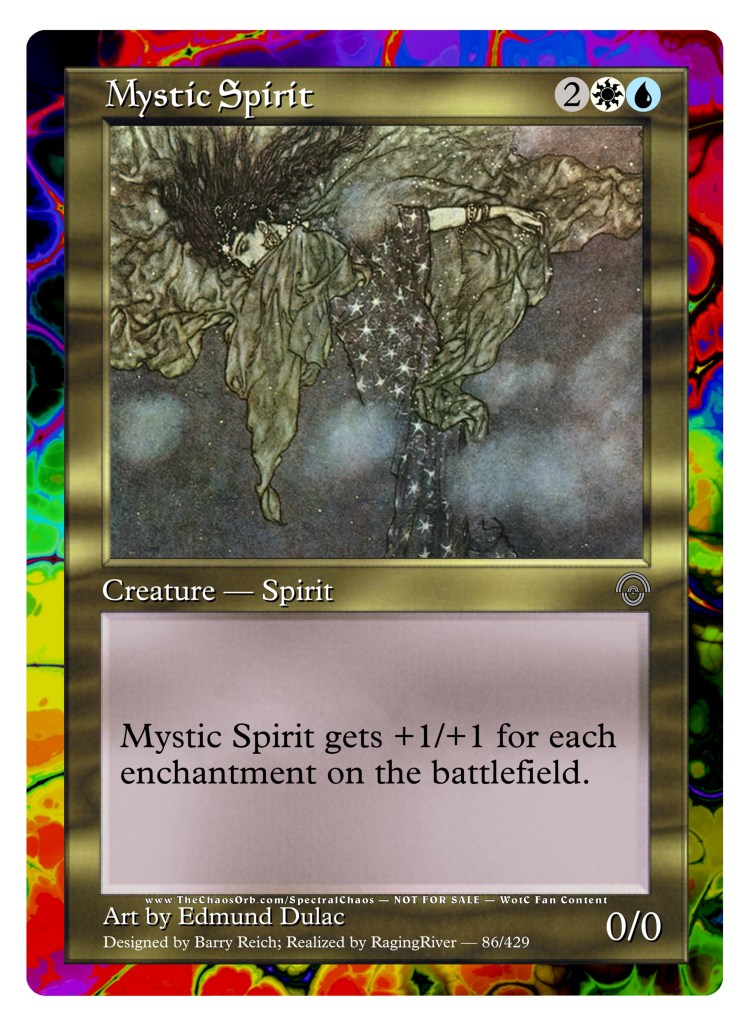
Realized
Mystic Spirit – {2}{W}{U}
Creature – Spirit
Mystic Spirit gets +1/+1 for each enchantment on the battlefield.
0/0
087 – Catoni Walrus
(Uncommon Creature (Multicolor))
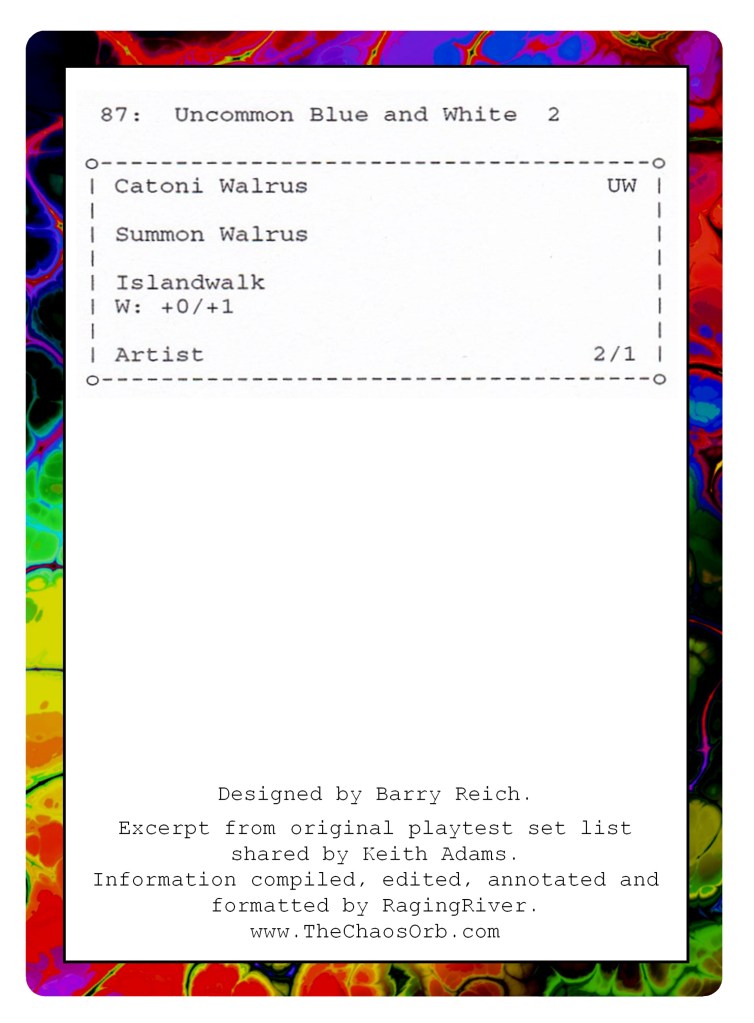
Original Playtest 
Realized
Catoni Walrus – {W}{U}
Creature – Walrus
Islandwalk.
{W}: +0/+1 until end of turn.
2/1
ChaosHistory: The intentional misspelling of long-time playtester and designer Charlie Catino’s last name has been a running joke through his entire Magic career. This was an early example.
088 – Ice Maiden
(Uncommon Creature (Multicolor))

Original Playtest 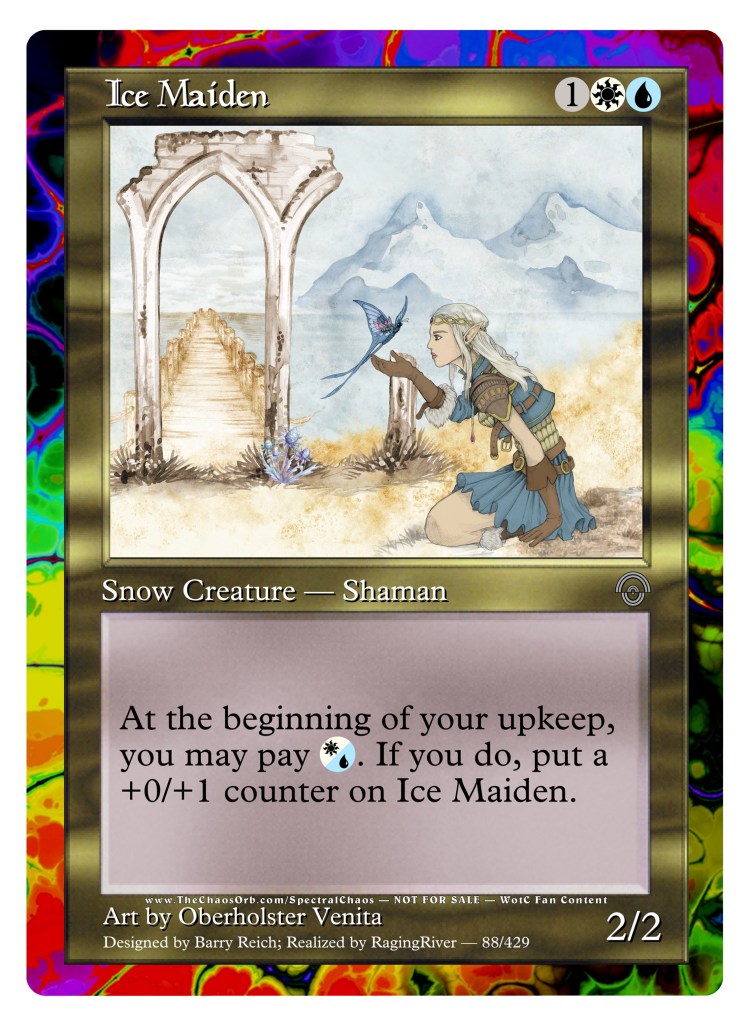
Realized
Ice Maiden – {1}{W}{U}
Snow Creature – Shaman
At the beginning of your upkeep, you may pay {W/U}. If you do, put a +0/+1 counter on Ice Maiden.
2/2
089 – Earthshake
(Uncommon Instant (Multicolor))
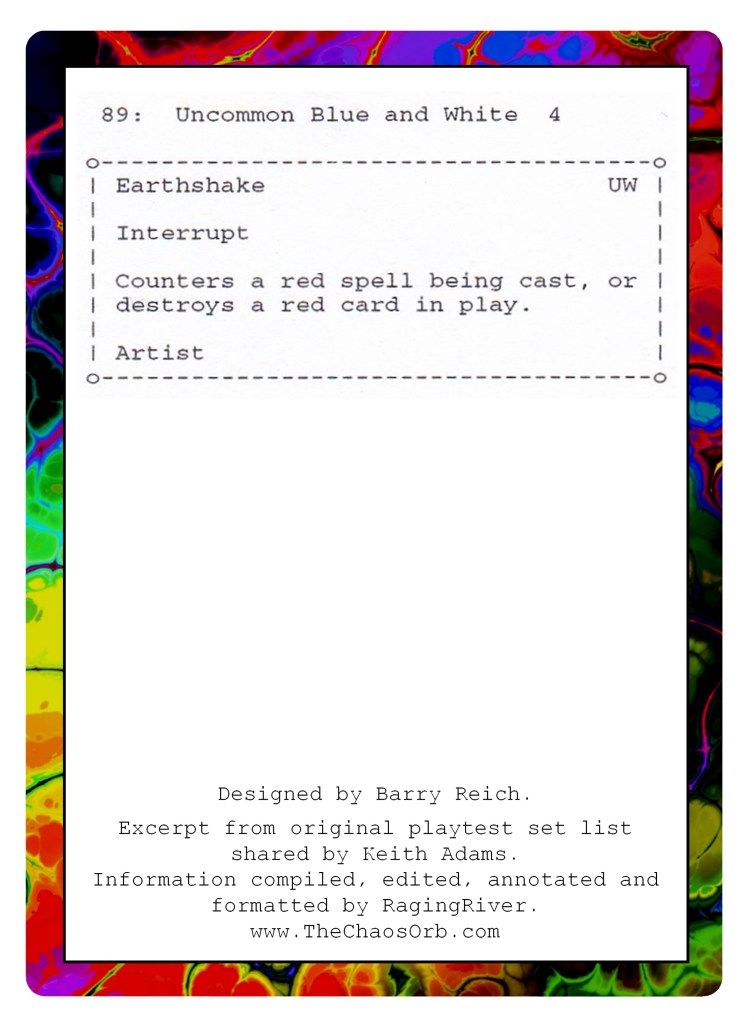
Original Playtest 
Realized
Earthshake – {W}{U}
Instant
Choose one –
– Counter target red spell.
– Destroy target red permanent.
ChaosHistory: Essentially, this was Alpha’s powerful Blue Elemental Blast with a white mana tax, to encourage multicolor decks.
090 – Psychic Leech
(Uncommon Creature (Multicolor))

Original Playtest 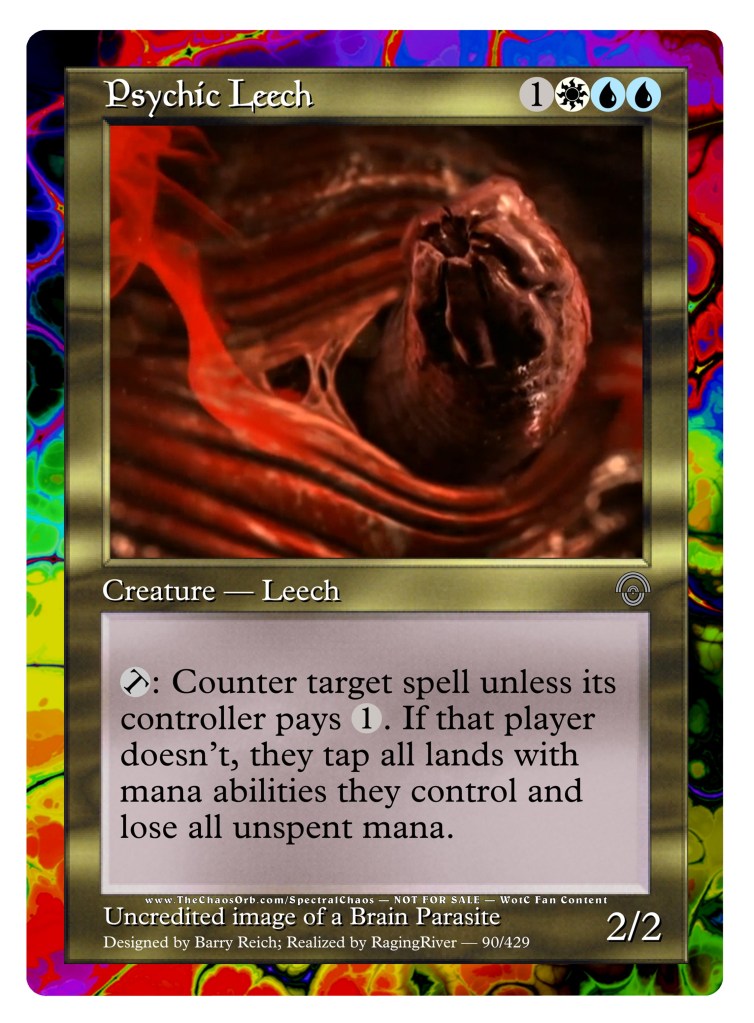
Realized
Psychic Leech – {1}{W}{U}{U}
Creature – Leech
{T}: Counter target spell unless its controller pays {1}. If that player doesn’t, they tap all lands with mana abilities they control and lose all unspent mana.
2/2
- Does not increase the mana cost of the spell. It just requires a separate expenditure in order for it to succeed.
- When this ability resolves, the spell’s controller either pays X mana or lets their lands become tapped. The lands that become tapped are not “tapped for mana.” If they choose to pay, they may pay the X mana using whatever mana abilities they want to use (not just mana abilities from their lands).
- Only lands that actually have mana abilities will get tapped. This includes basic lands and lands with mana abilities printed on them, as well as lands which have been granted a mana ability by some effect.
091 – Battle Swap
(Uncommon Instant (Multicolor))

Original Playtest 
Realized
Battle Swap – {U}{R}
Chaotic Instant
Cast this spell only during the declare blockers step.
Choose one –
– Remove target blocking creature from combat, or have it block a different attacking creature.
– Exchange two target attacking creatures. (Creatures that were blocking one now block the other attacking creature instead. This doesn’t change effects or abilities that were targeting an attacking creature.)
(Note: Rulings last updated Feb. 1, 2021.)
- You declare modes and targets as part of casting Battle Swap. If you choose the first mode, you don’t decide whether to remove that creature from combat or have it block a different attacker until Battle Swap resolves.
- If you choose the second mode targeting attacking Creature A and attacking Creature B, this is what Battle Swap will do upon resolution: (1) if the creatures were attacking different players or planeswalkers, Creature A is now attacking whatever Creature B was attacking, and vice versa, and (2) all creatures assigned to block Creature A now block Creature B instead, and vice versa. You can’t exchange only some blockers – they all get swapped. Effects targeting Creature A or Creature B, their landwalk or other abilities, damage already marked on them – none of these things are changed by Battle Swap.
- No matter which mode you choose, Battle Swap has no effect on creatures controlled by the defending player that aren’t blocking. You can’t force a creature that isn’t blocking to become a blocker.
- If you choose the first mode and wish to assign the blocker to block a different attacking creature, that block must be legal. However, if you choose the second mode, the blockers are all swapped as a group, regardless of legality. This means that the second mode of Battle Swap might result in an attacker with menace being blocked by only one creature, or a flying creature blocked by a creature that couldn’t normally block a flyer, or an unblockable creature becoming blocked. Note that even if this happens, it won’t change the consequence of such block occurring; for exampl, if you use Battle Swap‘s second mode to switch a red blocker to an attacking creature with protection from red, combat damage to that attacker from that blocker would still be prevented.
- Does not undo any abilities which triggered due to the declaration of blockers. Any abilities already triggered by a creature being declared as a blocker will still resolve, regardless of whether it blocks a different creature (or, under the first mode, is removed from combat). Switching blockers won’t trigger any abilities which trigger on a creature “becoming a blocker,” because that creature was already a blocker and the simple change of who it’s blocking does not trigger such abilities. However, an ability that triggers based on what kind of attacking creature that blocker is blocking might trigger again, if the new attacker it’s blocking qualifies.
- If Battle Swap results in a previously unblocked attacker becoming blocked, and an ability triggers when that attacking creature becomes blocked, that ability will trigger upon resolution of Battle Swap. Similarly, if a blocker is removed from combat under the first mode, anything that would trigger as a result of that creature being removed from combat will trigger once Battle Swap resolves.
092 – Avatvian Warlord
(Uncommon Creature (Red))

Original Playtest 
Realized
Avatvian Warlord – {3}{R}
Creature – Human Warrior
{T}: Target black creature gets first strike until end of turn.
1/3
- The creature is checked for color when it is targeted, and again when this ability resolves.
- The creature will still have first strike even if its color changes later in the turn, after this ability resolves.
093 – Horns of Jericho
(Uncommon Instant (Red))

Original Playtest 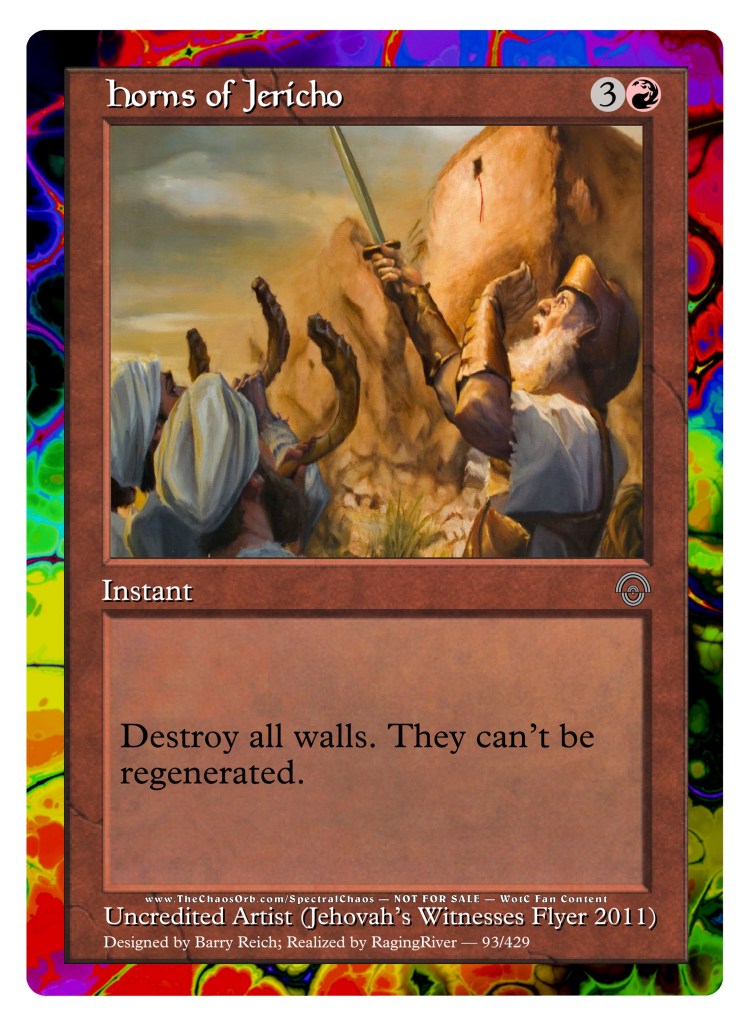
Realized
Horns of Jericho – {3}{R}
Instant
Destroy all walls. They can’t be regenerated.
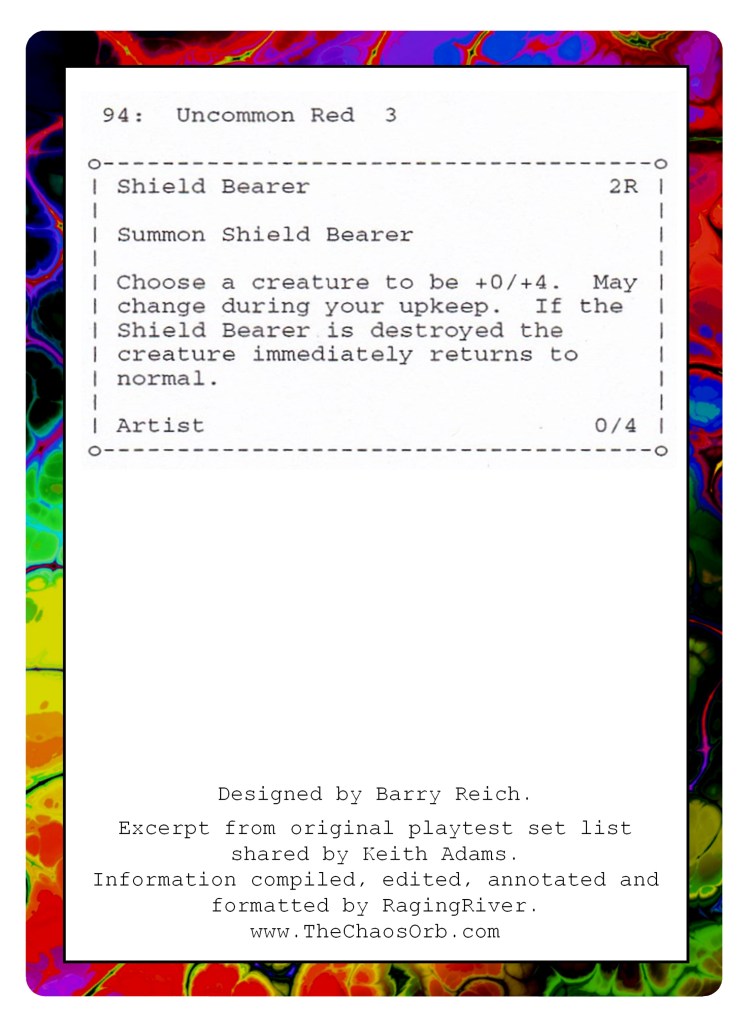
094 – Shield Bearer
(Uncommon Creature ((Red)
Original Playtest 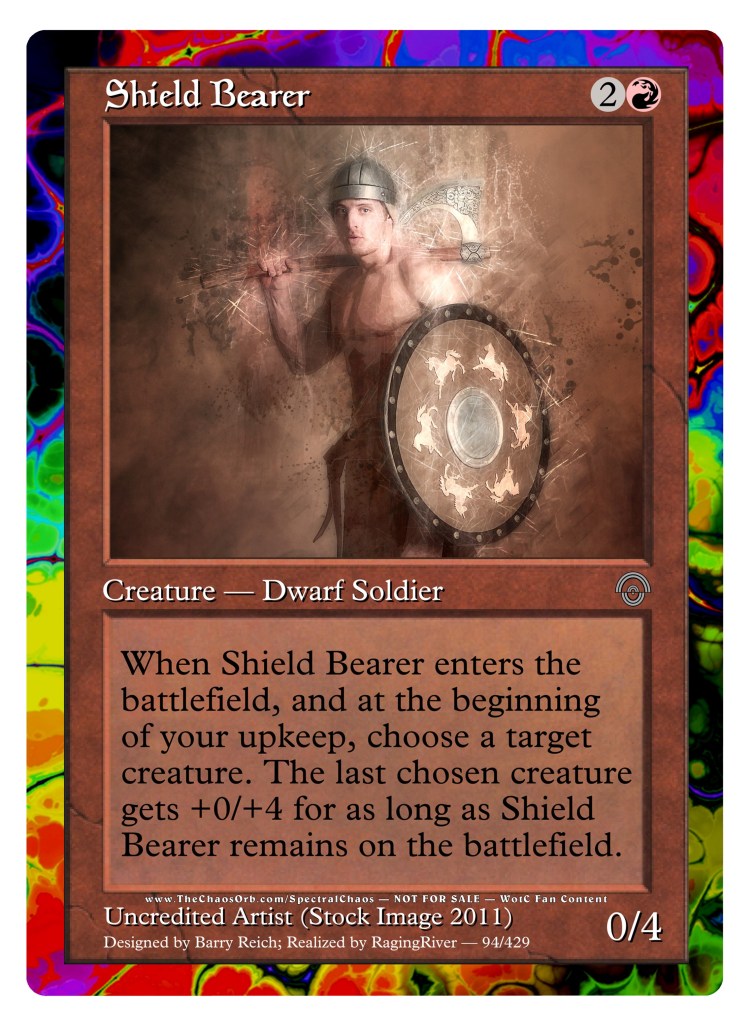
Realized
Shield Bearer – {2}{R}
Creature – Dwarf Soldier
When Shield Bearer enters the battlefield, and at the beginning of your upkeep, choose a target creature. The last chosen creature gets +0/+4 for as long as Shield Bearer remains on the battlefield.
0/4
(Note: Text and rulings last updated Feb. 1, 2021.)
- The ability is not optional. When it triggers, you must target a creature to get +0/+4. You can target Shield Bearer itself if possible.
- If Shield Bearer leaves the battlefield after the ability resolves, the targeted creature immediately loses the +0/+4 bonus. If Shield Bearer leaves the battlefield and then returns, its ability would trigger again when it enters the battlefield, but the creature that was getting the bonus from when it was on the battlefield before won’t “remember” and regain the bonus; when Shield Bearer enters the battlefield again, it is considered a new object.
- If the triggered ability is countered or fails to resolve for some reason, the most recent creature that was chosen will still continue to get the bonus. If the creature that is currently receiving the bonus leaves the battlefield, then nothing will have the bonus until the ability triggers and resolves again.
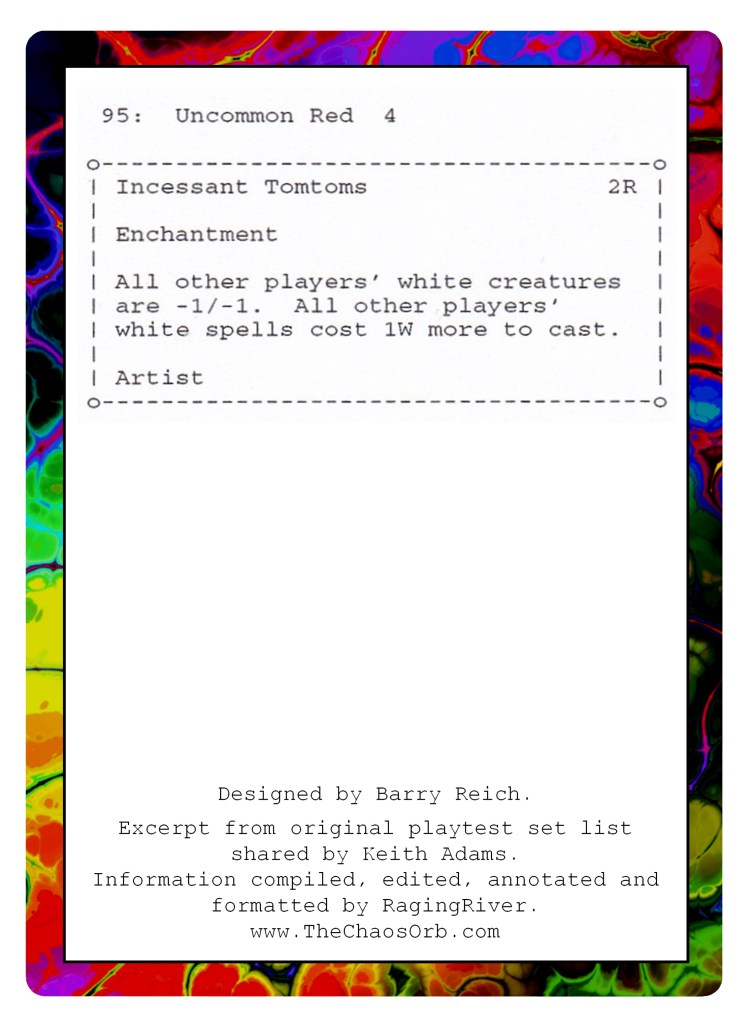
095 – Incessant Tomtoms
(Uncommon Enchantment (Red))
Original Playtest 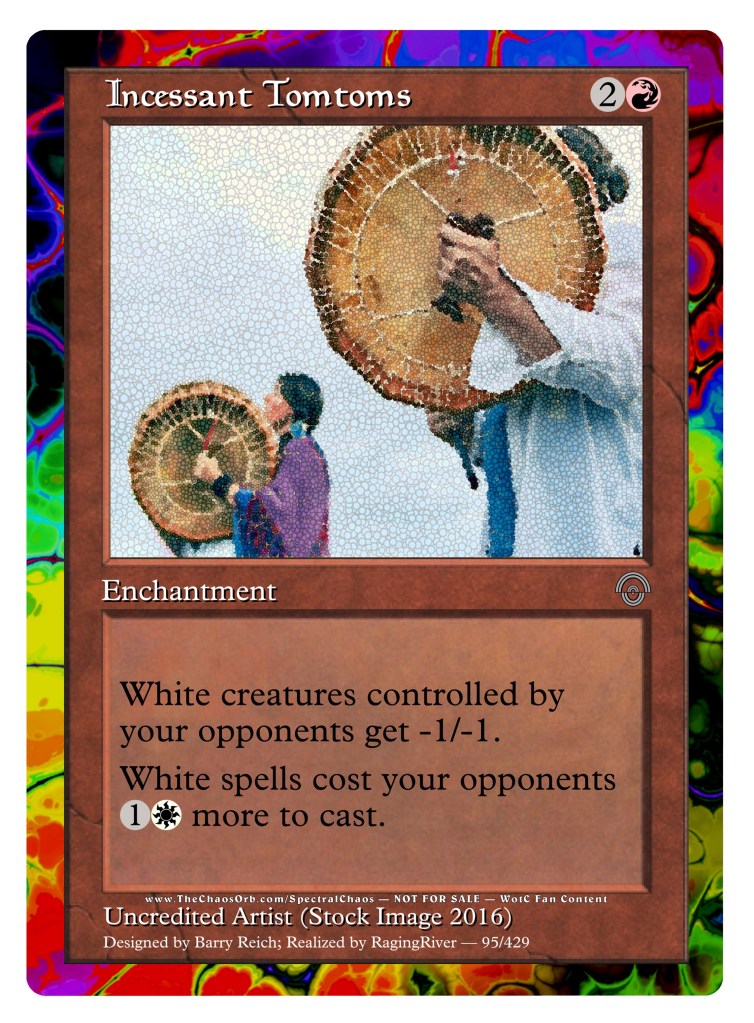
Realized
Incessant Tomtoms – {2}{R}
Enchantment
White creatures controlled by your opponents get -1/-1.
White spells cost your opponents {1}{W} more to cast.
096 – Prismatic Blast
(Uncommon Sorcery (Red))

Original Playtest 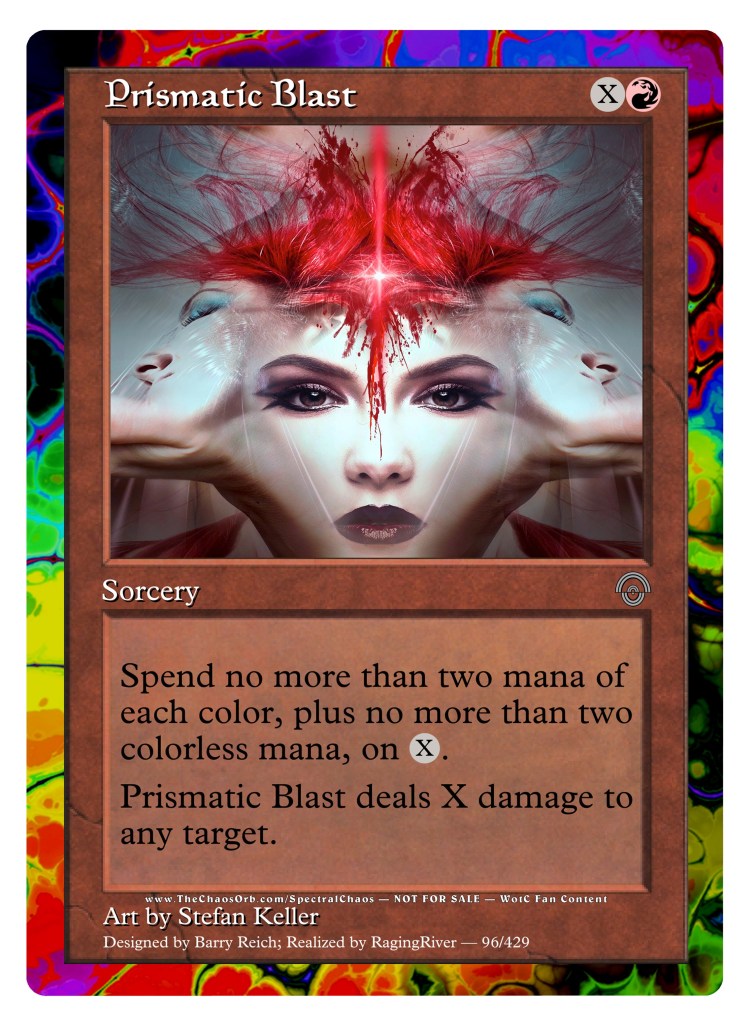
Realized
Prismatic Blast – {X}{R}
Sorcery
Spend no more than two mana of each color, plus no more than two colorless mana, on X.
Prismatic Blast deals X damage to any target.
097 – Acid Dragon
(Uncommon Creature (Red))

Original Playtest 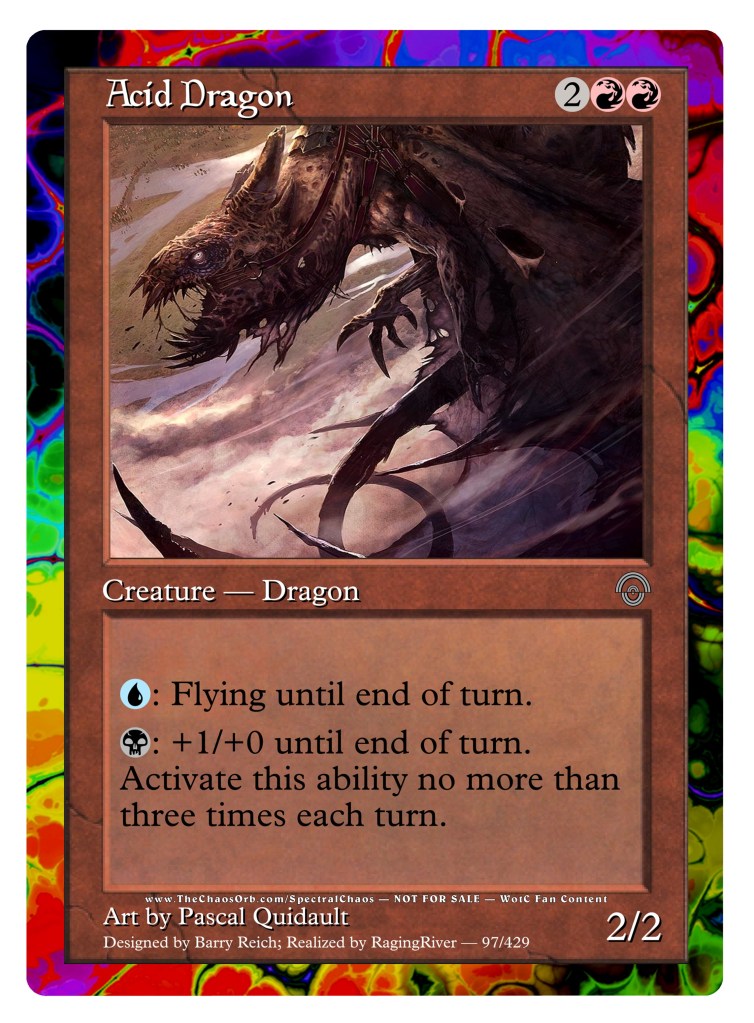
Realized
Acid Dragon – {2}{R}{R}
Creature – Dragon
{U}: Flying until end of turn.
{B}: +1/+0 until end of turn. Activate this ability no more than three times each turn.
2/2
098 – Thorgar the HUGE
(Uncommon Creature (Red))

Original Playtest 
Realized
Thorgar the HUGE – {4}{R}{R}
Creature – Giant
Whenever Thorgar the HUGE blocks or is blocked by a wall, destroy that wall at end of combat.
{T}: Add one mana of any color.
4/4
ChaosHistory: This was the name of a character Alpha playtester Skaff Elias created during a D&D campaign.
099 – Master Swordsman
(Uncommon Creature (Red))

Original Playtest 
Realized
Master Swordsman – {4}{R}{R}
Creature – Human Knight
First strike
4/4
100 – Keldon Walker
(Uncommon Creature (Red))
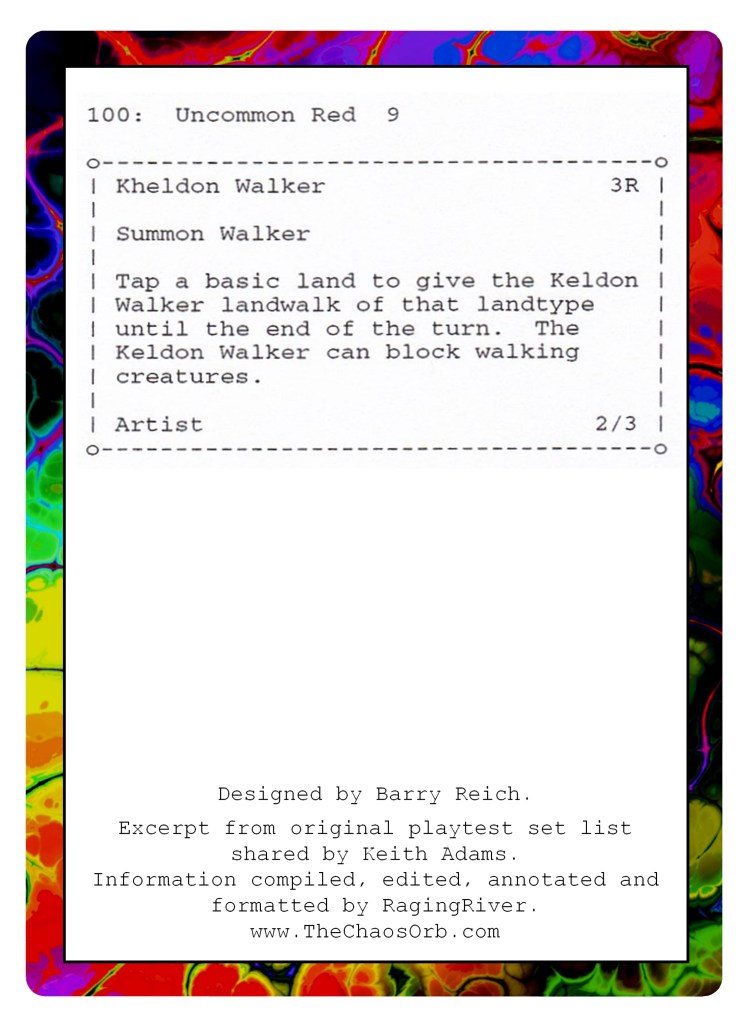
Original Playtest 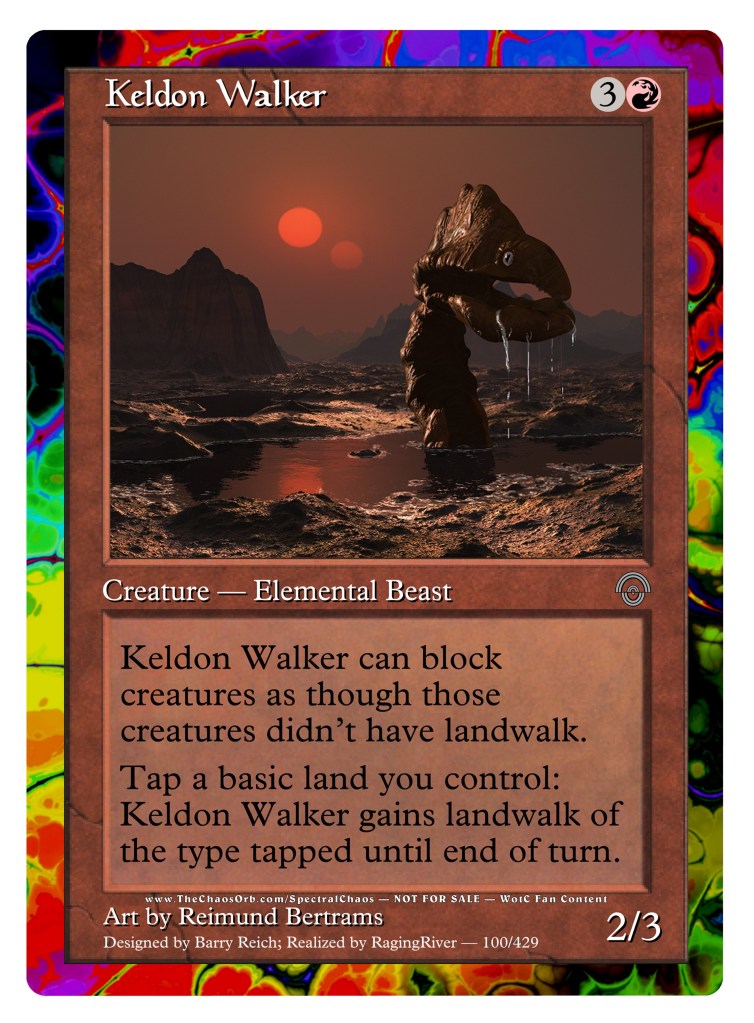
Realized
Keldon Walker – {3}{R}
Creature – Elemental Beast
Keldon Walker can block creatures as though those creatures didn’t have landwalk.
Tap a basic land you control: Keldon Walker gains landwalk of the type tapped until end of turn.
2/3
- If the basic land tapped by Keldon Walker‘s activated ability somehow has more than one land type, Keldon Walker gains all those landwalk types until end of turn.
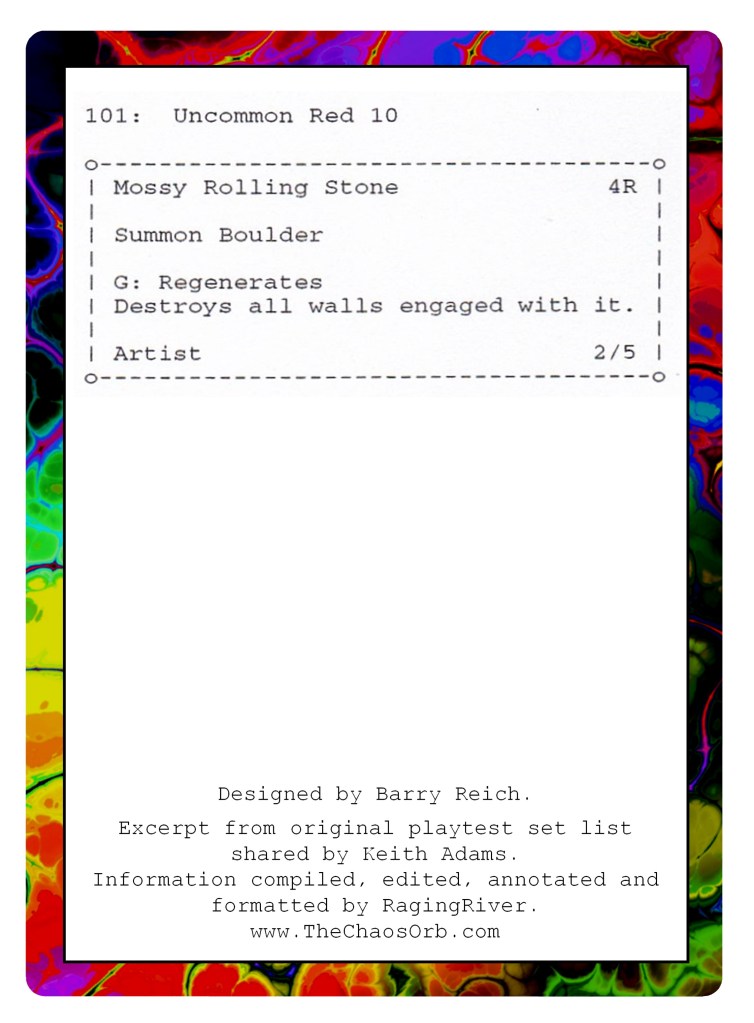
101 – Mossy Rolling Stone
(Uncommon Creature (Red))
Original Playtest 
Realized
Mossy Rolling Stone – {4}{R}
Creature – Elemental
Whenever Mossy Rolling Stone blocks or is blocked by a wall, destroy that wall at end of combat.
{G}: Regenerate Mossy Rolling Stone.
2/5
102 – Unnatural Rock Formation
(Uncommon Creature (Red))

Original Playtest 
Realized
Unnatural Rock Formation – {3}{R}
Creature – Wall
Defender
{B}: Unnatural Rock Formation is 6/1 until end of turn.
1/6
103 – Mana Beetle
(Uncommon Creature (Red))

Original Playtest 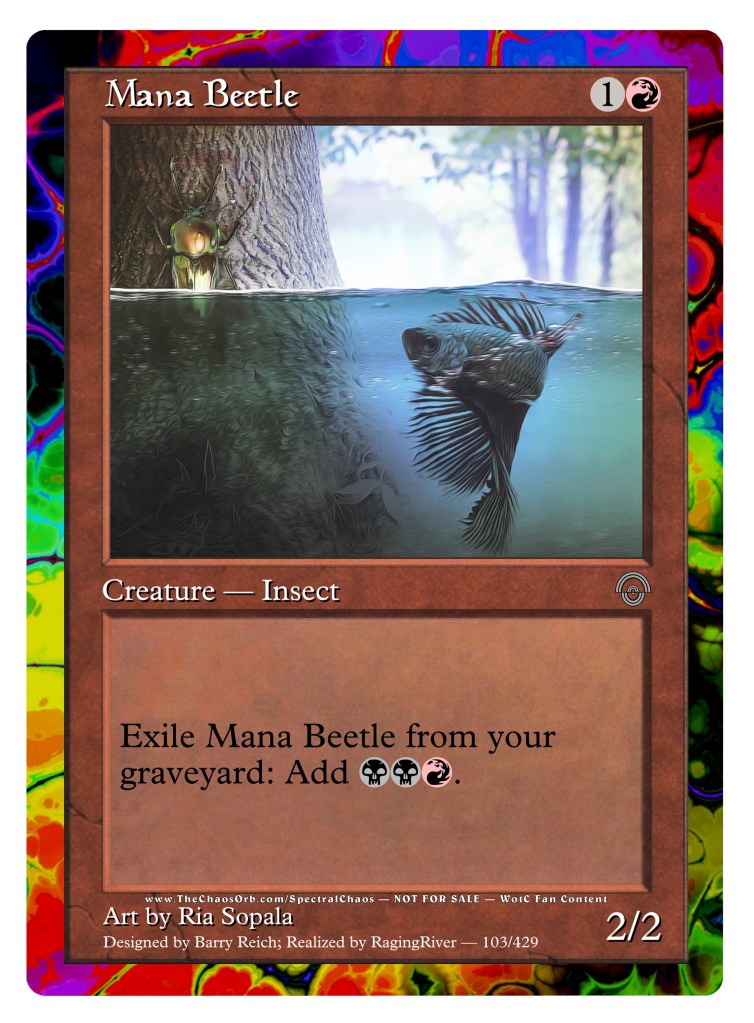
Realized
Mana Beetle – {1}{R}
Creature – Insect
Exile Mana Beetle from your graveyard: Add {B}{B}{R}.
2/2
104 – Shock Wave
(Uncommon Sorcery (Red))

Original Playtest 
Realized
Shock Wave – {X}{R}
Sorcery
Spend no more than one mana of each color, plus no more than one colorless mana, on X.
Shock Wave deals X damage to each creature and player.
105 – Grenade
(Uncommon Sorcery (Red))

Original Playtest 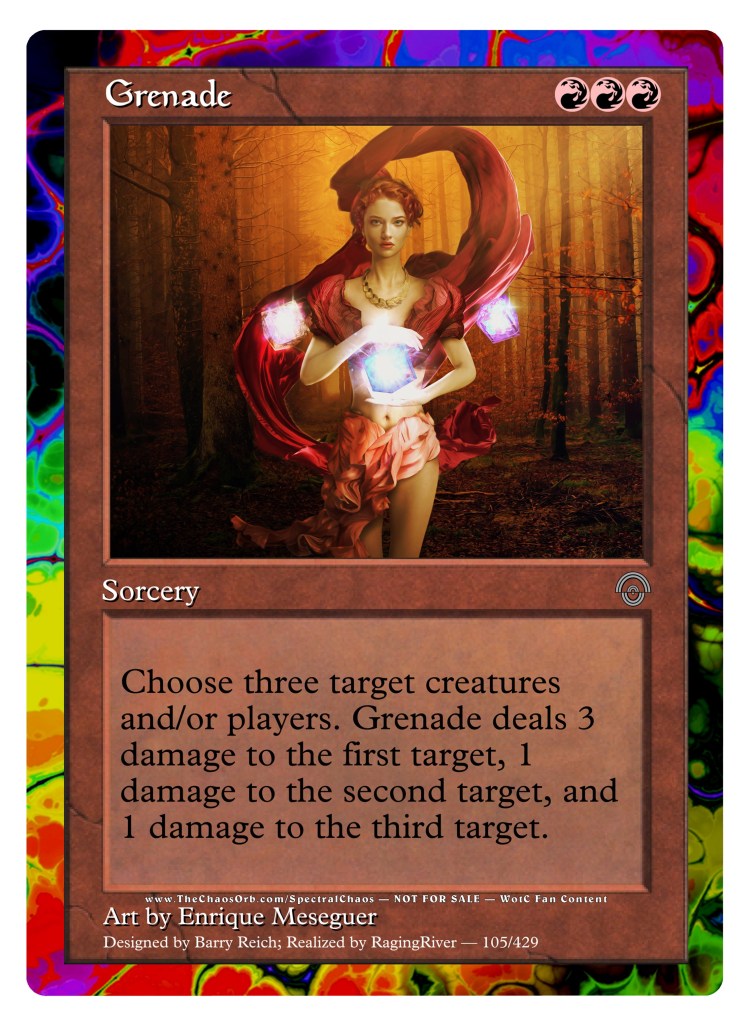
Realized
Grenade – {R}{R}{R}
Sorcery
Choose three target creatures and/or players. Grenade deals 3 damage to the first target, 1 damage to the second target, and 1 damage to the third target.
- Grenade must have three different targets. It could be three players, three creatures, or some combination of creatures and players.
106 – Orcish Flamethrower
(Uncommon Sorcery (Red))

Original Playtest 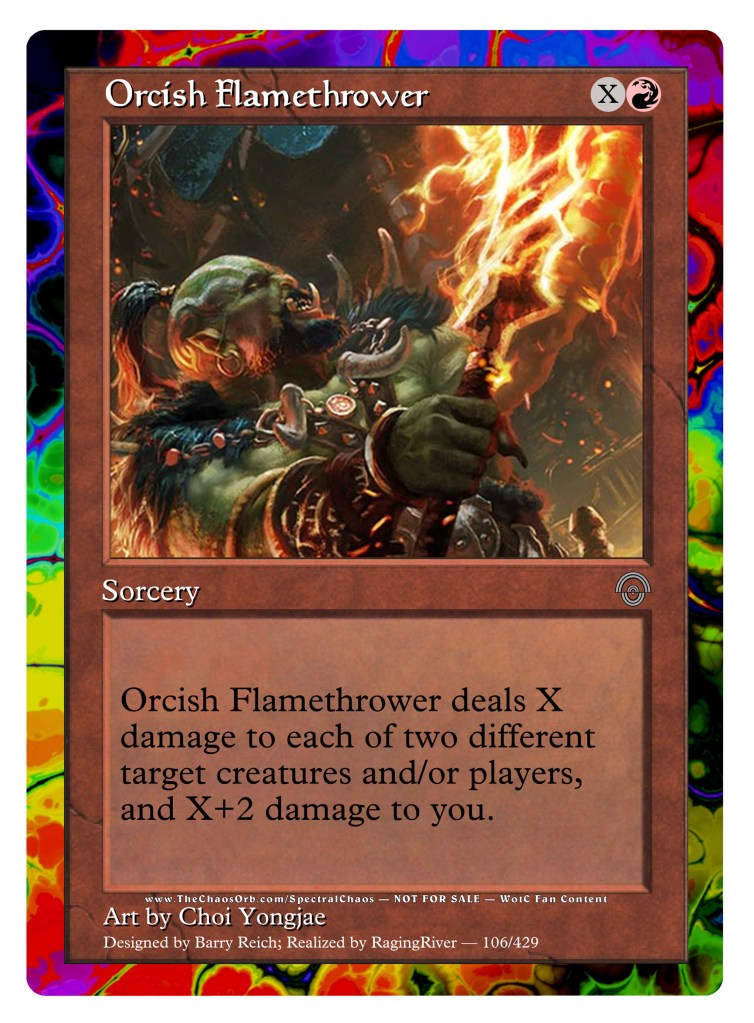
Realized
Orcish Flamethrower – {X}{R}
Sorcery
Orcish Flamethrower deals X damage to each of two different target creatures and/or players, and X+2 damage to you.
- Orcish Flamethrower must have two different targets. It could be two players, two creatures, or a creature and a player.
- It’s probably a terrible idea, but one of the targets could be yourself. If you did that, you would take X damage and also take X+2 damage.
107 – Blight
(Uncommon Enchantment (Red))
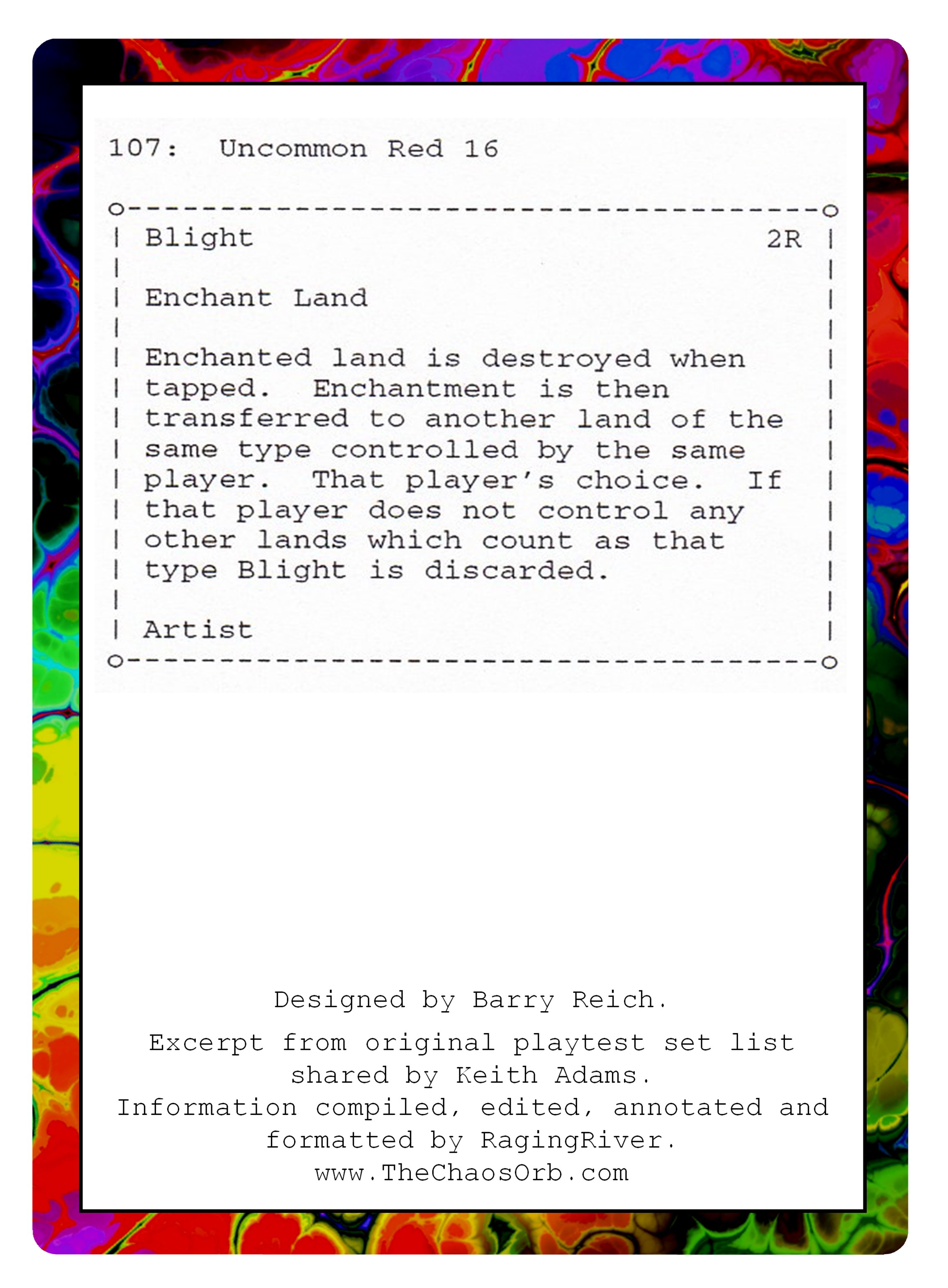

Realized
Blight – {2}{R}
Enchantment – Aura
Enchant land
When enchanted land becomes tapped, destroy it. If that land’s controller controls any lands that share a basic land type with the land that was destroyed, attach Blight to one of those lands of that player’s choice.
- If Blight is destroyed directly, or the land is destroyed by a spell or some other ability, then Blight goes to the graveyard like any aura would.
- The controller of the destroyed land must attach Blight to another land they control that shares a basic land type if possible. If there are no valid choices, Blight is simply put into the graveyard.
- Because the ability isn’t targeted, the controller of the destroyed land may attach it to a land that has shroud.
- If the enchanted land can’t be destroyed for some reason, Blight will continue to enchant it. Blight will keep triggering each time the land is tapped.
108 – Energy Boost
(Uncommon Instant (Red))

Original Playtest 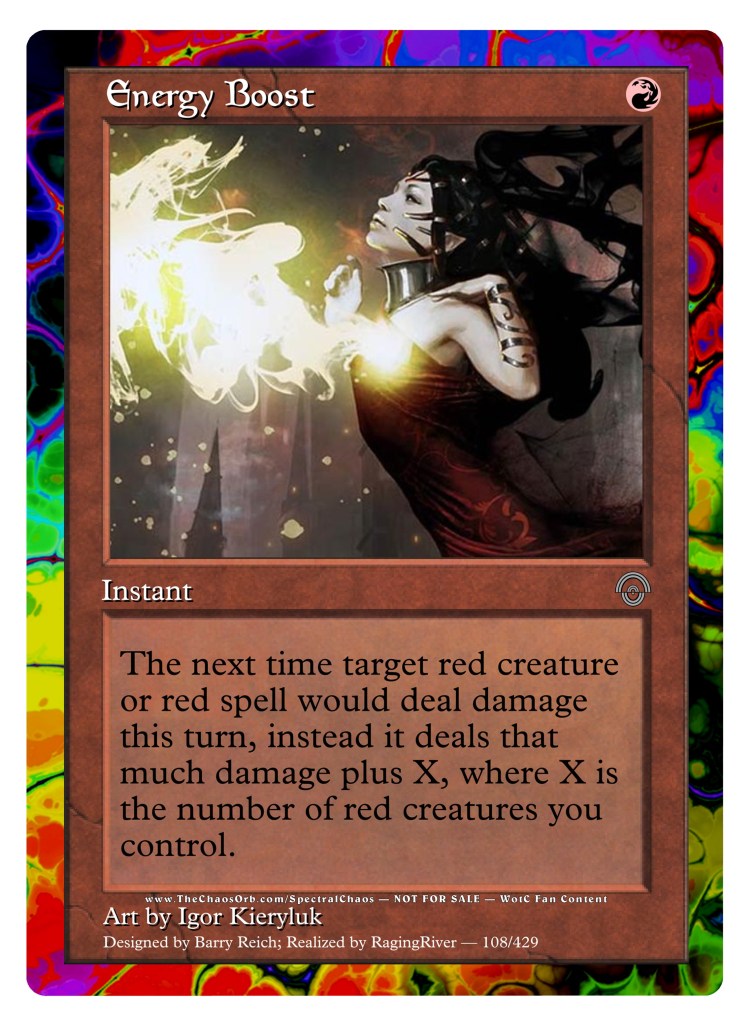
Realized
Energy Boost – {R}
Instant
The next time target red creature or red spell would deal damage this turn, instead it deals that much damage plus X, where X is the number of red creatures you control.
- You check the color of the target when casting Energy Boost and again when it resolves. However, if you target a red creature or spell with Energy Boost and then, after Energy Boost resolves but before that creature or spell deals damage this turn, that creature or spell stops being red, Energy Boost‘s replacement effect will still happen.
- X is determined based on how many red creatures you control at the time Energy Boost resolves, not how many red creatures you control when the damage from the targeted creature or spell would be dealt later this turn.
109 – SIFT
(Uncommon Sorcery (Multicolor))
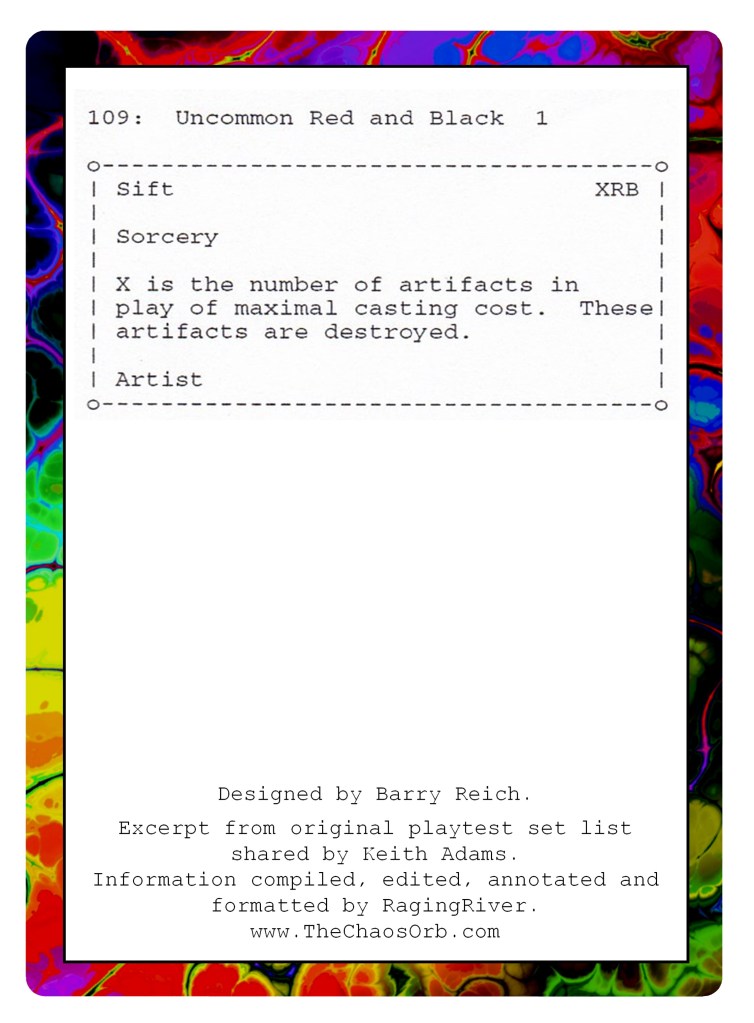
Original Playtest 
Realized
Sift – {X}{B}{R}
Sorcery
X is the number of artifacts on the battlefield that share the highest converted mana cost as you cast this spell.
Destroy all artifacts that share the highest converted mana cost.
- X is based on the number of artifacts in play that share the highest converted mana cost as you cast Sift. However, Sift will destroy whichever artifact(s) share the highest converted mana cost when it resolves, whether they are more, fewer or different from the artifacts that X was based on when Sift was cast. If by the time Sift resolves one or more artifacts share a higher converted mana cost than the artifact(s) in play when Sift was cast, then the new higher CMC artifact(s) will be destroyed instead. If the highest CMC artifact(s) in play when Sift was cast are no longer in play when it resolves, then the next-highest CMC artifact(s) will be destroyed instead.
- Sift does not target. You may cast Sift with X=0 if there are no artifacts on the battlefield. Regardless of how many artifacts were in play when Sift was cast, if there are no artifacts in play by the time Sift resolves, it will have no effect.
110 – Chaos Curse
(Uncommon Instant (Multicolor))

Original Playtest 
Realized
Chaos Curse – {1}{B}{R}
Instant
Chaos Curse deals X damage to target player or creature, where X is the number of chaotic permanents that player or that creature’s controller controls.
- X is determined based on how many chaotic permanents they control when Chaos Curse resolves.
111 – Cleric of Sameze
(Uncommon Creature (White))

Original Playtest 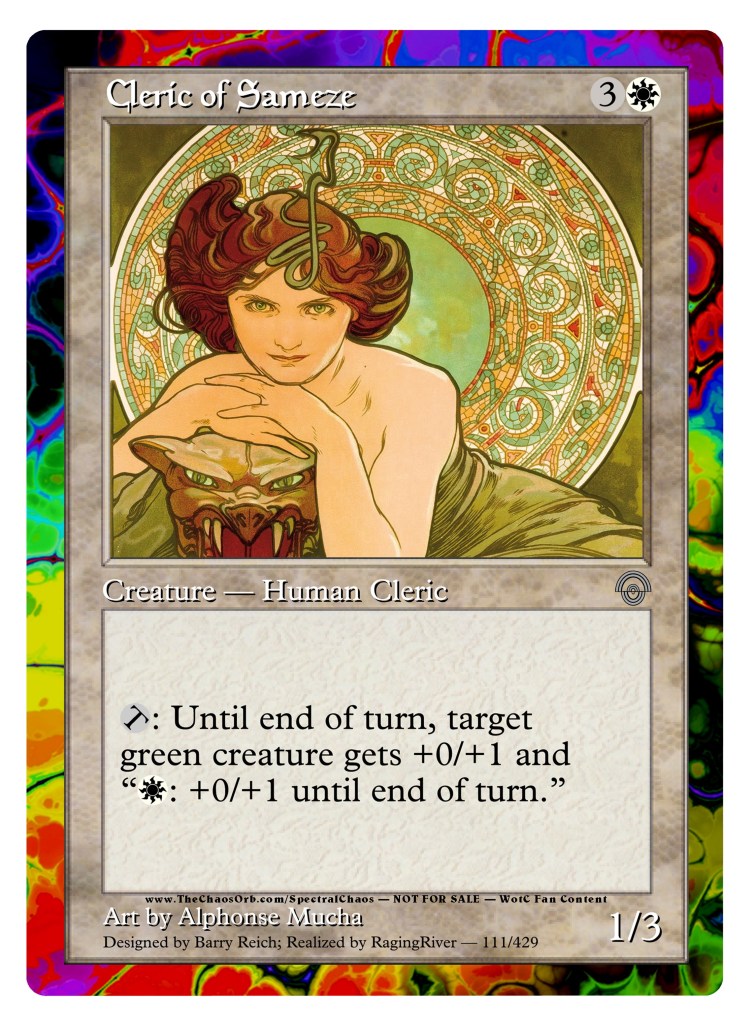
Realized
Cleric of Sameze – {3}{W}
Creature – Human Cleric
{T}: Until end of turn, target green creature gets +0/+1 until end of turn and “{W}: +0/+1 until end of turn.”
1/3
- The creature is checked for color when it is targeted, and again when this ability resolves.
- The creature will still have the abilities granted by Cleric of Sameze‘s ability even if its color changes later in the turn.
112 – Blue Cloak
(Uncommon Enchantment (White))

Original Playtest 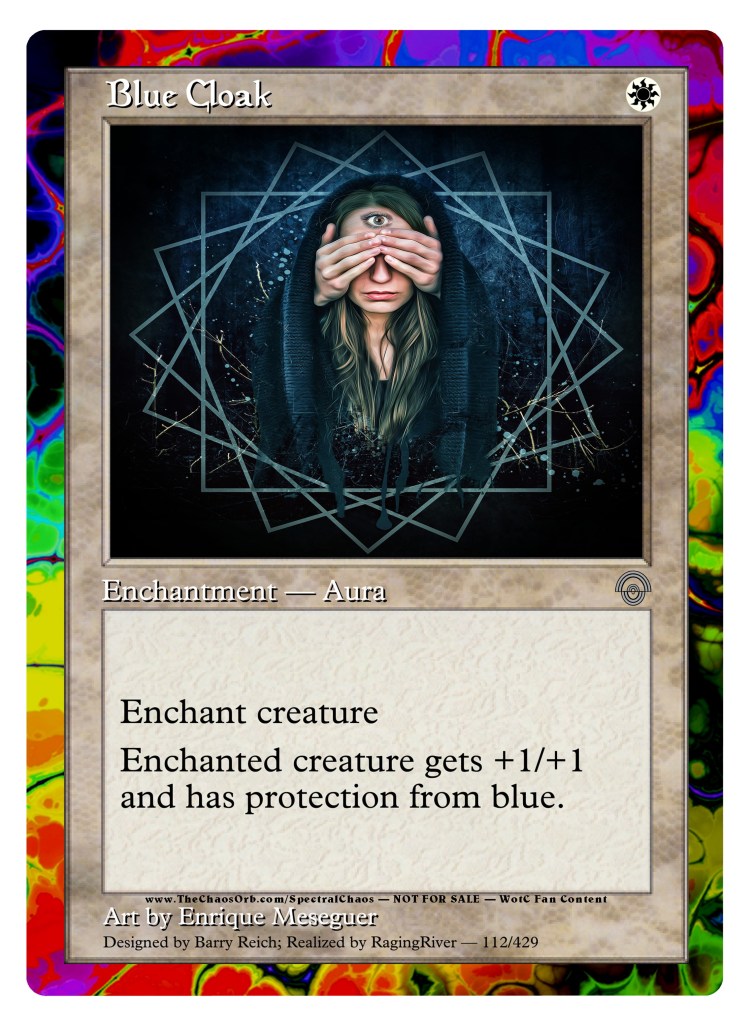
Realized
Blue Cloak – {W}
Enchantment – Aura
Enchant creature
Enchanted creature gets +1/+1 and has protection from blue.
113 – Red Cloak
(Uncommon Enchantment (White))
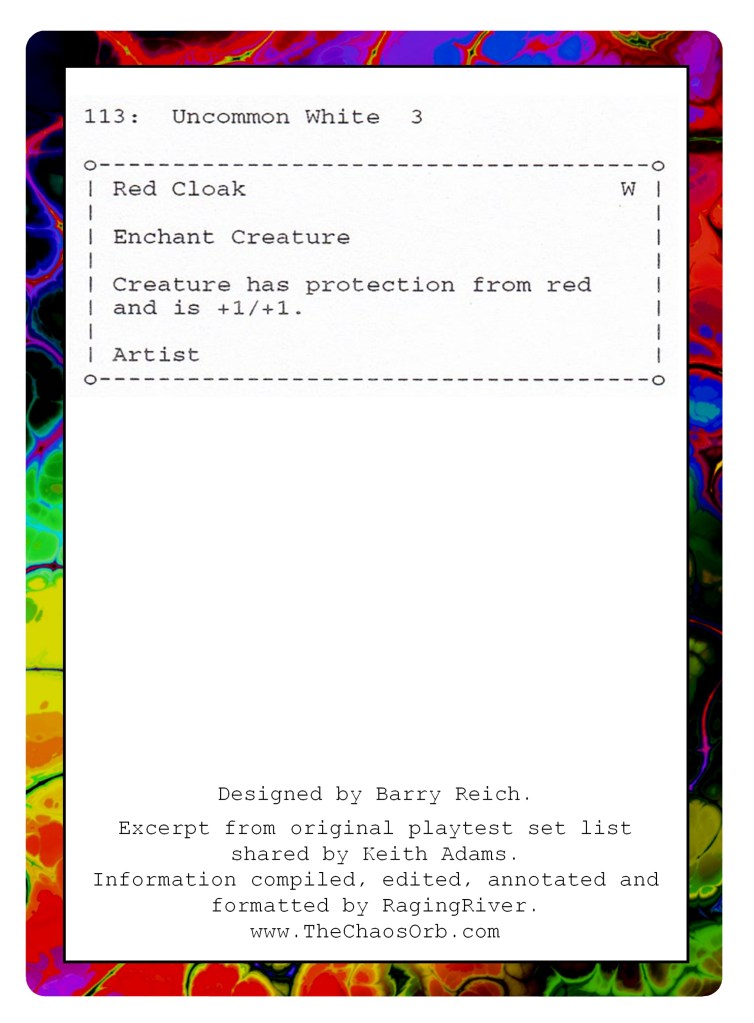
Original Playtest 
Realized
Red Cloak – {W}
Enchantment – Aura
Enchant creature
Enchanted creature gets +1/+1 and has protection from red.
114 – White Cloak
(Uncommon Enchantment (White))

Original Playtest 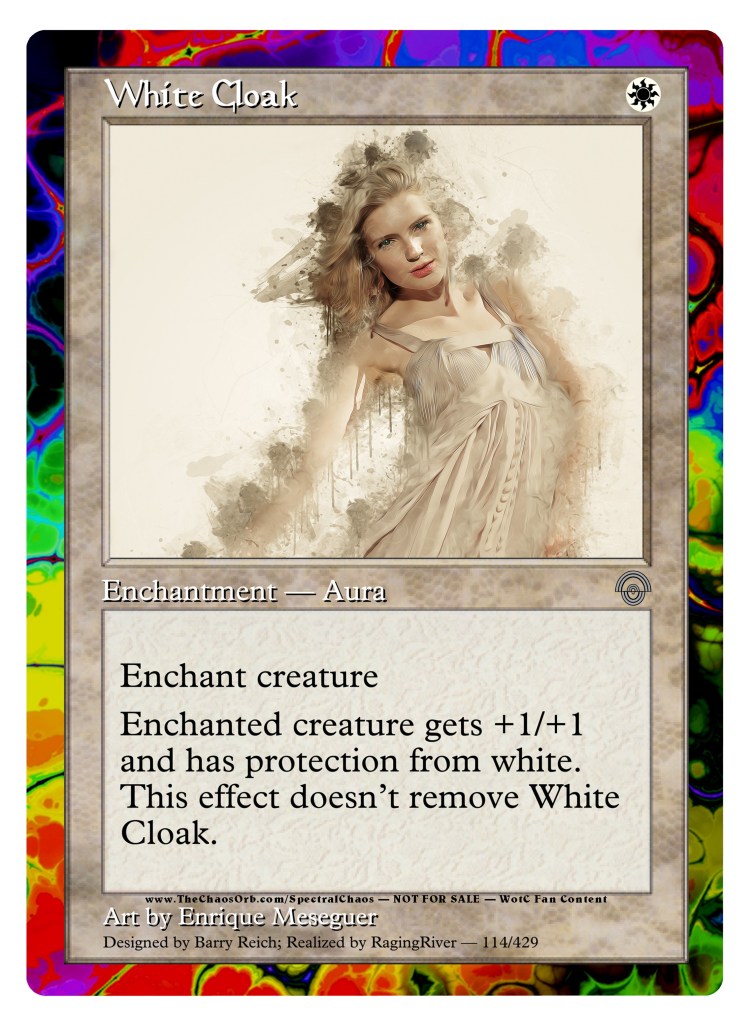
Realized
White Cloak – {W}
Enchantment – Aura
Enchant creature
Enchanted creature gets +1/+1 and has protection from white. This effect doesn’t remove White Cloak.
115 – Black Cloak
(Uncommon Enchantment (White))

Original Playtest 
Realized
Black Cloak – {W}
Enchantment – Aura
Enchant creature
Enchanted creature gets +1/+1 and has protection from black.
116 – Green Cloak
(Uncommon Enchantment (White))
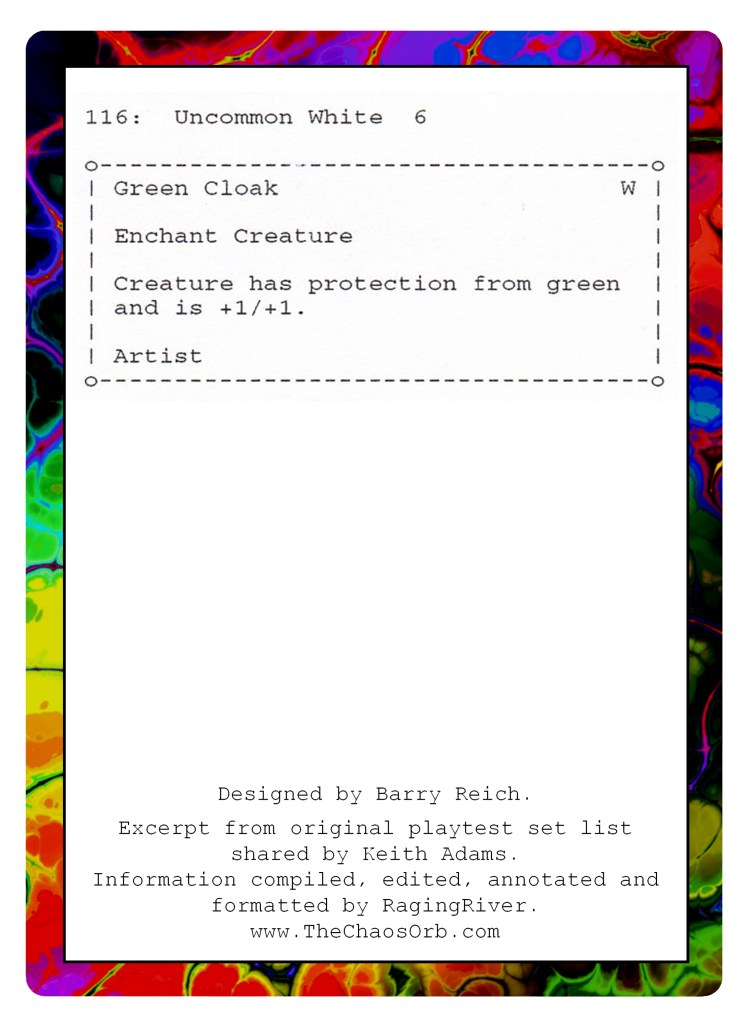
Original Playtest 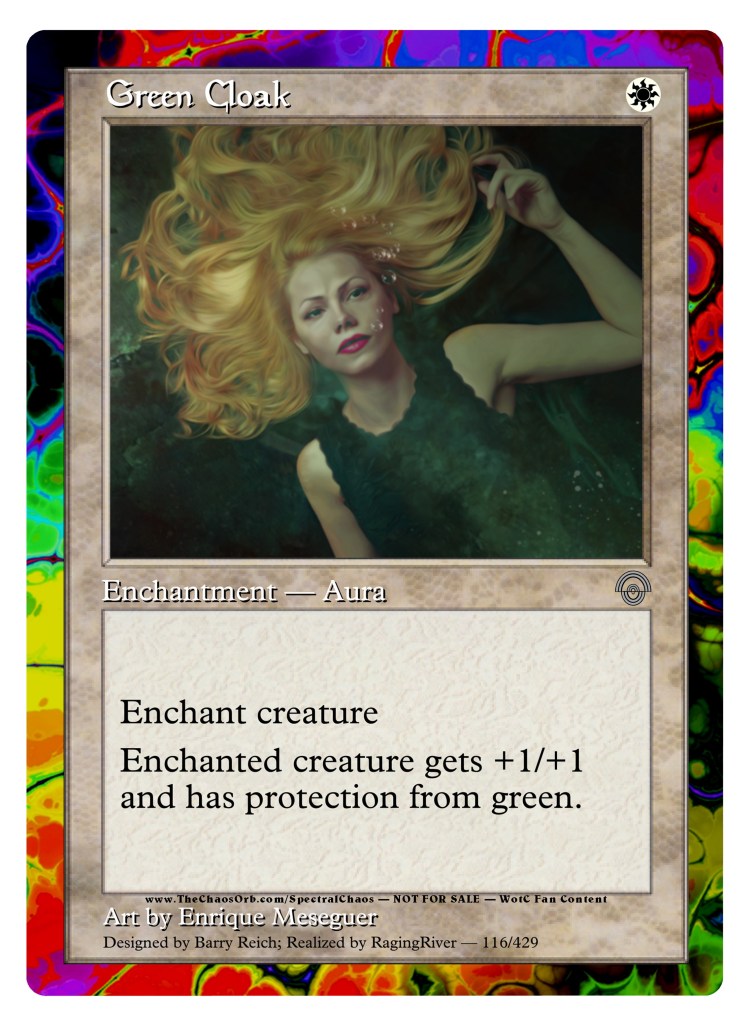
Realized
Green Cloak – {W}
Enchantment – Aura
Enchant creature
Enchanted creature gets +1/+1 and has protection from green.
117 – Jade Acolyte
(Uncommon Creature (White))
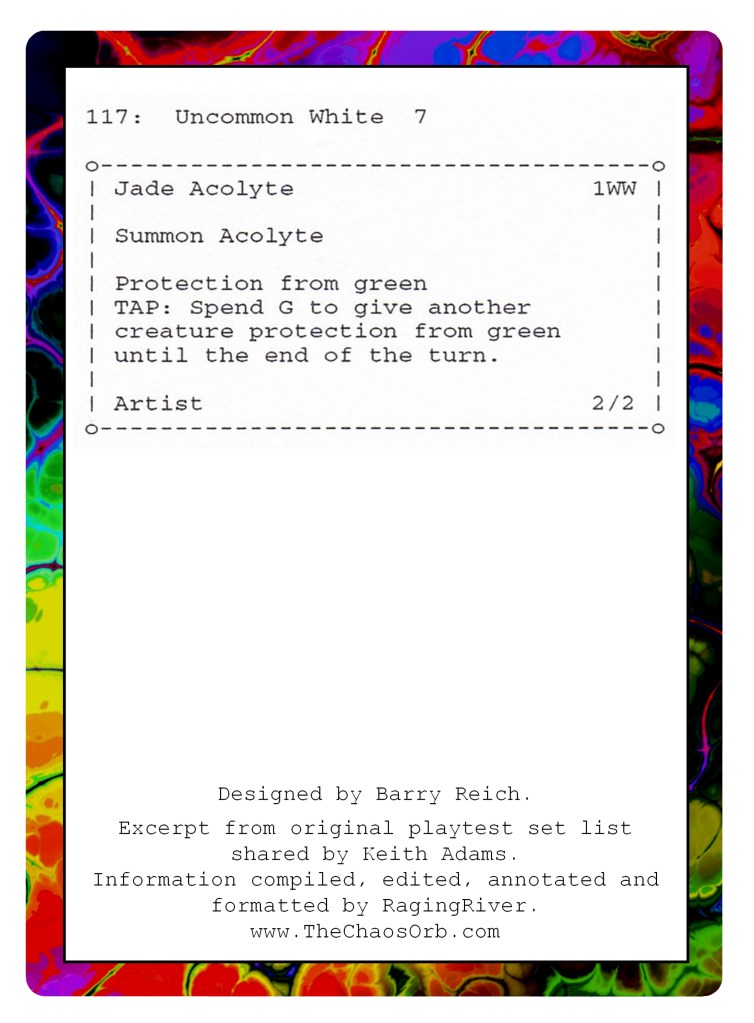
Original Playtest 
Realized
Jade Acolyte – {1}{W}{W}
Creature – Cleric Shaman
Protection from green
{G}, {T}: Target creature gets protection from green until end of turn.
2/2
118 – River Acolyte
(Uncommon Creature (White))
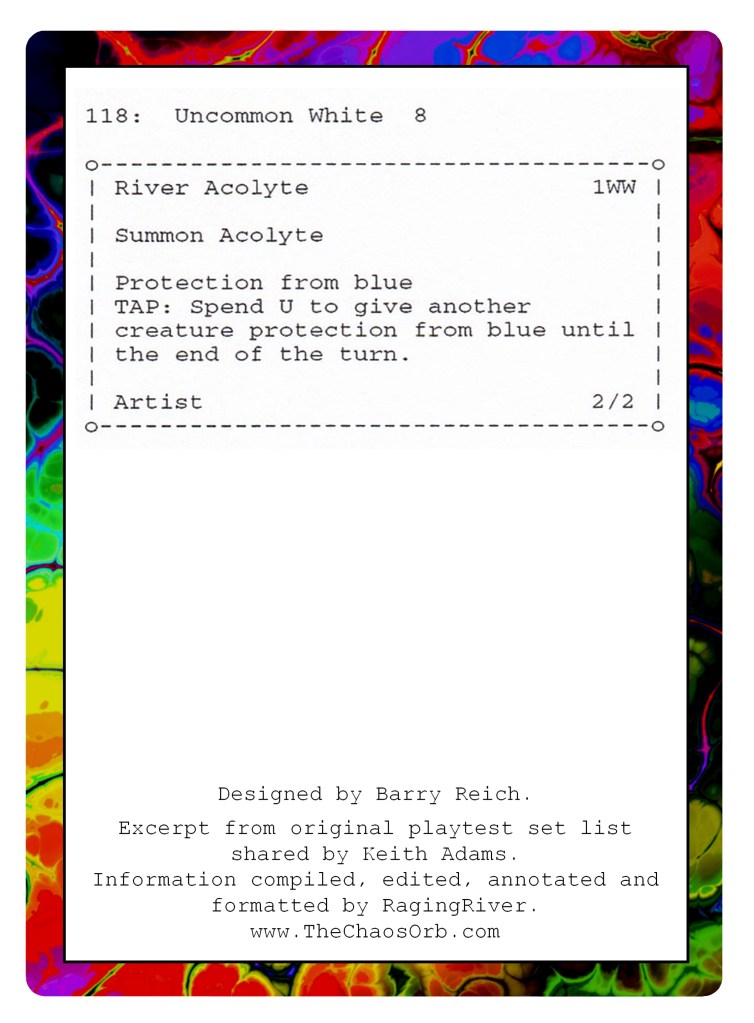
Original Playtest 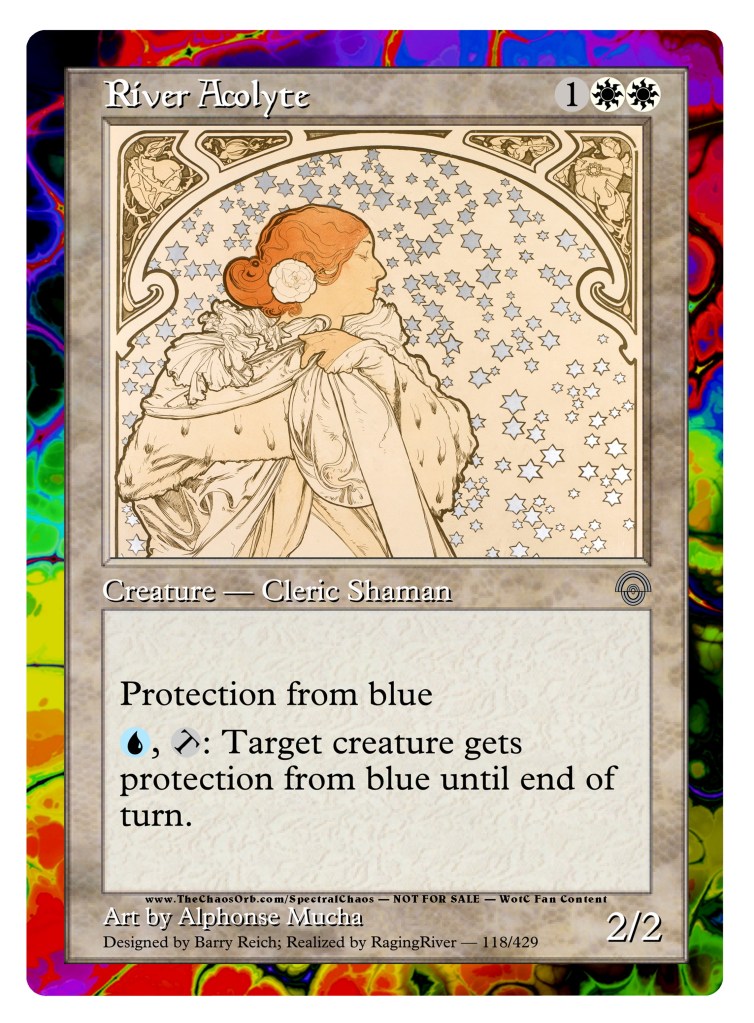
Realized
River Acolyte – {1}{W}{W}
Creature – Cleric Shaman
Protection from blue
{U}, {T}: Target creature gets protection from blue until end of turn.
2/2
119 – Pegasus Rider
(Uncommon Creature (White))

Original Playtest 
Realized
Pegasus Rider – {3}{W}{W}
Creature – Human Knight
Flying, first strike
3/2
120 – Northern Ranger
(Uncommon Creature (White))

Original Playtest 
Realized
Northern Ranger – {2}{W}{W}
Creature – Human Scout
{W}{W}, pay 1 life, {T}: Destroy target red permanent.
3/3
121 – Arizona Phoenix
(Uncommon Creature (White))

Original Playtest 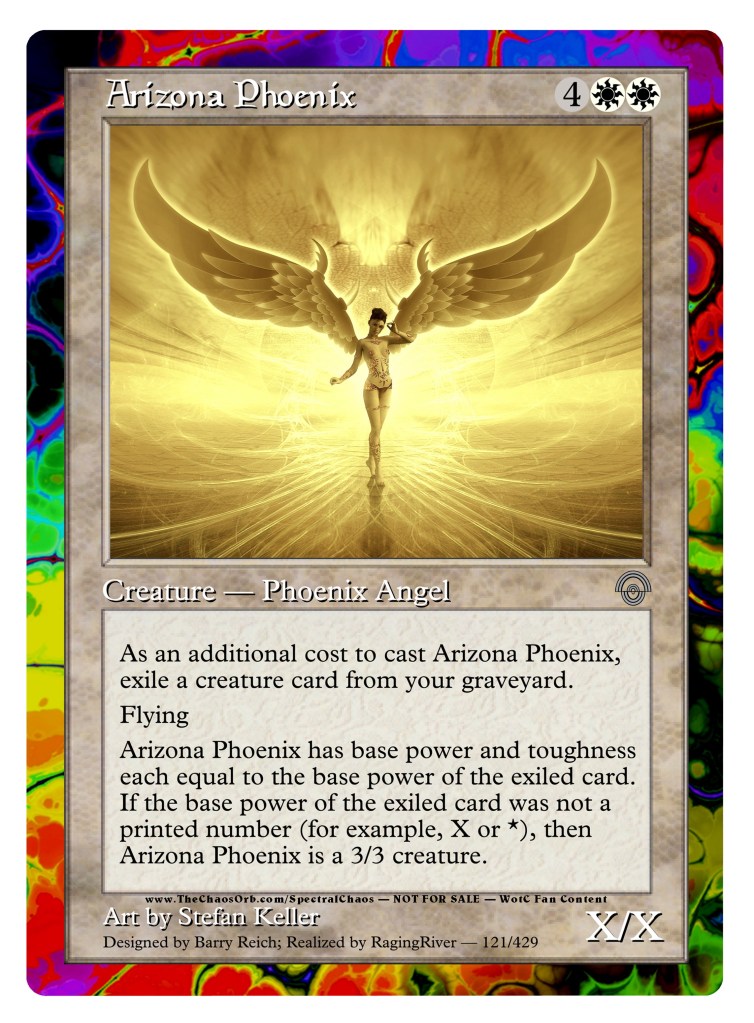
Realized
Arizona Phoenix – {4}{W}{W}
Creature – Phoenix Angel
As an additional cost to cast Arizona Phoenix, exile a creature card from your graveyard.
Flying
Arizona Phoenix has base power and toughness each equal to the base power of the exiled card. If the base power of the exiled card was not a printed number (for example, X or *), then Arizona Phoenix is a 3/3 creature.
X/X
(Note: Rulings added Feb. 10, 2021.)
- Players can only respond once this spell has been cast and all its costs have been paid. No one can try to otherwise remove the creature card you exiled in order to prevent you from casting this spell.
- If Arizona Phoenix somehow ends up on the battlefield without being cast, it is a 3/3 creature.
122 – Swords to Plowshares
(Uncommon Instant (White))

Original Playtest 
Realized
Swords to Plowshares – {W}{W}
Instant
Exile target creature. Its controller gains life equal to its power.
ChaosHistory: Considering the ease of splashing white in most decks in a multicolor themed set, this powerful Alpha staple was playtested at a higher casting cost.
- The amount of life gained is equal to the power of the targeted creature as it last existed on the battlefield.
- If the creature’s power is negative, its controller doesn’t lose or gain life.
123 – Page’s Lace
(Uncommon Instant (White))

Original Playtest 
Realized
Page’s Lace – {W}
Instant
Target spell or permanent becomes the color of your choice. (It stops being any other colors. Its mana symbols remain unchanged. This effect lasts indefinitely.)
ChaosHistory: This type of effect would eventually find a home in blue, with cards like Mirage’s Prismatic Lace.
- You choose the color when Page’s Lace resolves.
- You can target any spell or permanent, regardless of its colors (or if it’s colorless). You could choose to change a monocolored spell or permanent to the same color.
124 – Bad Karma
(Uncommon Enchantment (White))
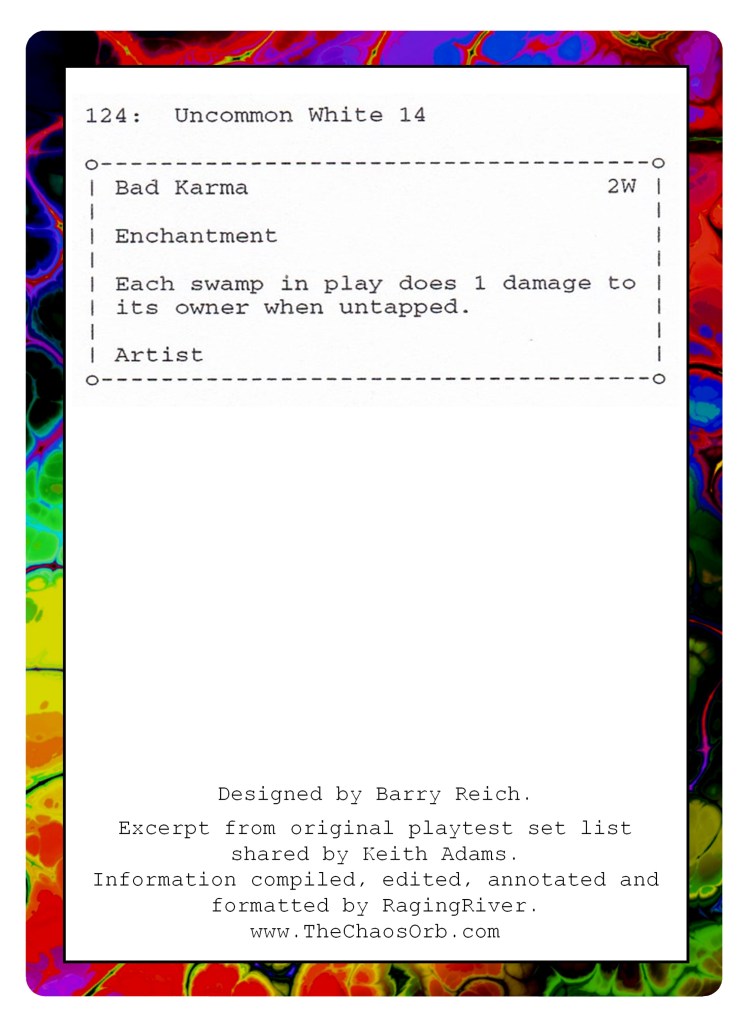
Original Playtest 
Realized
Bad Karma – {2}{W}
Enchantment
Whenever a swamp is untapped, Bad Karma deals 1 damage to that swamp’s controller. (This will trigger once for each swamp untapped.)
125 – Stream of Healing
(Uncommon Instant (White))
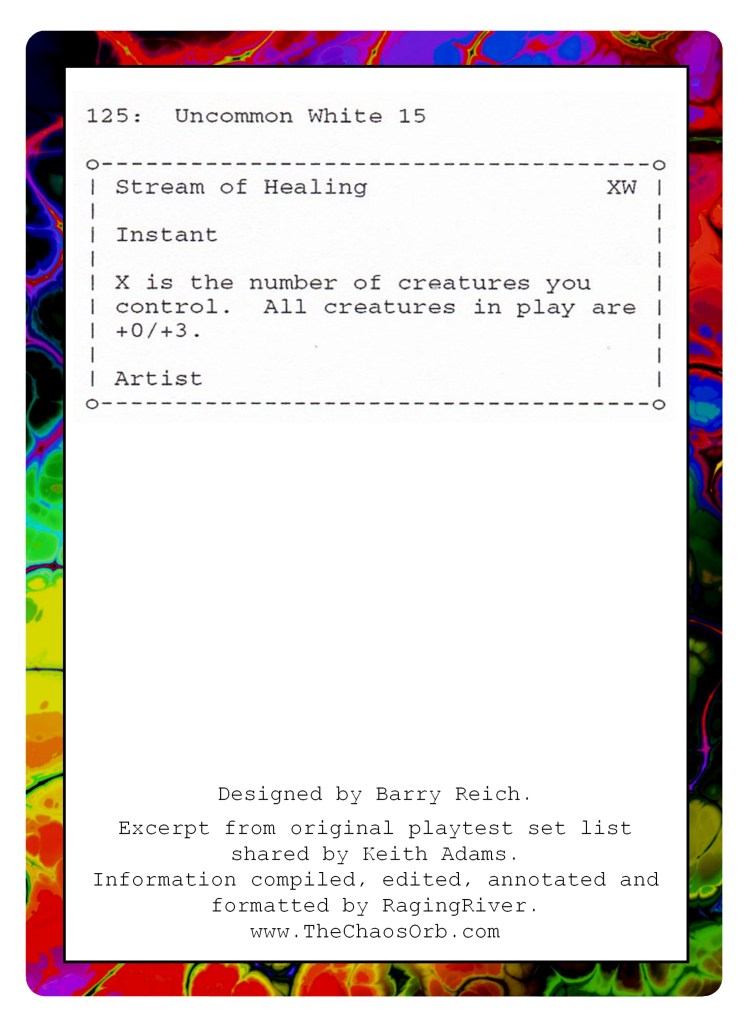
Original Playtest 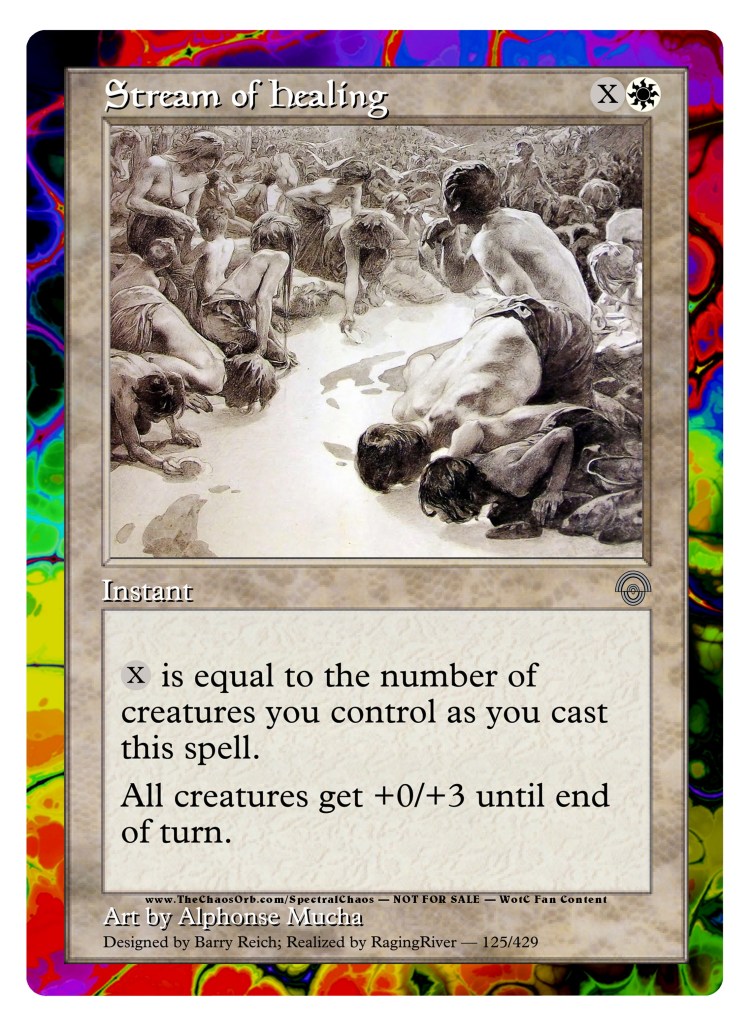
Realized
Stream of Healing – {X}{W}
Instant
X is equal to the number of creatures you control as you cast this spell.
All creatures get +0/+3 until end of turn.
126 – Health
(Uncommon Enchantment (White))
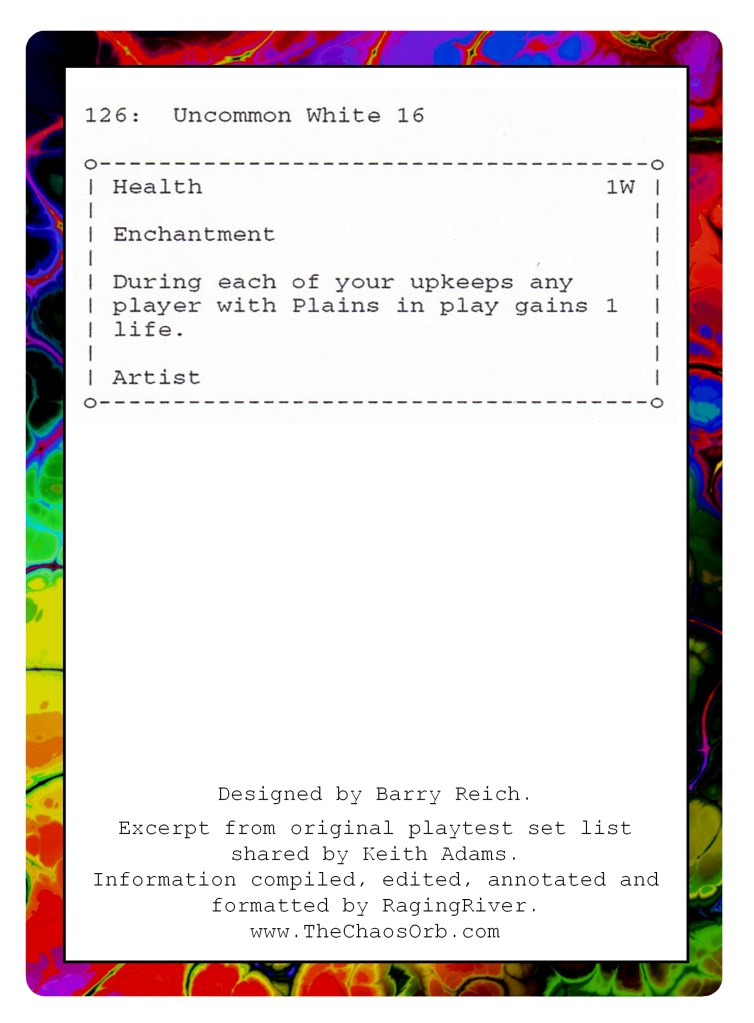
Original Playtest 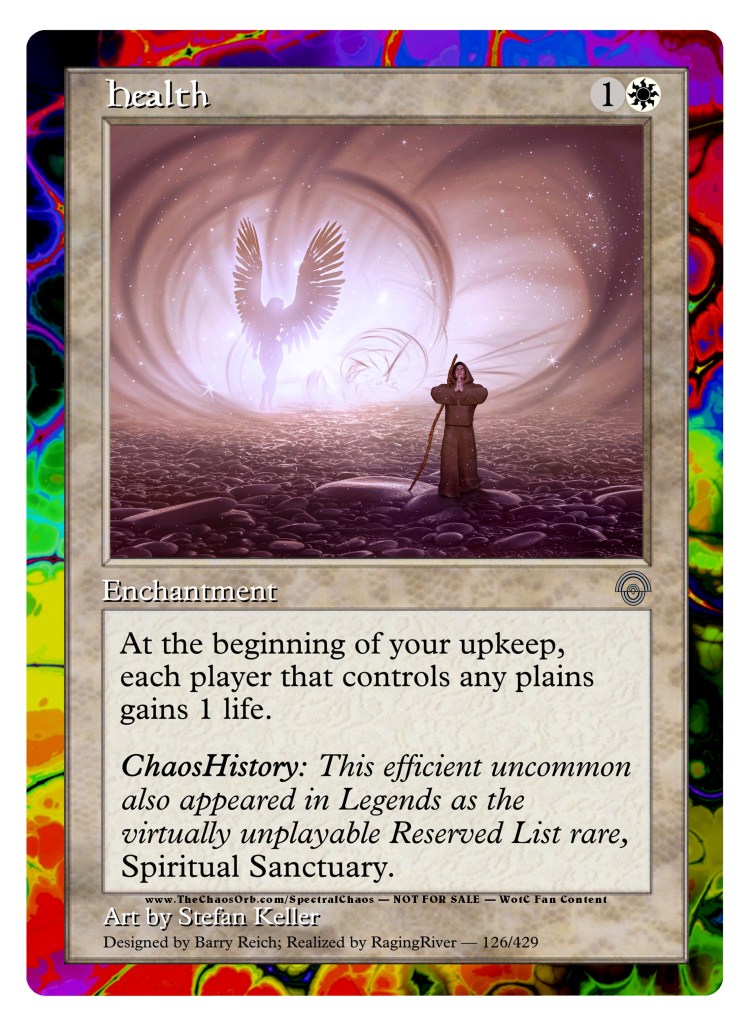
Realized
Health – {1}{W}
Enchantment
At the beginning of your upkeep, each player that controls any plains gains 1 life.
ChaosHistory: This efficient uncommon also appeared in Legends as the virtually unplayable Reserved List rare, Spiritual Sanctuary.
127 – Order
(Uncommon Enchantment (White))

Original Playtest 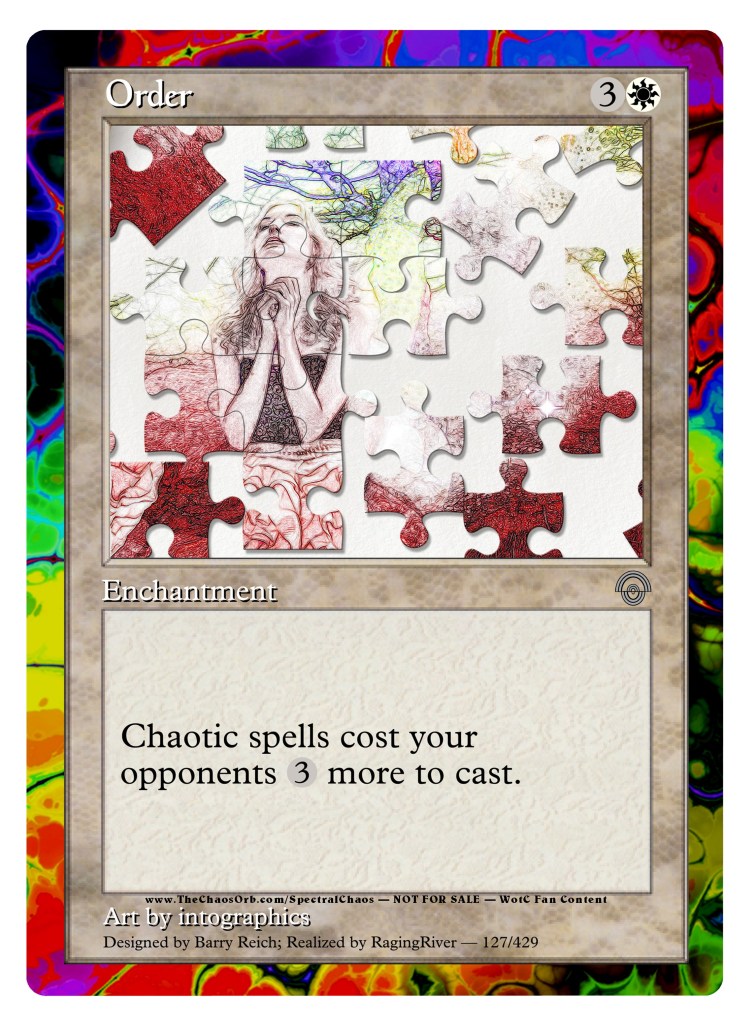
Realized
Order – {3}{W}
Enchantment
Chaotic spells cost your opponents {3} more to cast.
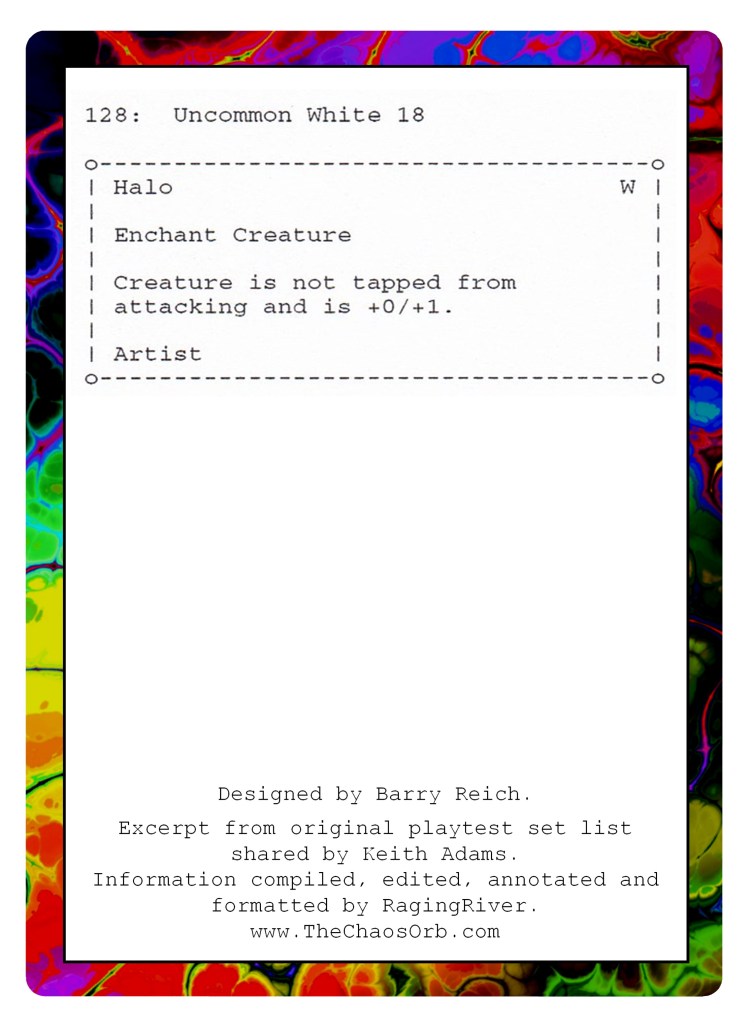
128 – Halo
(Uncommon Enchantment (White))
Original Playtest 
Realized
Halo – {W}
Enchantment – Aura
Enchant creature
Enchanted creature gets +0/+1 and has vigilance.
129 – Marble Obelisk
(Uncommon Creature (Multicolor))

Original Playtest 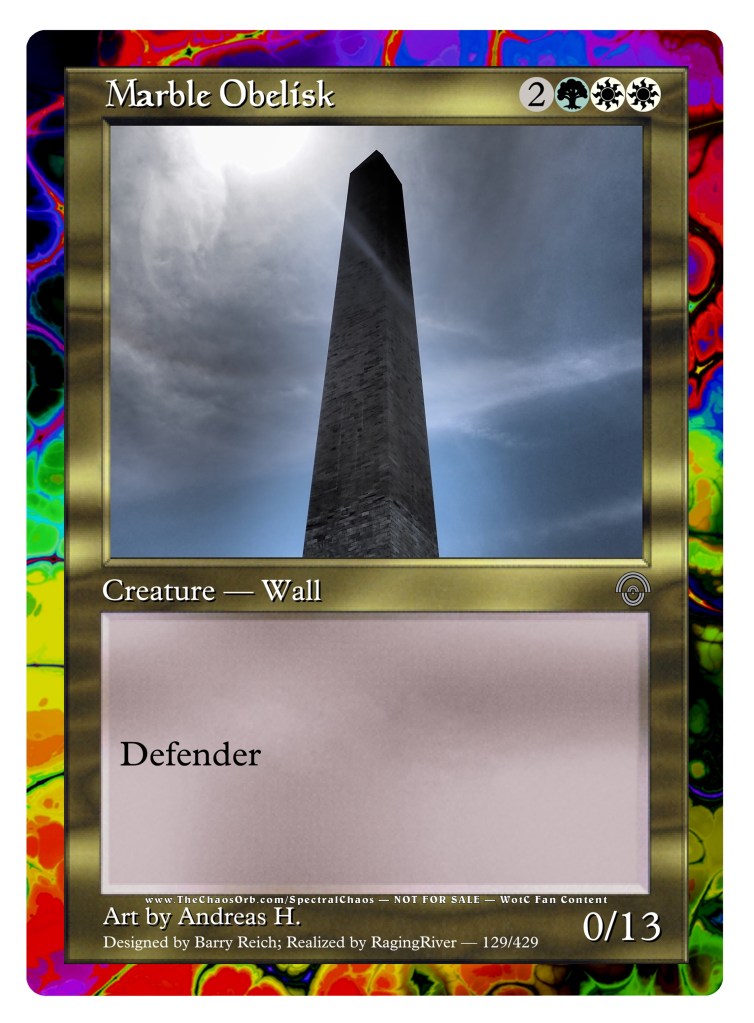
Realized
Marble Obelisk – {2}{G}{W}{W}
Creature – Wall
Defender
0/13
130 – Color Blindness
(Uncommon Enchantment (Multicolor))

Original Playtest 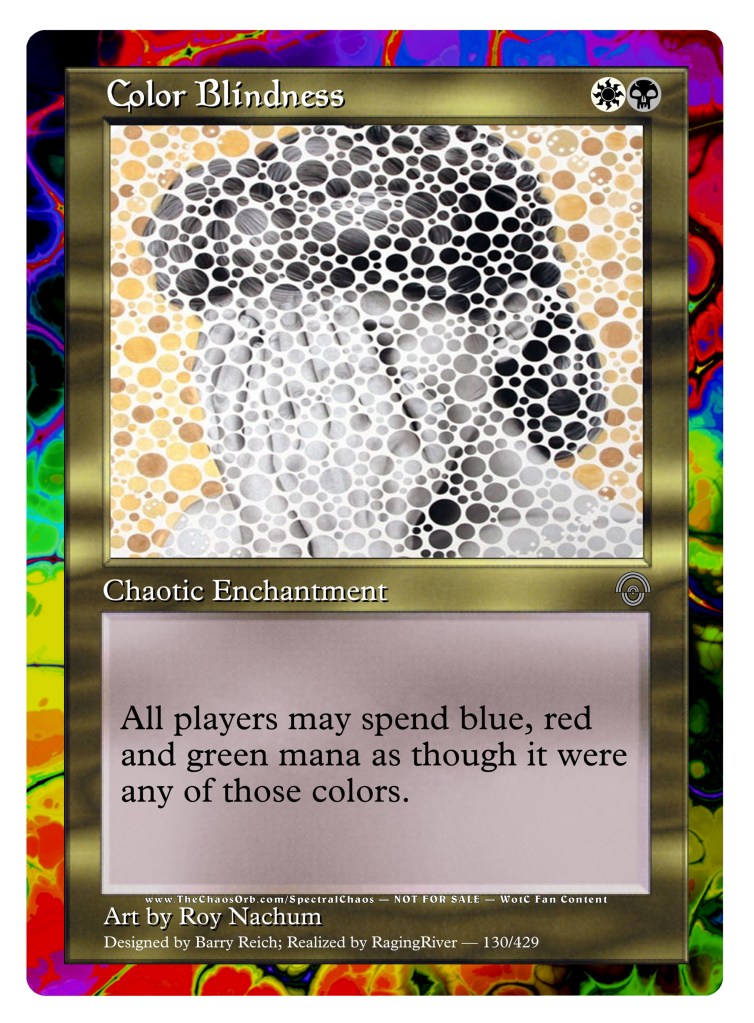
Realized
Color Blindness – {W}{B}
Chaotic Enchantment
All players may spend blue, red and green mana as though it were any of those colors.
- Mana is still blue, red or green, players can just spend it as though it were any of those colors. If a mana source could generate multiple colors of mana, players still need to indicate which color of mana they are generating. For example, a player tapping a Volcanic Island still needs to indicate whether they are tapping it for blue or red mana, even though it could be spent as either.
- If Color Blindness leaves the battlefield, players can still spend blue, red and green mana already in their mana pool this way until their mana pool empties. Any blue, red or green mana added to mana pools after Color Blindness leaves the battlefield would have to be spent like normal.
131 – Imp of the Iron Hooves
(Uncommon Creature (Black))

Original Playtest 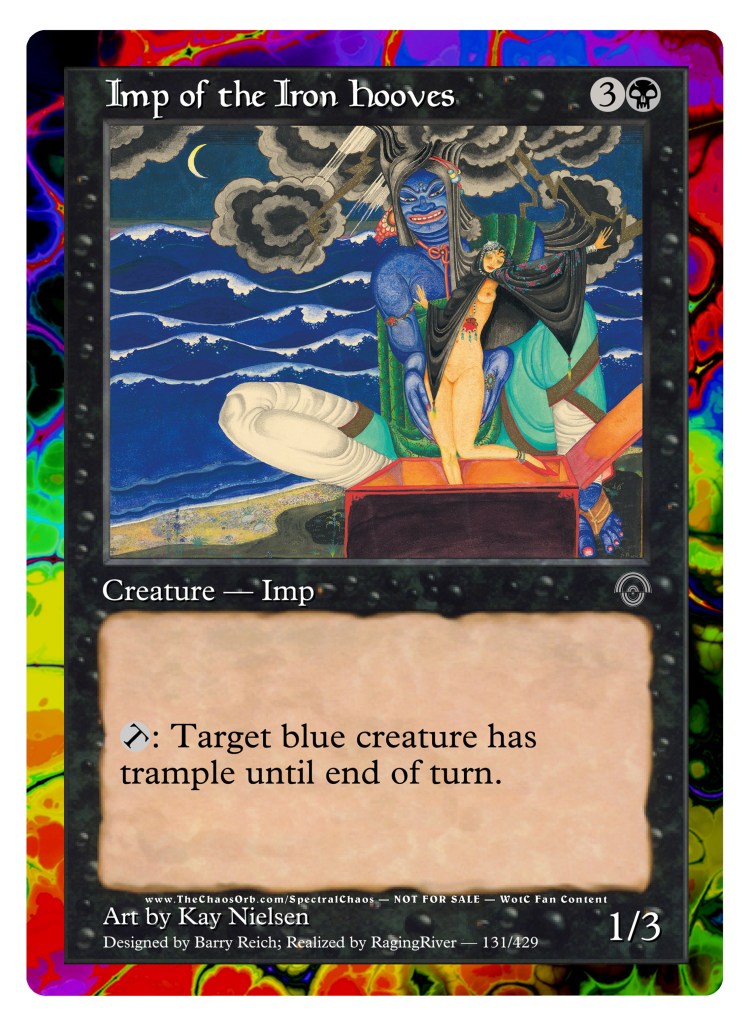
Realized
Imp of the Iron Hooves – {3}{B}
Creature – Imp
{T}: Target blue creature has trample until end of turn.
1/3
- The creature is checked for color when it is targeted, and again when this ability resolves.
- The creature will still have trample even if its color changes later in the turn.
132 – Graveyard Vulture
(Uncommon Creature (Black))

Original Playtest 
Realized
Graveyard Vulture – {2}{B}{B}
Creature – Bird
Flying
{T}, exile a creature card from your graveyard: Put a +1/+1 counter on Graveyard Vulture.
2/2
133 – Giant Bat
(Uncommon Creature (Black))

Original Playtest 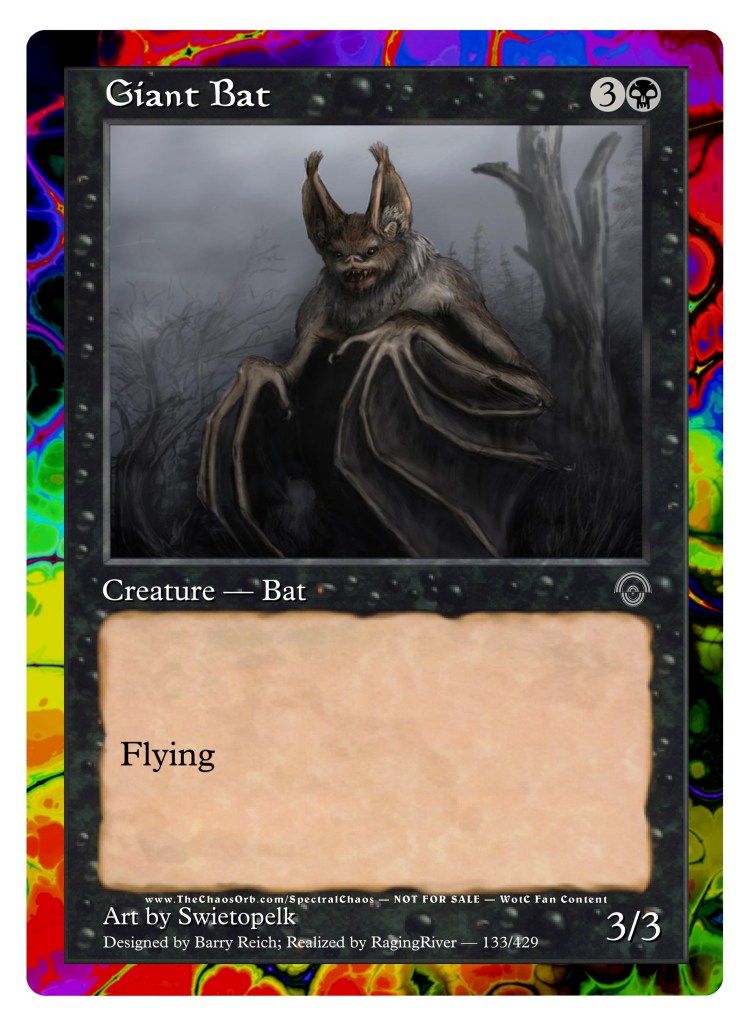
Realized
Giant Bat – {3}{B}
Creature – Bat
Flying
3/3
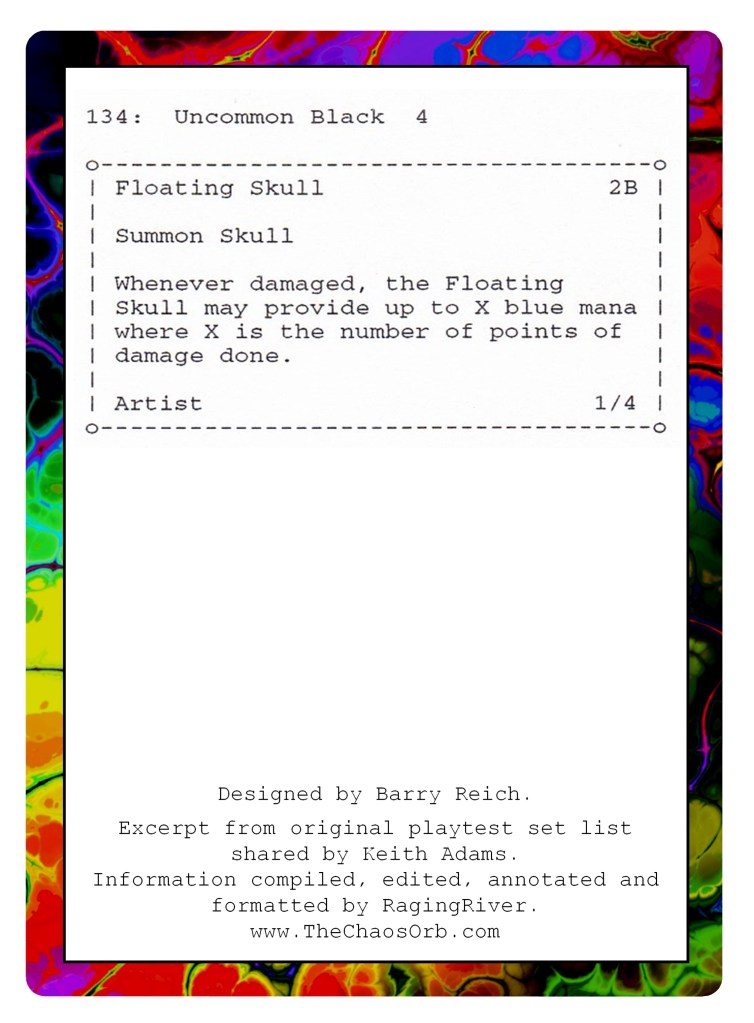
134 – Floating Skull
(Uncommon Creature (Black))
Original Playtest 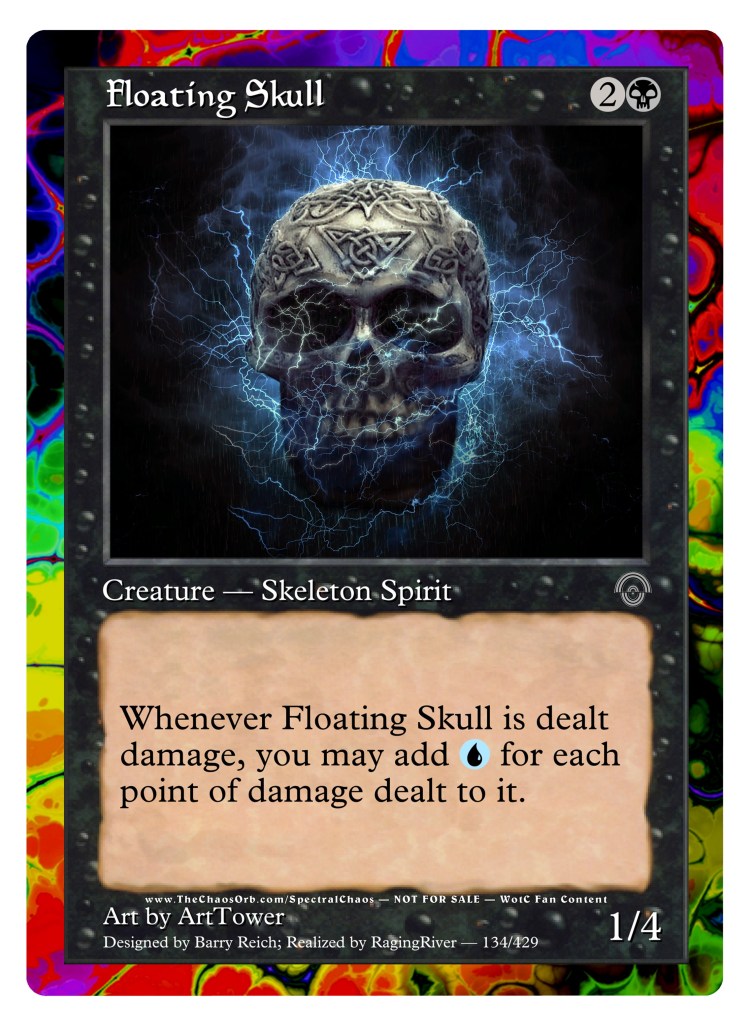
Realized
Floating Skull – {2}{B}
Creature – Skeleton Spirit
Whenever Floating Skull is dealt damage, you may add {U} for each point of damage dealt to it.
1/4
- If Floating Skull is dealt 2 or more damage, you may add an amount of blue mana equal to some or all of that damage.
- If damage to Floating Skull is prevented, you don’t get to add mana.
135 – Rous Eel
(Uncommon Creature (Black))

Original Playtest 
Realized
Rous Eel – {1}{B}{B}
Creature – Eel
Swampwalk
{R}, {T}: Put a +1/-1 counter on Rous Eel.
1/4
136 – Wall of Death
(Uncommon Creature (Black))

Original Playtest 
Realized
Wall of Death – {2}{B}{B}
Creature – Wall
Defender
{0}: The next time Wall of Death would be dealt damage this turn, instead Wall of Death is dealt that much damage reduced by 1 and Wall of Death deals 1 damage to any other target. (You can only activate this ability once for each time damage is dealt.)
0/3
- Once you activate the ability, you have to wait until its replacement effect happens (or wears off during the cleanup step) before activating it again.
- When you activate the ability, you must choose a target to be potentially redirected damage, but you don’t choose a source of damage. Wall of Death can’t target itself. Once you activate Wall of Death‘s ability, whatever damage next gets dealt to Wall of Death will be reduced by 1. Wall of Death will then deal 1 damage to the target, regardless of the source of damage dealt to Wall of Death. Note however that you could then immediately activate the ability again, thus reducing the next damage to be dealt to Wall of Death this turn.
- The damage is dealt by Wall of Death simultaneously with the reduced damage dealt to Wall of Death.
- If the target is no longer a valid target by the time Wall of Death is next dealt damage (for example, if it is no longer on the battlefield), the damage to Wall of Death will still be reduced by 1, but Wall of Death won’t deal 1 damage to anything.
- If damage to Wall of Death is prevented or otherwise replaced, it never gets dealt to Wall of Death so Wall of Death‘s ability won’t replace anything. The replacement effect would remain until Wall of Death was actually damaged this turn.
137 – Waterfall
(Uncommon Enchantment (Black))

Original Playtest 
Realized
Waterfall – {B}
Enchantment – Aura
Enchant land
Enchanted land has “{T}: Add {U}{U}” and loses all other mana abilities.
- This supersedes any other mana abilities of the land, including mana abilities granted by virtue of its land type. If the land has a basic land type, it still has that type, but it won’t have the mana ability associated with that type.
- Non-mana abilities of the land aren’t affected.
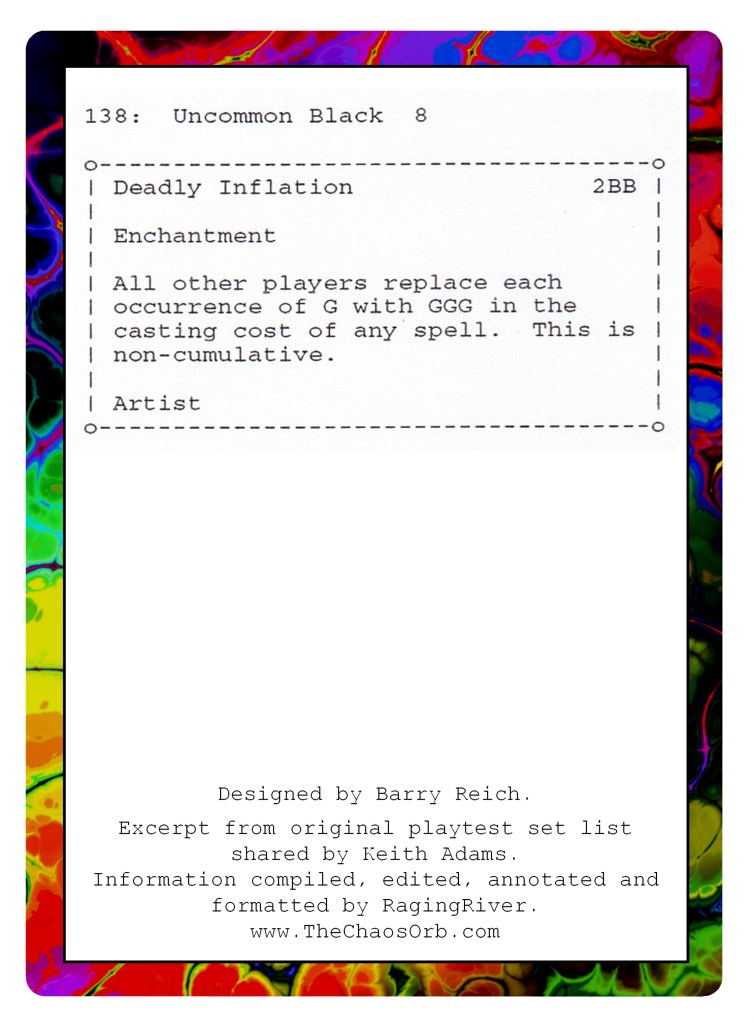
138 – Deadly Inflation
(Uncommon Enchantment (Black))
Original Playtest 
Realized
Deadly Inflation – {2}{B}{B}
Enchantment
Spells cost your opponents an additional {G}{G} to cast for each green mana symbol in their casting cost.
- A hybrid symbol that is both green and another type is a green mana symbol, regardless of what cost is paid for it.
- This is an additional cost; it doesn’t actually add mana symbols to the casting cost.
139 – Enrage
(Uncommon Enchantment (Black))

Original Playtest 
Realized
Enrage – {B}
Enchantment – Aura
Enchant creature
{U}: Enchanted creature gets +1/-1 until end of turn.
140 – Nightfall
(Uncommon Instant (Black))

Original Playtest 
Realized
Nightfall – {B}{B}
Instant
All black creatures get +2/+2 until end of turn.
141 – Water Lilies
(Uncommon Creature (Multicolor))

Original Playtest 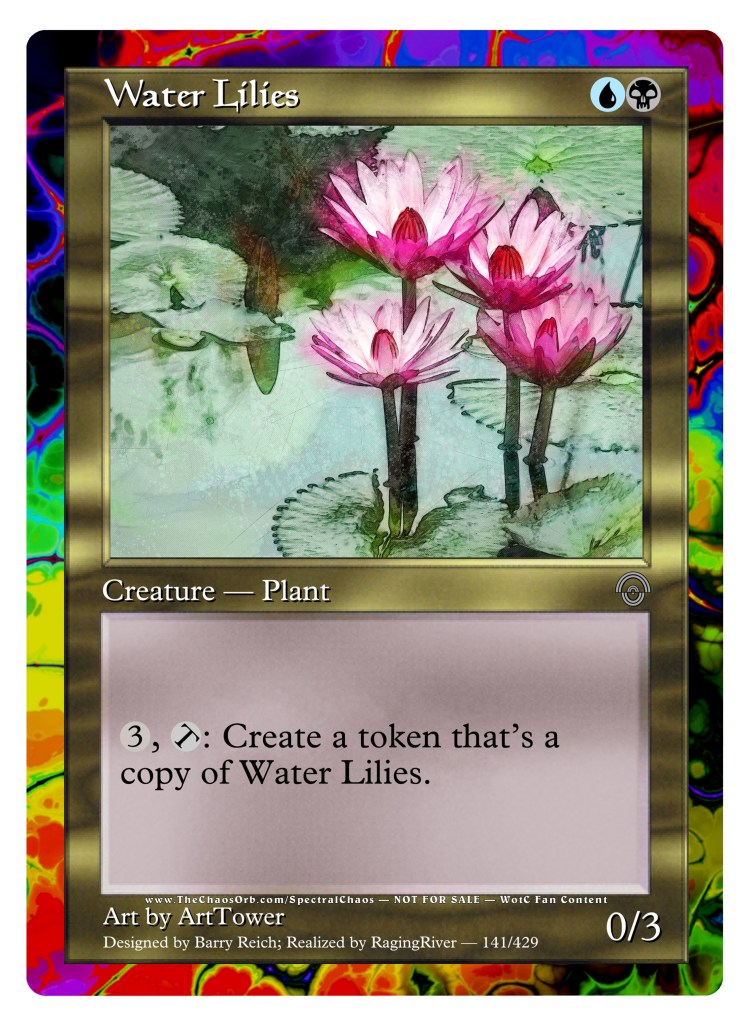
Realized 
Copy Token
Water Lilies – {U}{B}
Creature – Plant
{3}, {T}: Create a token that’s a copy of Water Lilies.
0/3
- The token will be an exact copy, including this activated ability.
142 – Poltergeist
(Uncommon Creature (Multicolor))

Original Playtest 
Realized
Poltergeist – {2}{U}{B}
Creature – Spirit
{U}{B}, {T}: Target artifact you control becomes a X+1/X+1 flying artifact creature until end of turn, where X is its converted mana cost. It retains its abilities. At the beginning of the end step, destroy that artifact. It can’t be regenerated.
2/2
- You may target an artifact creature. If you do, it gains flying and its base power and toughness are as described in Poltergeist‘s ability. Abilities that set its base power and toughness (like Beast of Burden) wouldn’t apply, but abilities that affect its power or toughness (like Otarian Juggernaut) would continue to apply.
- An equipment that becomes a creature can’t be attached to a creature. It’s other (non-equip) abilities would continue to apply.
143 – Gybe’s Psychic Crush
(Uncommon Instant (Multicolor))

Original Playtest 
Realized
Gybe’s Psychic Crush – {U}{B}{B}
Instant
Destroy target creature.
ChaosHistory: Chris Gybe was a friend of Barry’s who helped playtest Spectral Chaos.
144 – Pettey’s Hex
(Uncommon Enchantment (Multicolor))
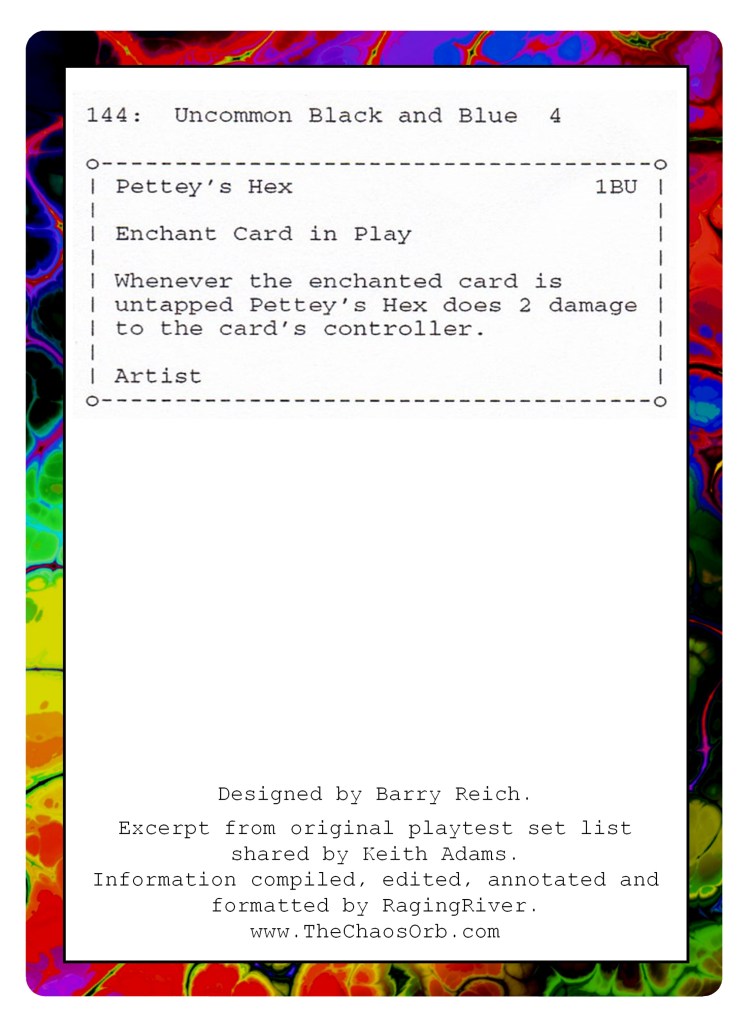
Original Playtest 
Realized
Pettey’s Hex – {1}{U}{B}
Enchantment – Aura
Enchant permanent
Whenever enchanted permanent becomes untapped, Pettey’s Hex deals 2 damage to that permanent’s controller.
ChaosHistory: Dave Pettey was one of the original Alpha playtesters. He helped design Ice Age and Alliances.
145 – Spitting Cobra
(Uncommon Creature (Multicolor))

Original Playtest 
Realized
Spitting Cobra – {B}{G}
Chaotic Creature – Snake
At end of combat, put a paralyzation counter on each creature blocking or blocked by Spitting Cobra. A creature with a paralyzation counter doesn’t untap during its controller’s untap step and has “{4}: Untap this creature. Activate this ability only during your upkeep and only once per turn.”
1/2
ChaosHistory: A similar design would be used for Dread Wight, released in Ice Age.
- A creature will gain a paralyzation counter each combat it survives the Spitting Cobra; however, multiple paralyzation counters are redundant. That creature will have one instance of the ability, and can be untapped during its controller’s upkeep for 4 mana only once, regardless of how many paralyzation counters are on it.
- A creature will continue to be paralyzed (and continue to have the “pay to untap during upkeep” ability) for as long as any paralyzation counter remains on it, even if Spitting Cobra is no longer on the battlefield.
146 – Voodoo Doll
(Uncommon Creature (Multicolor))

Original Playtest 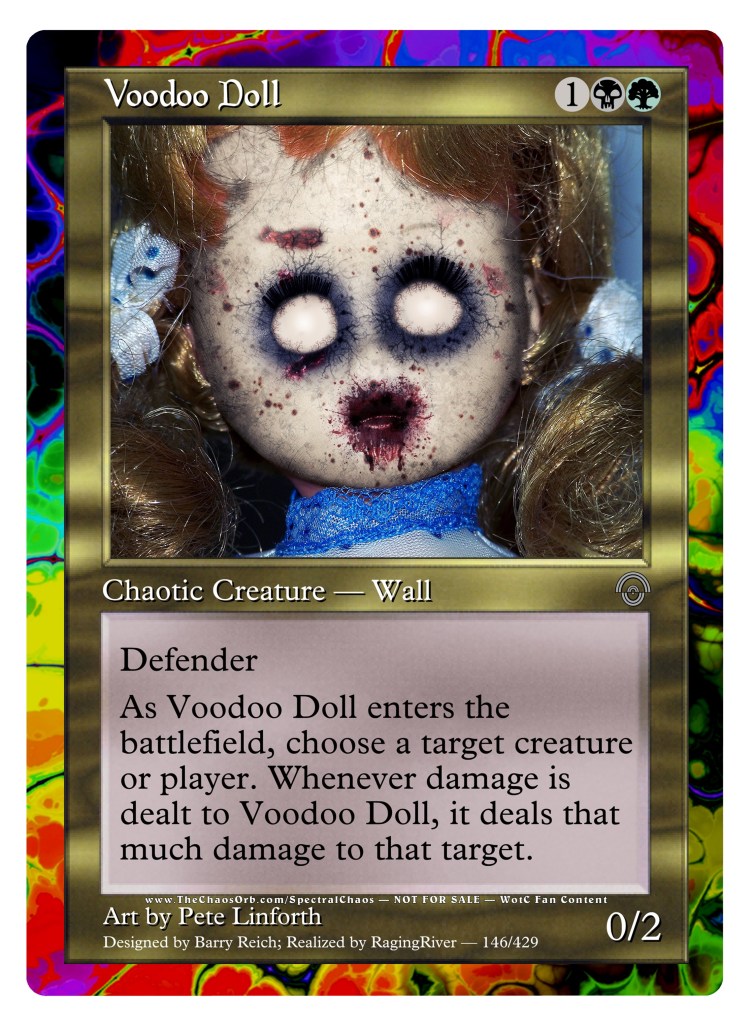
Realized
Voodoo Doll – {1}{B}{G}
Chaotic Creature – Wall
Defender
As Voodoo Doll enters the battlefield, choose a target creature or player. Whenever damage is dealt to Voodoo Doll, it deals that much damage to that target.
0/2
- Voodoo Doll‘s enter the battlefield ability targets a creature or player. The second (triggered) part of the ability refers back to whatever that target was, but that part doesn’t itself target. If that creature or player gains shroud later, Voodoo Doll will still deal damage to it.
- If Voodoo Doll‘s enter the battlefield ability is countered, the rest of the ability will never trigger.
147 – Punishment
(Uncommon Enchantment (Multicolor))
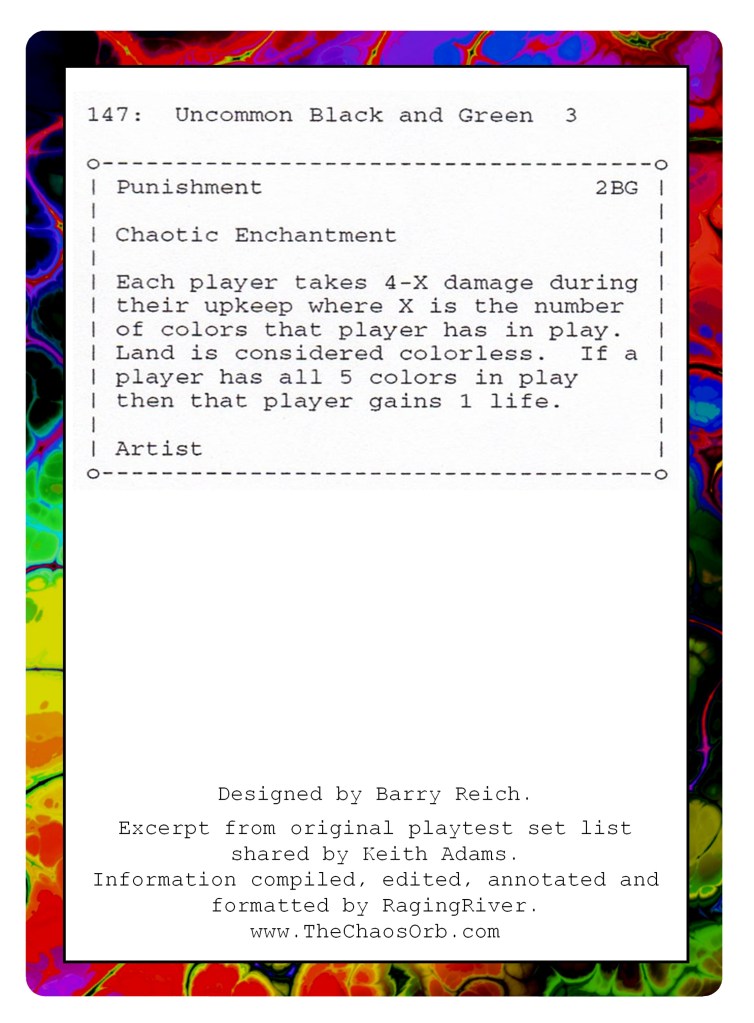
Original Playtest 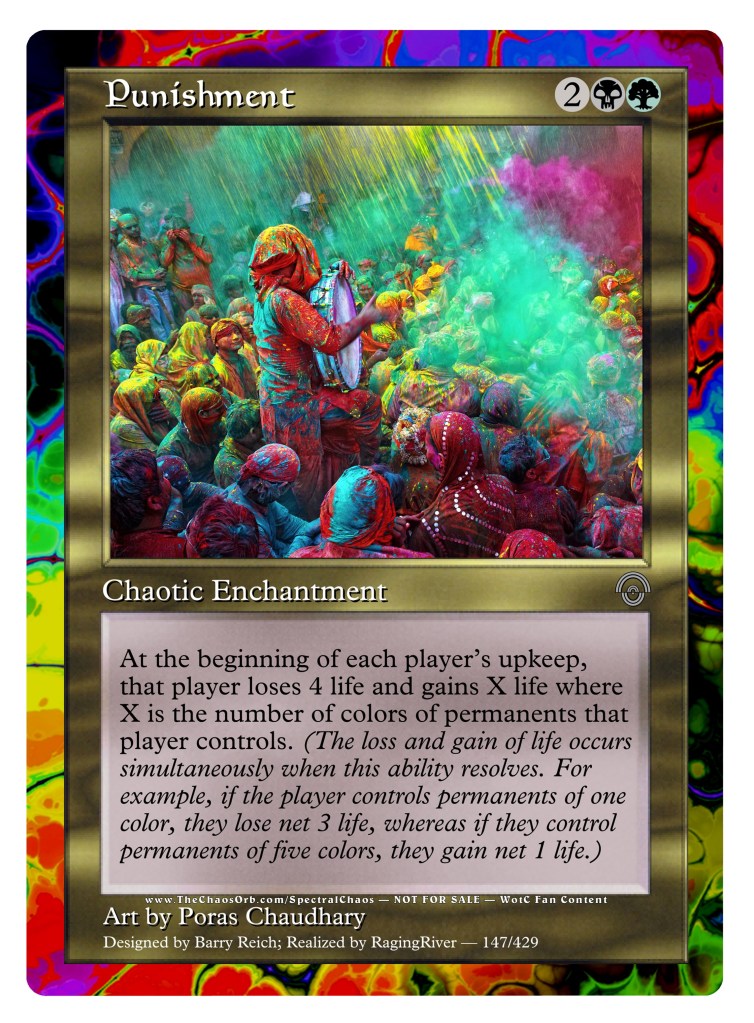
Realized
Punishment – {2}{B}{G}
Chaotic Enchantment
At the beginning of each player’s upkeep, that player loses 4 life and gains X life where X is the number of colors of permanents that player controls. (The loss and gain of life occurs simultaneously when this ability resolves. For example, if the player controls permanents of one color, they lose net 3 life, whereas if they control permanents of five colors, they gain net 1 life.)
- When considering prevention or replacement effects on a player gaining or losing life (such as Sulfuric Vortex, Tainted Remedy or Boon Reflection) only the net life gain or loss is considered. For example, if a player controlled Sulfuric Vortex and permanents of 5 colors, the correct interpretation is that there is a net gain of 1 life prevented by Sulfuric Vortex (so their life total won’t change). It would not be correct to interpret this as the player losing 4 life and then separately gaining 5 life (prevented by Sulfuric Vortex) for a net loss of 4 life.
148 – Lightning Rod
(Uncommon Creature (Multicolor))

Original Playtest 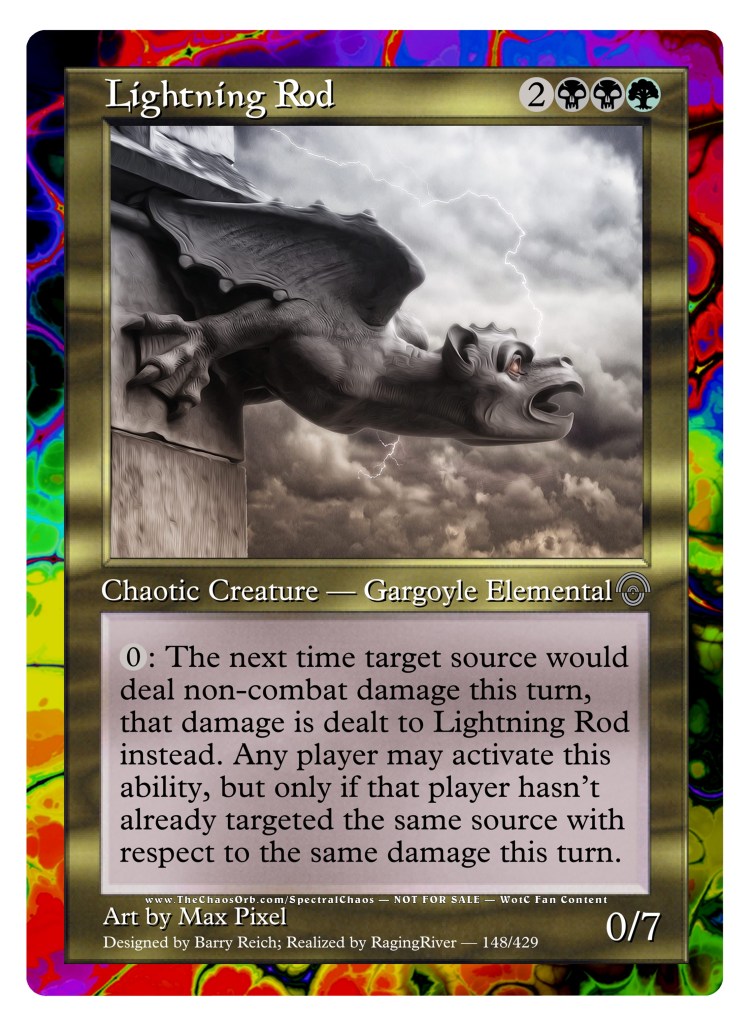
Realized
Lightning Rod – {2}{B}{B}{G}
Chaotic Creature – Gargoyle Elemental
{0}: The next time target source would deal non-combat damage this turn, that damage is dealt to Lightning Rod instead. Any player may activate this ability, but only if that player hasn’t already targeted the same source with respect to the same damage this turn.
0/7
- This is a damage redirection effect. The effect does not change the source of the damage.
- Each time a player activates this ability, they target a source of potential damage. A source doesn’t need to be capable of dealing non-combat damage (or capable of dealing damage at all) to be a legal target. The source may be a creature, or any other game object that can be targeted.
- Once this ability resolves, it can’t be “undone” by activating it again targeting a different source. Lightning Rod will just end up getting redirected damage from both of those sources.
- Can be used even when there is no damage to prevent. It prevents the next non-combat damage (if any) from the source this turn. If the chosen source deals combat damage (instead of non-combat damage), that’s irrelevant to Lightning Rod – the replacement effect will remain in place, and the next non-combat damage that source deals will still get redirected to Lightning Rod.
- Who controls Lightning Rod is irrelevant to the ability. If, after activating this ability but before any damage is dealt by that source, control of Lightning Rod changes, the next non-combat damage from that source will still be redirected to Lightning Rod.
- The limitation described in the last part of the ability prevents players from stalling the game indefinitely in a situation where there are multiple Lightning Rods on the battlefield.
- The phrase “with respect to the same damage” just refers to the next non-combat damage that source would deal this turn. Once that source deals non-combat damage this turn, then any player could activate Lightning Rod again targeting the same source again.
- If, after activating this ability, non-combat damage from that source gets prevented or redirected by some other effect or ability, this will replace Lightning Rod‘s effect and essentially means it will “wear off.” This can require some strategy. For example, say a Lightning Rod is in play, your opponent controls a Circle of Protection: Red and you activate the ability of your Goblin Bomb, targeting your opponent. If you activate Lightning Rod‘s ability first, the opponent could activate CoP:Red, and you wouldn’t be able to activate Lightning Rod again targeting the Goblin Bomb. If you wait until they activate CoP:Red, then you activate the Lightning Rod, they would have to activate CoP:Red again to prevent the damage instead of letting it be redirected.
- If a player activates Lightning Rod, a different player could activate it again targeting the same source, but in most cases that would be unnecessary and redundant.
149 – Hestian Quickling
(Uncommon Creature (Green))
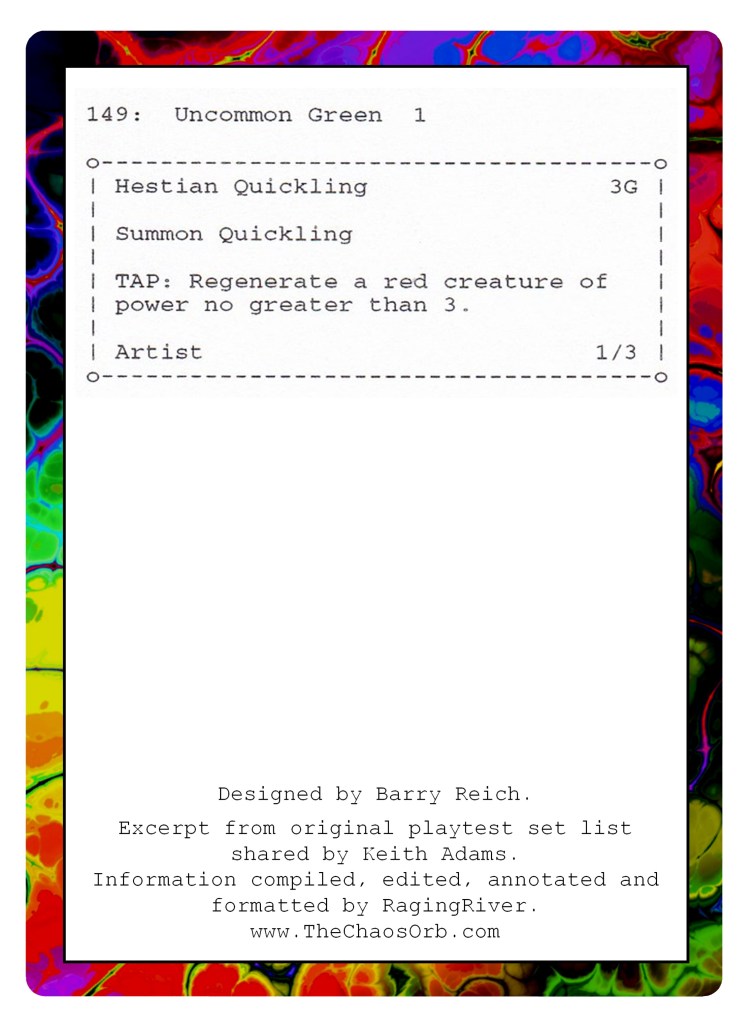
Original Playtest 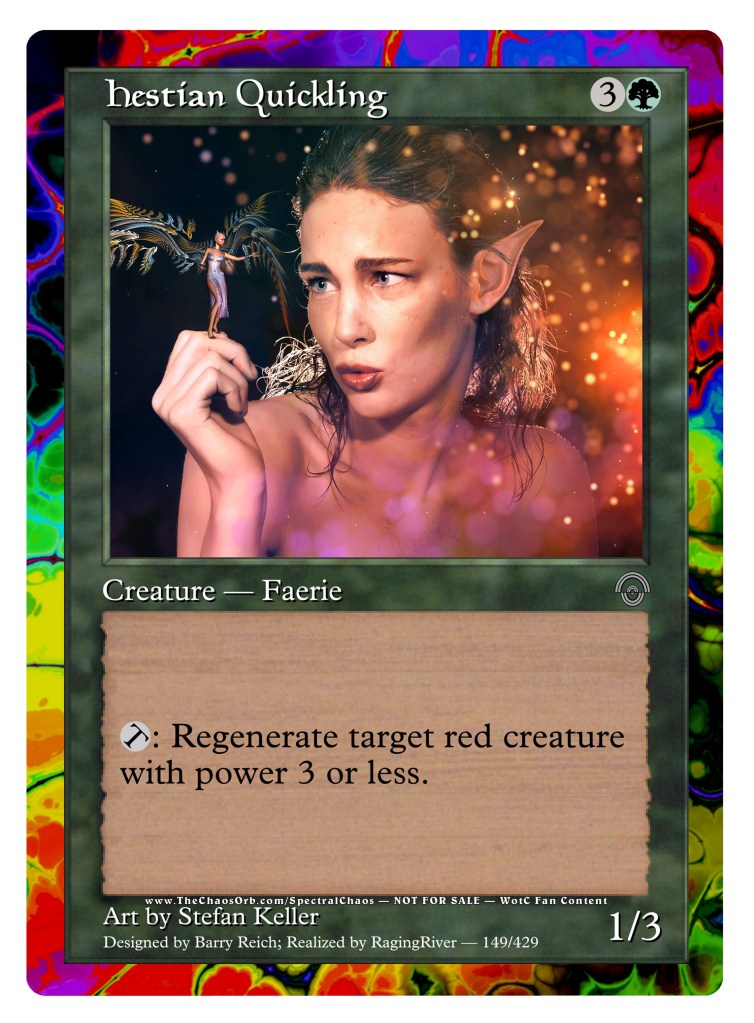
Realized
Hestian Quickling – {3}{G}
Creature – Faerie
{T}: Regenerate target red creature with power 3 or less.
1/3
- The creature is checked for color and power level when it is targeted, and again when this ability resolves.
- The regeneration shield will stay on the creature even if its color or power changes later in the turn.
150 – Worshipper of the Holy Flame
(Uncommon Creature (Green))

Original Playtest 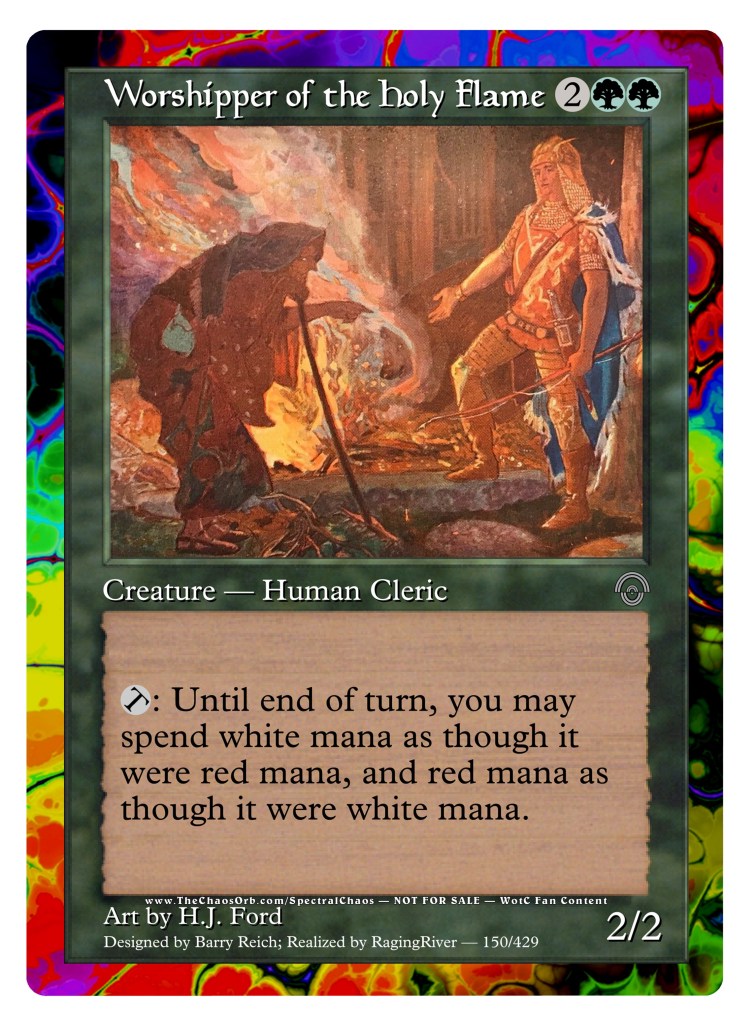
Realized
Worshipper of the Holy Flame – {2}{G}{G}
Creature – Human Cleric
{T}: Until end of turn, you may spend white mana as though it were red mana, and red mana as though it were white mana.
2/2
- You’ll be able to spend mana this way until end of turn, even if Worshipper of the Holy Flame leaves the battlefield.
151 – EL TIMTOR’S CHARM
(Uncommon Enchantment (Green))

Original Playtest 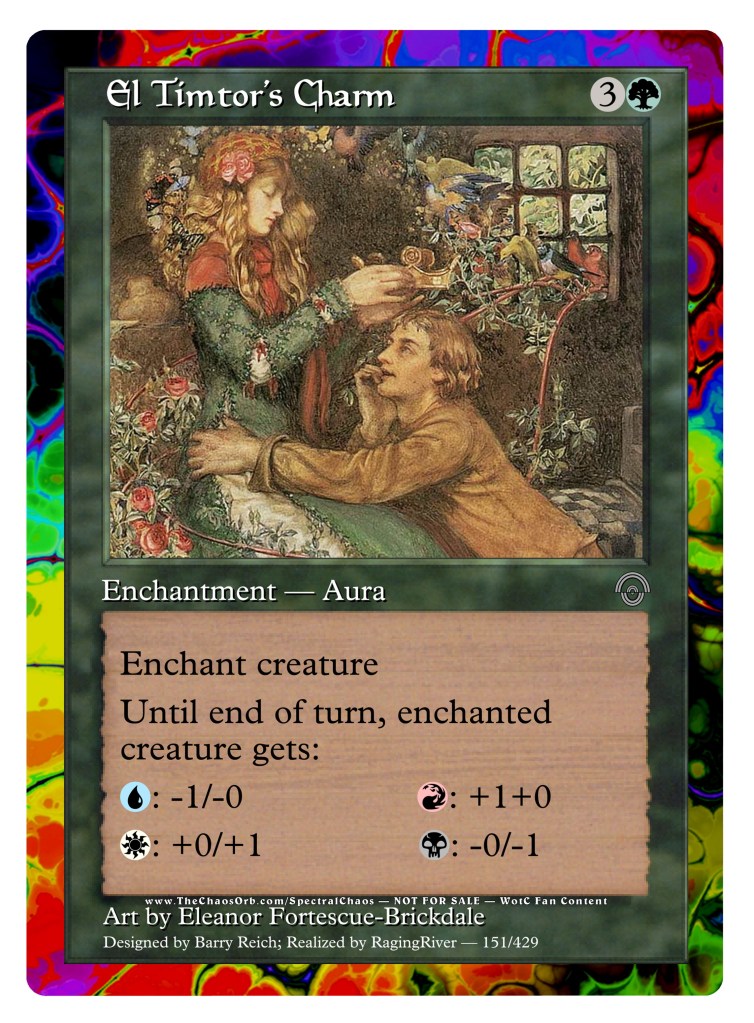
Realized
El Timtor’s Charm – {3}{G}
Enchantment – Aura
Enchant creature
Until end of turn, enchanted creature gets:
{U}: -1/-0
{R}: +1/+0
{W}: +0/+1
{B}: -0/-1
152 – Lemming
(Uncommon Creature (Green))
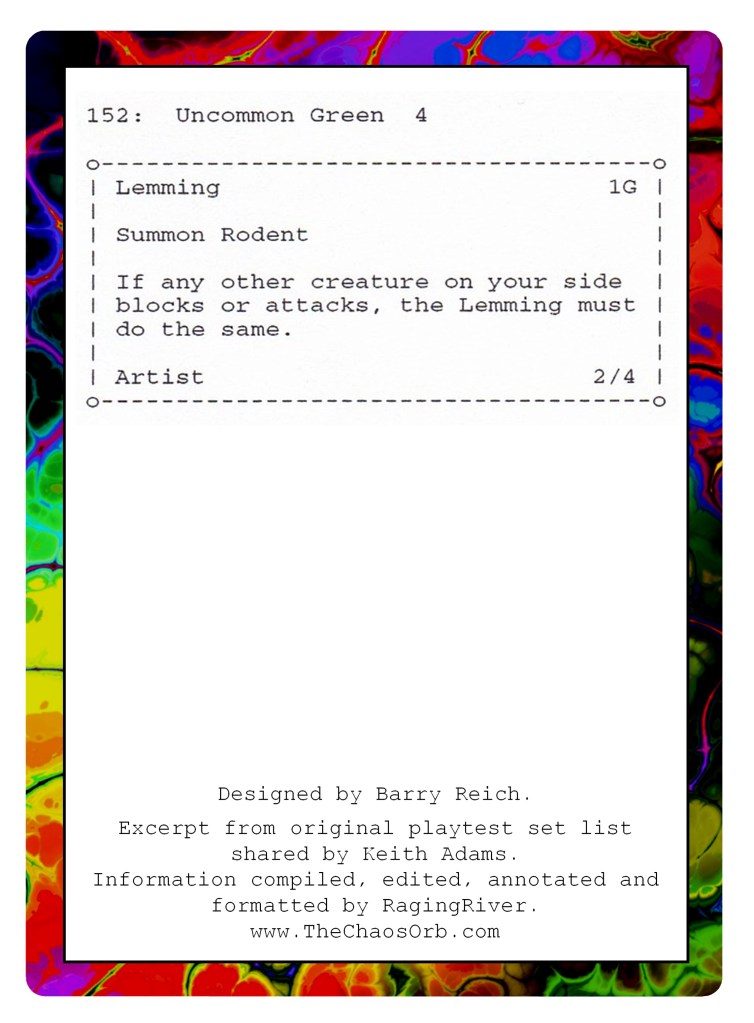
Original Playtest 
Realized
Lemming – {1}{G}
Creature – Lemming
If you declare attackers, Lemming attacks if able. (Lemming can attack different opponents than your other attacking creatures are attacking.)
If you declare blockers, Lemming blocks if able. (Lemming can block different attacking creatures than your other creatures are blocking.)
2/4
- If Lemming is removed from combat or for any other reason it stops attacking or blocking after it was declared as an attacker or blocker, your other creatures will still attack and block as normal.
153 – Malec-Hi Shortbowman
(Uncommon Creature (Green))

Original Playtest 
Realized
Malec-Hi Shortbowman – {2}{G}{G}
Creature – Human Knight
{T}: Malec-Hi Shortbowman deals 1 damage to any target.
0/3
ChaosHistory: Malec-Hi is an anagram of the name of Barry’s brother Michael.
154 – Mati the Lizard Queen
(Uncommon Creature (Green))

Original Playtest 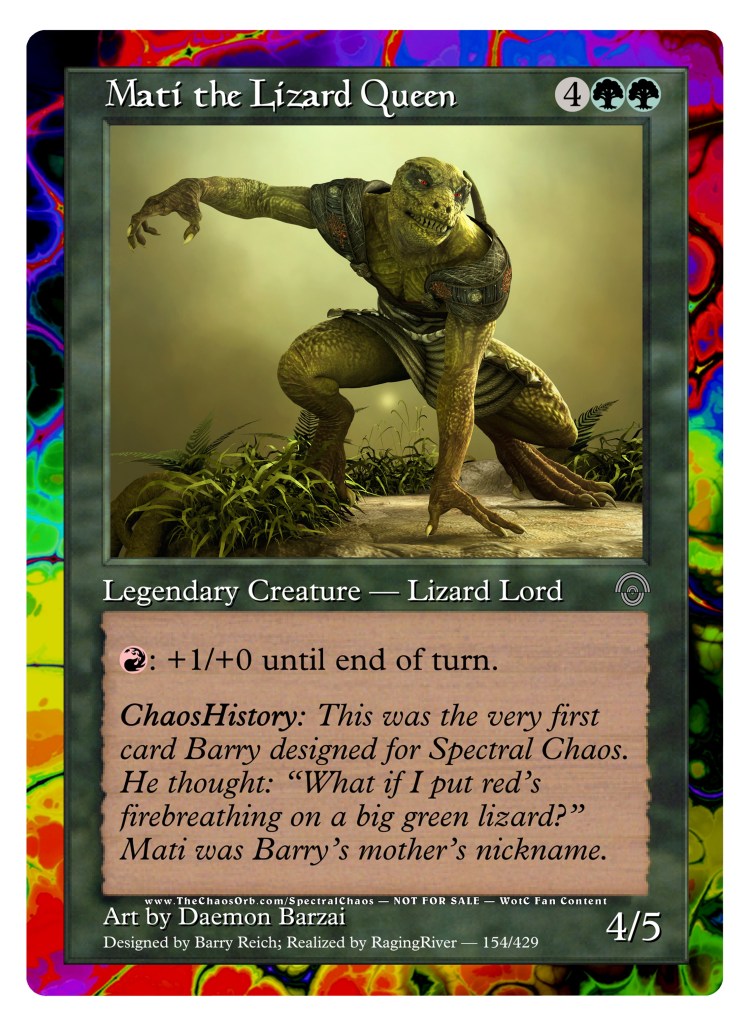
Realized
Mati the Lizard Queen – {4}{G}{G}
Legendary Creature – Lizard Lord
{R}: +1/+0 until end of turn.
4/5
ChaosHistory: This was the very first card Barry designed for Spectral Chaos. He thought: “What if I put red’s firebreathing on a big green lizard?” Mati was Barry’s mother’s nickname.
155 – Old Man Willow
(Uncommon Creature (Green))

Original Playtest 
Realized
Old Man Willow – {2}{G}
Creature – Plant Wall
Defender
At the beginning of your upkeep, you may pay {G}. If you do, put a +1/+1 counter on Old Man Willow.
1/1.
156 – Elvish Aura
(Uncommon Enchantment (Green))

Original Playtest 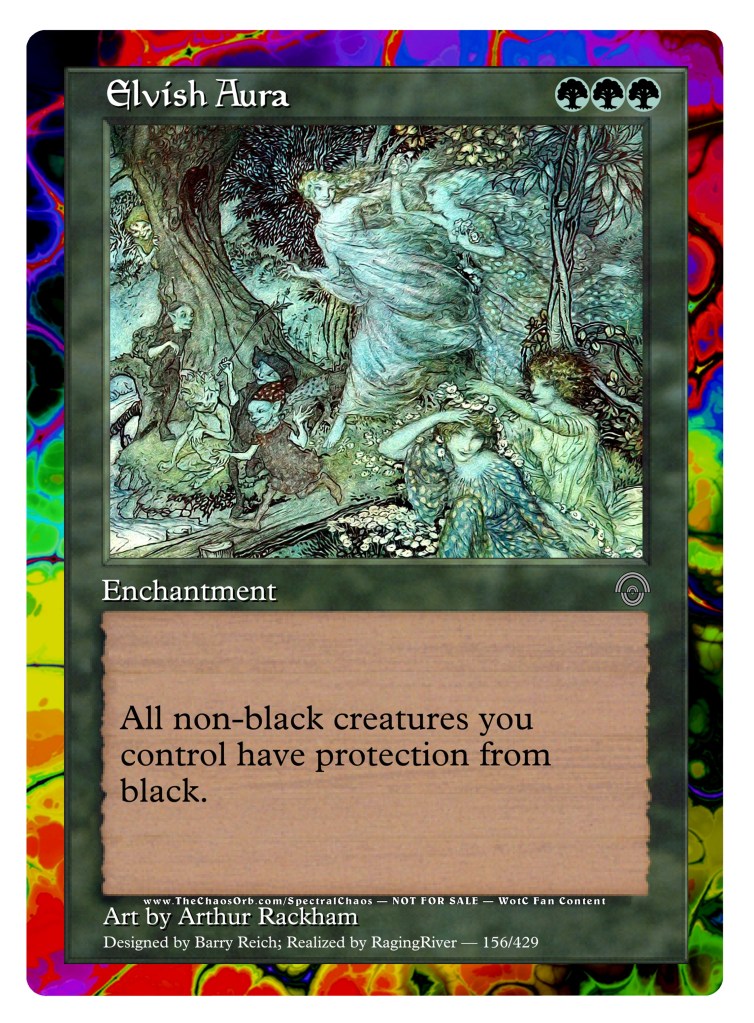
Realized
Elvish Aura – {G}{G}{G}
Enchantment
All non-black creatures you control have protection from black.
157 – Forbidden Lore
(Uncommon Enchantment (Green))
Original Playtest 
Realized
Forbidden Lore – {1}{G}
Enchantment – Aura
Enchant land
Enchanted land has “{T}: Target creature gets +1/+0 or +0/+1 until end of turn.”
If enchanted land is a plains, instead it has “{T}: Target creature gets +1/+0 or +0/+2 until end of turn.”
158 – Drought
(Uncommon Enchantment (Green))
Original Playtest 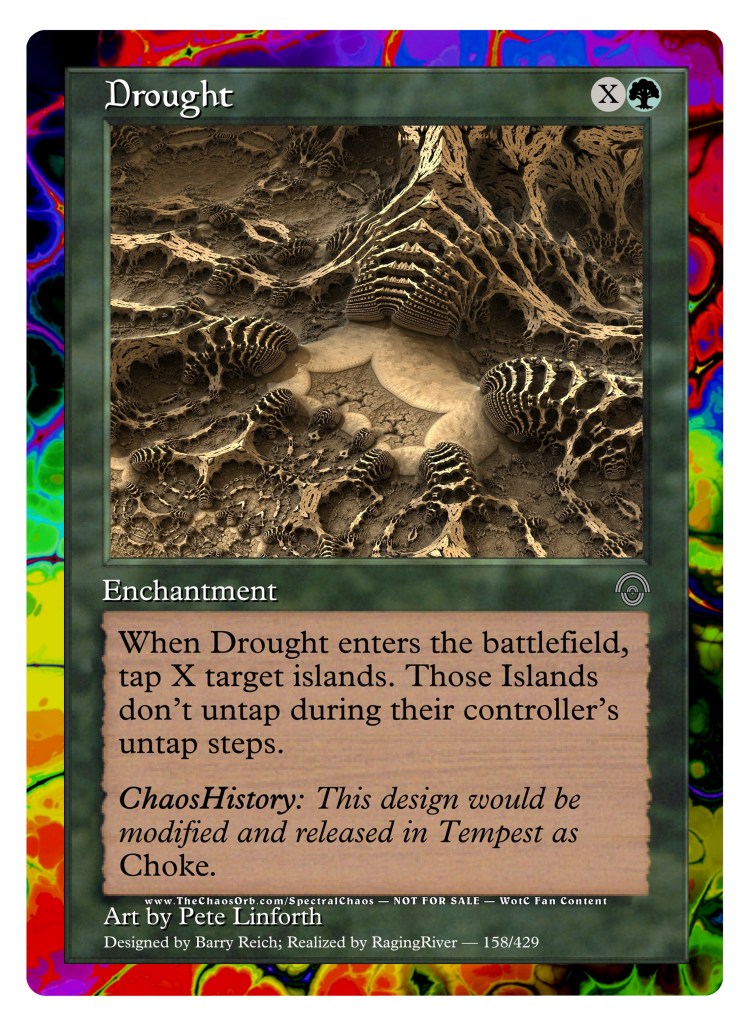
Realized
Drought – {X}{G}
Enchantment
When Drought enters the battlefield, tap X target islands. Those Islands don’t untap during their controller’s untap steps.
ChaosHistory: This design would be modified and released in Tempest as Choke.
- You pay for X when you cast the spell, but you don’t target islands yet. You can pay more for X than there are islands on the battlefield at the time Drought is cast.
- You target X islands as part of Drought‘s enter the battlefield trigger being put onto the stack. You can target islands that are already tapped. You can target any card with the land type island; it doesn’t have to be a basic Island. You have to target X different islands if there are enough valid targets. If there aren’t X islands to target, target as many as possible, regardless of who controls those islands. If any of those islands are no longer on the battlefield when Drought‘s enter the battlefield ability resolves, Drought will still tap and affect the remaining targeted islands.
159 – Hanging Vines
(Uncommon Enchantment (Green))

Original Playtest 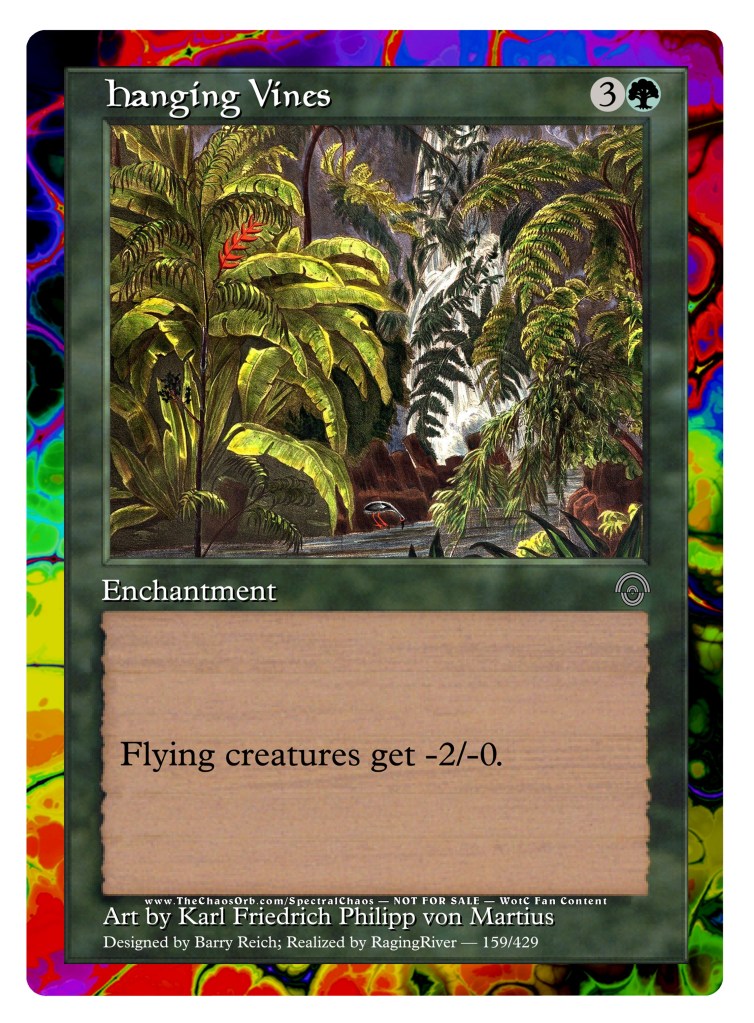
Realized
Hanging Vines – {3}{G}
Enchantment
Flying creatures get -2/-0.
160 – Spider Monkey
(Uncommon Creature (Green))
Original Playtest 
Realized
Spider Monkey – {1}{G}{G}
Creature – Ape
Forestwalk
2/2
161 – Frumious Bandersnatch
(Uncommon Creature (Green))

Original Playtest 
Realized
Frumious Bandersnatch – {1}{G}
Creature – Ouphe
When Frumious Bandersnatch dies, if it was dealt combat damage this turn, it deals 5 damage to each creature it blocked or that blocked it this turn.
1/1
“Beware the Jubjub bird, and shun the frumious Bandersnatch!” – Lewis Carroll, Jabberwocky
- It doesn’t matter whether Frumious Bandersnatch died due to combat damage or for some other reason. Its ability will still trigger if it was dealt combat damage at some point this turn.
- Effects such as Tracker or Prey Upon do not count as combat damage.
- The ability doesn’t target. Creatures with shroud or hexproof will still take damage from the ability.
162 – Treeline Wanderer
(Uncommon Creature (Multicolor))
Original Playtest 
Realized
Treeline Wanderer – {3}{R}{G}
Creature – Giant
{T}: Until end of turn, you may spend white mana as though it were red mana, and red mana as though it were white mana.
3/3
- You’ll be able to spend mana this way until end of turn, even if Treeline Wanderer leaves the battlefield.
163 – Brown Fungus
(Uncommon Creature (Multicolor))

Original Playtest 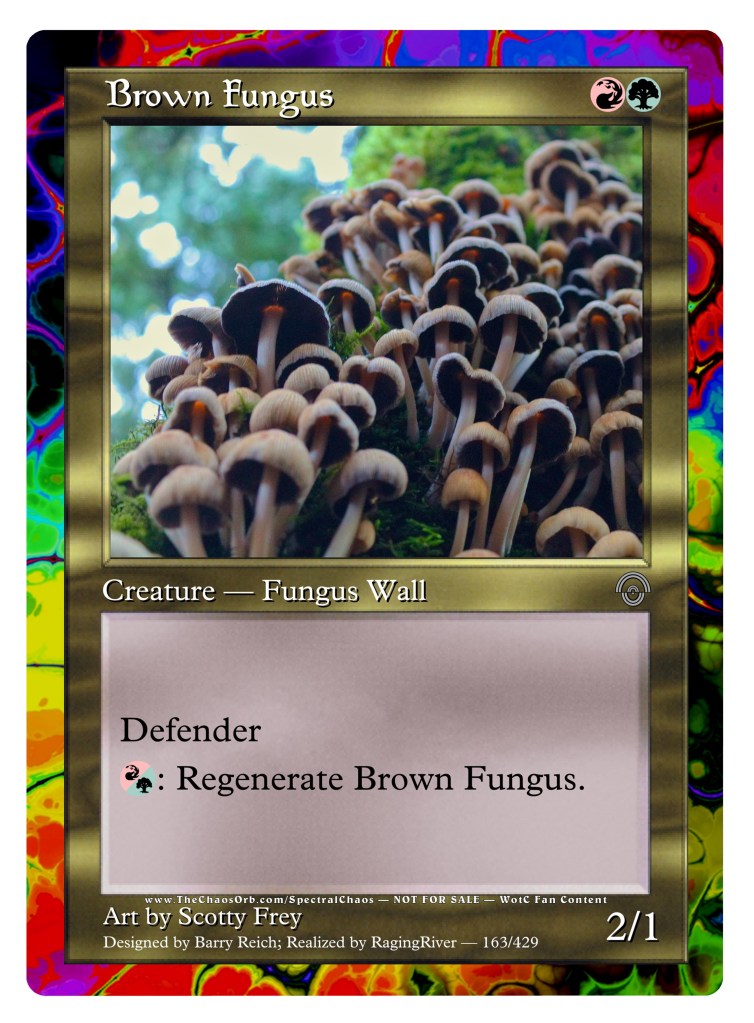
Realized
Brown Fungus – {R}{G}
Creature – Fungus Wall
Defender
{R/G}: Regenerate Brown Fungus.
2/1
164 – Rampage
(Uncommon Instant (Multicolor))

Original Playtest 
Realized
Rampage – {R}{G}
Instant
Attacking creatures get +1/+0 and trample until end of turn.
165 – Waterlog
(Uncommon Instant (Multicolor))

Original Playtest 
Realized
Waterlog – {R}{G}
Instant
Choose one –
– Counter target blue spell.
– Destroy target blue permanent.
ChaosHistory: Essentially, this was Alpha’s powerful Red Elemental Blast with a green mana tax, to encourage multicolor decks.
166 – Shift
(Uncommon Enchantment (Multicolor))
Original Playtest 
Realized
Shift – {G}{U}
Chaotic Enchantment
Switch each creature’s power and toughness. (If a second Shift is in play, the effects cancel each other.)
- Basically, if there are an odd number of Shifts on the battlefield, it will work, and if there are an even number of Shifts on the battlefield, the effects will all cancel each other.
167 – Crystal Sceptre
(Uncommon Artifact)

Original Playtest 
Realized
Crystal Sceptre – {3}
Artifact
Whenever a blue spell resolves, you gain 1 life.
ChaosHistory: This alternate take on Alpha’s Crystal Rod would eventually become Darksteel’s lucky charm, Kraken’s Eye.
- You’ll gain 1 life after the blue spell finishes resolving, but (if it’s a permanent) before it enters the battlefield. Basically, this trigger will go onto the stack after all “cast” triggers have resolved, but before any “enters the battlefield” triggers are placed on the stack. This is weird, but it’s the closest way to approximate the original wording of the playtest card, which was based on when “a blue spell is successfully cast.” The concept of a spell being “successfully cast” is a relic of the pre-5th edition rules, during the era of interrupts and spells resolving in “batches.” Essentially, “successfully cast” meant the spell hadn’t been countered (and there was no remaining way it could be countered), but it hadn’t resolved yet. There’s not a perfect way to recreate this concept in the wording of modern rules. Most cards originally written this way were errata’d to simply trigger upon being “cast,” but I chose to instead word it as triggering upon resolution, as this will more closely recreate how this would have worked under the pre-5th edition rules in most circumstances.
- As long as this was on the battlefield when the red spell started resolving, Crystal Sceptre‘s ability will still trigger when that spell finishes resolving even if it’s no longer on the battlefield (for example, if that spell destroyed Crystal Sceptre).
168 – Iron Rose
(Uncommon Artifact)
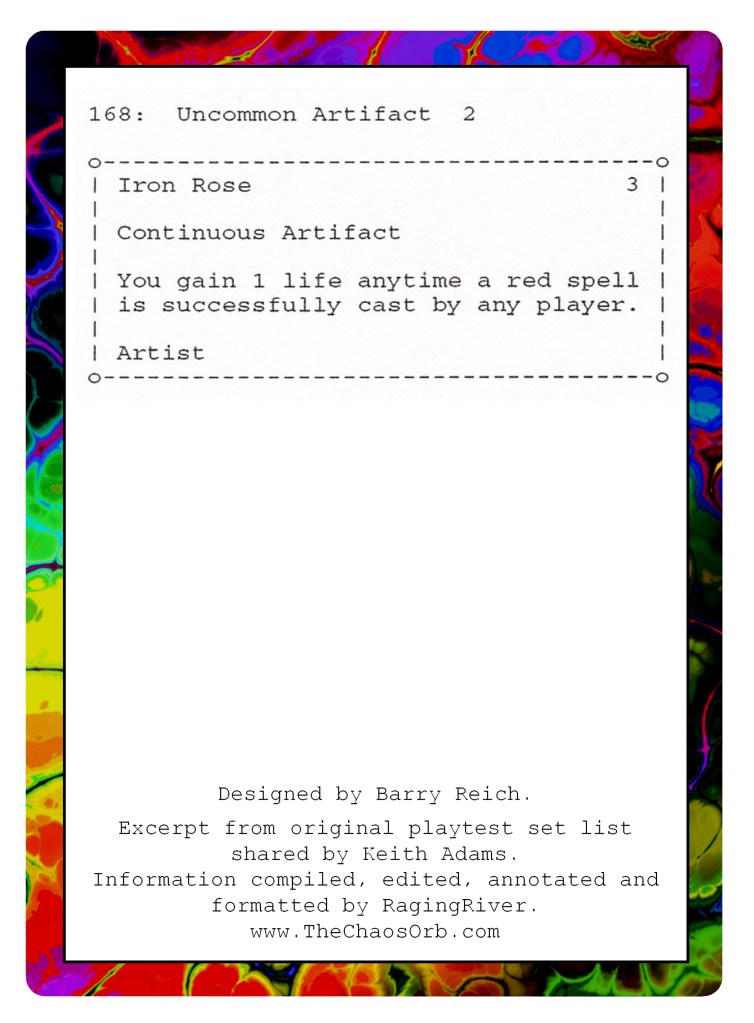
Original Playtest 
Realized
Iron Rose – {3}
Artifact
Whenever a red spell resolves, you gain 1 life.
ChaosHistory: This alternate take on Alpha’s Iron Star would eventually become Darksteel’s lucky charm, Dragon’s Claw.
- You’ll gain 1 life after the red spell finishes resolving, but (if it’s a permanent) before it enters the battlefield. Basically, this trigger will go onto the stack after all “cast” triggers have resolved, but before any “enters the battlefield” triggers are placed on the stack. This is weird, but it’s the closest way to approximate the original wording of the playtest card, which was based on when “a red spell is successfully cast.” The concept of a spell being “successfully cast” is a relic of the pre-5th edition rules, during the era of interrupts and spells resolving in “batches.” Essentially, “successfully cast” meant the spell hadn’t been countered (and there was no remaining way it could be countered), but it hadn’t resolved yet. There’s not a perfect way to recreate this concept in the wording of modern rules. Most cards originally written this way were errata’d to simply trigger upon being “cast,” but I chose to instead word it as triggering upon resolution, as this will more closely recreate how this would have worked under the pre-5th edition rules in most circumstances.
- As long as this was on the battlefield when the red spell started resolving, Iron Rose‘s ability will still trigger when that spell finishes resolving even if it’s no longer on the battlefield (for example, if that spell destroyed Iron Rose).
169 – Ivory Chalice
(Uncommon Artifact)

Original Playtest 
Realized
Ivory Chalice – {3}
Artifact
Whenever a white spell resolves, you gain 1 life.
ChaosHistory: This alternate take on Alpha’s Ivory Cup would eventually become Darksteel’s lucky charm, Angel’s Feather.
- You’ll gain 1 life after the white spell finishes resolving, but (if it’s a permanent) before it enters the battlefield. Basically, this trigger will go onto the stack after all “cast” triggers have resolved, but before any “enters the battlefield” triggers are placed on the stack. This is weird, but it’s the closest way to approximate the original wording of the playtest card, which was based on when “a white spell is successfully cast.” The concept of a spell being “successfully cast” is a relic of the pre-5th edition rules, during the era of interrupts and spells resolving in “batches.” Essentially, “successfully cast” meant the spell hadn’t been countered (and there was no remaining way it could be countered), but it hadn’t resolved yet. There’s not a perfect way to recreate this concept in the wording of modern rules. Most cards originally written this way were errata’d to simply trigger upon being “cast,” but I chose to instead word it as triggering upon resolution, as this will more closely recreate how this would have worked under the pre-5th edition rules in most circumstances.
- As long as this was on the battlefield when the white spell started resolving, Ivory Chalice‘s ability will still trigger when that spell finishes resolving even if it’s no longer on the battlefield (for example, if that spell destroyed Ivory Chalice).
170 – Crown of Bone
(Uncommon Artifact)

Original Playtest 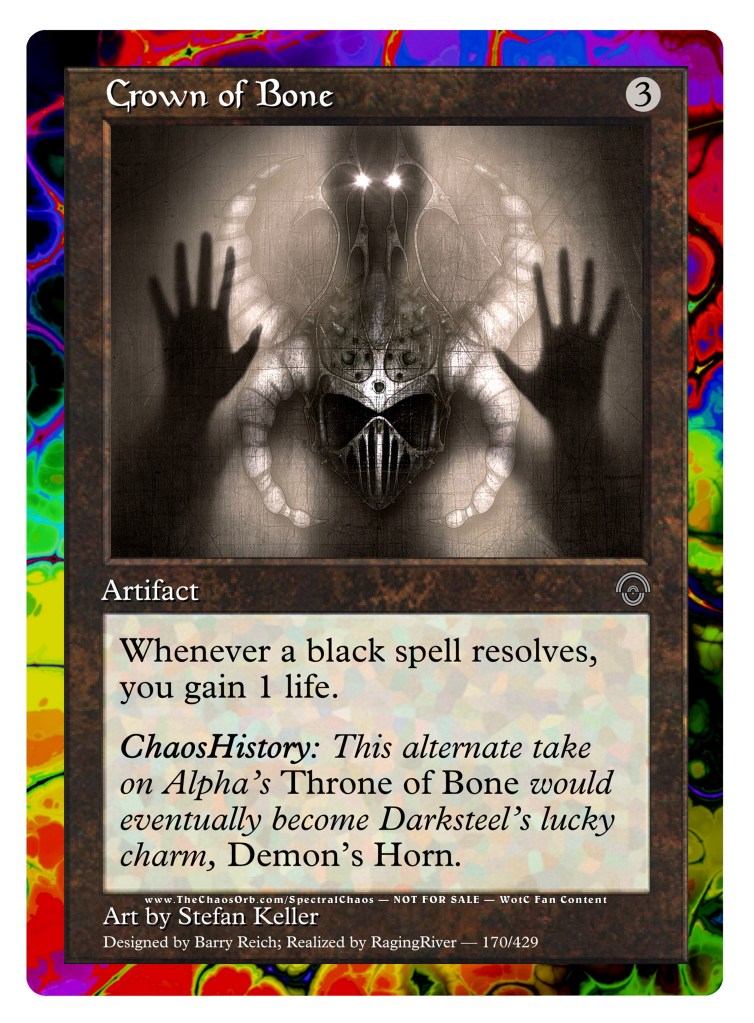
Realized
Crown of Bone – {3}
Artifact
Whenever a black spell resolves, you gain 1 life.
ChaosHistory: This alternate take on Alpha’s Throne of Bone would eventually become Darksteel’s lucky charm, Demon’s Horn.
- You’ll gain 1 life after the black spell finishes resolving, but (if it’s a permanent) before it enters the battlefield. Basically, this trigger will go onto the stack after all “cast” triggers have resolved, but before any “enters the battlefield” triggers are placed on the stack. This is weird, but it’s the closest way to approximate the original wording of the playtest card, which was based on when “a black spell is successfully cast.” The concept of a spell being “successfully cast” is a relic of the pre-5th edition rules, during the era of interrupts and spells resolving in “batches.” Essentially, “successfully cast” meant the spell hadn’t been countered (and there was no remaining way it could be countered), but it hadn’t resolved yet. There’s not a perfect way to recreate this concept in the wording of modern rules. Most cards originally written this way were errata’d to simply trigger upon being “cast,” but I chose to instead word it as triggering upon resolution, as this will more closely recreate how this would have worked under the pre-5th edition rules in most circumstances.
- As long as this was on the battlefield when the black spell started resolving, Crown of Bone‘s ability will still trigger when that spell finishes resolving even if it’s no longer on the battlefield (for example, if that spell destroyed Crown of Bone).
171 – Ivy Sphere
(Uncommon Artifact)

Original Playtest 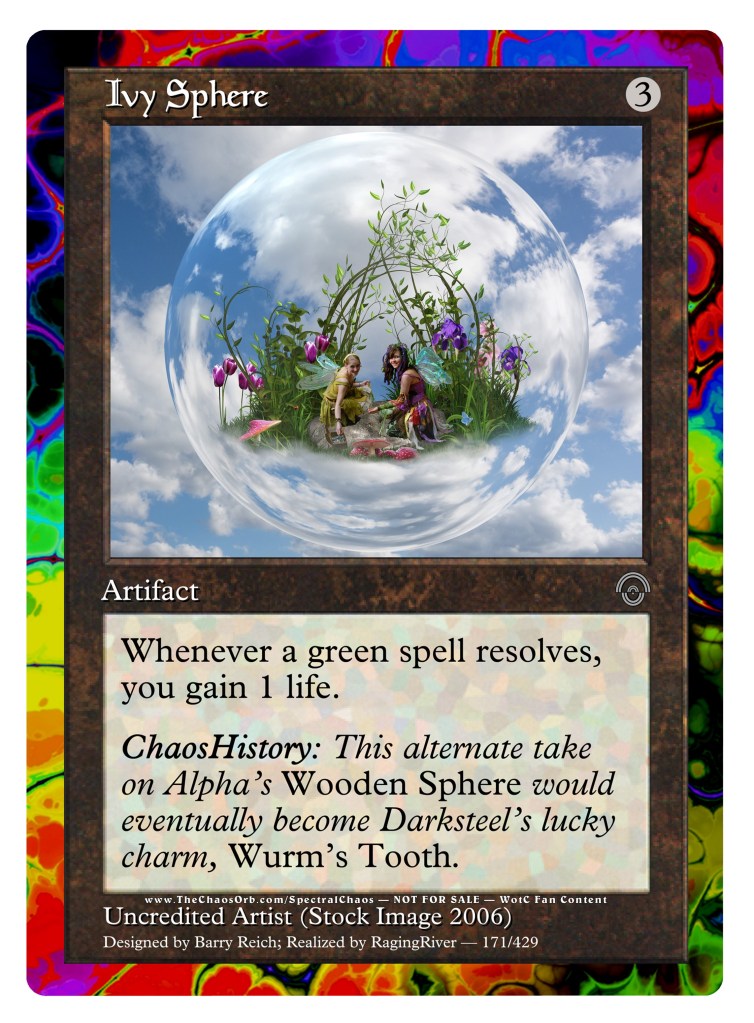
Realized
Ivy Sphere – {3}
Artifact
Whenever a green spell resolves, you gain 1 life.
ChaosHistory: This alternate take on Alpha’s Wooden Sphere would eventually become Darksteel’s lucky charm, Wurm’s Tooth.
- You’ll gain 1 life after the green spell finishes resolving, but (if it’s a permanent) before it enters the battlefield. Basically, this trigger will go onto the stack after all “cast” triggers have resolved, but before any “enters the battlefield” triggers are placed on the stack. This is weird, but it’s the closest way to approximate the original wording of the playtest card, which was based on when “a green spell is successfully cast.” The concept of a spell being “successfully cast” is a relic of the pre-5th edition rules, during the era of interrupts and spells resolving in “batches.” Essentially, “successfully cast” meant the spell hadn’t been countered (and there was no remaining way it could be countered), but it hadn’t resolved yet. There’s not a perfect way to recreate this concept in the wording of modern rules. Most cards originally written this way were errata’d to simply trigger upon being “cast,” but I chose to instead word it as triggering upon resolution, as this will more closely recreate how this would have worked under the pre-5th edition rules in most circumstances.
- As long as this was on the battlefield when the green spell started resolving, Ivy Sphere‘s ability will still trigger when that spell finishes resolving even if it’s no longer on the battlefield (for example, if that spell destroyed Ivy Sphere).
172 – Soul Gate
(Uncommon Artifact)

Original Playtest 
Realized
Soul Gate – {3}
Artifact
Whenever a creature dies, you gain 1 life.
ChaosHistory: This alternate version of Alpha’s Soul Net was never printed as an artifact, but it would become the white enchantment Moonlit Wake in Mercadian Masques.
- A creature that’s been regenerated or exiled hasn’t died, so you won’t gain life.
173 – Helm of Disorder
(Uncommon Artifact)

Original Playtest 
Realized
Helm of Disorder – {1}
Artifact
Whenever a chaotic spell resolves, you gain 1 life.
- You’ll gain 1 life after the chaotic spell finishes resolving, but (if it’s a permanent) before it enters the battlefield. Basically, this trigger will go onto the stack after all “cast” triggers have resolved, but before any “enters the battlefield” triggers are placed on the stack. This is weird, but it’s the closest way to approximate the original wording of the playtest card, which was based on when “a chaotic spell is successfully cast.” The concept of a spell being “successfully cast” is a relic of the pre-5th edition rules, during the era of interrupts and spells resolving in “batches.” Essentially, “successfully cast” meant the spell hadn’t been countered (and there was no remaining way it could be countered), but it hadn’t resolved yet. There’s not a perfect way to recreate this concept in the wording of modern rules. Most cards originally written this way were errata’d to simply trigger upon being “cast,” but I chose to instead word it as triggering upon resolution, as this will more closely recreate how this would have worked under the pre-5th edition rules in most circumstances.
- As long as Helm of Disorder was on the battlefield when that chaotic spell started resolving, Helm of Disorder‘s ability will still trigger when that spell finishes resolving even if it’s no longer on the battlefield (for example, if that spell destroyed Helm of Disorder).
174 – Rainbow Orb
(Uncommon Artifact)
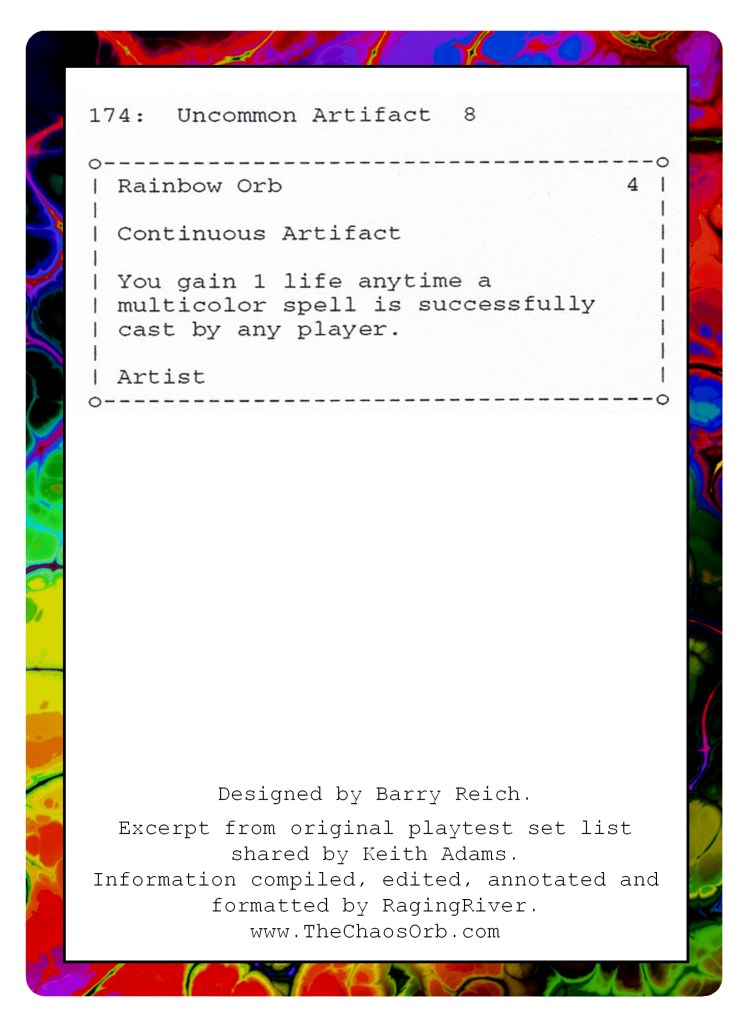
Original Playtest 
Realized
Rainbow Orb – {4}
Artifact
Whenever a multicolor spell resolves, you gain 1 life.
- You’ll gain 1 life after the multicolor spell finishes resolving, but (if it’s a permanent) before it enters the battlefield. Basically, this trigger will go onto the stack after all “cast” triggers have resolved, but before any “enters the battlefield” triggers are placed on the stack. This is weird, but it’s the closest way to approximate the original wording of the playtest card, which was based on when “a multicolor spell is successfully cast.” The concept of a spell being “successfully cast” is a relic of the pre-5th edition rules, during the era of interrupts and spells resolving in “batches.” Essentially, “successfully cast” meant the spell hadn’t been countered (and there was no remaining way it could be countered), but it hadn’t resolved yet. There’s not a perfect way to recreate this concept in the wording of modern rules. Most cards originally written this way were errata’d to simply trigger upon being “cast,” but I chose to instead word it as triggering upon resolution, as this will more closely recreate how this would have worked under the pre-5th edition rules in most circumstances.
- As long as Rainbow Orb was on the battlefield when that multicolor spell started resolving, Rainbow Orb‘s ability will still trigger when that spell finishes resolving even if it’s no longer on the battlefield (for example, if that spell destroyed Rainbow Orb).
175 – Helm of Order
(Uncommon Artifact)

Original Playtest 
Realized
Helm of Order – {2}
Artifact
Whenever a chaotic spell controlled by an opponent resolves, Helm of Order deals 2 damage to that player.
- The player will be dealt damage after the chaotic spell finishes resolving, but (if it’s a permanent) before it enters the battlefield. Basically, this trigger will go onto the stack after all “cast” triggers have resolved, but before any “enters the battlefield” triggers are placed on the stack. This is weird, but it’s the closest way to approximate the original wording of the playtest card, which was based on when a player “successfully casts a chaotic spell.” The concept of a spell being “successfully cast” is a relic of the pre-5th edition rules, during the era of interrupts and spells resolving in “batches.” Essentially, “successfully cast” meant the spell hadn’t been countered (and there was no remaining way it could be countered), but it hadn’t resolved yet. There’s not a perfect way to recreate this concept in the wording of modern rules. Most cards originally written this way were errata’d to simply trigger upon being “cast,” but I chose to instead word it as triggering upon resolution, as this will more closely recreate how this would have worked under the pre-5th edition rules in most circumstances.
- As long as Helm of Order was on the battlefield when that chaotic spell started resolving, Helm of Order‘s ability will still trigger when that spell finishes resolving even if it’s no longer on the battlefield (for example, if that spell destroyed Helm of Order).
176 – Shylock’s Mazer
(Uncommon Artifact)
Original Playtest 
Realized
Shylock’s Mazer – {2}
Artifact
{T}: Add three mana of any one color. Put 3 charge counters on Shylock’s Mazer.
At the beginning of your upkeep, if there are any charge counters on Shylock’s Mazer, add another charge counter.
{1}: Remove a charge counter from Shylock’s Mazer. Activate this ability only during your upkeep.
At the beginning of your draw step, you lose life equal to the number of charge counters on Shylock’s Mazer.
- Shylock’s Mazer‘s triggered ability will trigger and add a charge counter if there were any charge counters on it when your upkeep step began, even if there aren’t any charge counters on it anymore by the time this ability resolves.
177 – Lifegiver
(Uncommon Artifact Creature)

Original Playtest 
Realized
Lifegiver – {3}
Artifact Creature – Construct
Whenever Lifegiver dies or is regenerated, you gain 2 life. (It must actually be regenerated; merely placing a regeneration shield on it doesn’t result in life gain.)
1/1
178 – Faded Mox
(Uncommon Artifact)
Original Playtest 
Realized
Faded Mox – {0}
Artifact
{T}: Add {1}.
ChaosHistory: A promotional prize card with this same design called Mox Crystal was given to winners of some “5-color” tournaments (an unofficial Magic format with devout followers in the early 2000s). 5-color became “Prismatic” on MTGO.
179 – Ethereal Shifter
(Uncommon Artifact Creature)
Original Playtest 
Realized
Ethereal Shifter – {1}
Artifact Creature – Construct
Shroud
Prevent all non-combat damage that would be dealt to Ethereal Shifter.
1/2
180 – Mana Magnet
(Uncommon Artifact)

Original Playtest 
Realized
Mana Magnet – {1}
Artifact
You don’t lose life from mana burn.
{1}: Put a magnet counter on Mana Magnet. Activate this ability only on your turn, and only once per turn.
{T}, sacrifice Mana Magnet: Add an amount of colorless mana equal to the number of magnet counters on Mana Magnet.
- Mana will still empty at the end of each step and phase, you just don’t lose life because of it.
- If Mana Magnet leaves the battlefield, its effect ceases immediately. You’ll take mana burn from unused mana when your mana pool empites at the end of that step or phase.
181 – Paxin’s Gauntlets
(Uncommon Artifact)
Original Playtest 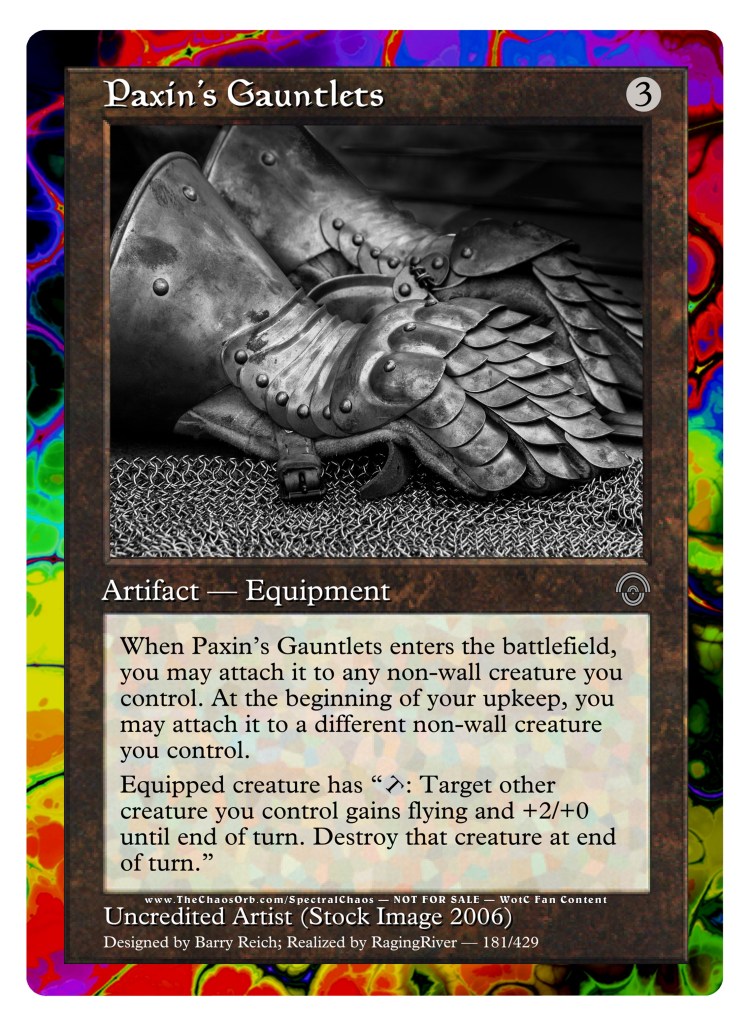
Realized
Paxin’s Gauntlets – {3}
Artifact – Equipment
When Paxin’s Gauntlets enters the battlefield, you may attach it to any non-wall creature you control. At the beginning of your upkeep, you may attach it to a different non-wall creature you control.
Equipped creature has “{T}: Target other creature you control gains flying and +2/+0 until end of turn. Destroy that creature at end of turn.”
- This equipment has no “equip” ability, because Barry Reich conceived of this over 10 years before equipment was first printed by Wizards of the Coast.
182 – Jaccartel
(Uncommon Artifact Creature)

Original Playtest 
Realized
Jaccartel – {4}
Artifact Creature – Golem
Flying
Choose an opponent as Jaccartel enters the battlefield. Jaccartel gets -1/-1 for each type of basic land that opponent controls.
When that opponent loses the game, sacrifice Jaccartel.
6/6
- Jaccartel counts basic land types, but it only looks at basic lands when doing that count. So it won’t see non-basic lands at all, but if a basic land somehow acquires a second basic land type, Jaccartel would see and count that.
183 – Celestial Prism
(Uncommon Artifact)
Original Playtest 
Realized
Celestial Prism – {3}
Artifact
{2}, {T}: Add 1 mana of any color.
ChaosHistory: One of only three true reprints from the original Alpha set in Spectral Chaos, this was a logical inclusion in a multicolor set.
184 – Scroll of Papyrus
(Uncommon Artifact)
Original Playtest 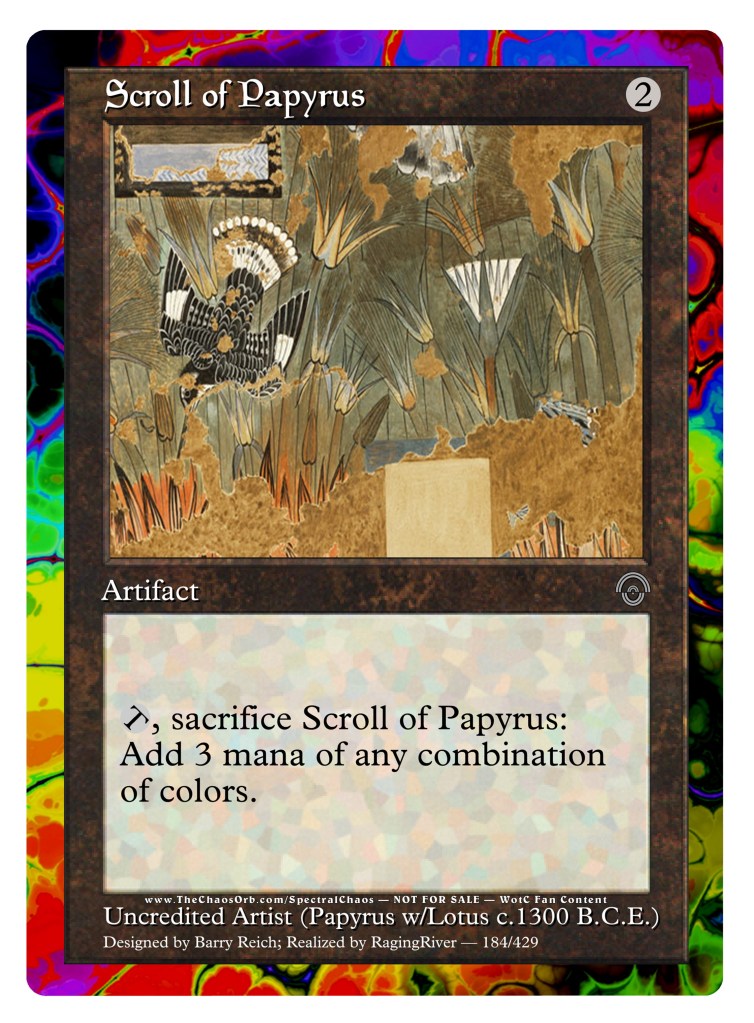
Realized
Scroll of Papyrus – {2}
Artifact
{T}, sacrifice Scroll of Papyrus: Add 3 mana of any combination of colors.
185 – Sequential
(Uncommon Artifact Creature)
Original Playtest 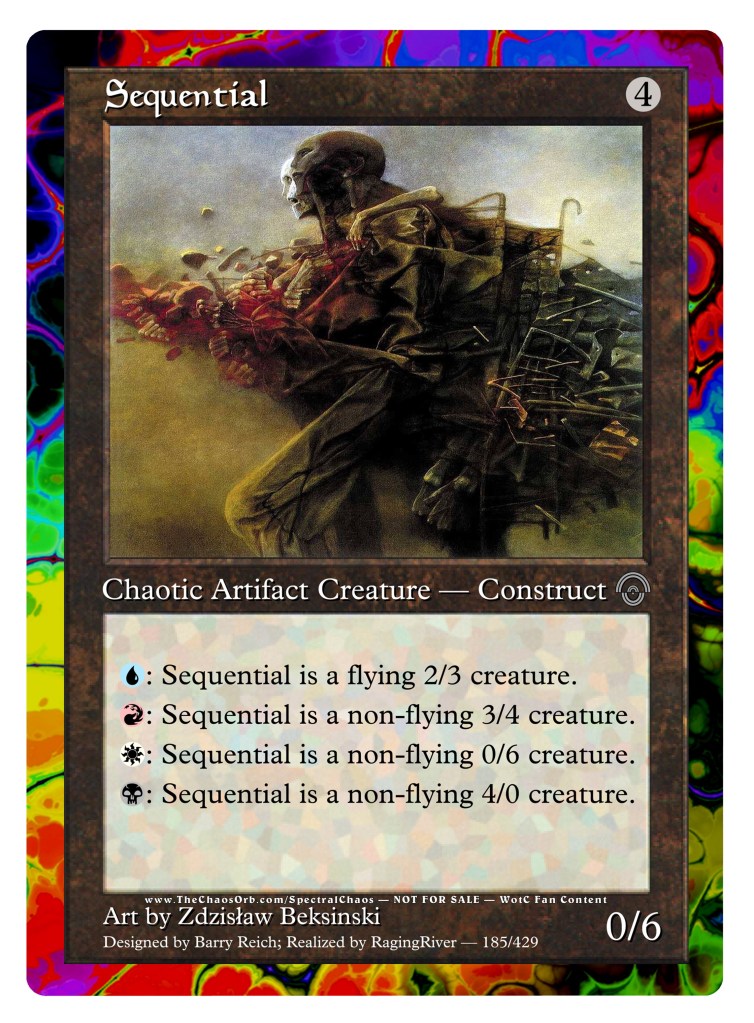
Realized
Sequential – {4}
Chaotic Artifact Creature – Construct
{U}: Sequential is a flying 2/3 creature.
{R}: Sequential is a non-flying 3/4 creature.
{W}: Sequential is a non-flying 0/6 creature.
{B}: Sequential is a non-flying 4/0 creature.
0/6
- Each ability resets Sequential‘s base power and toughness. Auras or other effects that change its power or toughness will now change the new base power or toughness.
- The abilities do not end at end of turn. Sequential will have the new base power and toughness until you activate one of its abilities again or some other effect changes its base power or toughness.
- When you activate any ability other than the first ability, Sequential will lose flying if it had that ability. Something else could still give it flying later on.
- Sequential‘s last activated ability will set the base toughness to zero. If you activate this ability, it will need its toughness pumped by an aura or some other effect, otherwise it will just immediately die.
186 – Gymnasium
(Uncommon Artifact)
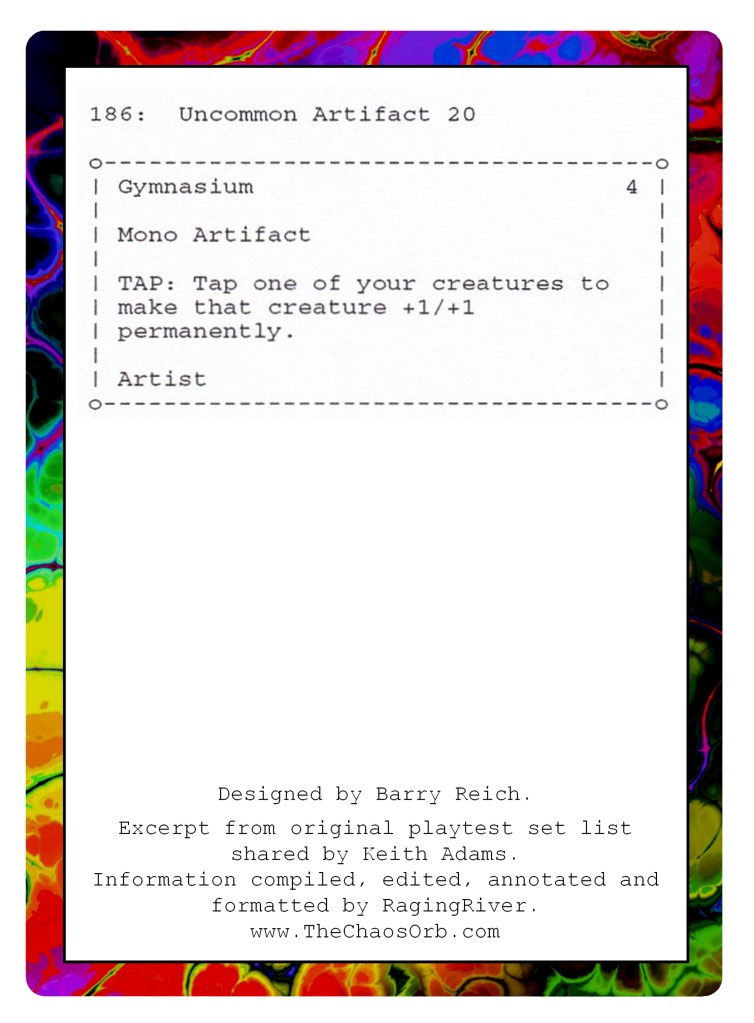
Original Playtest 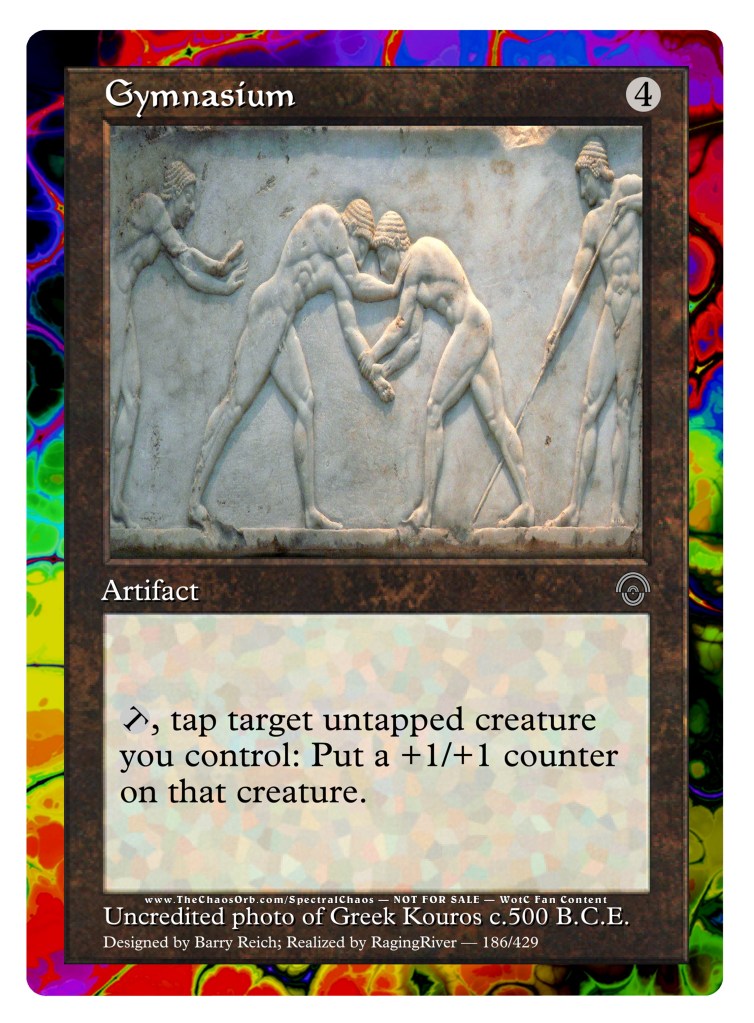
Realized
Gymnasium – {4}
Artifact
{T}, tap target untapped creature you control: Put a +1/+1 counter on that creature.
187 – Copy Chaos
(Uncommon Enchantment (Multicolor))
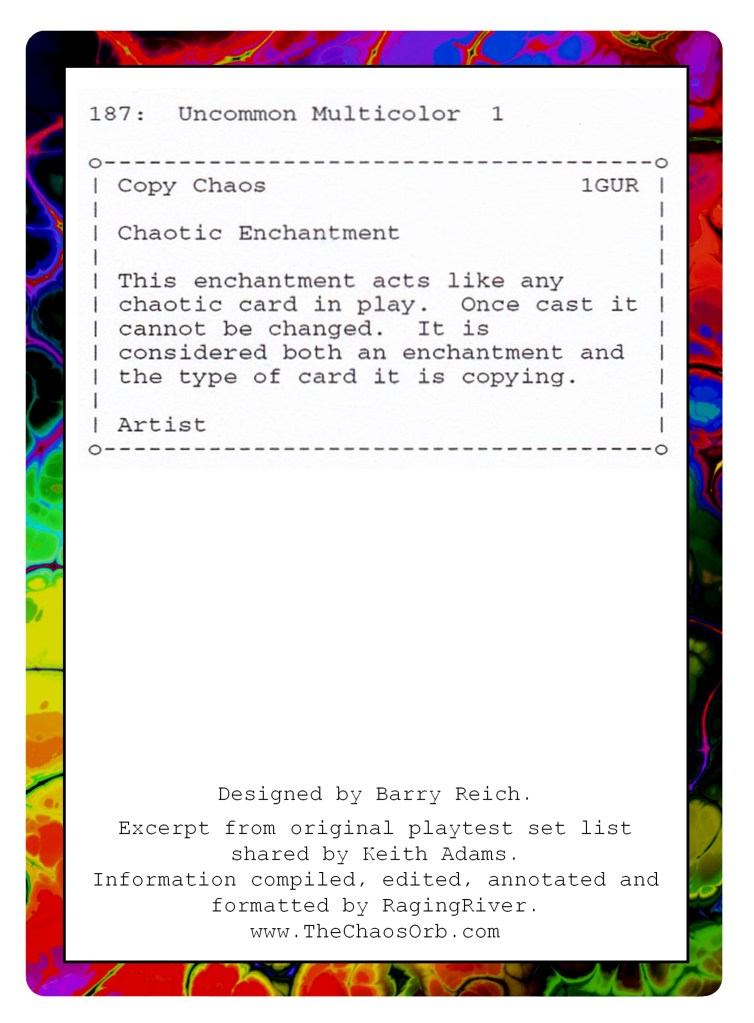
Original Playtest 
Realized
Copy Chaos – {1}{U}{R}{G}
Chaotic Enchantment
You may have Copy Chaos enter the battlefield as a copy of any chaotic permanent on the battlefield, except it’s an enchantment in addition to its other types.
- Copy Chaos doesn’t target the chosen permanent.
- If you choose to copy an aura, you also choose a legal permanent for the Copy Chaos copy of it to enchant. Copy Chaos doesn’t target that permanent, however, so it can enter the battlefield attached to a creature with shroud or hexproof.
- If you choose an aura and there isn’t a legal permanent for it to enchant, you put Copy Chaos into your graveyard. It never enters the battlefield.
- If you don’t choose anything for Copy Chaos to copy, it enters the battlefield without copying anything, and it sits there with a useless ability.
- Copies all copiable values, including mana cost and color.
- Copy Chaos copies exactly what was printed on the original permanent and nothing more (unless that permanent is copying something else or is a token; see below). It doesn’t copy whether that permanent is tapped or untapped, whether it has any counters on it or Auras attached to it, or any non-copy effects that have changed its power, toughness, types, color, or so on.
- If the chosen permanent is copying something else (for example, if the chosen permanent is another Copy Chaos), then your Copy Chaos enters the battlefield as whatever the chosen permanent copied.
- If the chosen permanent is a token, Copy Chaos copies the original characteristics of that token as stated by the effect that put it onto the battlefield. Copy Chaos is not a token.
- Any enters-the-battlefield abilities of the copied permanent will trigger when Copy Chaos enters the battlefield. Any “as [this permanent] enters the battlefield” or “[this permanent] enters the battlefield with” abilities of the chosen permanent will also work.
- If the chosen permanent has {X} in its mana cost, X is considered to be zero.
- If Copy Chaos somehow enters the battlefield at the same time as another permanent, Copy Chaos can’t become a copy of that permanent. You may choose only a permanent that’s already on the battlefield.
RARES (121):
Click here to download high-resolution copies of the Spectral Chaos Rares at Ko-fi.

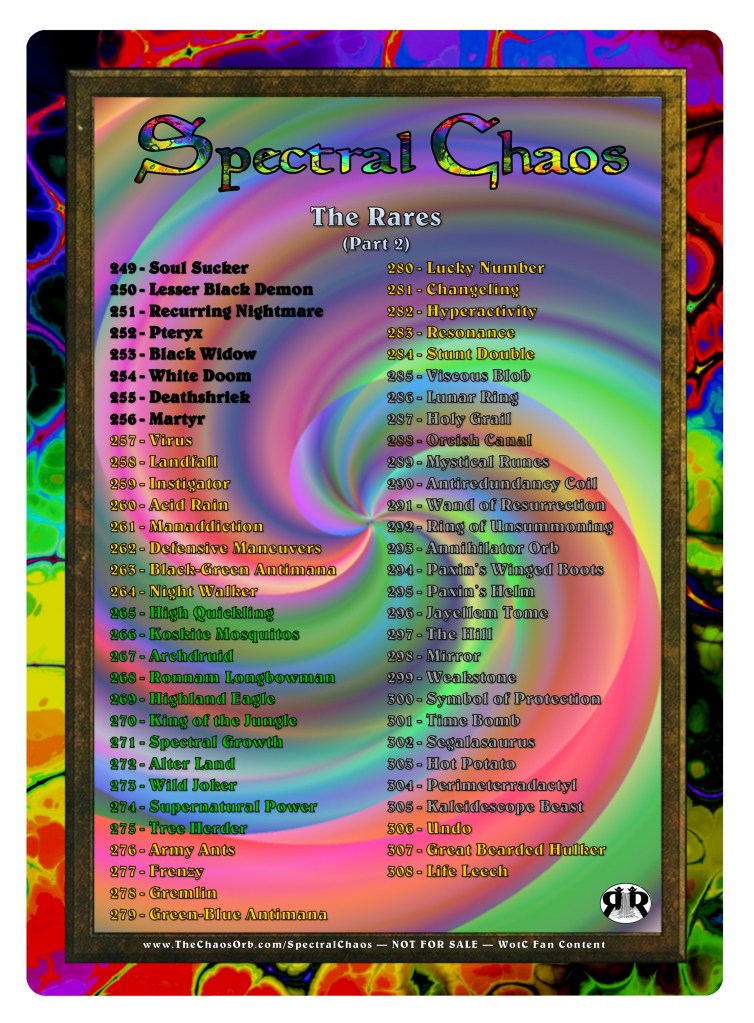
188 – Unstable Terrain
(Rare Land)

Original Playtest 
Realized
Unstable Terrain
Chaotic Land
At the beginning of your upkeep, put a seismic counter on Unstable Terrain. When there are five or more seismic counters on Unstable Terrain, remove them all.
If Unstable Terrain has: -> Unstable Terrain is:
– 0 seismic counters -> an island
– 1 seismic counter -> a mountain
– 2 seismic counters -> a plains
– 3 seismic counters -> a swamp
– 4 seismic counters -> a forest
- While Unstable Terrain has 5 or more seismic counters on it (for example, for the brief period of time after you put the 5th seismic counter on it, while the removal of counters trigger is still on the stack), Unstable Terrain won’t have a basic land type at all.
189 – Mage of the Hidden Way
(Rare Creature (Blue))
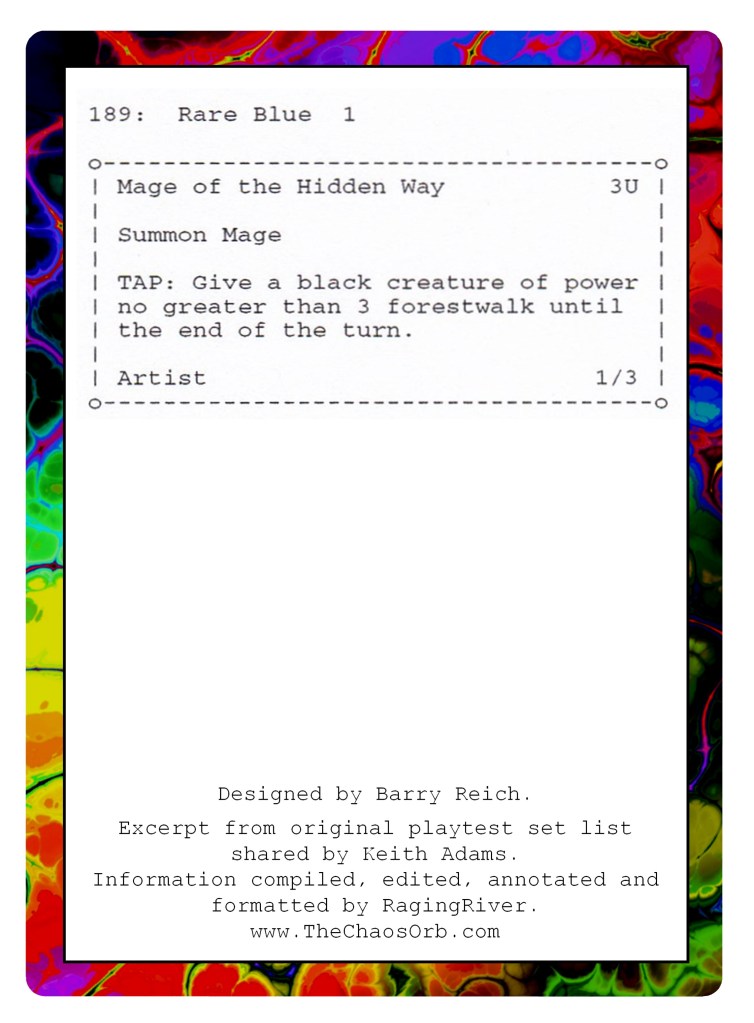
Original Playtest 
Realized
Mage of the Hidden Way – {3}{U}
Creature – Human Wizard
{T}: Target black creature with power no greater than 3 gains forestwalk until end of turn.
1/3
- The creature is checked for color and power level when it is targeted, and again when this ability resolves.
- The creature will still have forestwalk even if its color or power changes later in the turn.
190 – Dolphin King
(Rare Creature (Blue))
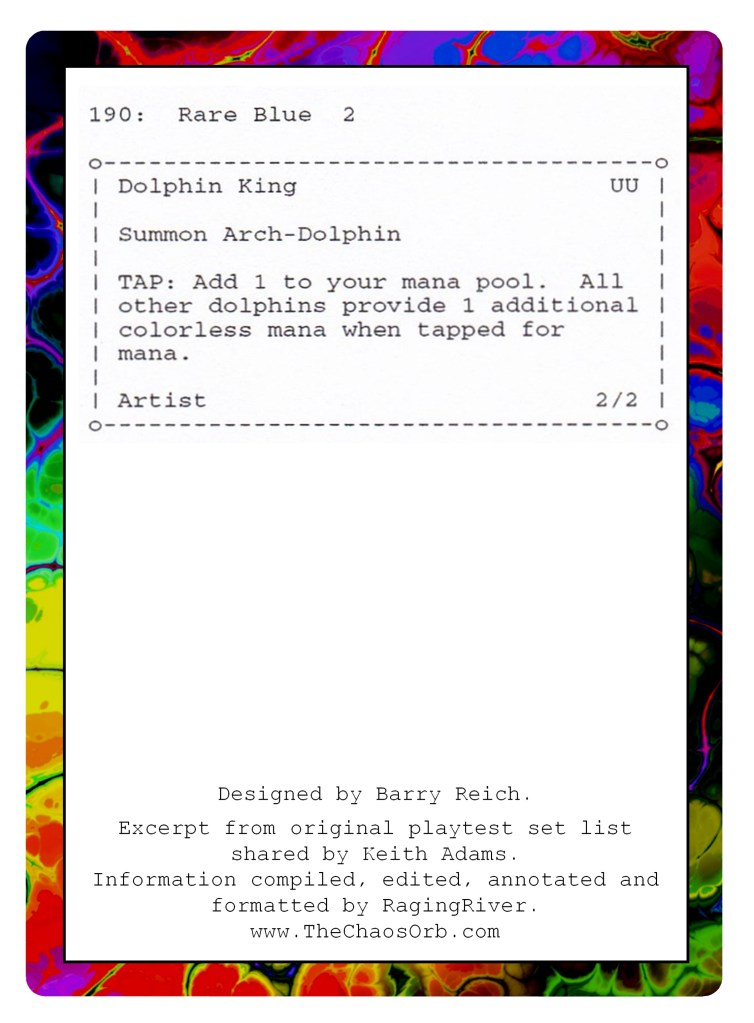
Original Playtest 
Realized
Dolphin King – {U}{U}
Creature – Dolphin Lord
{T}: Add {1}.
Whenever another dolphin you control is tapped for mana, it provides an additional {1}.
2/2
191 – Sultanic Ardor
(Rare Enchantment (Blue))

Original Playtest 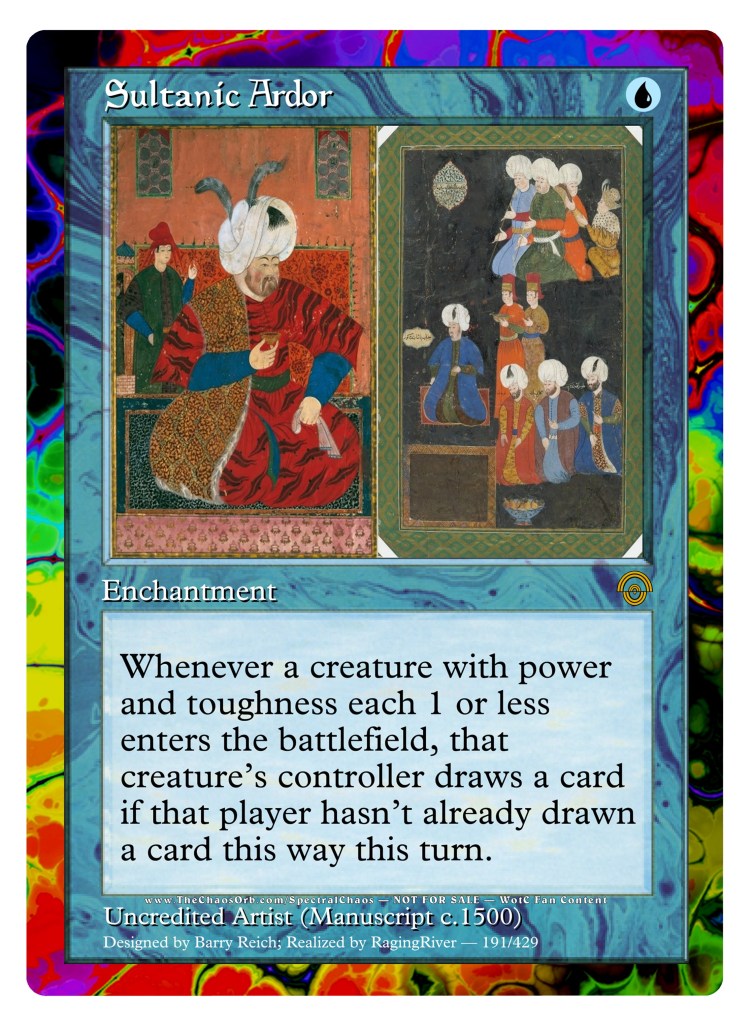
Realized
Sultanic Ardor – {U}
Enchantment
Whenever a creature with power and toughness each 1 or less enters the battlefield, that creature’s controller draws a card if that player hasn’t already drawn a card this way this turn.
- Normally this will trigger for 0/1 or 1/1 creatures. However, a 1/0, 0/0 or creature with negative power and toughness would also cause it to trigger.
- The creature entering the battlefield is what triggers the ability. If for some reason that creature is immediately sacrificed or placed in the graveyard (for example, if its toughness to 0 or less), it still entered the battlefield so Sultanic Ardor will still trigger.
- Sultanic Ardor cares about the power and toughness of the creature when it first enters the battlefield (i.e., its base power and toughness, as modified by any continuous effects). It doesn’t matter if an “enter the battlefield” or other triggered ability will soon modify that power or toughness.
- Sultanic Ardor‘s ability will only trigger for a player once per turn, the first time a creature enters the battlefield that satisfies the criteria. It doesn’t matter if other creatures come into play, or that first creature is bounced and then re-enters play.
- If something prevents the card draw entirely (like Leovold, Emissary of Trest), then Sultanic Ardor would trigger again the next time this turn a creature that satisfies the criteria enters the battlefield under that player’s control. However, if something replaces the card draw with something else (like Uba Mask), that player is still considered to have “drawn a card this way this turn” and Sultanic Ardor‘s ability won’t trigger again for that player this turn.
192 – Dark Djinn
(Rare Creature (Blue))
Original Playtest 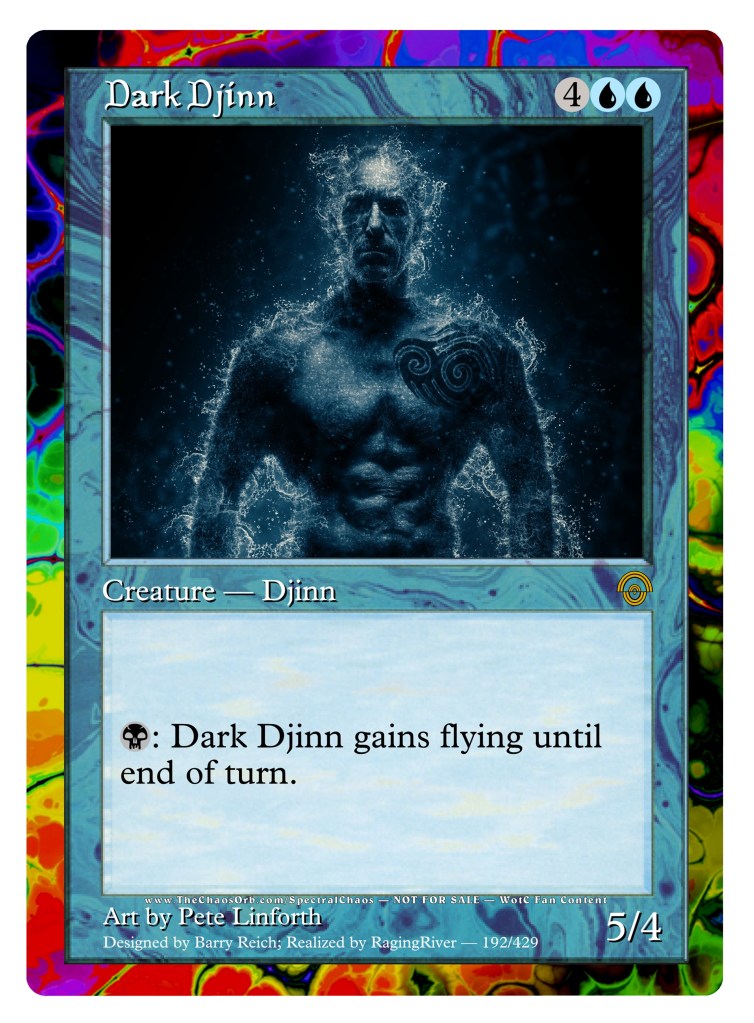
Realized
Dark Djinn – {4}{U}{U}
Creature – Djinn
{B}: Dark Djinn gains flying until end of turn.
5/4
193 – Dark Viper
(Rare Creature (Blue))

Original Playtest 
Realized
Dark Viper – {5}{U}{U}
Creature – Snake
Swamphome
6/7
194 – Updraft
(Rare Enchantment (Blue))
Original Playtest 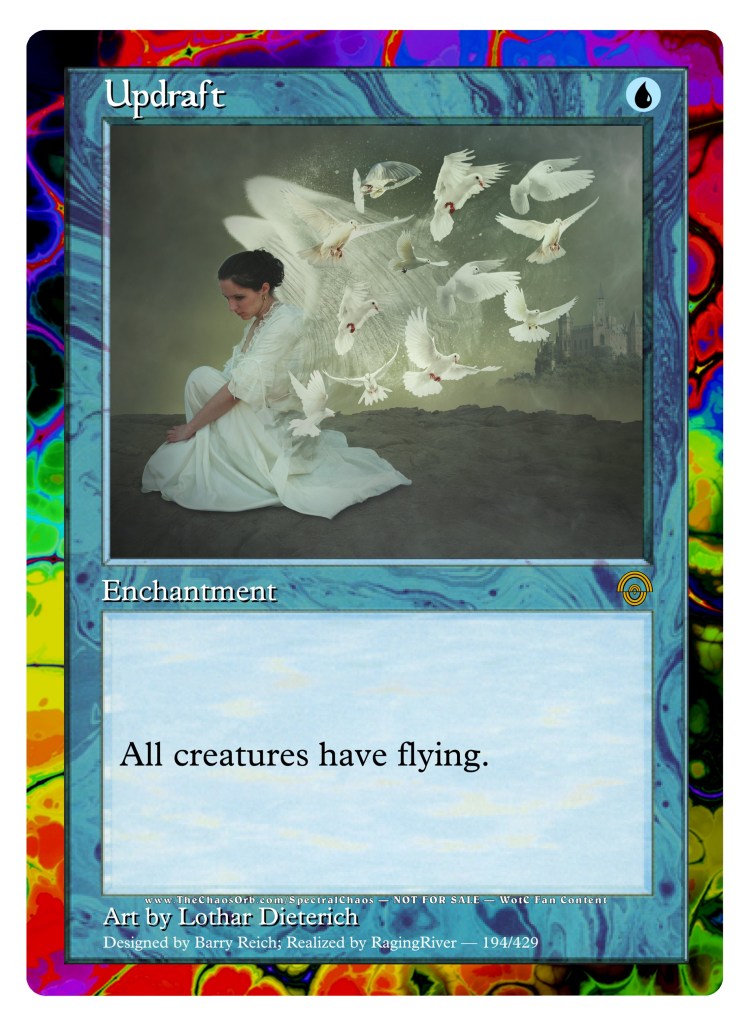
Realized
Updraft – {U}
Enchantment
All creatures have flying.
- This gives flying to all creatures on the battlefield when it enters the battlefield, and to each creature as that creature enters the battlefield. It does not prevent the flying ability being taken away from a creature after Updraft is already on the battlefield.
195 – Sayers’ Influence
(Rare Sorcery (Blue))
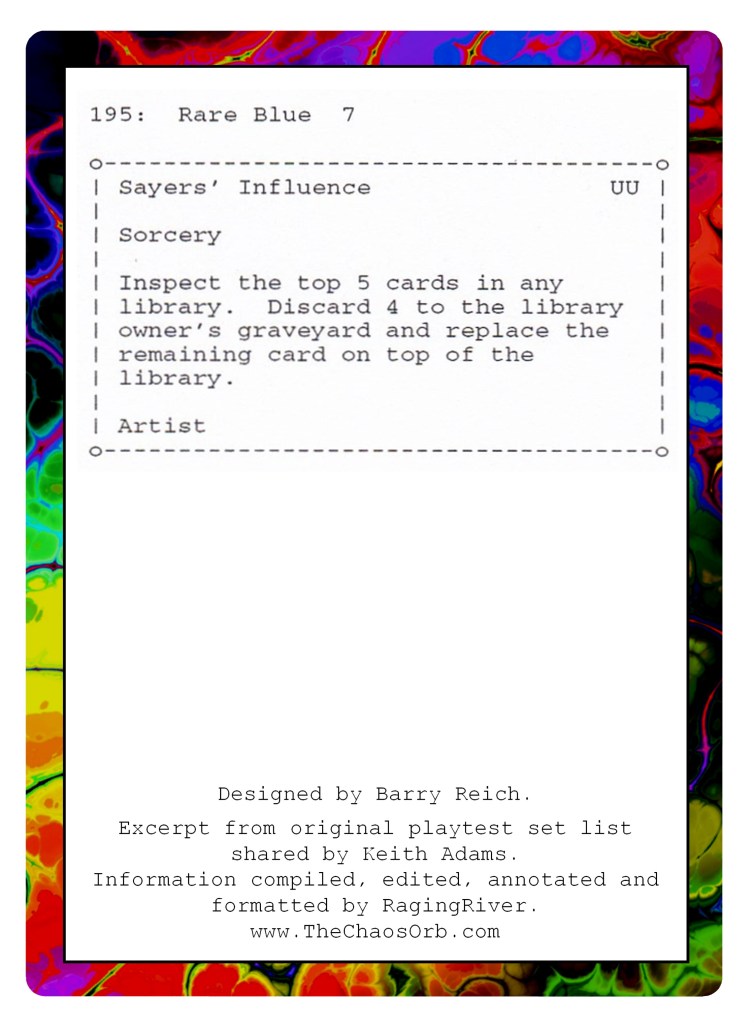
Original Playtest 
Realized
Sayers’ Influence – {U}{U}
Sorcery
Look at the top five cards of target player’s library. Put one card on top of their library and the rest in their graveyard.
ChaosHistory: Craig Sayers was a classmate and close friend of Barry’s.
196 – Great Flood
(Rare Sorcery (Blue))
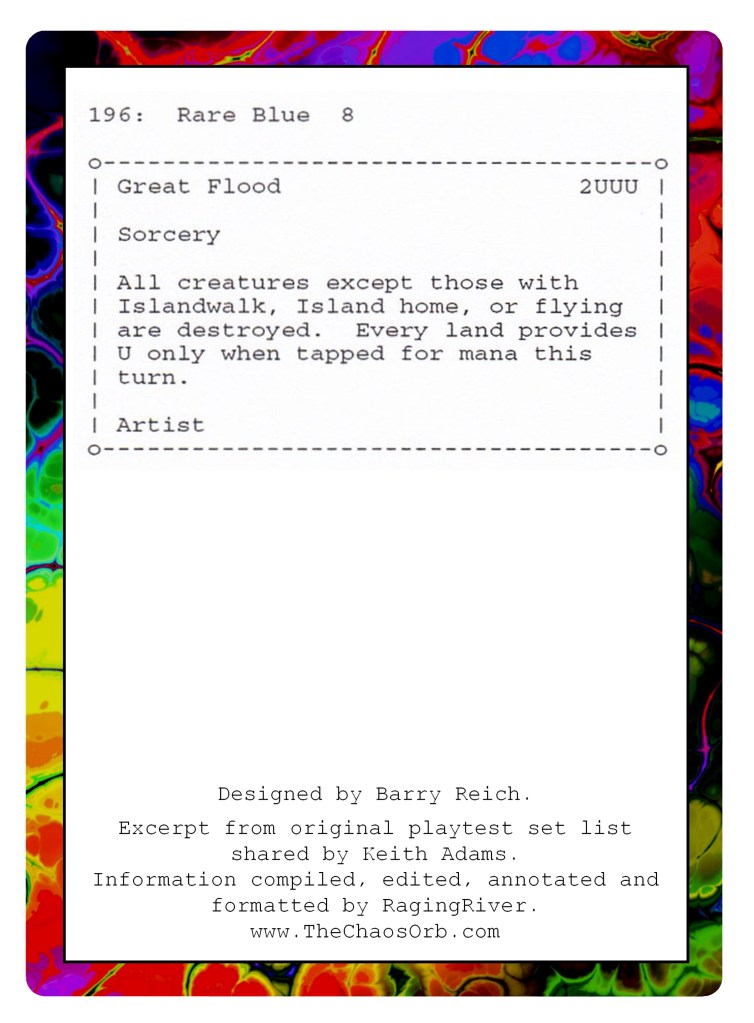
Original Playtest 
Realized
Great Flood – {2}{U}{U}{U}
Sorcery
Destroy all creatures that don’t have islandwalk, islandhome or flying.
Until end of turn, whenever a land is tapped for mana, it produces {U} instead of any other type.
- This only changes the color of mana that lands produce. It doesn’t change the quantity of or restrictions on mana generated from those lands.
197 – Pipe
(Rare Instant (Blue))

Original Playtest 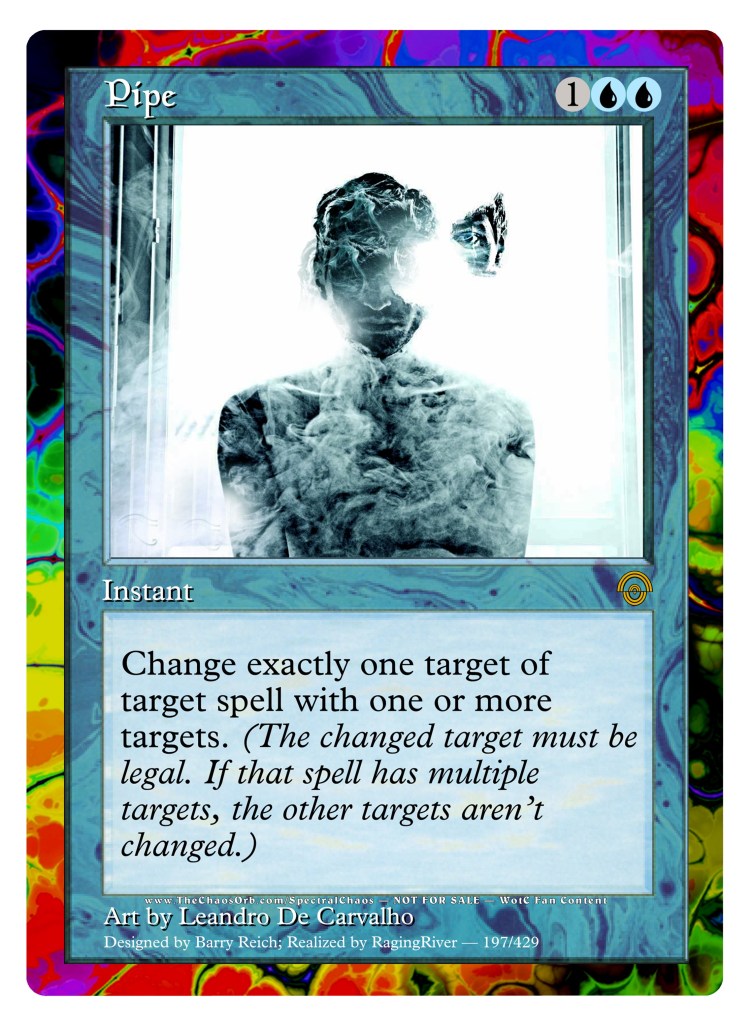
Realized
Pipe – {1}{U}{U}
Instant
Change exactly one target of target spell with one or more targets. (The changed target must be legal. If that spell has multiple targets, the other targets aren’t changed.)
198 – Numerical Hack
(Rare Instant (Blue))

Original Playtest 
Realized
Numerical Hack – {U}
Instant
Change the text of target permanent or spell by increasing all instances of one numeral or number word by 1. (For example, you can change “pay 3 life” to “pay 4 life,” or “draw one card” to “draw two cards.” You can’t increase words like “a” or “the” to “two”. You can’t increase values of {X}, numbers in generic mana symbols, or the number of targets required for a spell or ability already on the stack. This effect lasts indefinitely.)
- Always refer to the current oracle wording in determining how to apply Numerical Hack‘s effect. The distinction between text like “one counter” and “one permanent” being increased to two, whereas text like “a counter” and “a permanent” is not increased, does seem somewhat arbitrary, understood. But the implications of replacing words like “a” and “the” with “two” are just too far-reaching and too complicated to allow that interpretation.
- If you change the text of a spell which is to become a permanent, the permanent will retain the text change.
- Can target a card with no numerals or number words, or even one with no words at all.
- You can only change numbers printed on the card. It will not change any effects that are on the permanent.
- You choose the number to increase on resolution.
- Alters all occurences of the chosen number in the text box of the given card. For example, if you choose “one,” then all instances in the text of that card of “1” will become “2,” all instances of “one” will become “two,” “once” will become “twice” etc. Will only change the chosen number, not any larger number that may contain the chosen number (for example, if the chosen number is “one,” then “1” will become “2,” but “11” won’t become “12” or “22”).
- The term “number words” for this purpose only refers to cardinals (one, two, six, etc.) and the adverbials (once, twice, six times, etc.). Numerical Hack can’t increase other variants such as ordinals (first, second, sixth, etc.) or multipliers (single, double, sextuple, etc.).
- Power and toughness aren’t considered part of the “text” of a creature card, so you can’t increase the printed base power and toughness. However, a card that uses numerals or number words in its text to set a creature’s power or toughness (like Humility or Simplicity) could be increased, thus increasing the resulting power and toughness of the affected creatures.
- Although this can’t change the converted mana cost of anything, it can be used to increase references to converted mana costs in the text of a card (such as Aluren).
- You can’t change proper nouns (i.e. card names) such as “Two-Headed Giant of Foriys.”
199 – Color Hack
(Rare Instant (Blue))

Original Playtest 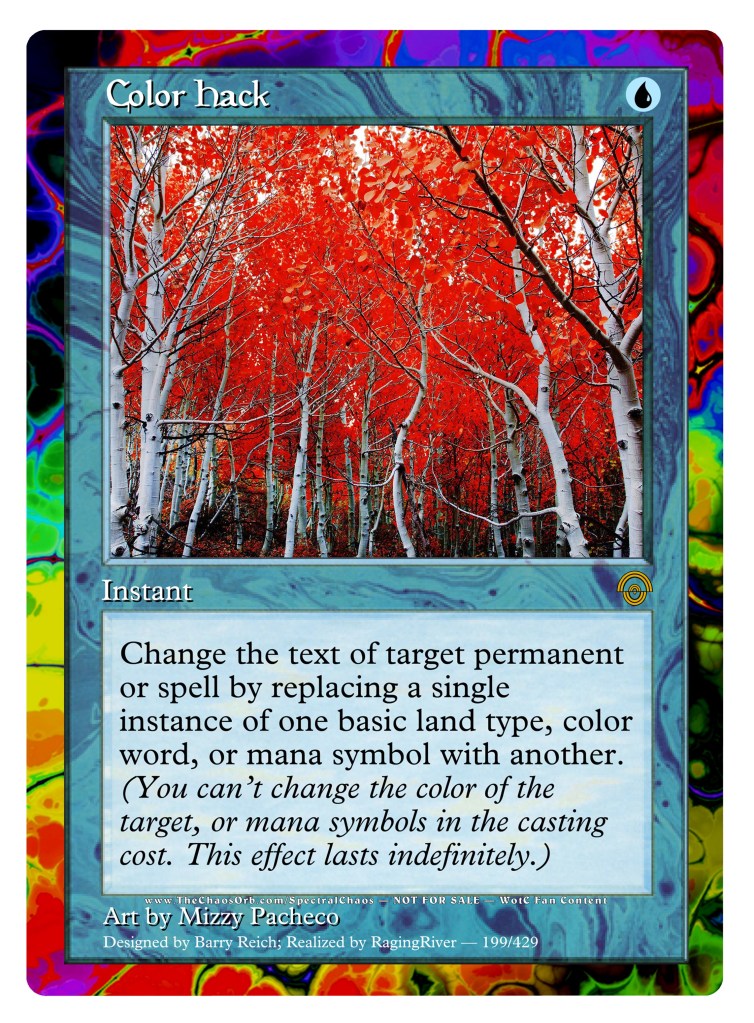
Realized
Color Hack – {U}
Instant
Change the text of target permanent or spell by replacing a single instance of one basic land type, color word, or mana symbol with another. (You can’t change the color of the target, or mana symbols in the casting cost. This effect lasts indefinitely.)
- If you change the text of a spell which is to become a permanent, the permanent will retain the text change.
- Alters one single instance of the chosen word or mana symbol in the text box of the given card. Words that simply refer back to that changed word or mana symbol are deemed to be part of a single “instance” to the extent necessary to make the change “work.”
- Can target a card with no appropriate words or mana symbols on it, or even one with no words at all.
- You can only change a word or mana symbol printed on the card. It will not change any effects that are on the permanent.
- You choose the word or mana symbol to change on resolution. You can’t change a word or mana symbol to itself. It must be a different word or mana symbol.
- It can be used to change a land’s type from one basic land type to another. For example, the land type “Forest” can be changed to “Island” so it produces blue mana. It doesn’t change the name of any permanent.
- No matter what you change, it won’t change the color identity of the card.
- You can’t change proper nouns (i.e. card names) such as “Island Fish Jasconius.”
200 – Magpie
(Rare Creature (Blue))
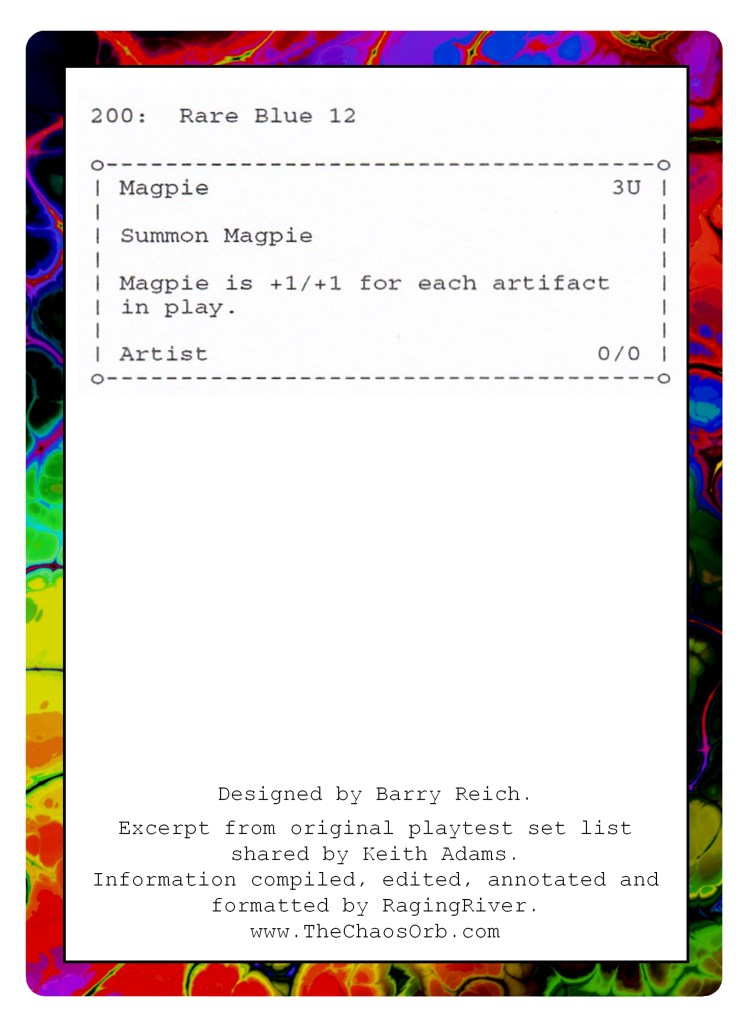
Original Playtest 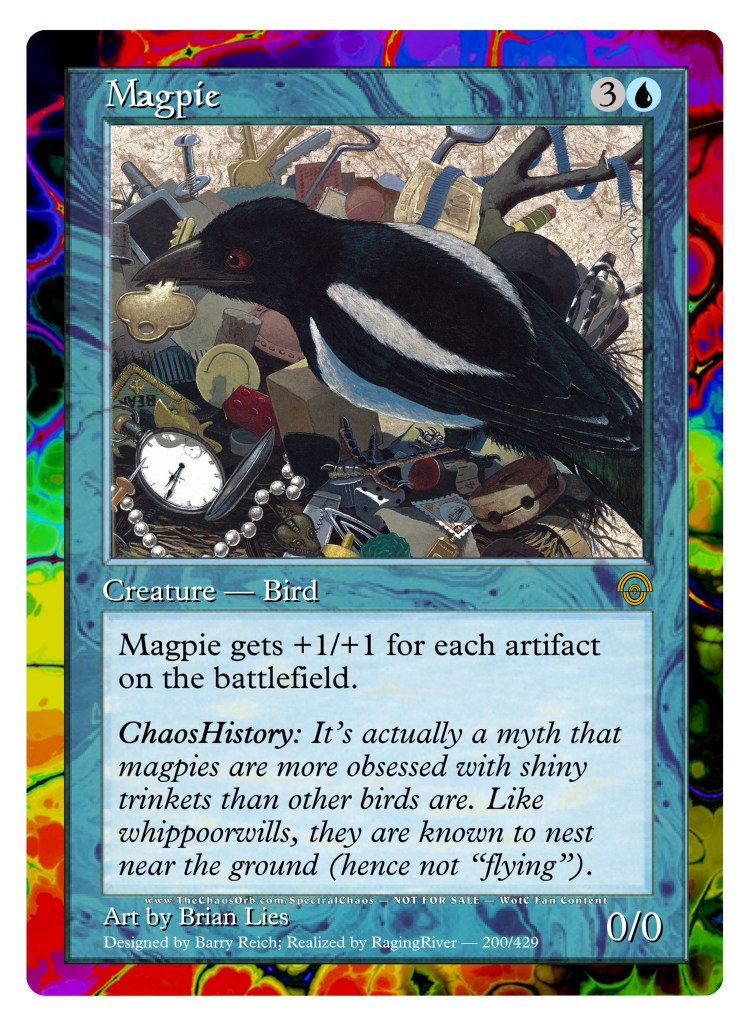
Realized
Magpie – {3}{U}
Creature – Bird
Magpie gets +1/+1 for each artifact on the battlefield.
0/0
ChaosHistory: It’s actually a myth that magpies are more obsessed with shiny trinkets than other birds are. Like whippoorwills, they are known to nest near the ground (hence not “flying”).
201 – Urza’s Spectral Shift
(Rare Instant (Blue))

Original Playtest 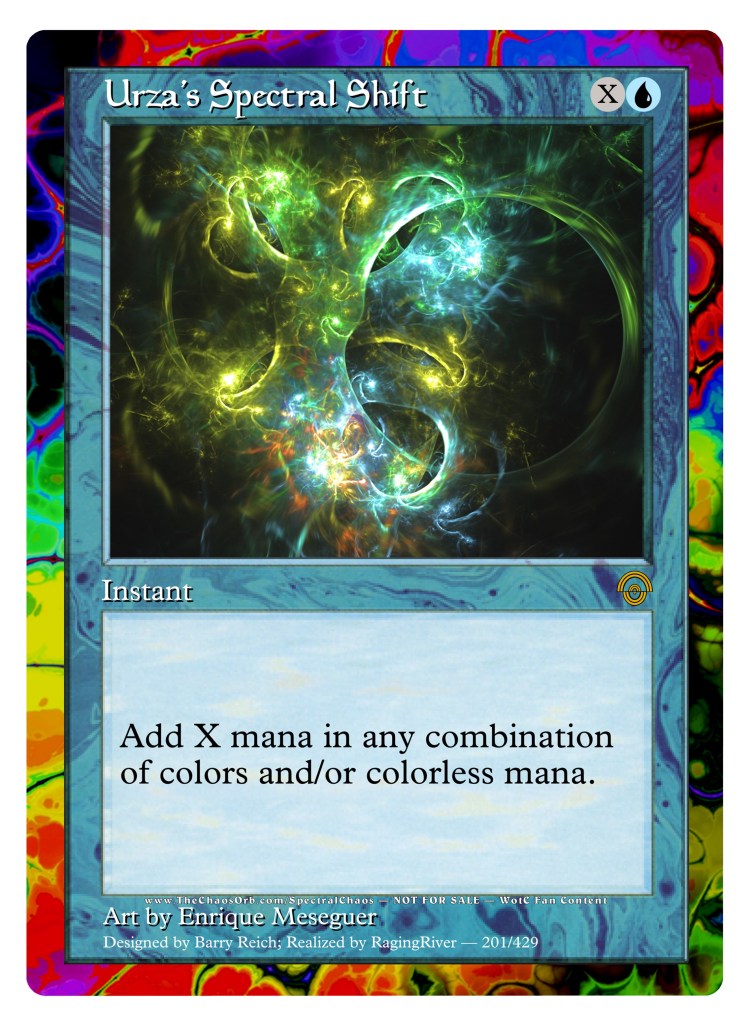
Realized
Urza’s Spectral Shift – {X}{U}
Instant
Add X mana in any combination of colors and/or colorless mana.
202 – Convert Creature
(Rare Enchantment (Multicolor))

Original Playtest 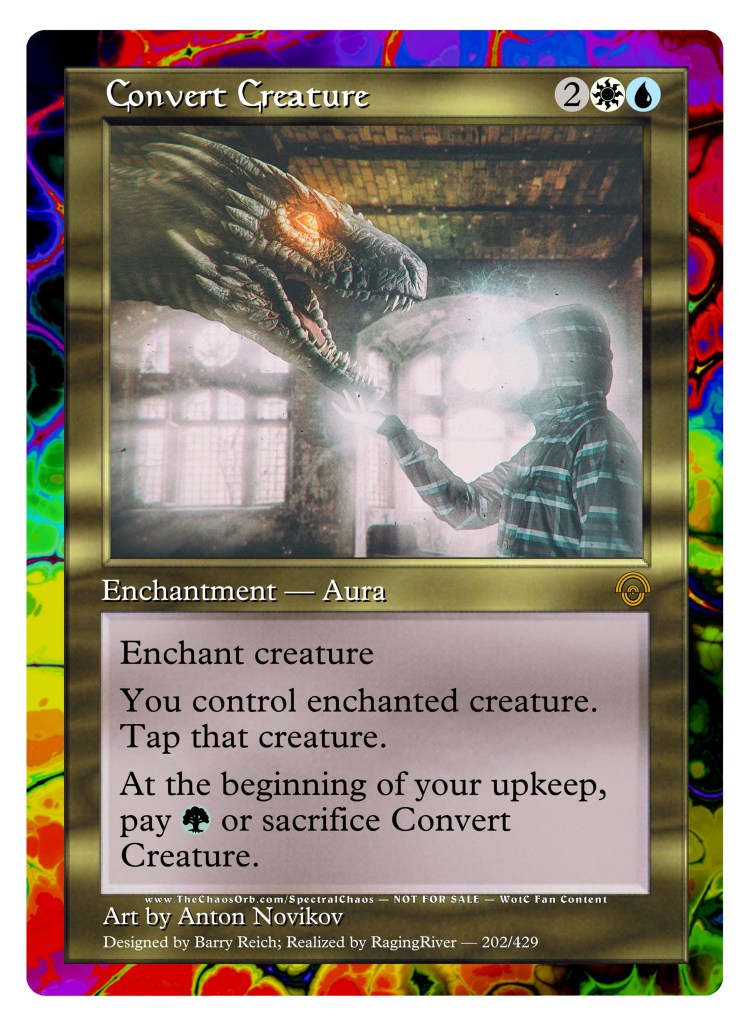
Realized
Convert Creature – {2}{W}{U}
Enchantment – Aura
Enchant creature
You control enchanted creature. Tap that creature.
At the beginning of your upkeep, pay {G} or sacrifice Convert Creature.
203 – Convert Enchantment
(Rare Enchantment (Multicolor))

Original Playtest 
Realized
Convert Enchantment – {2}{W}{U}
Enchantment – Aura
Enchant enchantment
You control enchanted enchantment.
204 – Semaphore
(Rare Enchantment (Multicolor))

Original Playtest 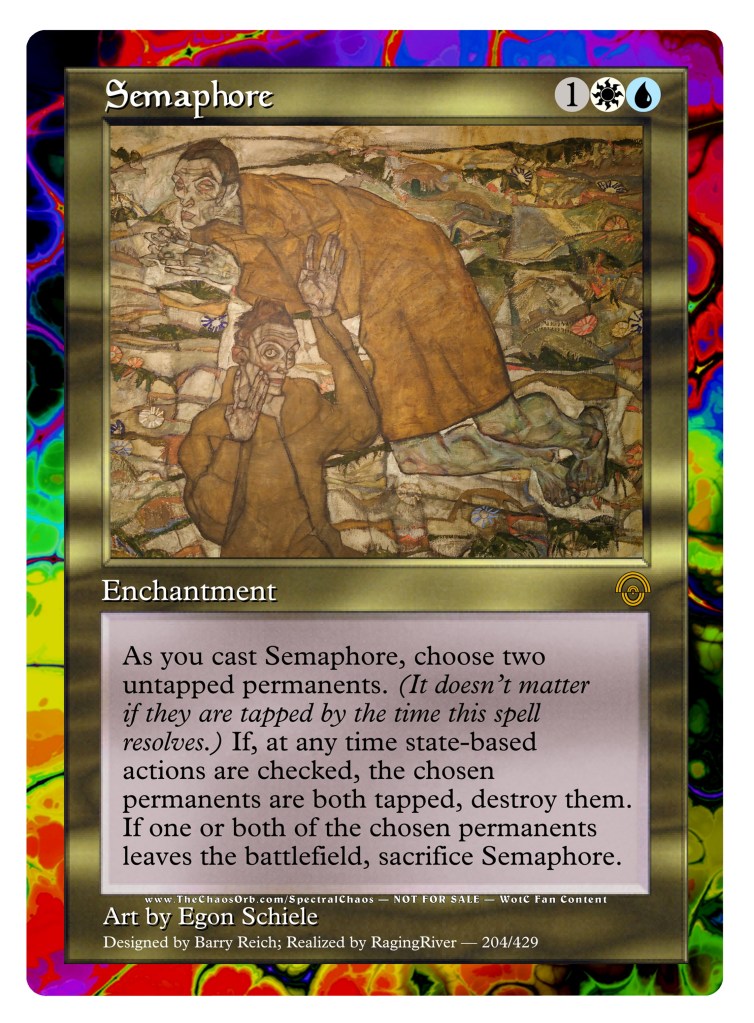
Realized
Semaphore – {1}{W}{U}
Enchantment
As you cast Semaphore, choose two untapped permanents. (It doesn’t matter if they are tapped by the time this spell resolves.)
If, at any time state-based actions are checked, the chosen permanents are both tapped, destroy them.
If one or both of the chosen permanents leaves the battlefield, sacrifice Semaphore.
- The chosen permanents could be controlled by different players. For example, you could choose an opponent’s creature and one of your own lands.
- The concept is that the two permanents can individually be tapped, one or the other, without any consequence, but those permanents can’t both be tapped at the same time for any reason. It doesn’t matter whether one of the permanents was tapped and then the other one becomes tapped, or both of them become tapped simultaneously. The reason the permanents became tapped is irrelevant. Theoretically, the two permanents could both be tapped in the midst of resolving a spell or ability but then one or both are no longer tapped by the time state-based actions are next checked, but that is exceptionally rare.
- Once you announce casting Semaphore, you can choose any untapped permanents on the battlefield. There’s no way for any player to tap permanents “fast enough” after Semaphore is announced to preclude them from being chosen, even if they are tapped for a mana ability.
- Semaphore doesn’t target, and it isn’t an aura. Permanents with shroud or protection from white, blue and/or enchantments, can still be chosen.
- If the chosen permanents are both tapped when Semaphore resolves, its first triggered ability will trigger immediately.
205 – Entropy’s Little Helper
(Rare Creature (Multicolor))
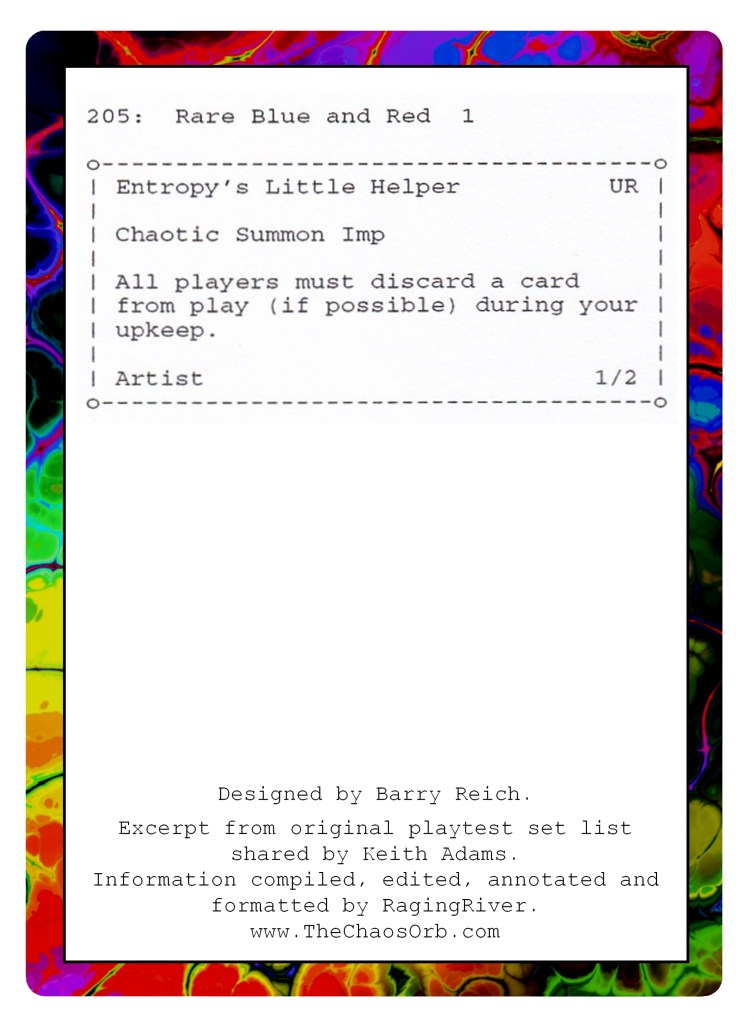
Original Playtest 
Realized
Entropy’s Little Helper – {U}{R}
Chaotic Creature – Imp
At the beginning of your upkeep, each player sacrifices a non-token permanent. (You choose what to sacrifice first, then continue in turn order. Then everything is sacrificed simultaneously.)
1/2
206 – Blue-Red Antimana
(Rare Instant (Multicolor))
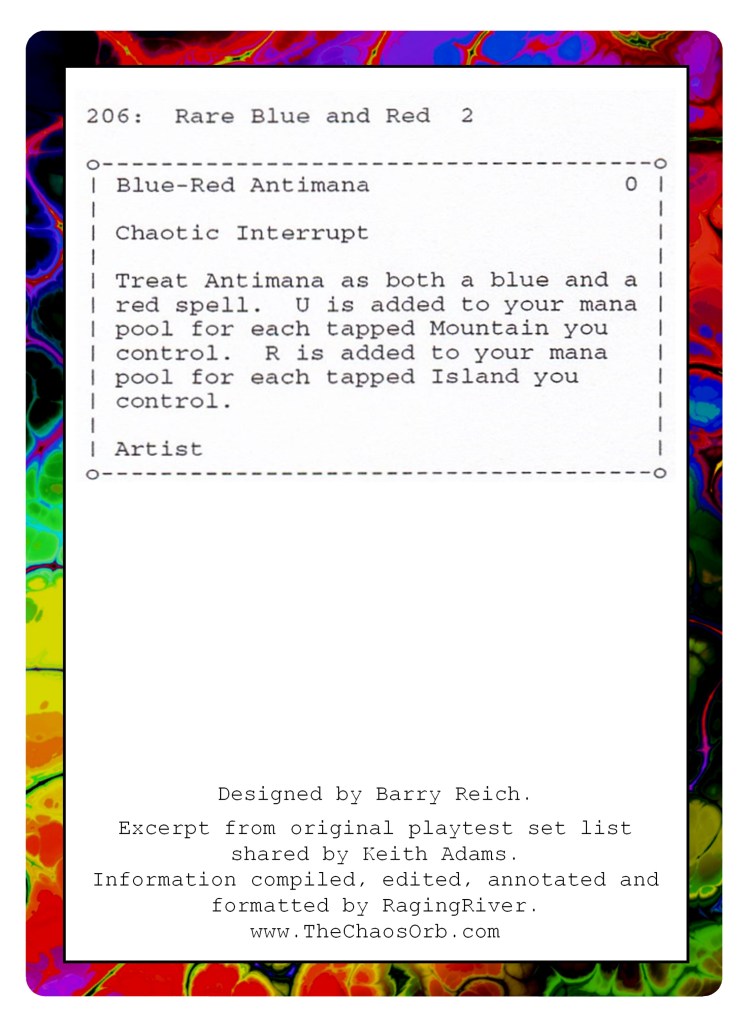
Original Playtest 
Realized
Blue-Red Antimana – {0}
Chaotic Instant
Blue-Red Antimana is blue and red.
Add {U} for each tapped mountain you control.
Add {R} for each tapped island you control.
- The amount of mana you get is determined based on how many of the lands are tapped when this resolves. If a tapped land has both basic land types, it will add one of each type of mana.
207 – Avatvian Fakir
(Rare Creature (Red))

Original Playtest 
Realized
Avatvian Fakir – {3}{R}
Creature – Human
{T}: Target green creature gets “{R}: +1/+0 until end of turn” until end of turn.
1/3
- The creature is checked for color when it is targeted, and again when this ability resolves.
- The creature will have the ability until end of turn even if its color changes later in the turn.
208 – Novice Swordsman
(Rare Creature (Red))
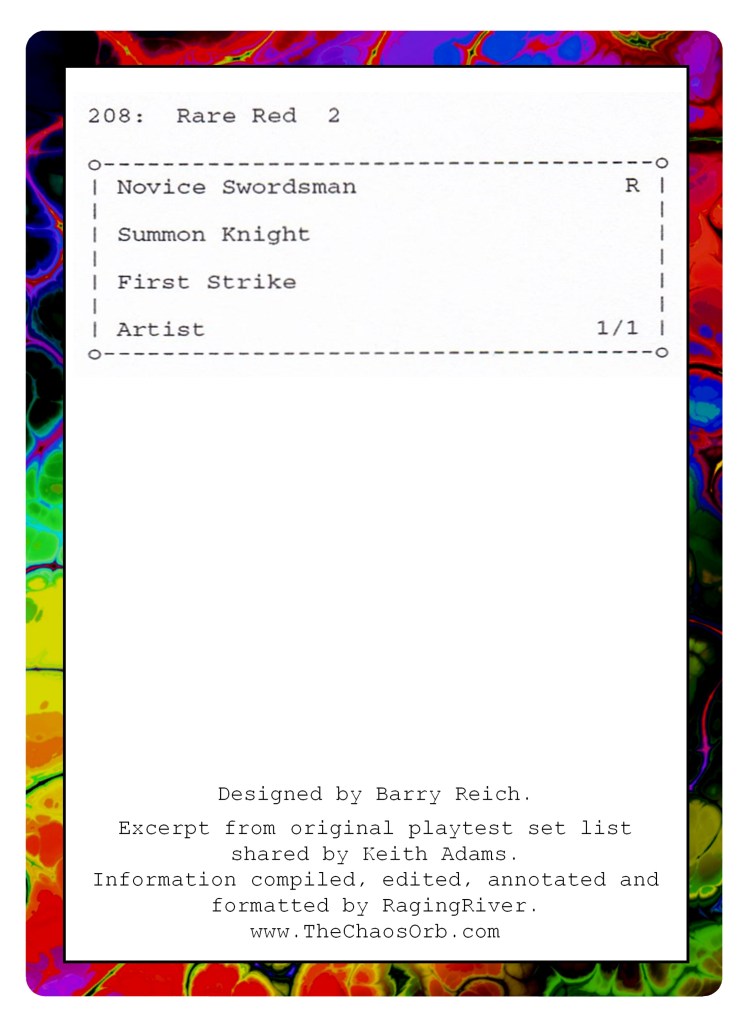
Original Playtest 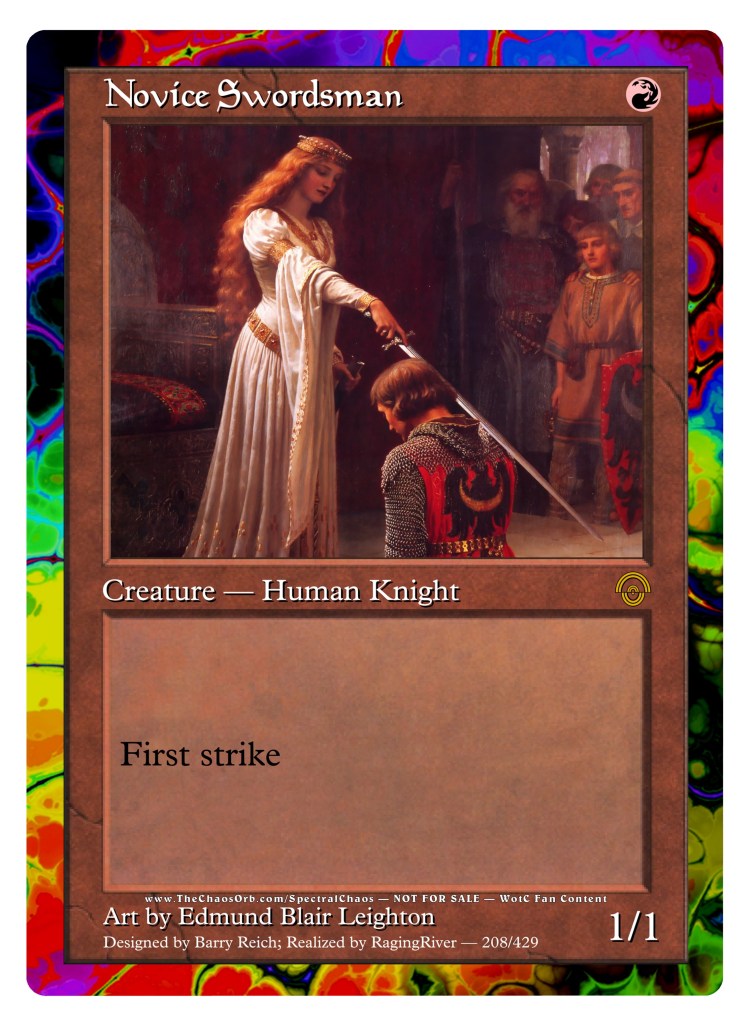
Realized
Novice Swordsman – {R}
Creature – Human Knight
First strike
1/1
209 – Flame Strike
(Rare Instant (Red))
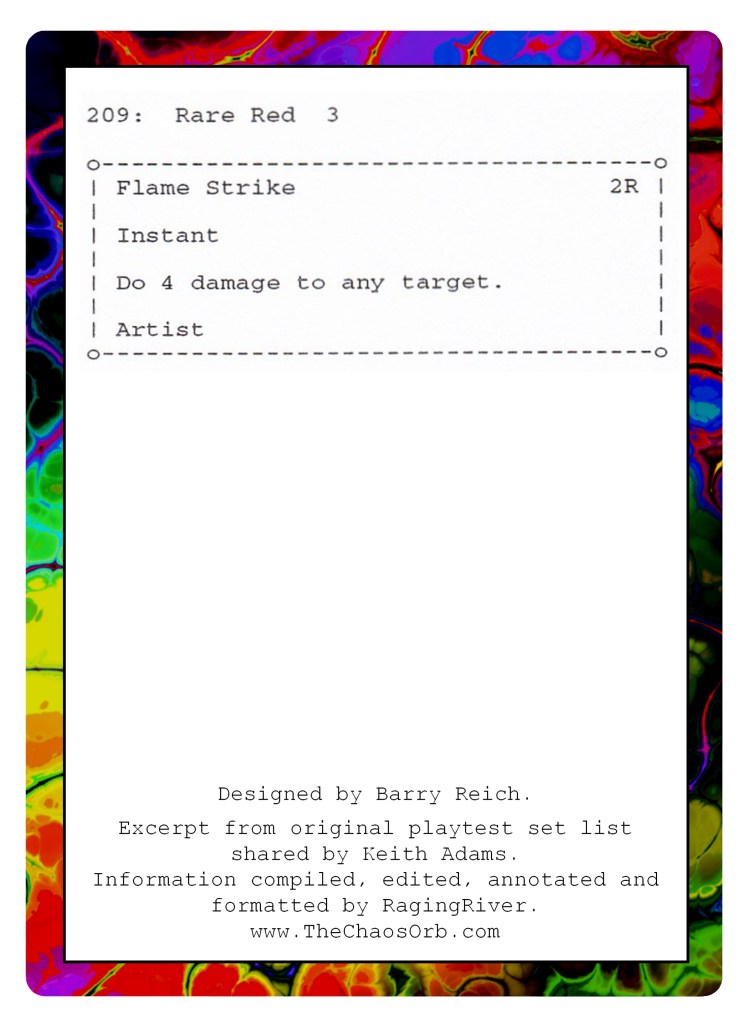
Original Playtest 
Realized
Flame Strike – {2}{R}
Instant
Flame Strike deals 4 damage to any target.
ChaosHistory: While many instants for 4 damage have been designed, none have been printed for only 3 mana without some drawback or restriction.
210 – Dusk Gargoyle
(Rare Creature (Red))

Original Playtest 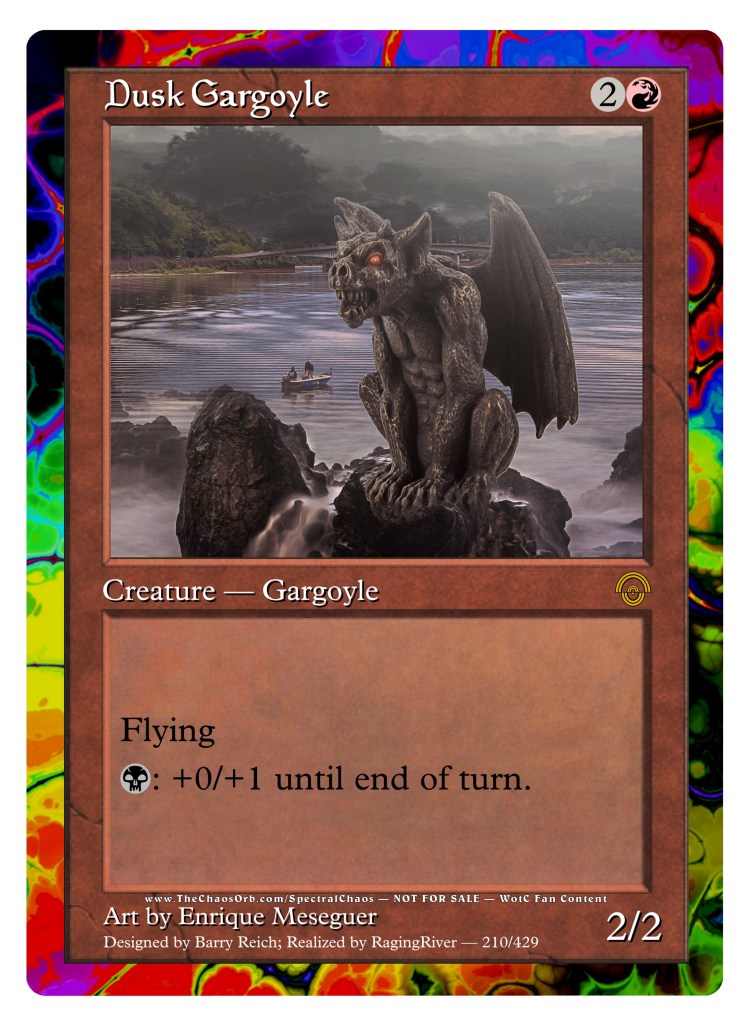
Realized
Dusk Gargoyle – {2}{R}
Creature – Gargoyle
Flying
{B}: +0/+1 until end of turn.
2/2
211 – Flying Sorceress
(Rare Creature (Red))

Original Playtest 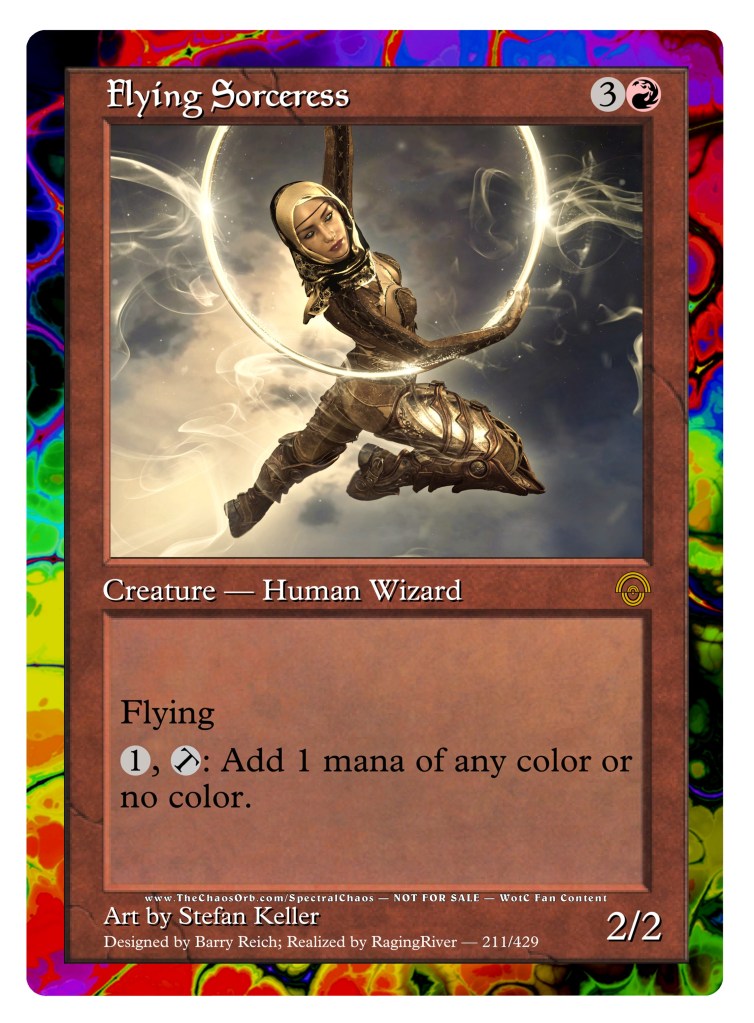
Realized
Flying Sorceress – {3}{R}
Creature – Human Wizard
Flying
{1}, {T}: Add 1 mana of any color or no color.
2/2
212 – Efreet
(Rare Creature (Red))
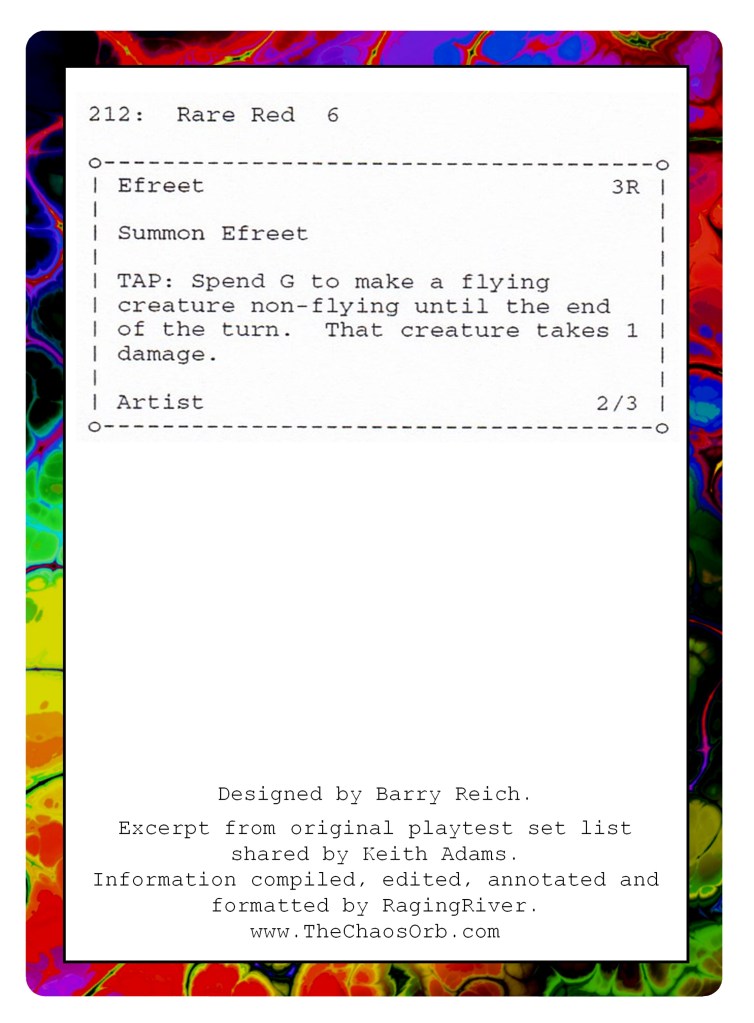
Original Playtest 
Realized
Efreet – {3}{R}
Creature – Efreet
{G}, {T}: Target flying creature loses flying until end of turn and Efreet deals 1 damage to that creature.
2/3
ChaosHistory: Efreets were a common feature of many early sets, especially Arabian Nights and Mirage.
213 – Lesser Red Demon
(Rare Creature (Red))
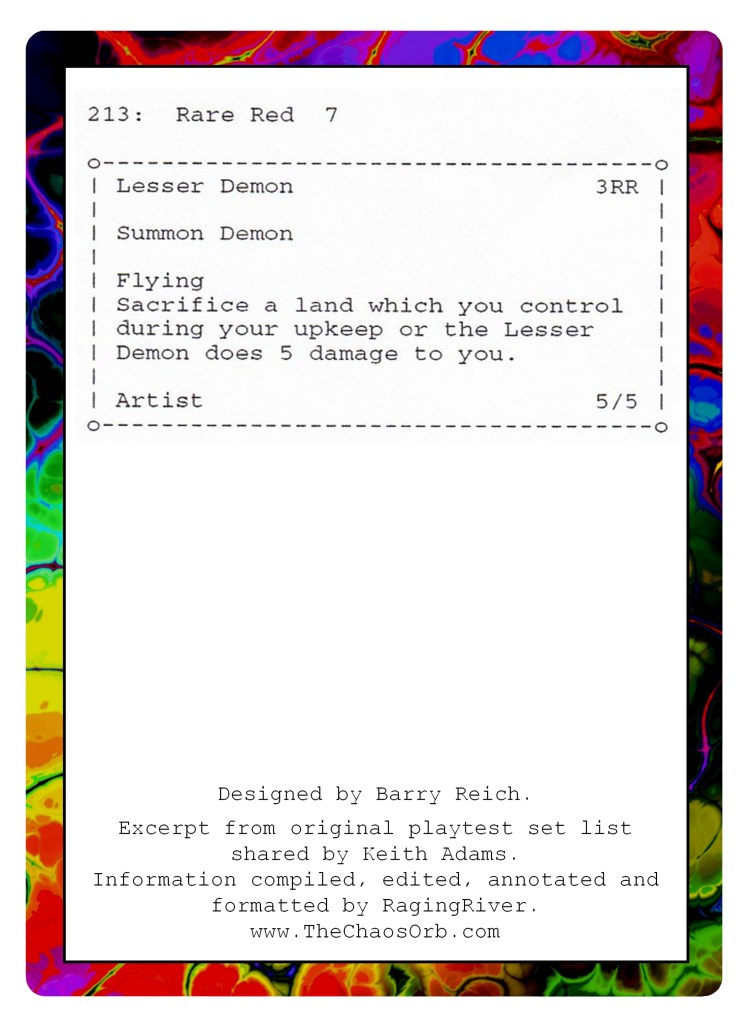
Original Playtest 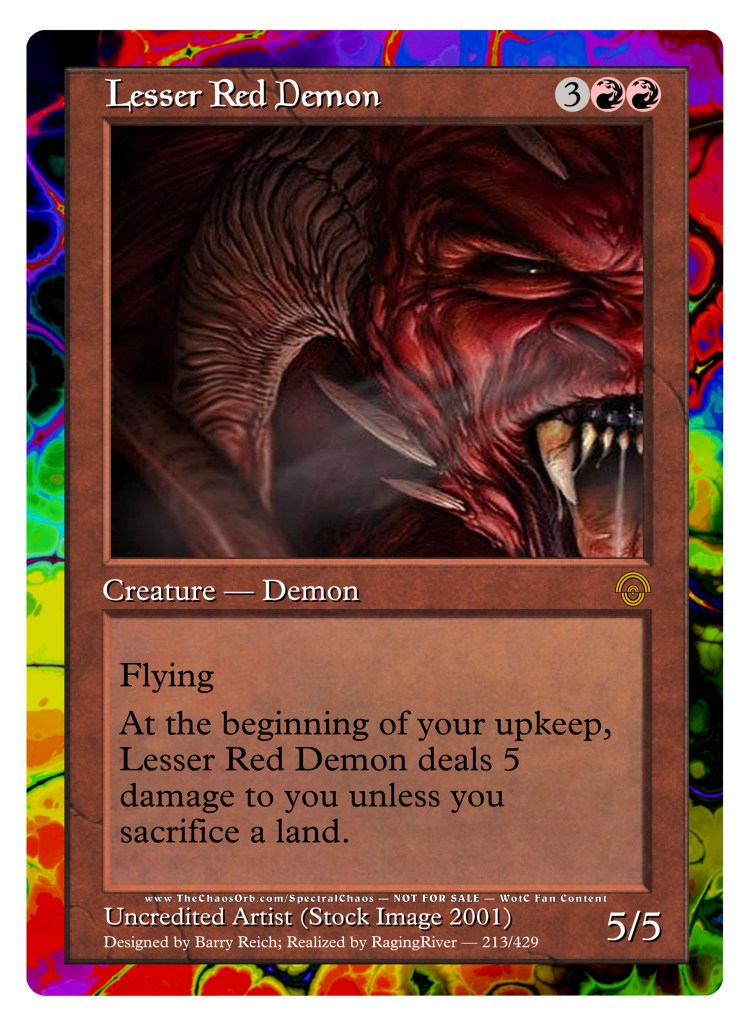
Realized
Lesser Red Demon – {3}{R}{R}
Creature – Demon
Flying
At the beginning of your upkeep, Lesser Red Demon deals 5 damage to you unless you sacrifice a land.
5/5
214 – Highland Horror
(Rare Creature (Red))

Original Playtest 
Realized
Highland Horror – {3}{R}{R}{R}
Creature – Dragon Horror
{U}: Flying until end of turn.
{W}: +1/+0 until end of turn.
3/3
215 – Dead Orc Swordsman
(Rare Creature (Red))
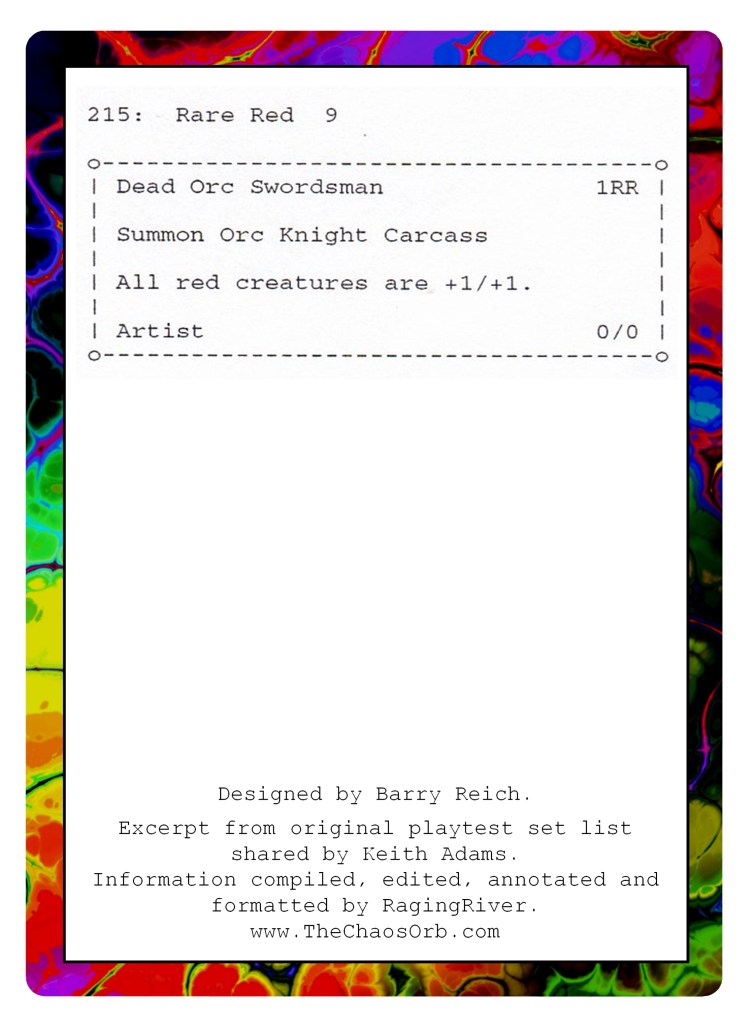
Original Playtest 
Realized
Dead Orc Swordsman – {1}{R}{R}
Creature – Zombie Orc Knight Lord
All red creatures get +1/+1.
0/0
216 – Spontaneous Combustion
(Rare Sorcery (Red))

Original Playtest 
Realized
Spontaneous Combustion – {2}{R}{R}
Sorcery
Spontaneous Combustion deals damage to each creature equal to that creature’s power.
- The amount of damage Spontaneous Combustion will deal to each creature is based on that creature’s power when Spontaneous Combustion resolves.
217 – Arbez
(Rare Creature (Red))

Original Playtest 
Realized
Arbez – {2}{R}
Creature – Human Wizard
You may spend white mana as though it were black mana, and black mana as though it were white mana.
2/2
ChaosHistory: Just read the name in reverse and you’ll get Barry’s joke.
- If Arbez leaves the battlefield, you can still spend white or black mana already in your mana pool this way until your mana pool empties. Any white or black mana added to your pool after Arbez leaves the battlefield would have to be spent like normal.
218 – Three-Headed Cyclops
(Rare Creature (Multicolor))
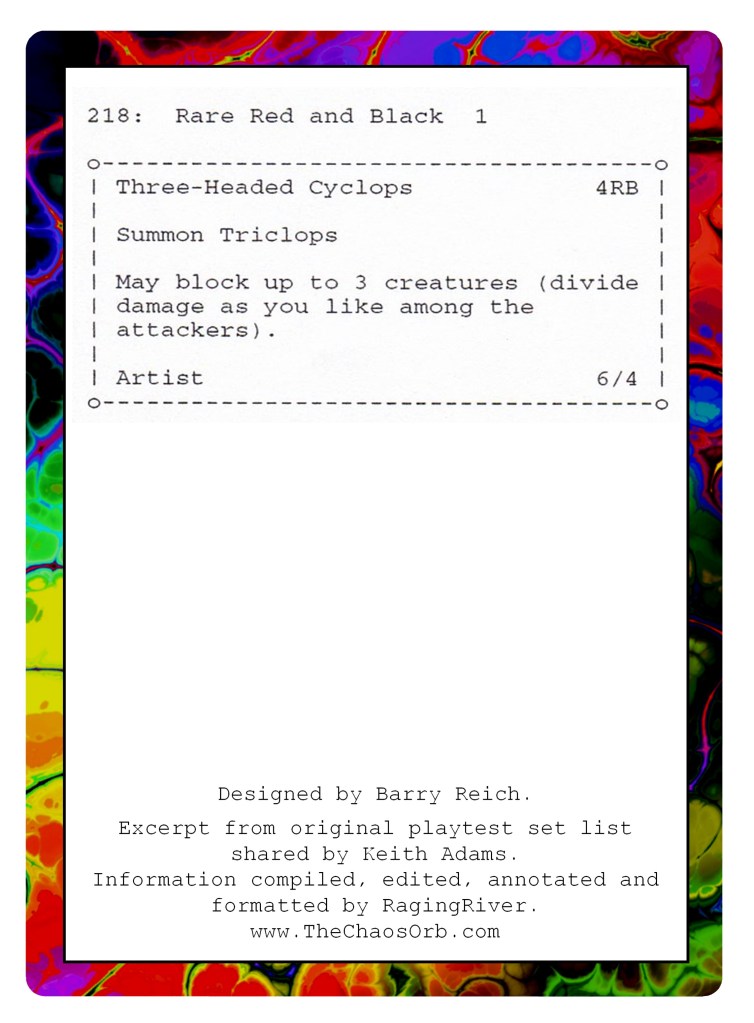
Original Playtest 
Realized
Three-Headed Cyclops – {4}{B}{R}
Creature – Cyclops
Three-Headed Cyclops can block up to two additional creatures.
6/4
219 – Mana Explosion
(Rare Sorcery (Multicolor))

Original Playtest 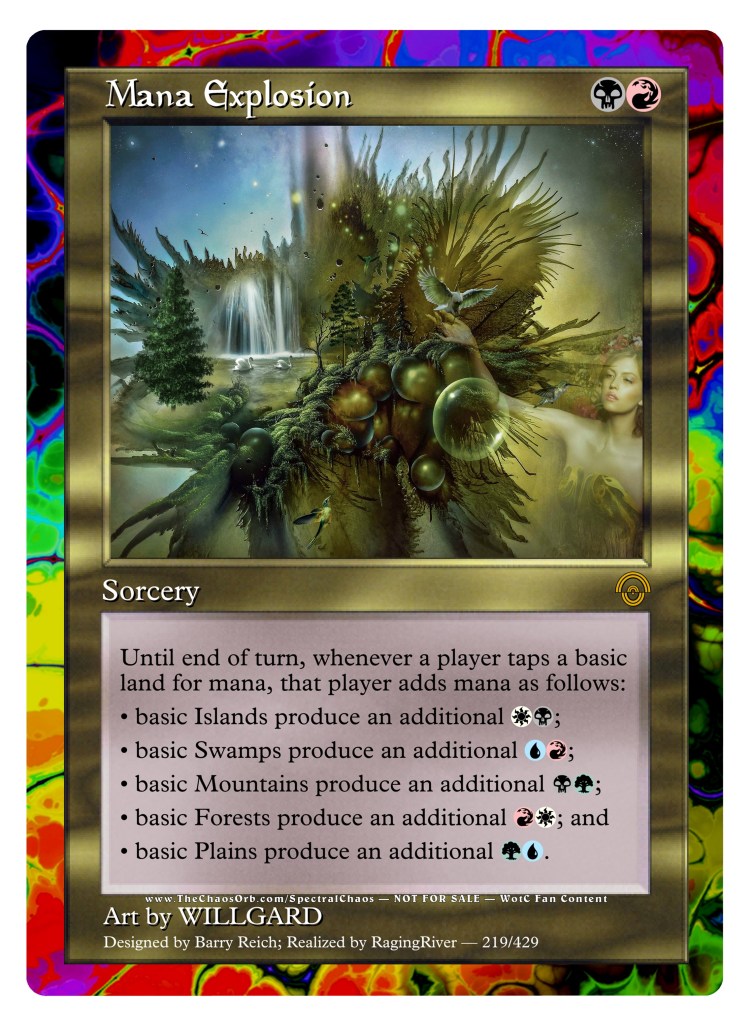
Realized
Mana Explosion – {B}{R}
Sorcery
Until end of turn, whenever a player taps a basic land for mana, that player adds mana as follows:
– basic Islands produce an additional {W}{B};
– basic Swamps produce an additional {U}{R};
– basic Mountains produce an additional {B}{G};
– basic Forests produce an additional {R}{W}; and
– basic Plains produce an additional {G}{U}.
- If a basic land has its basic land type changed, Mana Explosion‘s ability will see and cause it to produce additional mana based on that. For example, if a basic Forest is enchanted by Evil Presence, giving it the basic type of swamp, Mana Explosion will cause it to produce an additional {U}{R} when tapped for mana, not {R}{W}.
220 – Madness
(Rare Enchantment (Multicolor))
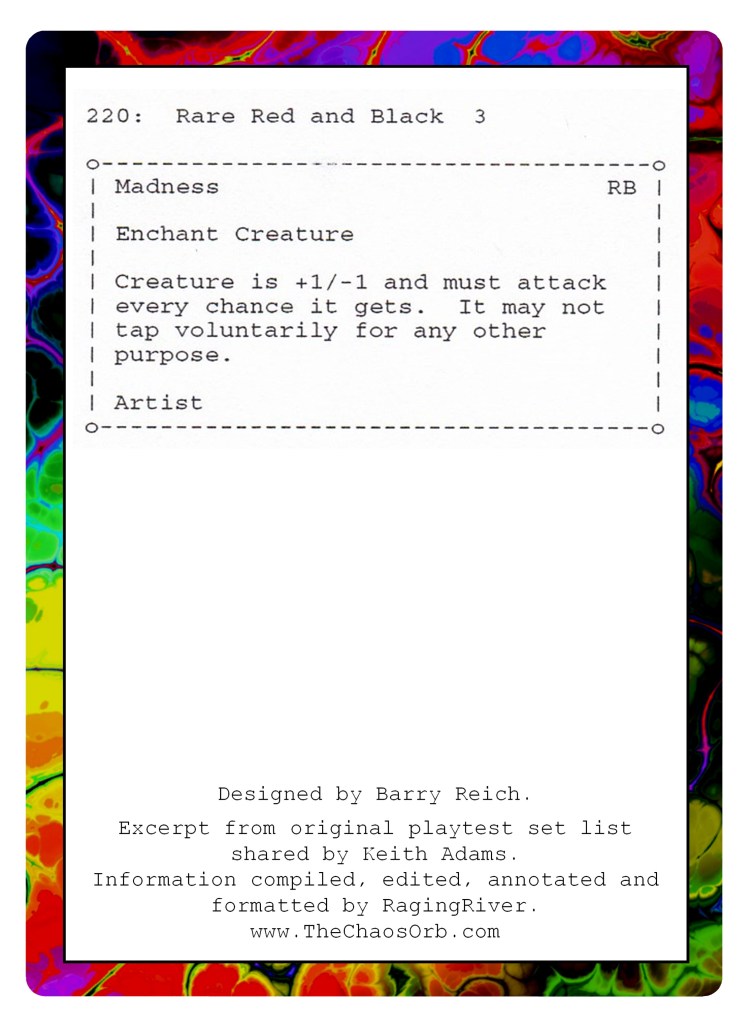
Original Playtest 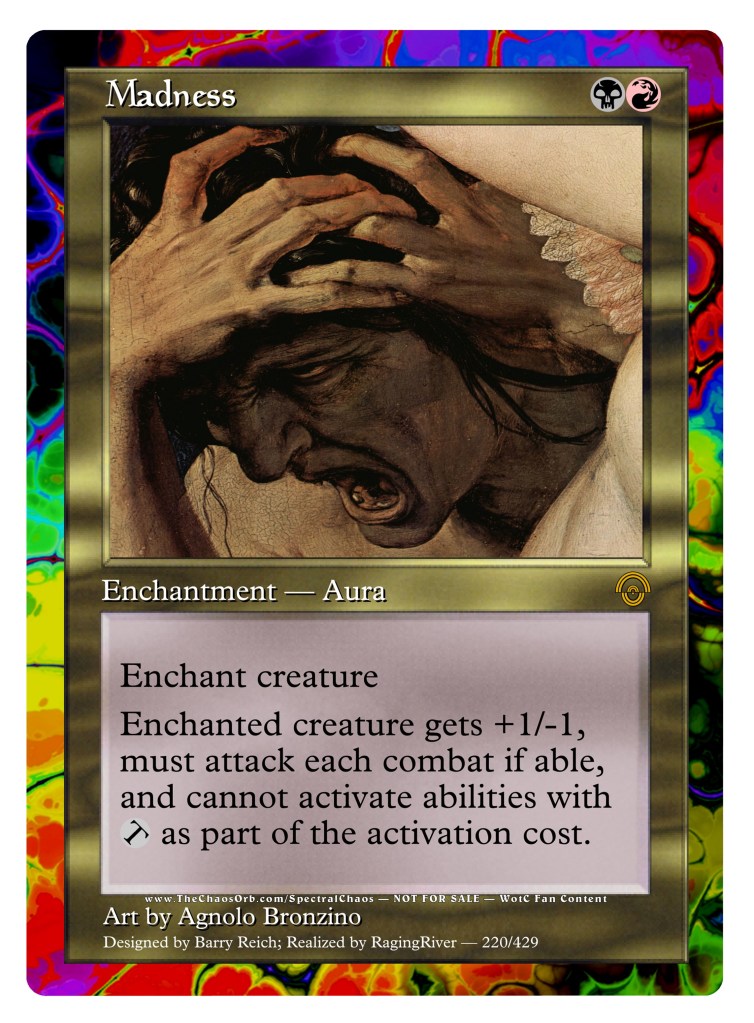
Realized
Madness – {B}{R}
Enchantment – Aura
Enchant creature
Enchanted creature gets +1/-1, must attack each combat if able, and cannot activate abilities with {T} as part of the activation cost.
- The enchanted creature is unable to tap to activate its own activated ability, but it could still be tapped by some other game mechanic (like convoke) or the activated ability of a different creature (like Sigil Tracer).
- Madness doesn’t change anything about triggered abilities, even if a triggered ability involves tapping the enchanted creature.
221 – Solar Flare
(Rare Enchantment (Multicolor))

Original Playtest 
Realized
Solar Flare – {1}{R}{W}
Chaotic Enchantment
When Solar Flare enters the battlefield, you draw eleven cards and each opponent draws ten cards.
Each player’s maximum hand size is increased by three.
- Players cannot decline to draw the cards. If for some reason a player is prevented from drawing cards, the other players will still draw cards.
222 – Red-White Antimana
(Rare Instant (Multicolor))
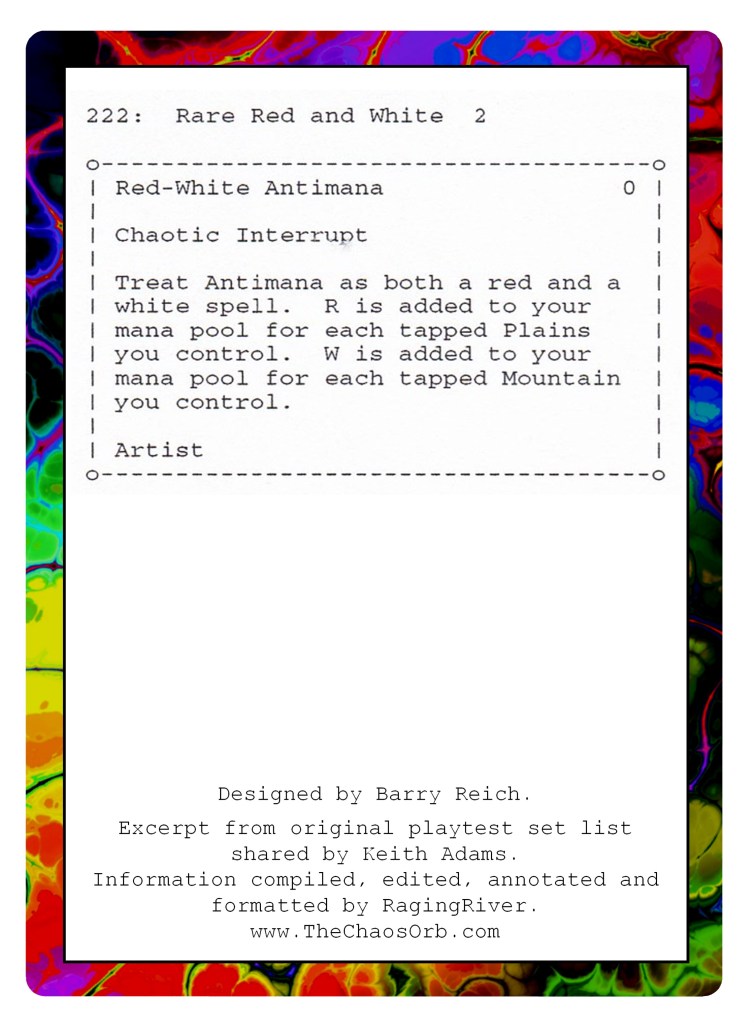
Original Playtest 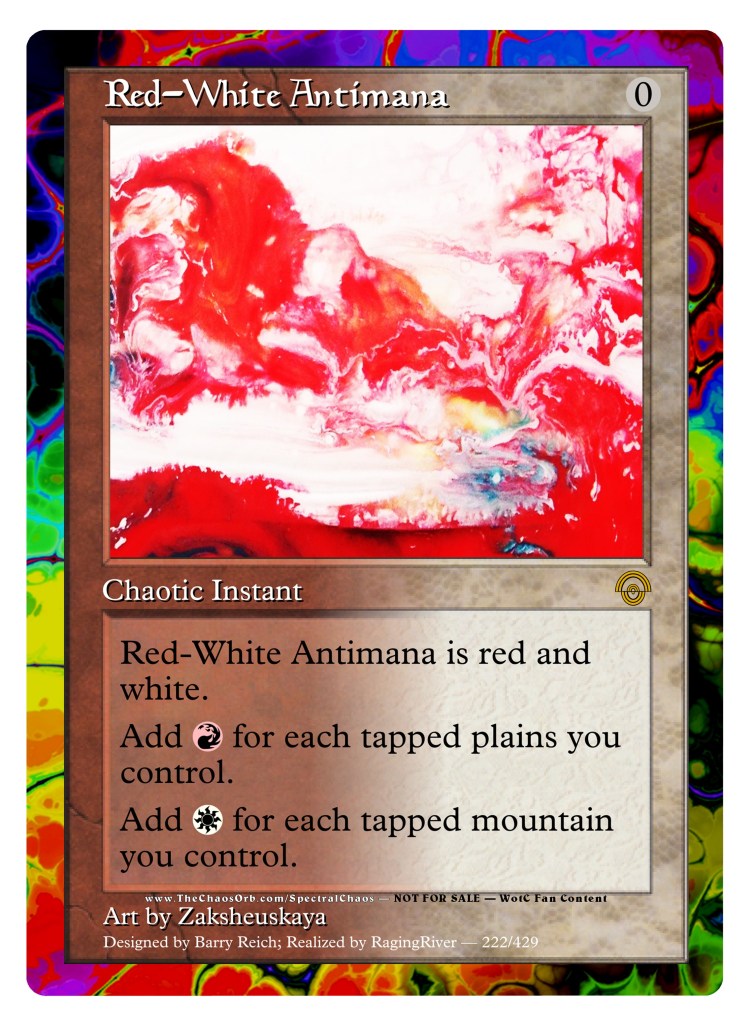
Realized
Red-White Antimana – {0}
Chaotic Instant
Red-White Antimana is red and white.
Add {R} for each tapped plains you control.
Add {W} for each tapped mountain you control.
- The amount of mana you get is determined based on how many of the lands are tapped when this resolves. If a tapped land has both basic land types, it will add one of each type of mana.
223 – Mana Inversion
(Rare Enchantment (Multicolor))

Original Playtest 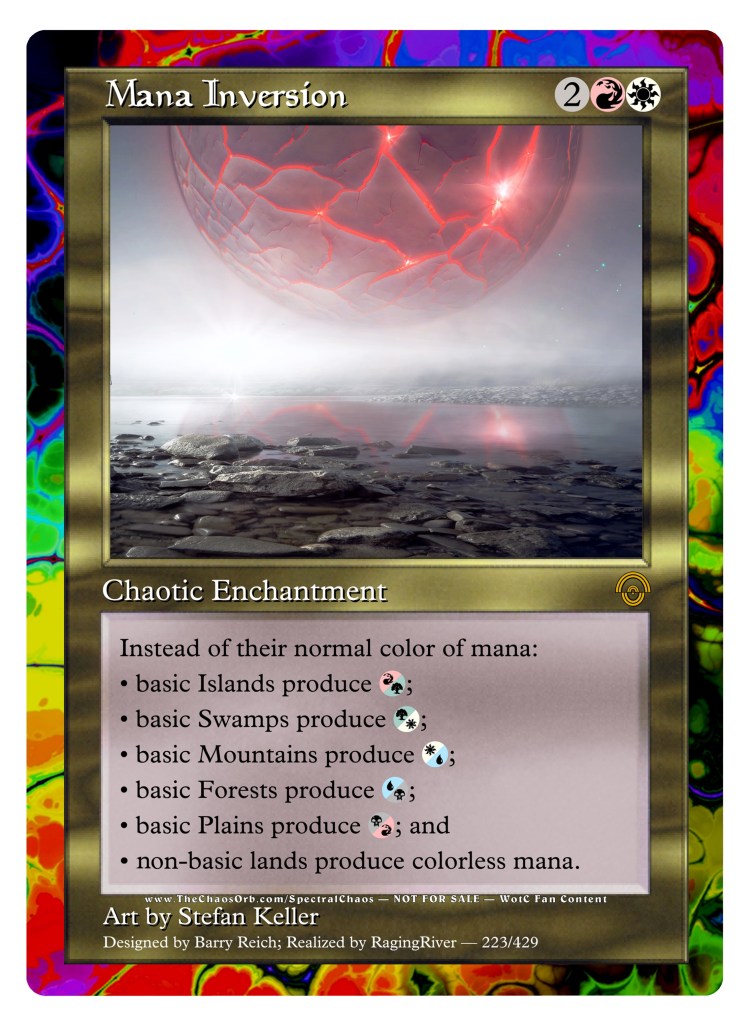
Realized
Mana Inversion – {2}{R}{W}
Chaotic Enchantment
Instead of their normal color of mana:
– basic Islands produce {R/G};
– basic Swamps produce {G/W};
– basic Mountains produce {W/U};
– basic Forests produce {U/B};
– basic Plains produce {B/R}; and
– non-basic lands produce colorless mana.
- The ability generates a replacement effect.
- This only changes the color of mana that lands produce. It doesn’t change the quantity of or restrictions on mana generated from those lands.
- The player controlling the basic land chooses which color to add each time they activate a mana ability of that basic land. But if it produces more than one mana, all that mana is of the same color.
- If a basic land has its basic land type changed, Mana Inversion‘s ability will replace that. For example, if a basic Forest is enchanted by Evil Presence, giving it the basic type of swamp, Mana Inversion will replace the swamp mana ability (so it will produce {G/W} when tapped for mana, not {U/B}).
- For basic lands, Mana Inversion only changes the color of mana produced by activating that basic land for mana based on its basic land type, not any other mana abilities it may have. So, for example, if a basic land were enchanted by Abundant Growth, it would still have the ability given by Abundant Growth and that ability would still work as normal. However, non-basic lands will not be able to produce colored mana of any kind, regardless of whether that ability is inherent to the card (like Underground Sea) or an ability granted by an aura (like Abundant Growth).
224 – Equilibrium
(Rare Enchantment (Multicolor))

Original Playtest 
Realized
Equilibrium – {3}{R}{W}
Chaotic Enchantment
At the beginning of each player’s draw step, that player draws X+1-Y cards, where X is that player’s maximum hand size (but not more than 10) and Y is the number of cards in their hand as this ability resolves.
(Note: Rulings last updated March 10, 2021.)
- For example, if a player has a maximum hand size of 7, and has 3 cards in their hand as this ability resolves, then the player will draw 5 cards. Essentially, each player will draw cards until they reach their maximum hand size plus 1 each turn; however, if a player’s maximum hand size is more than 10 or if they don’t have a maximum hand size at all (for example, if they have Library of Leng or Mnemosyne in play), then X is deemed to be 10 for the purpose of calculating the number of cards drawn to be drawn by Equilibrium‘s ability.
- The total number of cards to be drawn is a fixed number, calculated using the ability’s formula when the ability resolves. It doesn’t matter if a replacement effect (like Chains of Mephistopheles or Uba Mask) will prevent the player from actually ending up with that many cards in their hand.
- A player can’t draw 0 or less than 0 cards. If the formula results in a number that is 0 or less (meaning, that player already has cards in their hand equal to at least 1 more than their maximum hand size (or 11 cards in hand, regardless of maximum hand size)), then this triggered ability will do nothing.
- A player cannot decline to draw the cards. If there aren’t enough cards in their library, they will lose the game when forced to draw from their empty library.
225 – Blood Purist
(Rare Creature (Multicolor))

Original Playtest 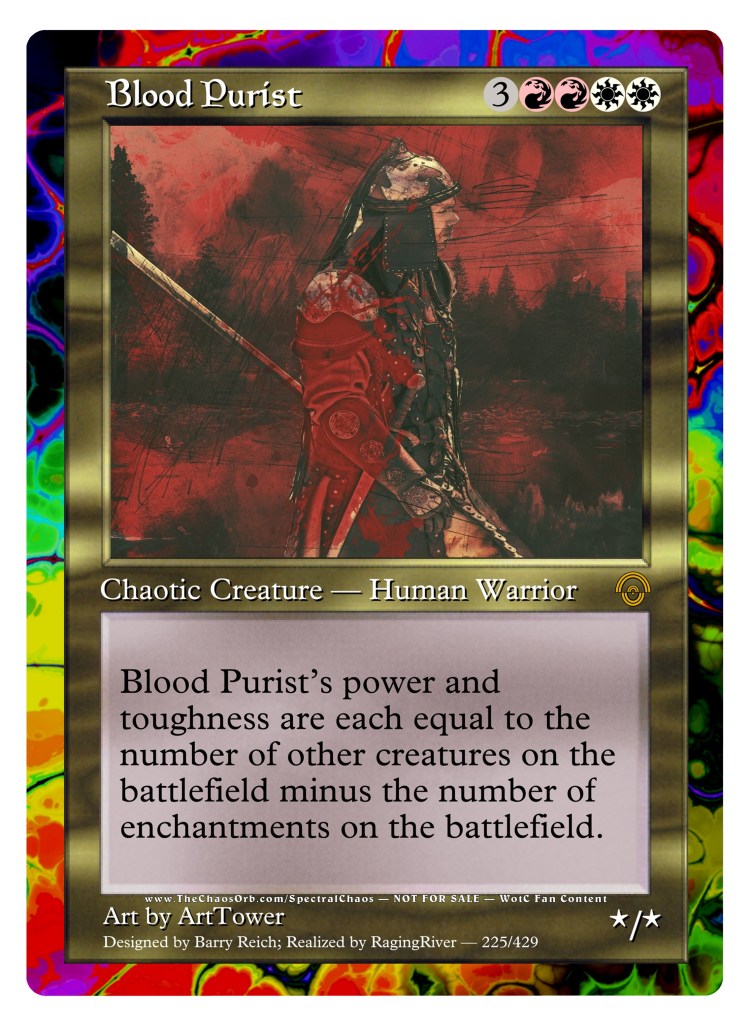
Realized
Blood Purist – {3}{R}{R}{W}{W}
Chaotic Creature – Human Warrior
Blood Purist’s power and toughness are each equal to the number of other creatures on the battlefield minus the number of enchantments on the battlefield.
*/*
226 – Latonian Cleric
(Rare Creature (White))

Original Playtest 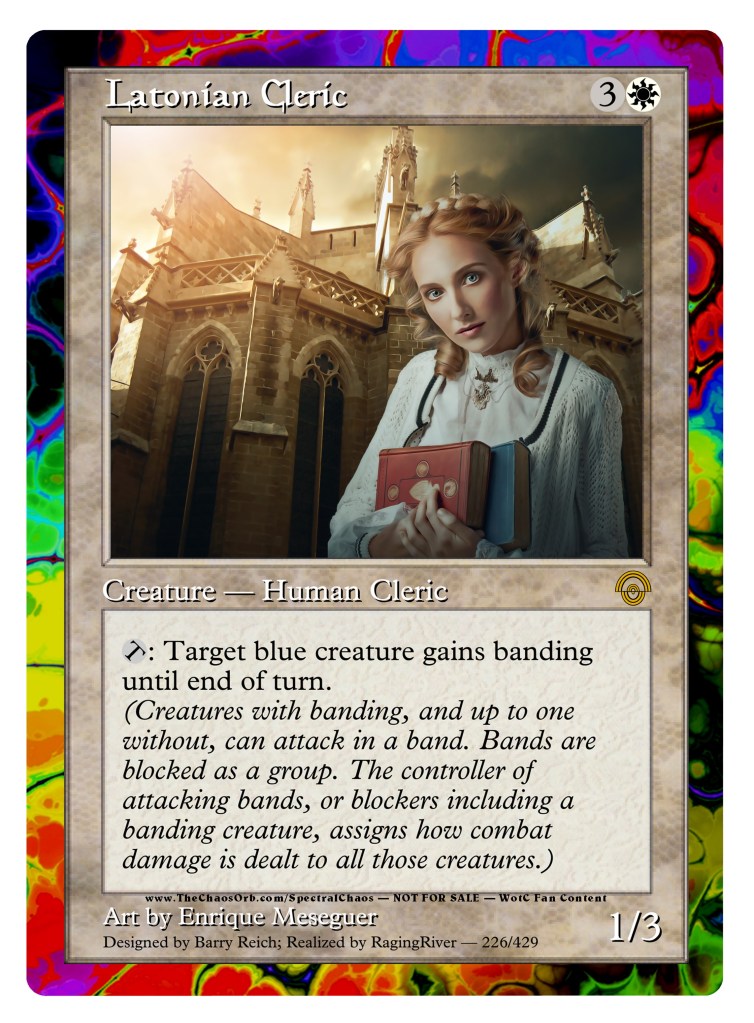
Realized
Latonian Cleric – {3}{W}
Creature – Human Cleric
{T}: Target blue creature gains banding until end of turn.
1/3
- The creature is checked for color when it is targeted, and again when this ability resolves.
- The creature will still have banding even if its color changes later in the turn.
227 – Blue Damping Field
(Rare Enchantment (White))

Original Playtest 
Realized
Blue Damping Field – {1}{W}
Enchantment
Pay 1 life: The next time a blue source of your choice would deal damage to you this turn, prevent that damage.
228 – Red Damping Field
(Rare Enchantment (White))
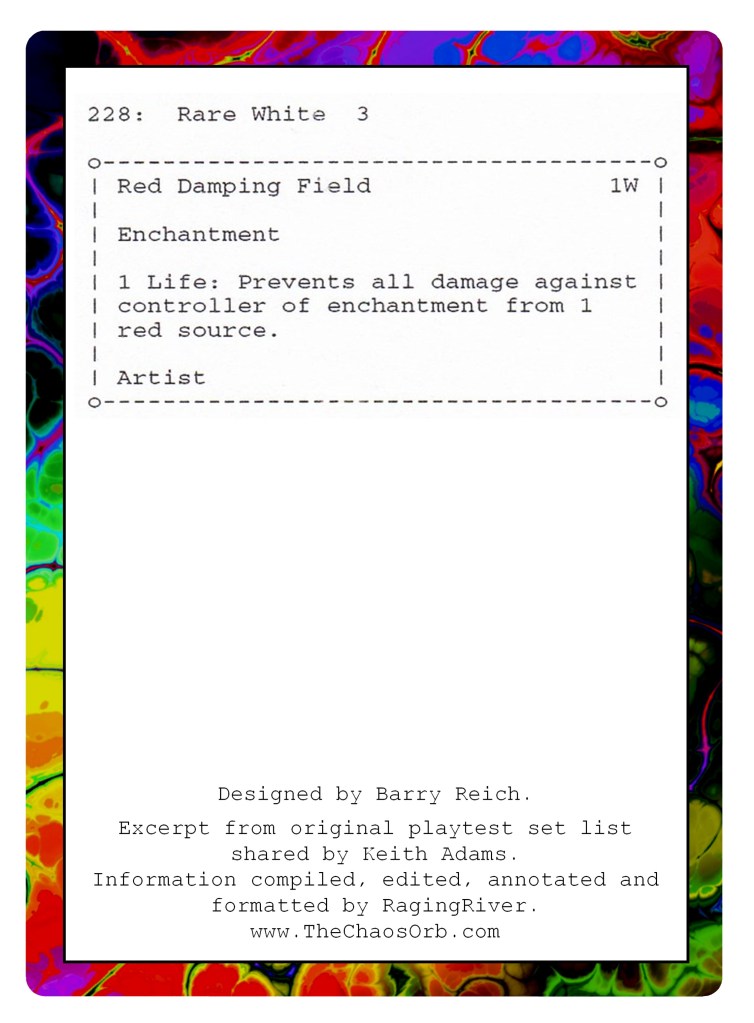
Original Playtest 
Realized
Red Damping Field – {1}{W}
Enchantment
Pay 1 life: The next time a red source of your choice would deal damage to you this turn, prevent that damage.
229 – White Damping Field
(Rare Enchantment (White))

Original Playtest 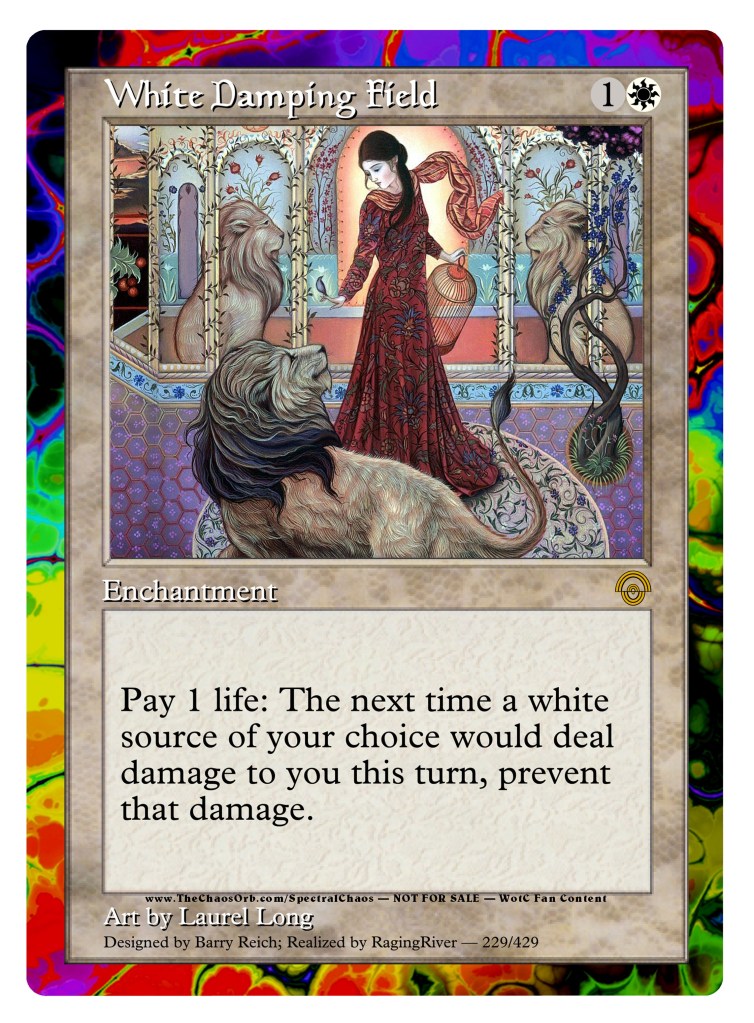
Realized
White Damping Field – {1}{W}
Enchantment
Pay 1 life: The next time a white source of your choice would deal damage to you this turn, prevent that damage.
230 – Black Damping Field
(Rare Enchantment (White))
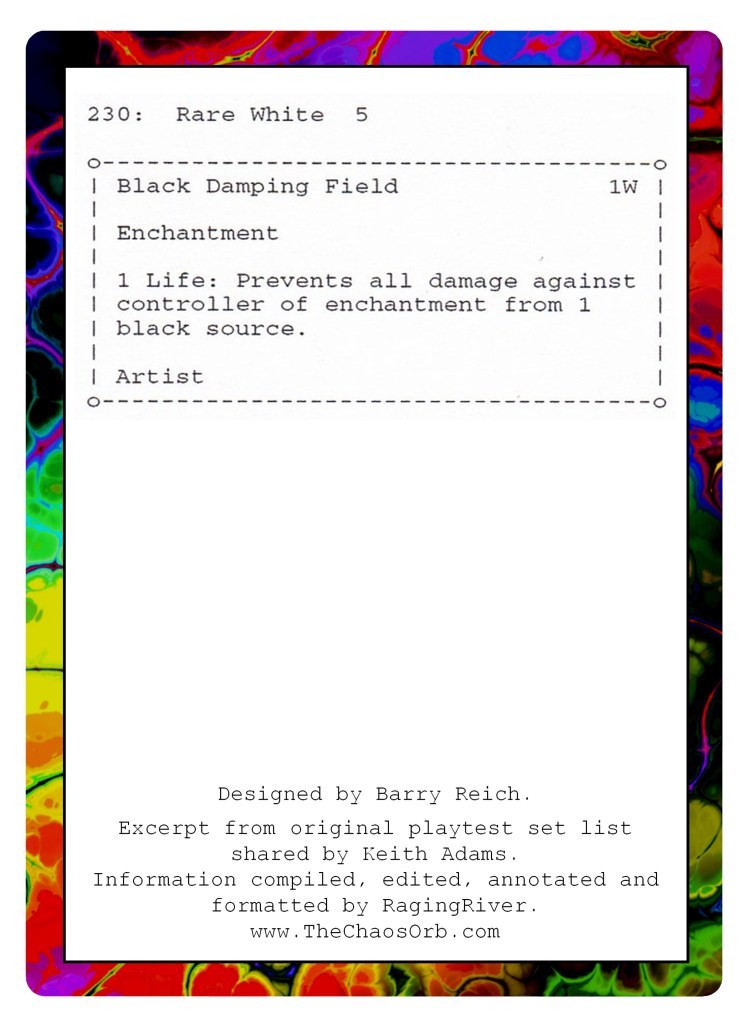
Original Playtest 
Realized
Black Damping Field – {1}{W}
Enchantment
Pay 1 life: The next time a black source of your choice would deal damage to you this turn, prevent that damage.
231 – Green Damping Field
(Rare Enchantment (White))

Original Playtest 
Realized
Green Damping Field – {1}{W}
Enchantment
Pay 1 life: The next time a green source of your choice would deal damage to you this turn, prevent that damage.
232 – Ebony Acolyte
(Rare Creature (White))

Original Playtest 
Realized
Ebony Acolyte – {1}{W}{W}
Creature – Cleric Shaman
Protection from white
{W}, {T}: Target creature gains protection from white until end of turn.
2/2
233 – Northern Paladin
(Rare Creature (White))
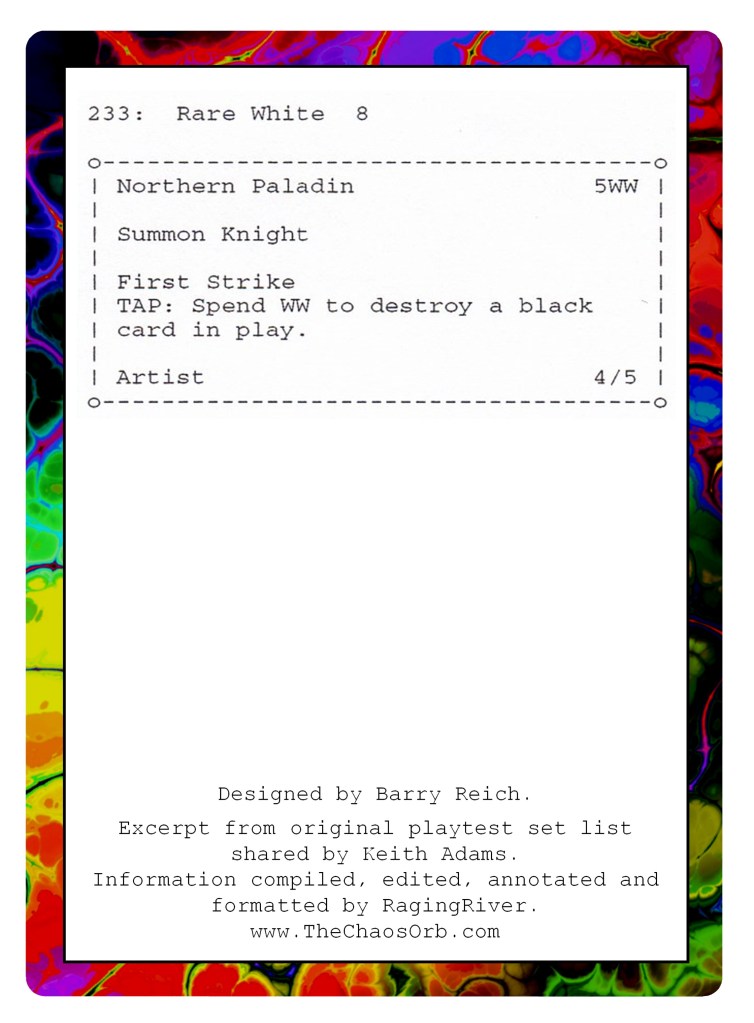
Original Playtest 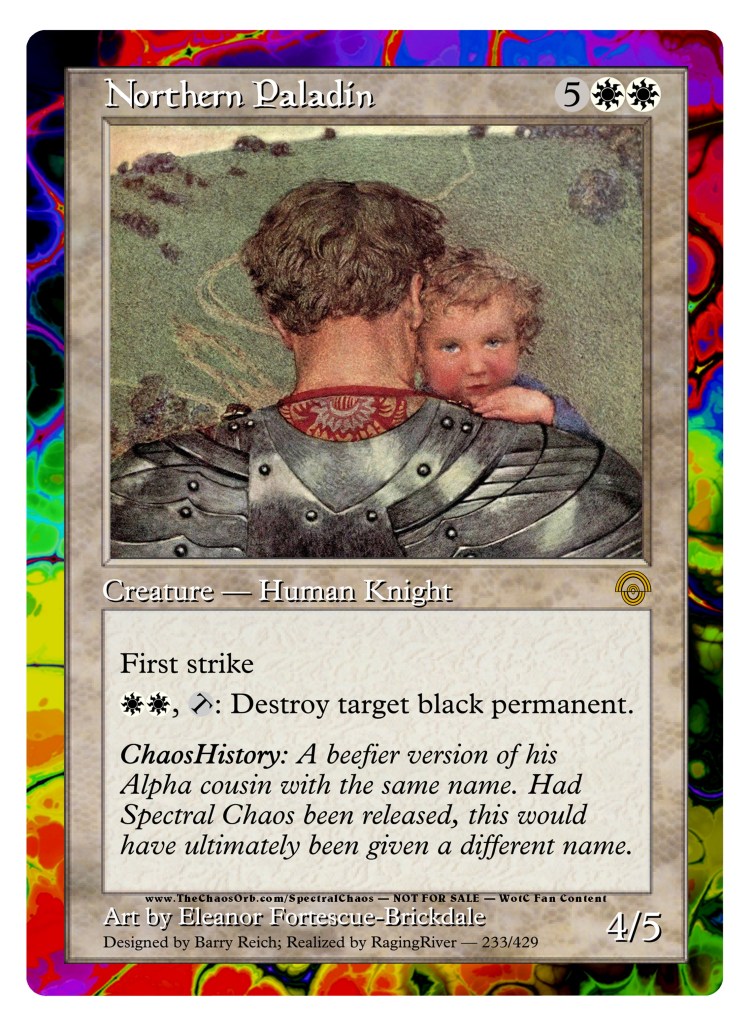
Realized
Northern Paladin – {5}{W}{W}
Creature – Human Knight
First strike
{W}{W}, {T}: Destroy target black permanent.
4/5
ChaosHistory: A beefier version of his Alpha cousin with the same name. Had Spectral Chaos been released, this would have ultimately been given a different name.
234 – Fallen Angel
(Rare Creature (White))
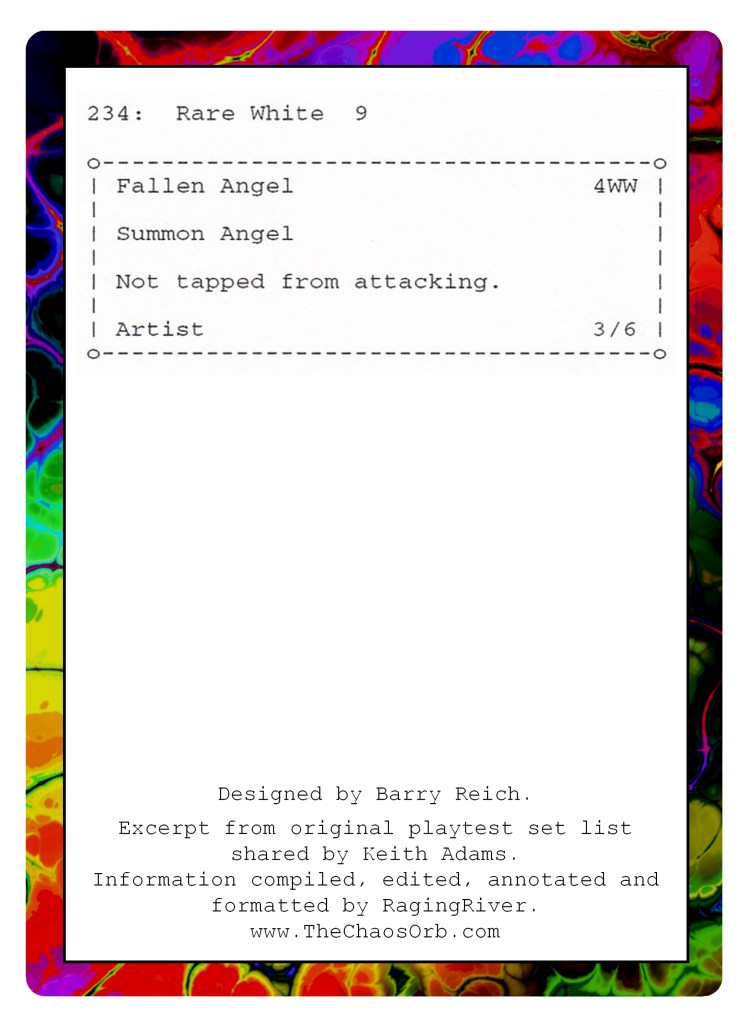
Original Playtest 
Realized
Fallen Angel – {4}{W}{W}
Creature – Angel
Vigilance
3/6
ChaosHistory: No relation to the separately designed Fallen Angel from Legends, this angel lost the ability to fly, but (like Alpha’s Serra Angel) still had vigilance.
235 – Wall of Life
(Rare Creature (White))

Original Playtest 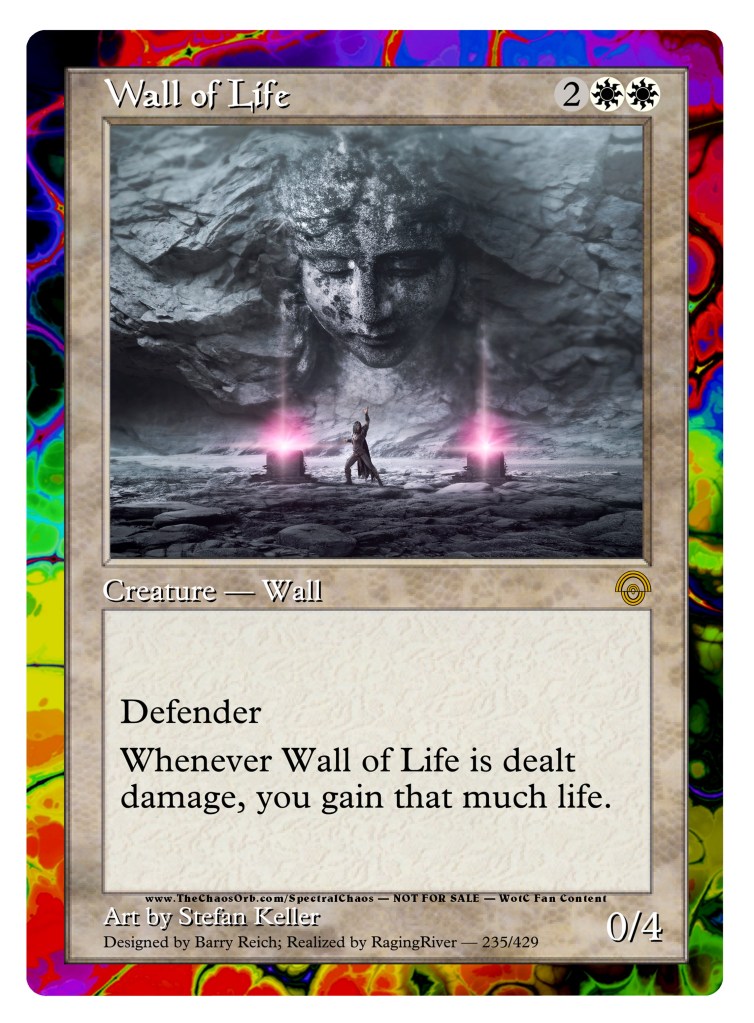
Realized
Wall of Life – {2}{W}{W}
Creature – Wall
Defender
Whenever Wall of Life is dealt damage, you gain that much life.
0/4
236 – Oasis
(Rare Enchantment (White))

Original Playtest 
Realized
Oasis – {W}
Enchantment – Aura
Enchant land
If enchanted land is tapped for mana, it provides {G}{W} instead of its normal type and amount of mana.
- This supersedes any other mana abilities of the land, including mana abilities granted by virtue of its land type.
- Non-mana abilities of the land aren’t affected. If the land somehow has the ability to generate mana without being tapped (exceptionally rare), it still has that ability.
237 – Holy Water
(Rare Instant (White))

Original Playtest 
Realized
Holy Water – {1}{W}
Sorcery
Destroy target chaotic permanent.
238 – Elvish Ranger
(Rare Creature (Multicolor))

Original Playtest 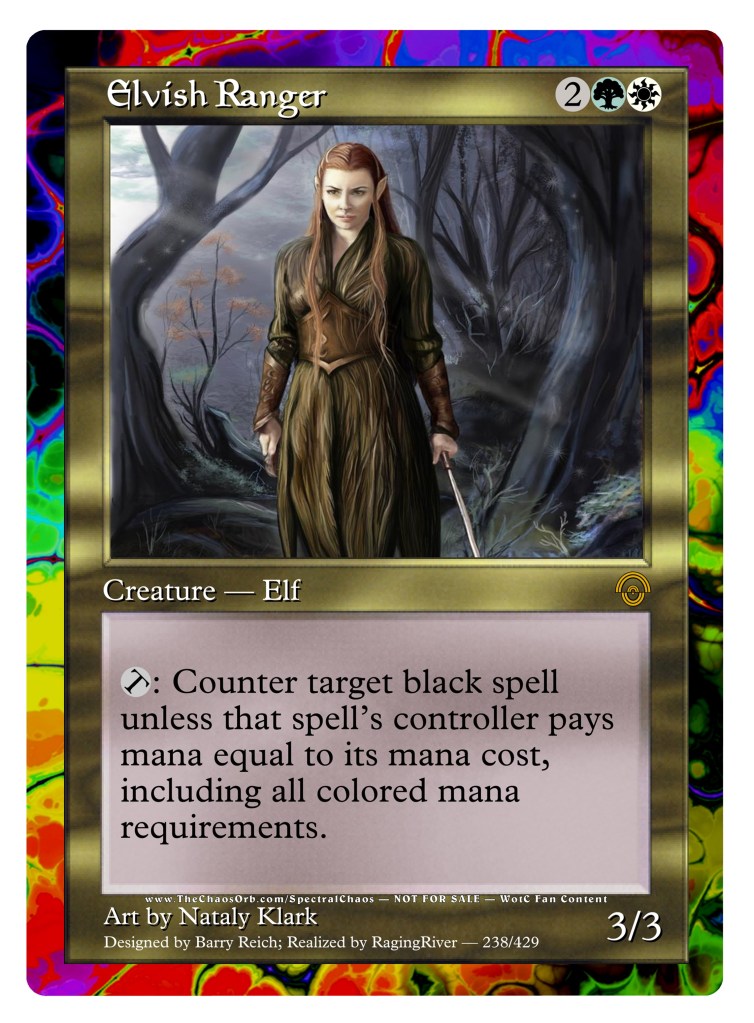
Realized
Elvish Ranger – {2}{G}{W}
Creature – Elf
{T}: Counter target black spell unless that spell’s controller pays mana equal to its mana cost, including all colored mana requirements.
3/3
239 – Swarm
(Rare Creature (Multicolor))
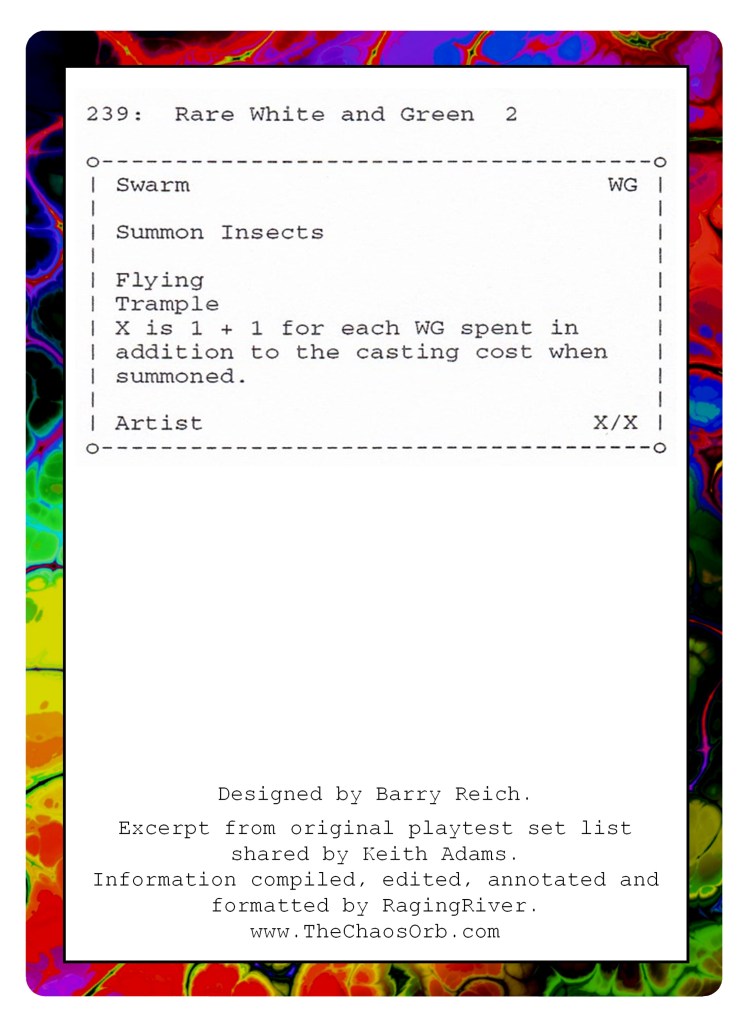
Original Playtest 
Realized
Swarm – {G}{W}
Creature – Insect
Flying, trample
Multikicker {G}{W}
Swarm enters the battlefield with a +1/+1 counter on it for each time it was kicked.
1/1
240 – Resurrection
(Rare Sorcery (Multicolor))
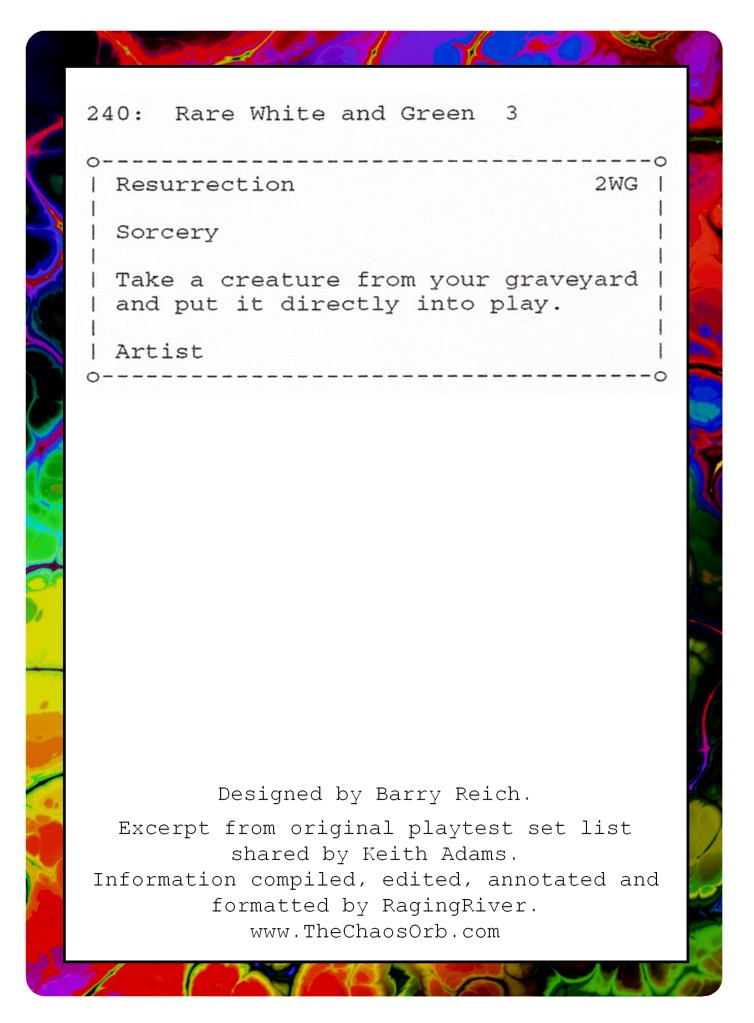
Original Playtest 
Realized
Resurrection – {2}{G}{W}
Sorcery
Return target creature card from your graveyard to the battlefield.
ChaosHistory: One of several Alpha cards intended to balance Spectral Chaos. This was playtested at a multicolor casting cost (instead of the original white).
241 – Empathy
(Rare Enchantment (Multicolor))

Original Playtest 
Realized
Empathy – {2}{G}{G}{W}
Enchantment
Whenever a creature dies, unless the controller of that creature pays {W}{W}, Empathy deals 1 damage to each creature and each player. (If multiple creatures die simultaneously, this ability triggers for each one, with Empathy’s controller choosing how to stack the triggers.)
242 – Grim Reaper
(Rare Creature (Multicolor))
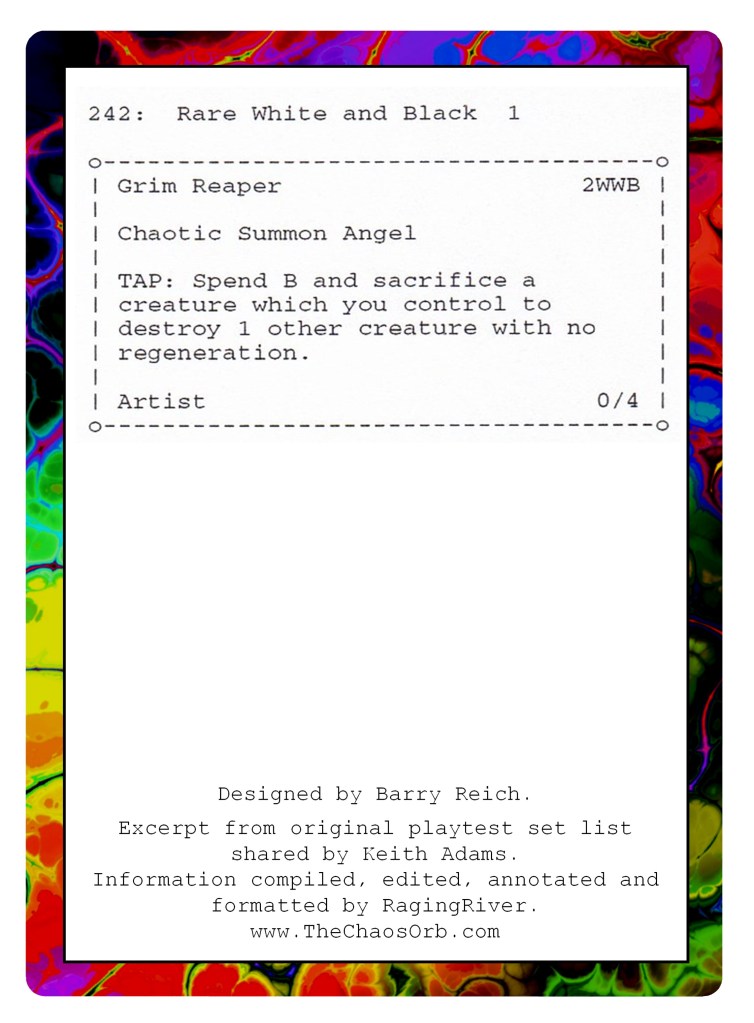
Original Playtest 
Realized
Grim Reaper – {2}{W}{W}{B}
Chaotic Creature – Angel Horror
{B}, {T}, sacrifice a creature: Destroy target creature. It can’t be regenerated.
0/4
243 – White-Black Antimana
(Rare Instant (Multicolor))
Original Playtest 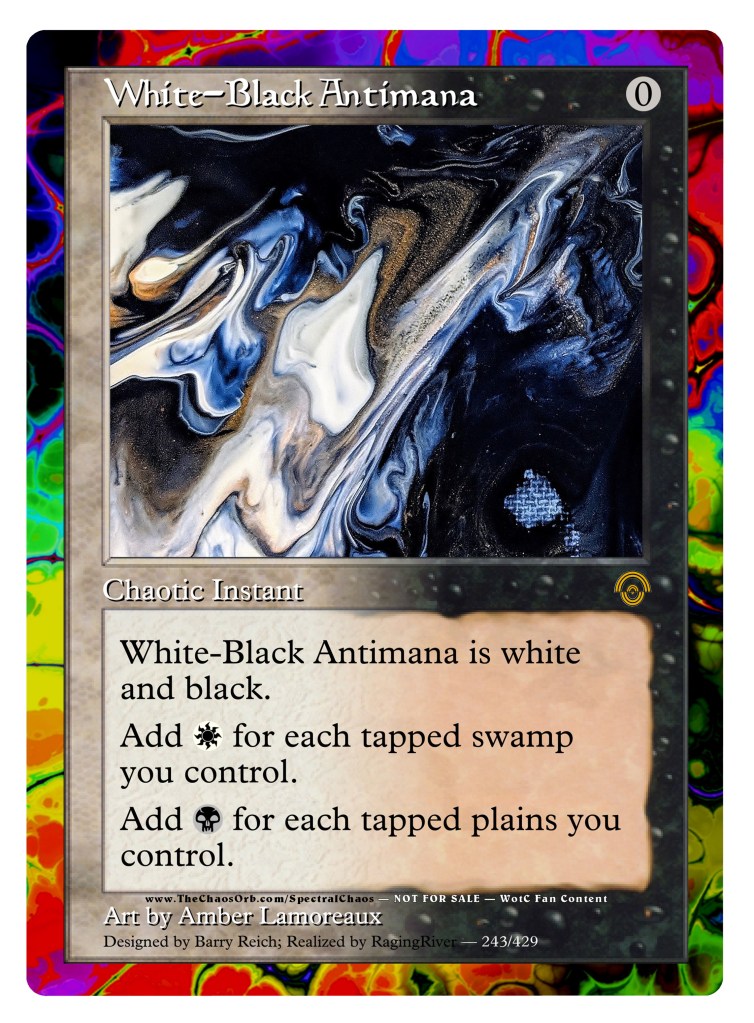
Realized
White-Black Antimana – {0}
Chaotic Instant
White-Black Antimana is white and black.
Add {W} for each tapped swamp you control.
Add {B} for each tapped plains you control.
- The amount of mana you get is determined based on how many of the lands are tapped when this resolves. If a tapped land has both basic land types, it will add one of each type of mana.
244 – Population Control
(Rare Sorcery (Multicolor))

Original Playtest 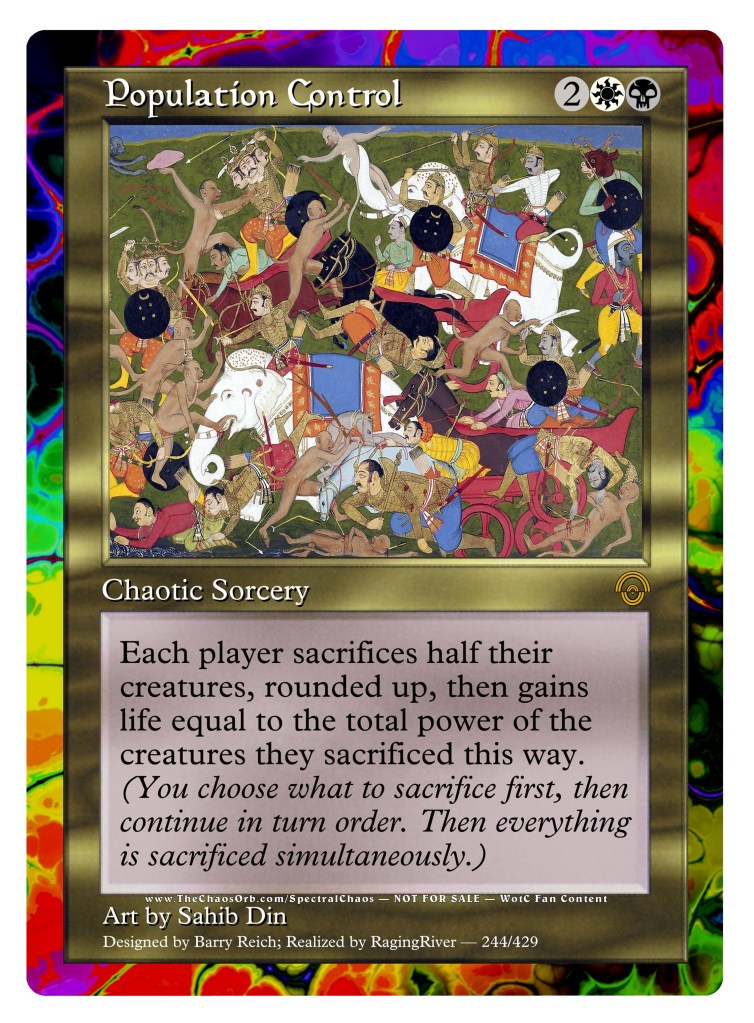
Realized
Population Control – {2}{W}{B}
Chaotic Sorcery
Each player sacrifices half their creatures, rounded up, then gains life equal to the total power of the creatures they sacrificed this way. (You choose what to sacrifice first, then continue in turn order. Then everything is sacrificed simultaneously.)
245 – Pastoral Faucoun
(Rare Creature (Black))
Original Playtest 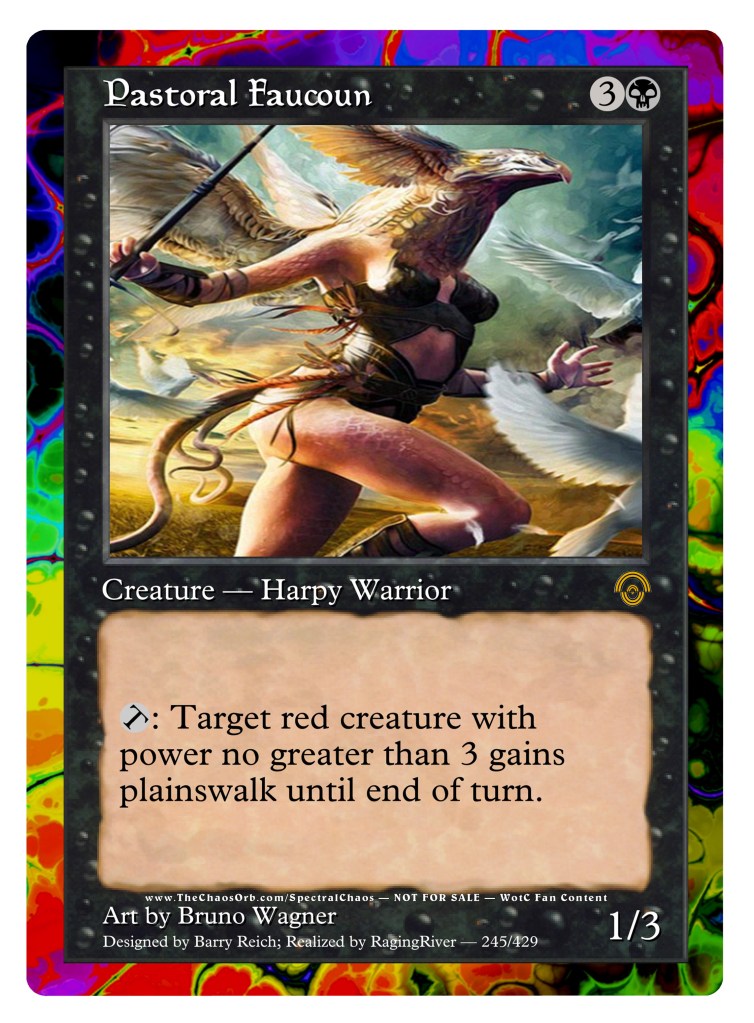
Realized
Pastoral Faucoun – {3}{B}
Creature – Harpy Warrior
{T}: Target red creature with power no greater than 3 gains plainswalk until end of turn.
1/3
- The creature is checked for color and power level when it is targeted, and again when this ability resolves.
- The creature will still have plainswalk even if its color or power changes later in the turn.
246 – Medusa
(Rare Creature (Black))

Original Playtest 
Realized
Medusa – {1}{B}
Creature – Gorgon
Whenever a creature blocks or is blocked by Medusa, that creature gains defender. (This effect lasts indefinitely.)
1/3
ChaosHistory: Infernal Medusa, a gorgon of a different design, also appeared in Legends.
247 – Avenger
(Rare Creature (Black))

Original Playtest 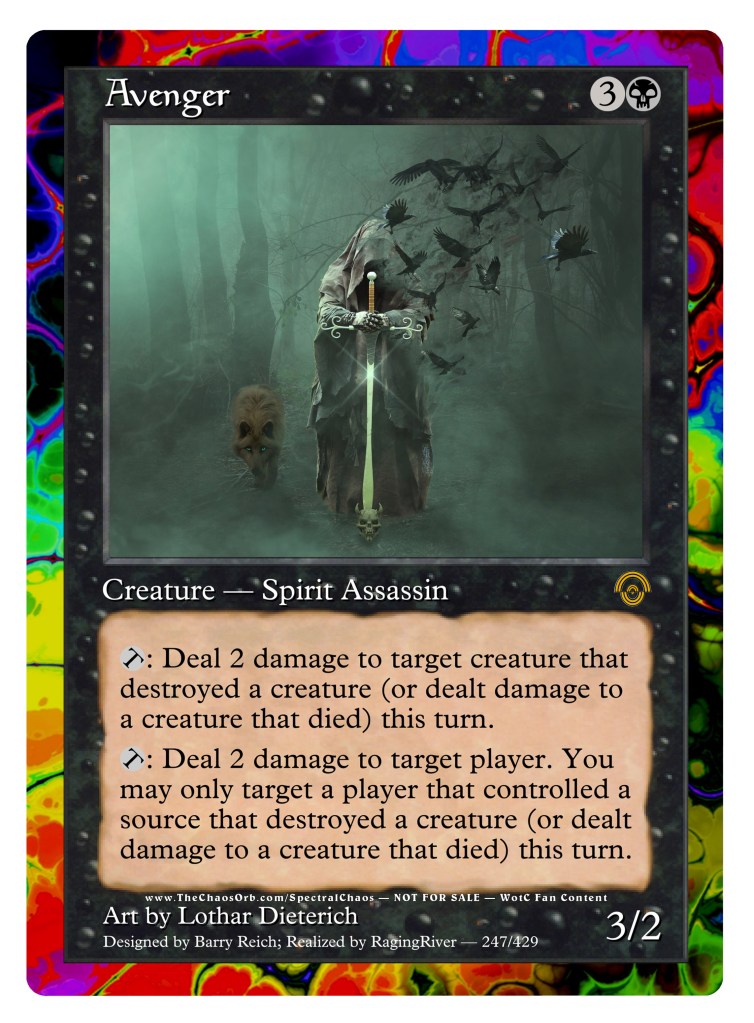
Realized
Avenger – {3}{B}
Creature – Spirit Assassin
{T}: Deal 2 damage to target creature that destroyed a creature (or dealt damage to a creature that died) this turn.
{T}: Deal 2 damage to target player. You may only target a player that controlled a source that destroyed a creature (or dealt damage to a creature that died) this turn.
3/2
- If a creature has lethal damage marked on it, you’d need to wait until the creature actually dies before activating either of Avenger‘s abilities.
- The creature must have been destroyed, or else been dealt damage and then died. A creature that was regenerated didn’t die. A creature that wasn’t destroyed, and that died without having been dealt damage, wouldn’t qualify. For example, a creature that is sacrificed wouldn’t qualify (unless it had been dealt damage before being sacrificed).
248 – Lunacy
(Rare Enchantment (Black))

Original Playtest 
Realized
Lunacy – {1}{B}{B}
Enchantment
At the beginning of your upkeep, put a shock counter on Lunacy. When there are four or more shock counters on Lunacy, remove them all.
If Lunacy has: -> All black creatures get:
– 0 shock counters -> -1/-1
– 1 shock counter -> +1/+1
– 2 shock counters -> +3/+2
– 3 shock counters -> +1/+1
- While Lunacy has 4 or more shock counters on it (for example, for the brief period of time after you put the 4th shock counter on it, while the removal of counters trigger is still on the stack), black creatures’ power and toughness won’t be changed at all.
249 – Soul Sucker
(Rare Creature (Black))

Original Playtest 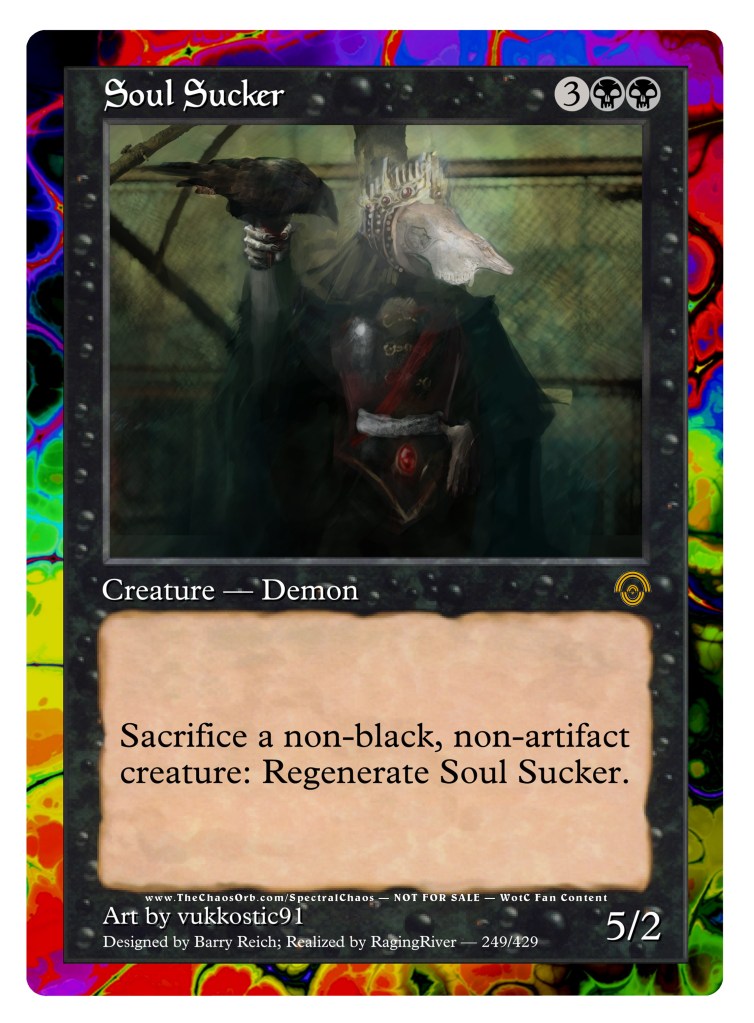
Realized
Soul Sucker – {3}{B}{B}
Creature – Demon
Sacrifice a non-black, non-artifact creature: Regenerate Soul Sucker.
5/2
250 – Lesser Black Demon
(Rare Creature (Black))
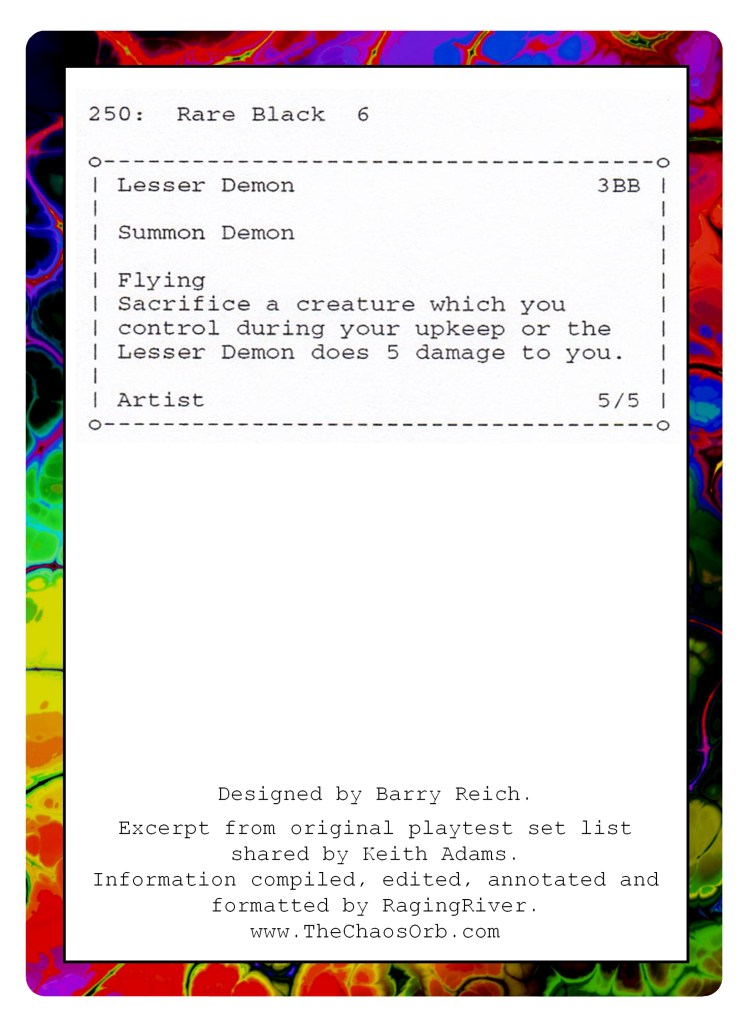
Original Playtest 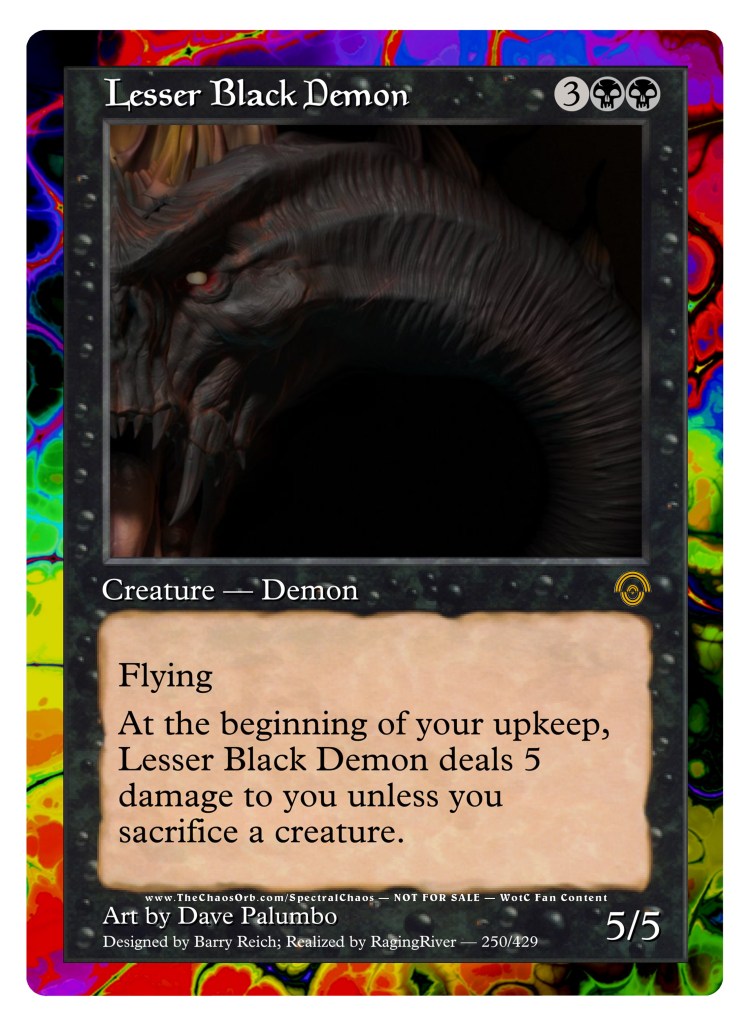
Realized
Lesser Black Demon – {3}{B}{B}
Creature – Demon
Flying
At the beginning of your upkeep, Lesser Black Demon deals 5 damage to you unless you sacrifice a creature.
5/5
251 – Recurring Nightmare
(Rare Creature (Black))
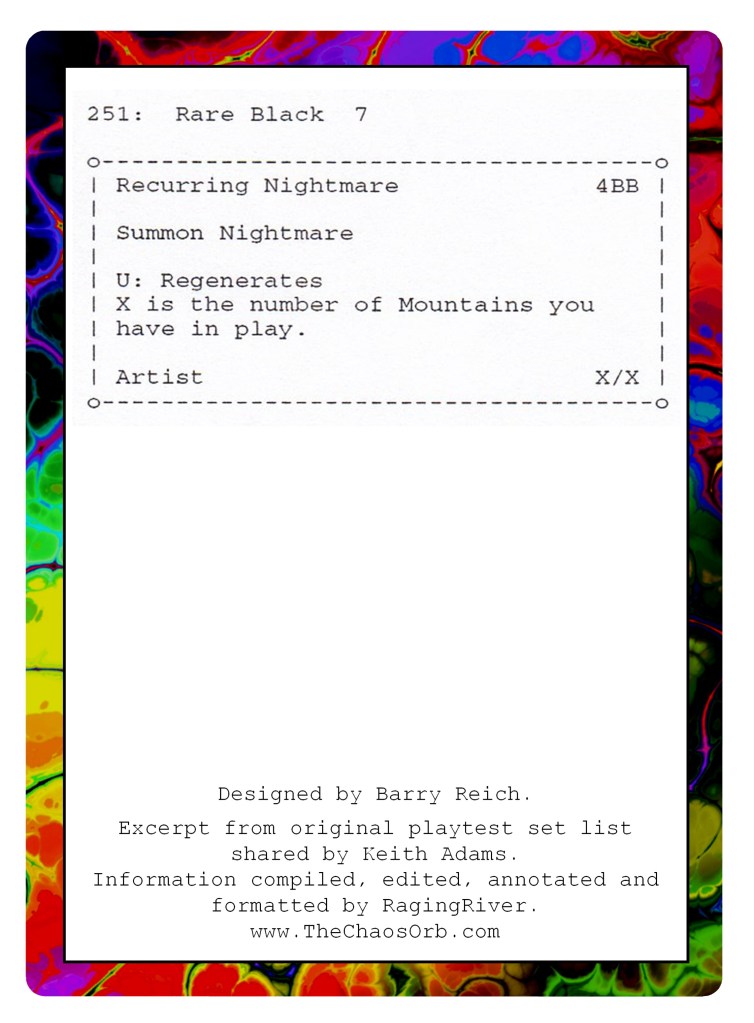
Original Playtest 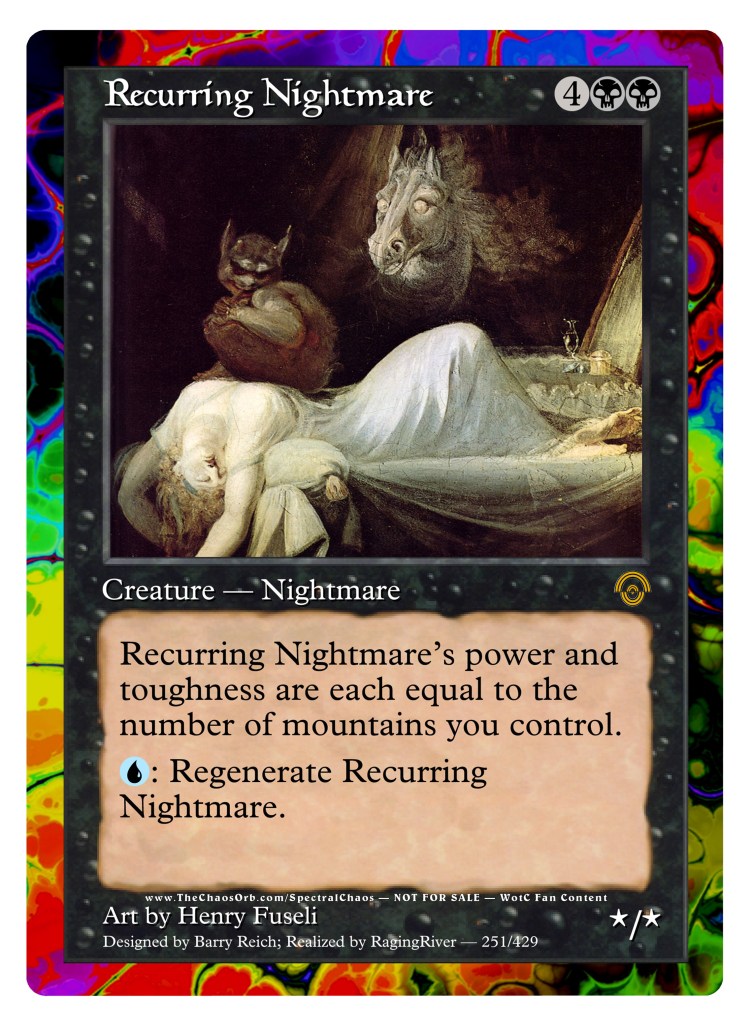
Realized
Recurring Nightmare – {4}{B}{B}
Creature – Nightmare
Recurring Nightmare’s power and toughness are each equal to the number of mountains you control.
{U}: Regenerate Recurring Nightmare.
*/*
252 – Pteryx
(Rare Creature (Black))
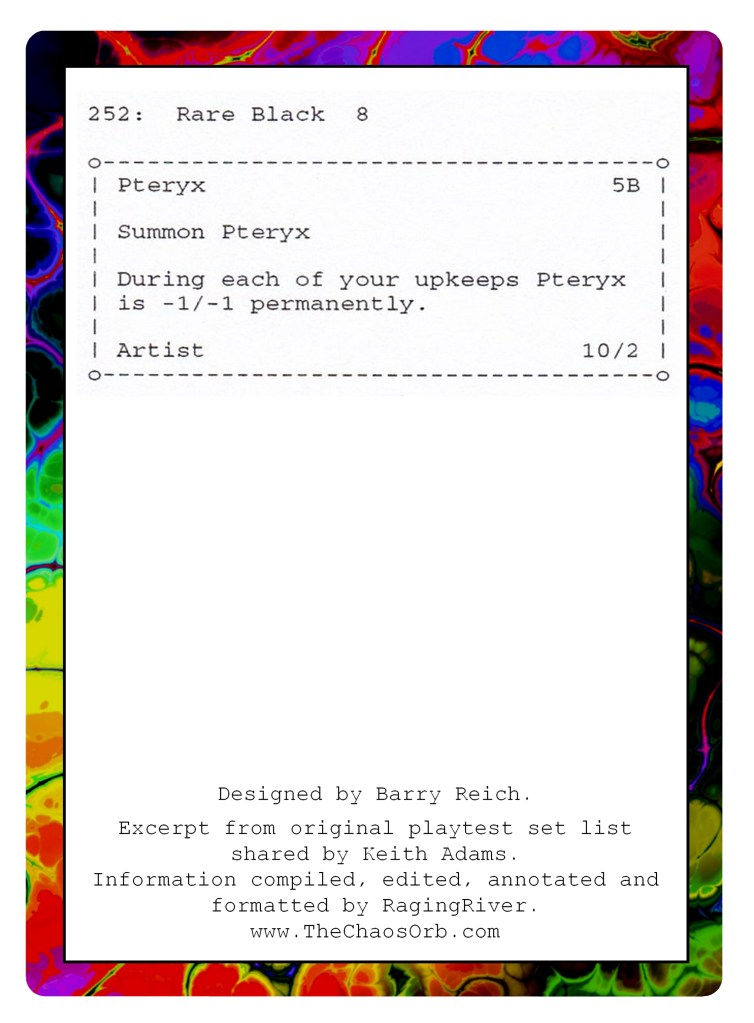
Original Playtest 
Realized
Pteryx – {5}{B}
Creature – Zombie Dinosaur
At the beginning of your upkeep, put a -1/-1 counter on Pteryx.
10/2
253 – Black Widow
(Rare Creature (Black))
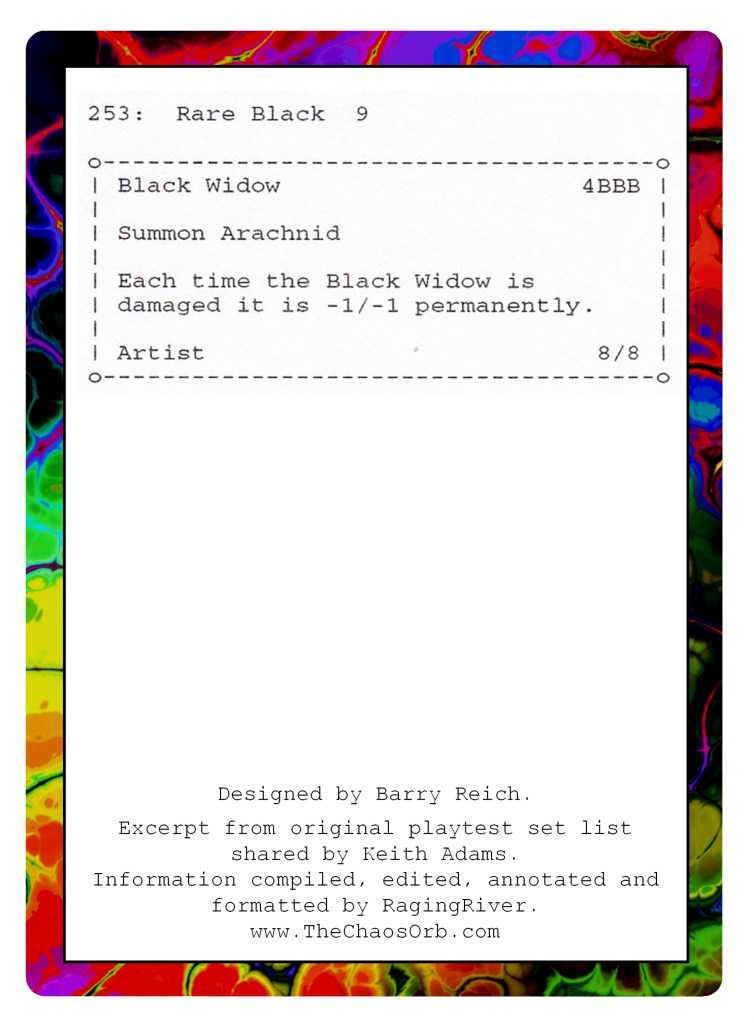
Original Playtest 
Realized
Black Widow – {4}{B}{B}{B}
Creature – Spider
If damage would be dealt to Black Widow, put that many -1/-1 counters on it instead.
8/8
254 – White Doom
(Rare Enchantment (Black))

Original Playtest 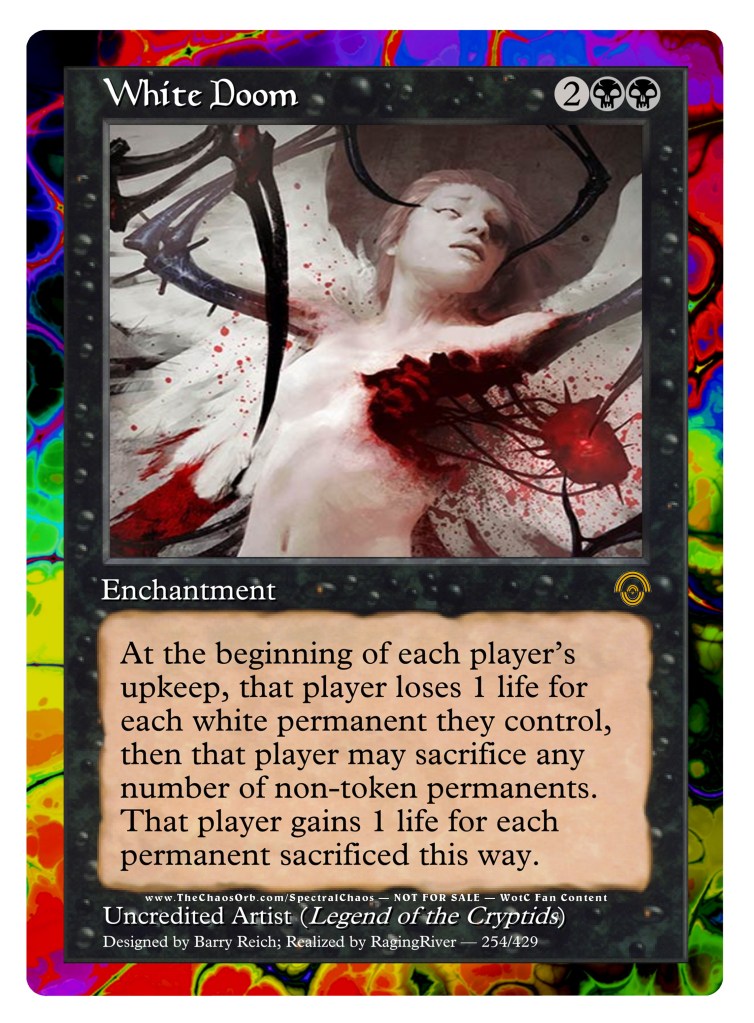
Realized
White Doom – {2}{B}{B}
Enchantment
At the beginning of each player’s upkeep, that player loses 1 life for each white permanent they control, then that player may sacrifice any number of non-token permanents. That player gains 1 life for each permanent sacrificed this way.
- Note that a player may sacrifice any non-token permanent during their upkeep as part of White Doom‘s effect — it doesn’t have to be white.
255 – Deathshriek
(Rare Sorcery (Black))

Original Playtest 
Realized
Deathshriek – {X}{B}
Sorcery
{X} is equal to the number of creatures on the battlefield that you don’t control as you cast this spell.
Deathshriek deals 2 damage to each creature. Whenever a creature dealt damage by Deathshriek dies this turn, you gain 1 life.
256 – Martyr
(Rare Creature (Black))

Original Playtest 
Realized
Martyr – {3}{B}
Creature – Human Cleric
{0}: The next time a source of your choice would deal damage this turn to a creature you control, that damage is dealt to Martyr instead. (All damage that would be dealt to that creature is redirected to Martyr. Other damage the source would deal is not redirected. You may activate this ability for different creatures choosing the same source.)
- Each time you activate this ability, you choose a source of potential damage and a creature you control. A source doesn’t need to be capable of dealing damage to be a legal choice.
- Can be used even when there is no damage to prevent. It prevents the next damage (if any) from the source to that creature this turn.
- If, after activating this ability but before any damage is dealt by that source to that creature, you lose control of that creature, the next damage from that source to that creature would still be redirected to Martyr.
- If you activate Martyr‘s ability multiple times choosing the same source for different creatures you control, and then that source deals damage to all those creatures simultaneously, all that damage is dealt to Martyr simultaneously. For example, if you control Martyr and 3 other non-flying creatures, your opponent casts Earthquake for X=3, and in response you activate Martyr for one of your creatures, hold priority and then activate it again on another of your creatures, then when Earthquake resolves, Martyr will take 9 damage (3 directly plus 3 from each of the two creatures redirecting damage to it), the 4th creature will take 3 damage, and you will take 3 damage, and all of such damage will be dealt simultaneously.
257 – Virus
(Rare Enchantment (Multicolor))

Original Playtest 
Realized
Virus – {U}{B}
Enchantment – Aura
Enchant creature
When Virus enters the battlefield, put a -2/-2 virus counter on enchanted creature.
Whenever a creature without a virus counter blocks or is blocked by a creature with a virus counter, put a -2/-2 virus counter on the first creature. A creature can’t have more than one virus counter. When no Virus is on the battlefield, remove all virus counters from all creatures.
- If multiple copies of Virus are in play, the second ability is redundant. Regardless of how many Virus are on the battlefield or who controls them, whenever a creature without a virus counter blocks or is blocked by a creature without a virus counter, only one virus counter will be put on the first creature.
- Virus counters stay on creatures as long as any card named Virus is on the battlefield, regardless of which Virus was the original source of any of the virus counters.
258 – Landfall
(Rare Sorcery (Multicolor))

Original Playtest 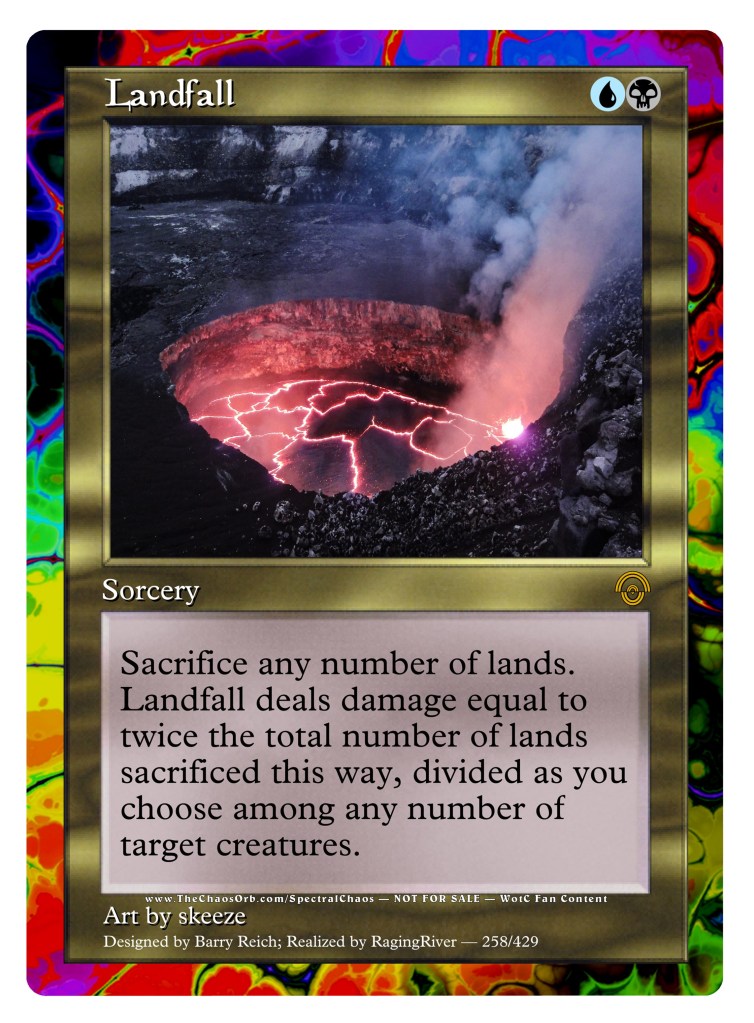
Realized
Landfall – {U}{B}
Sorcery
Sacrifice any number of lands. Landfall deals damage equal to the total number of lands sacrificed this way, divided as you choose among any number of target creatures.
- You choose the target creature(s) when you cast Landfall, but you don’t choose or sacrifice any lands until Landfall resolves. While Landfall is on the stack, your opponents will know what creatures you are targeting, but they won’t know which lands you intend to sacrifice or how much damage you intend to allocate among those creatures, or how. You can allocate damage however you wish among the targeted creatures, including allocating 0 damage to one or more of the targets. For this reason, you’ll typically target all of your opponent’s creatures when you cast Landfall. You may also target your own creatures.
- If Landfall is countered, you sacrifice no lands.
- If one or more of the targets are no longer on the battlefield by the time Landfall resolves, you may still sacrifice lands and do damage to the remaining target(s).
- You don’t need any lands in play to cast Landfall. You don’t have to sacrifice any lands when Landfall resolves. You can choose to sacrifice zero lands.
259 – Instigator
(Rare Creature (Multicolor))
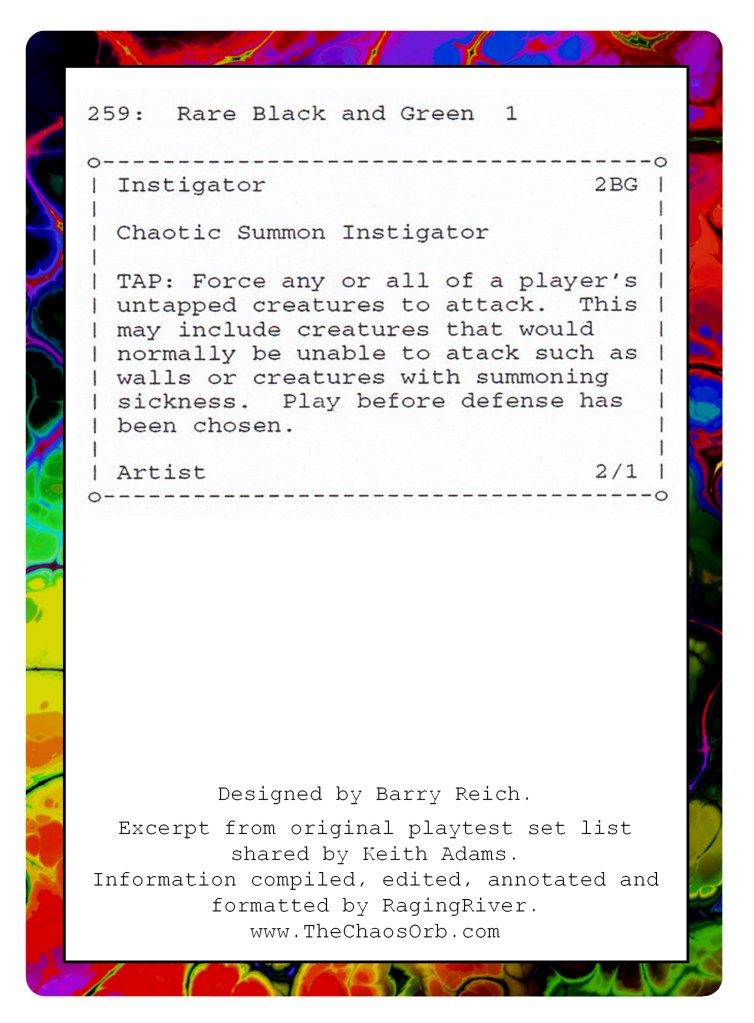
Original Playtest 
Realized
Instigator – {2}{B}{G}
Chaotic Creature – Faerie Rogue
{T}: Any number of target creatures attack this turn if able. If any of those creatures have defender, they may attack this turn as though they didn’t have defender. If any of those creatures have summoning sickness, they may attack this turn as though they had haste. Activate this ability only before the declare attackers step.
2/1
- You can activate this ability during any turn, but only before the declare attackers step. You can target creatures controlled by a player other than the active player, but not sure why you would want to.
- Instigator‘s ability doesn’t actually give any creatures haste. Those creatures still have summoning sickness and can’t tap to activate abilities; they can just attack as though they had haste.
260 – Acid Rain
(Rare Enchantment (Multicolor))
Original Playtest 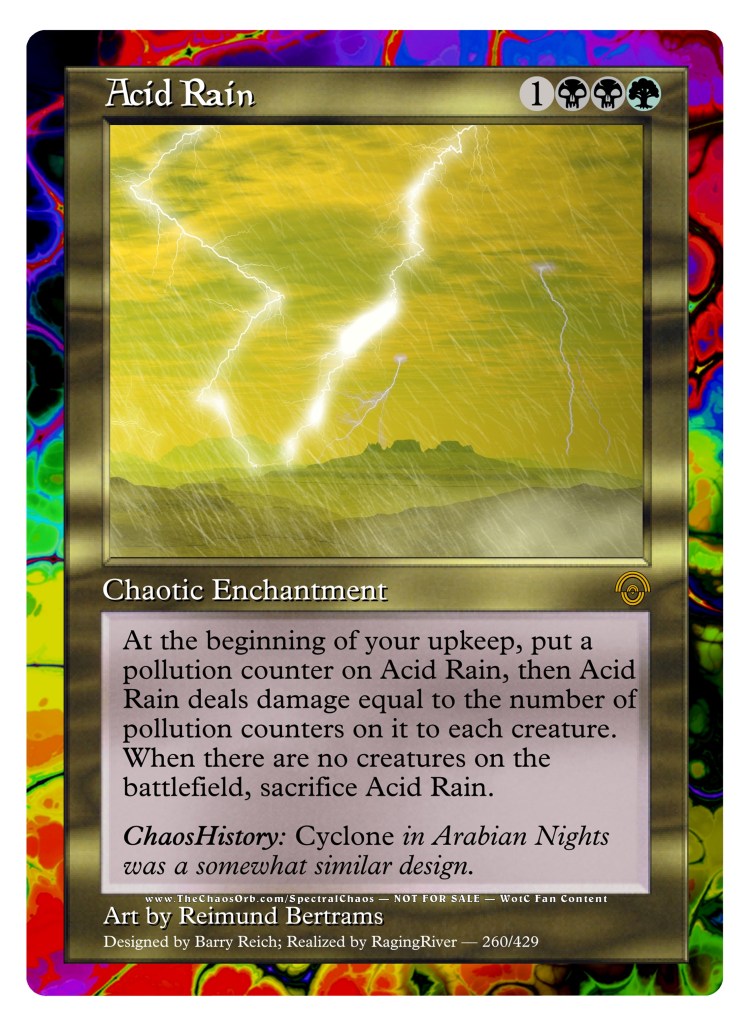
Realized
Acid Rain – {1}{B}{B}{G}
Chaotic Enchantment
At the beginning of your upkeep, put a pollution counter on Acid Rain, then Acid Rain deals damage equal to the number of pollution counters on it to each creature.
When there are no creatures on the battlefield, sacrifice Acid Rain.
ChaosHistory: Cyclone in Arabian Nights was a somewhat similar design.
- If Acid Rain is sacrificed or otherwise no longer on the battlefield after its first ability is already on the stack, the first ability will still resolve and deal damage based on the number of pollution counters on it when it was last on the battlefield.
261 – Manaddiction
(Rare Enchantment (Multicolor))

Original Playtest 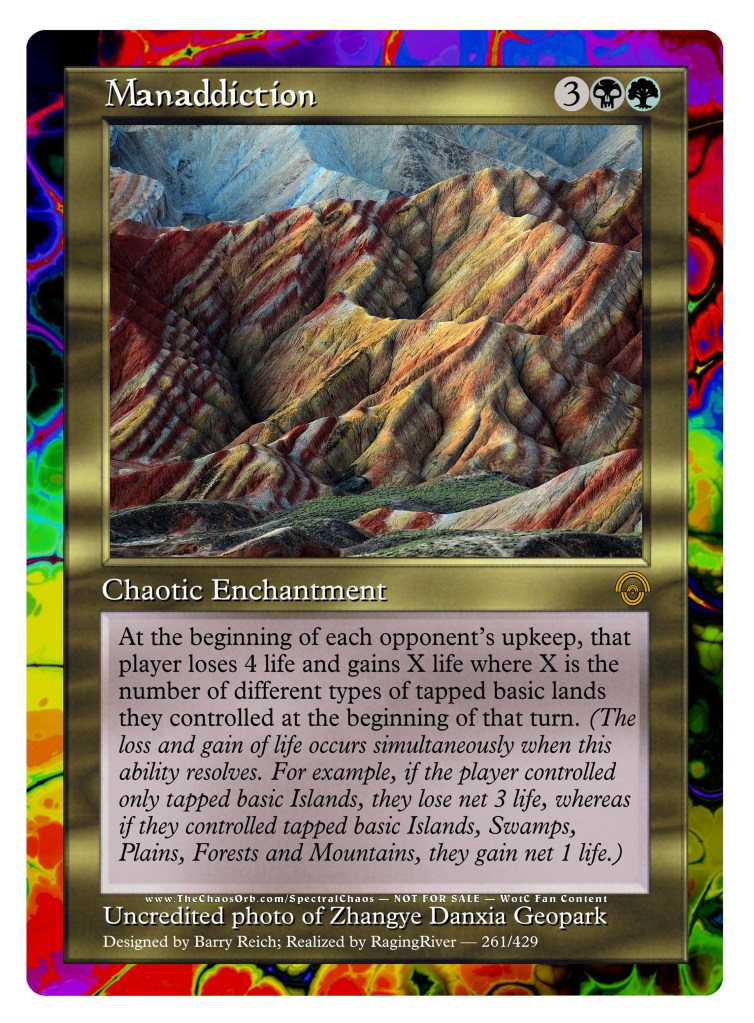
Realized
Manaddiction – {3}{B}{G}
Chaotic Enchantment
At the beginning of each opponent’s upkeep, that player loses 4 life and gains X life, where X is the number of different types of tapped basic lands they controlled at the beginning of that turn. (The loss and gain of life occurs simultaneously when this ability resolves. For example, if the player controlled only tapped basic Islands, they lose net 3 life, whereas if they controlled tapped basic Islands, Swamps, Plains, Forests and Mountains, they gain net 1 life.)
- Manaddiction counts basic land types, but it only looks at tapped basic lands when doing that count. So it won’t see non-basic lands at all, but if a tapped basic land somehow acquires a second basic land type, Manaddiction would see and count that.
- When considering prevention or replacement effects on a player gaining or losing life (such as Sulfuric Vortex, Tainted Remedy or Boon Reflection) only the net life gain or loss is considered. For example, if an opponent controlled Sulfuric Vortex and 5 tapped basic land types, the correct interpretation is that there is a net gain of 1 life prevented by Sulfuric Vortex (so their life total won’t change). It would not be correct to interpret this as the player losing 4 life and then separately gaining 5 life (prevented by Sulfuric Vortex) for a net loss of 4 life.
262 – Defensive Maneuvers
(Rare Instant (Multicolor))
Original Playtest 
Realized
Defensive Maneuvers – {B}{G}
Chaotic Instant
Cast this spell only during the declare attackers step.
Any number of target creatures must block this turn if able.
Blockers ignore all evasion abilities this turn. (Creatures without flying or reach may block flying attackers, unblockable creatures can be blocked, etc. Note this only makes blocking possible, it doesn’t change consequences of blocking; for example, a red creature could block an attacker with protection from red, but combat damage to the attacker would still be prevented.)
- You can cast this spell during your own declare attackers step in order to force certain creatures to block your attackers, or you can cast it during an opponent’s declare attackers step to enable your creatures to block their attackers.
- This doesn’t remove any abilities from attackers, or grant any abilities to blockers. It simply enables blockers to block attackers that they normally wouldn’t be able to block.
- All blockers ignore evasion abilities this turn, not just the creatures targeted by Defensive Maneuvers. You don’t have to target any creatures if you don’t want to.
263 – Black-Green Antimana
(Rare Instant (Multicolor))

Original Playtest 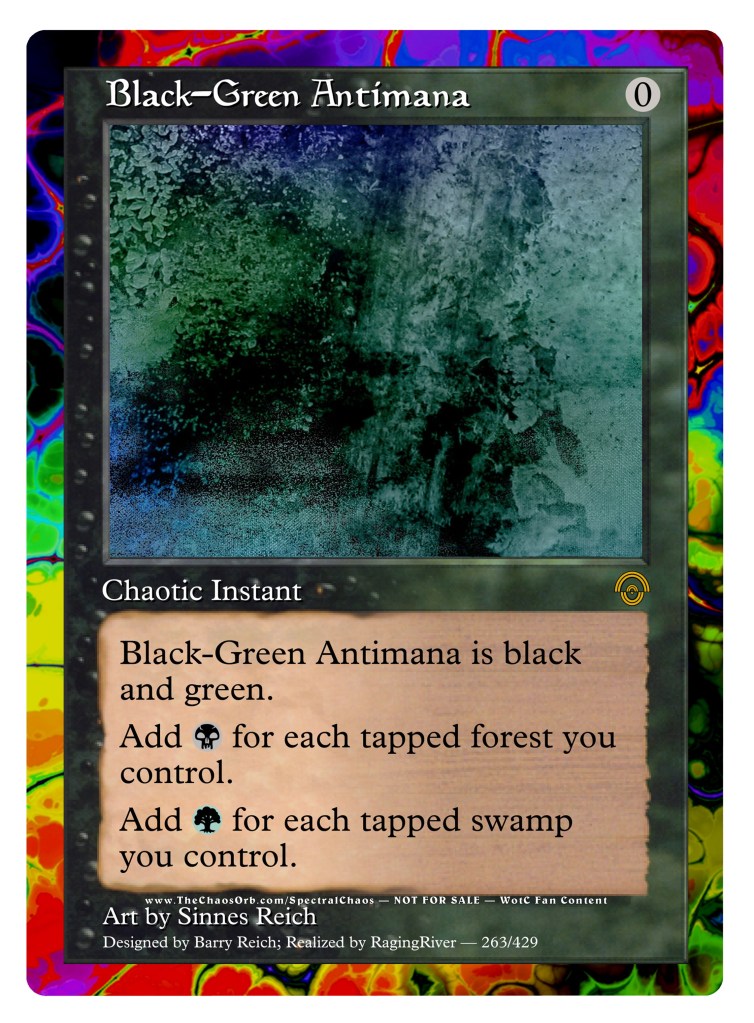
Realized
Black-Green Antimana – {0}
Chaotic Instant
Black-Green Antimana is black and green.
Add {B} for each tapped forest you control.
Add {G} for each tapped swamp you control.
- The amount of mana you get is determined based on how many of the lands are tapped when this resolves. If a tapped land has both basic land types, it will add one of each type of mana.
264 – Night Walker
(Rare Creature (Multicolor))
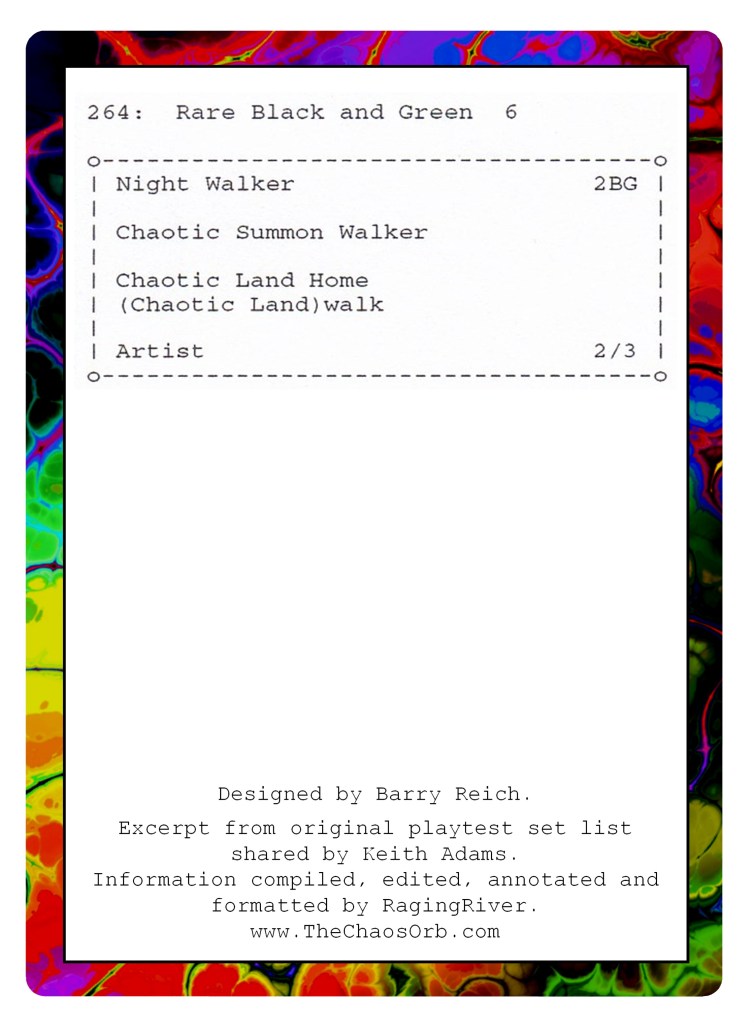
Original Playtest 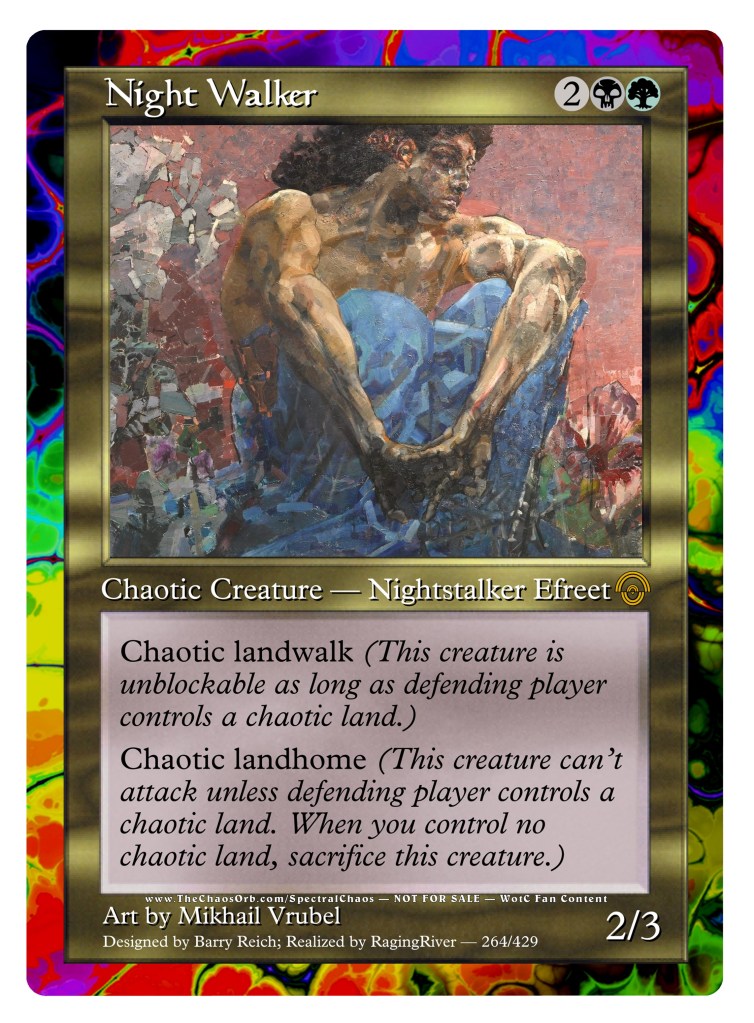
Realized
Night Walker – {2}{B}{G}
Chaotic Creature – Nightstalker Efreet
Chaotic landwalk
Chaotic landhome
2/3
265 – High Quickling
(Rare Creature (Green))

Original Playtest 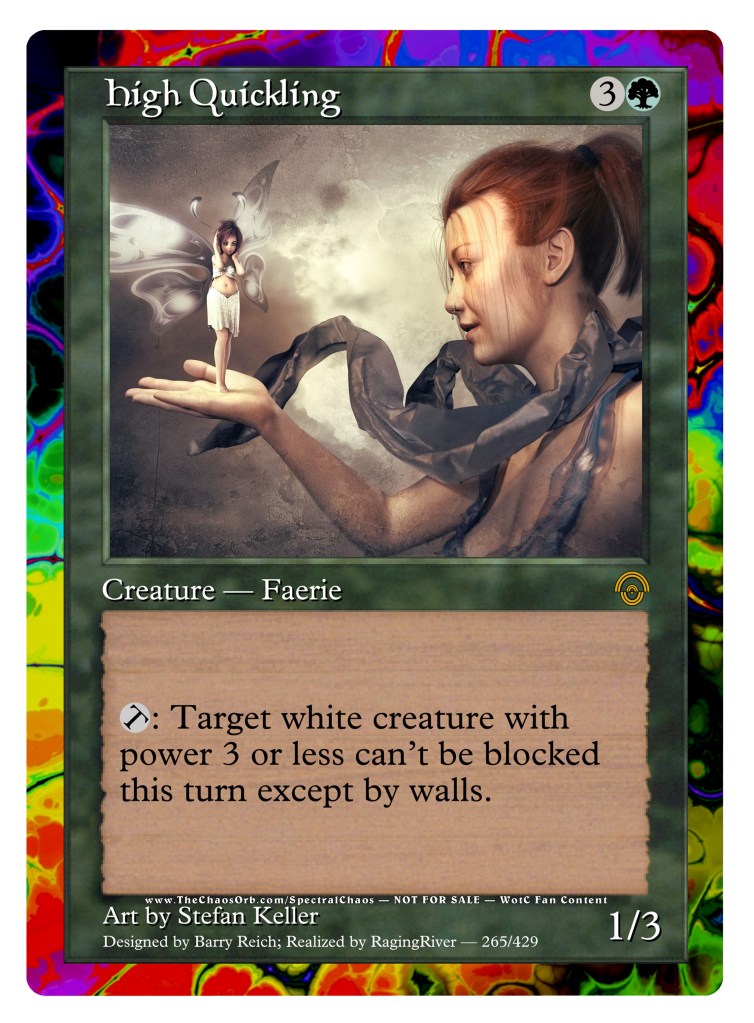
Realized
High Quickling – {3}{G}
Creature – Faerie
{T}: Target white creature with power 3 or less can’t be blocked this turn except by walls.
1/3
- The creature is checked for color and power level when it is targeted, and again when this ability resolves.
- The creature will still be unblockable (except by walls) even if its color or power changes later in the turn.
266 – Koskite Mosquitos
(Rare Creature (Green))

Original Playtest 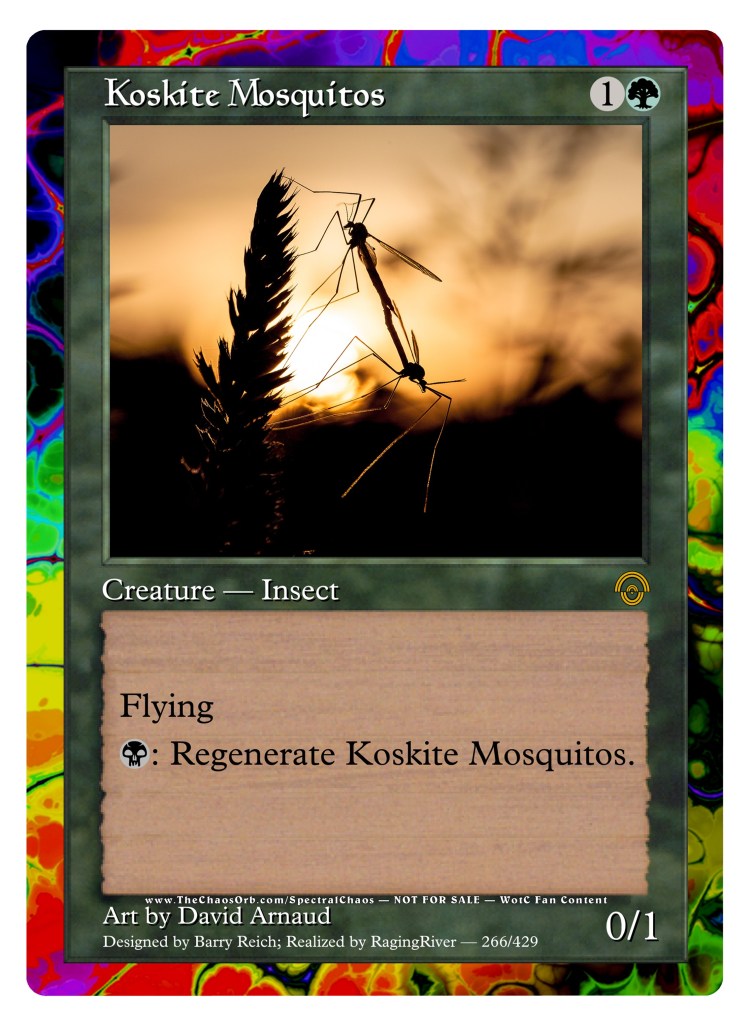
Realized
Koskite Mosquitos – {1}{G}
Creature – Insect
Flying
{B}: Regenerate Koskite Mosquitos.
0/1
267 – Archdruid
(Rare Creature (Green))
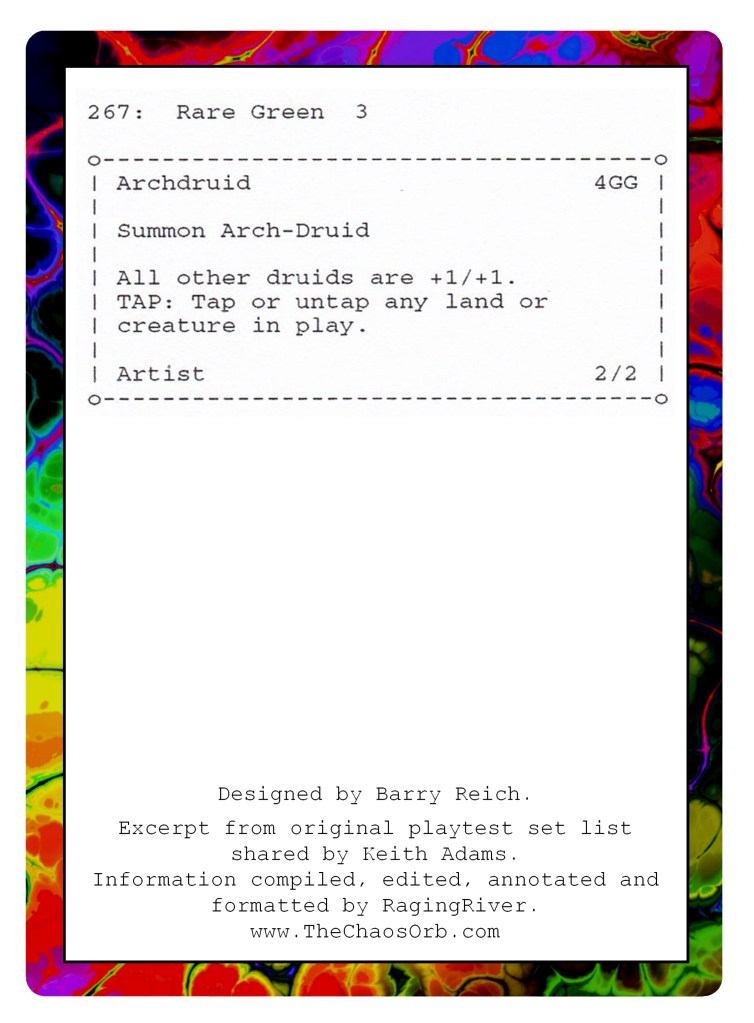
Original Playtest 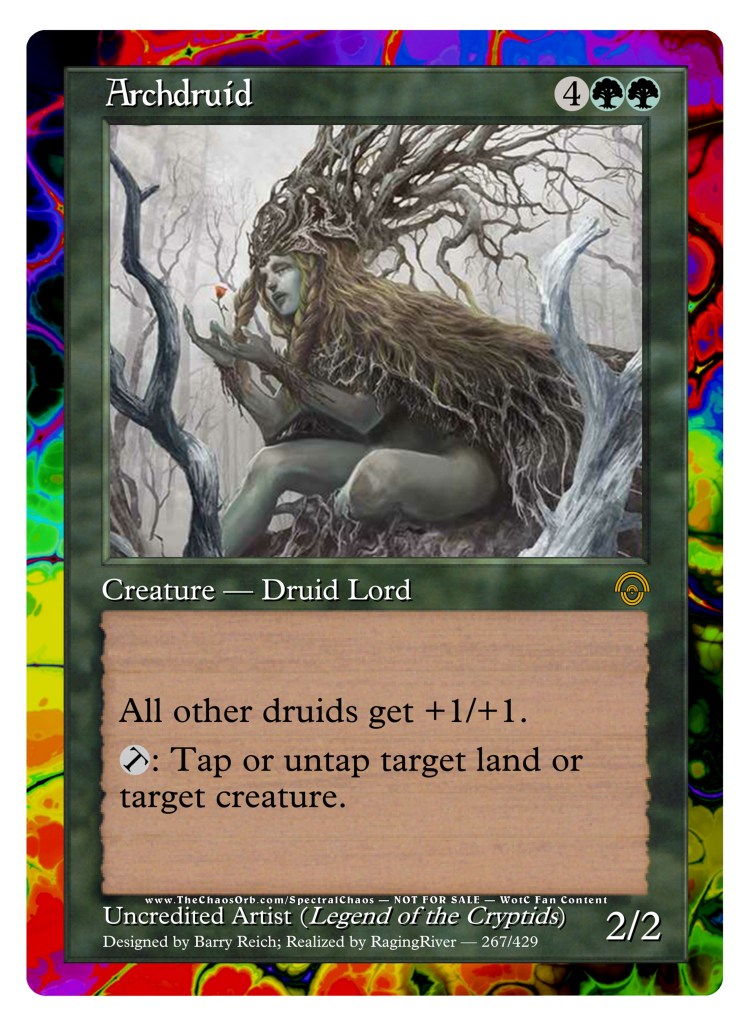
Realized
Archdruid – {4}{G}{G}
Creature – Druid Lord
All other druids get +1/+1.
{T}: Tap or untap target land or target creature.
2/2
268 – Ronnam Longbowman
(Rare Creature (Green))
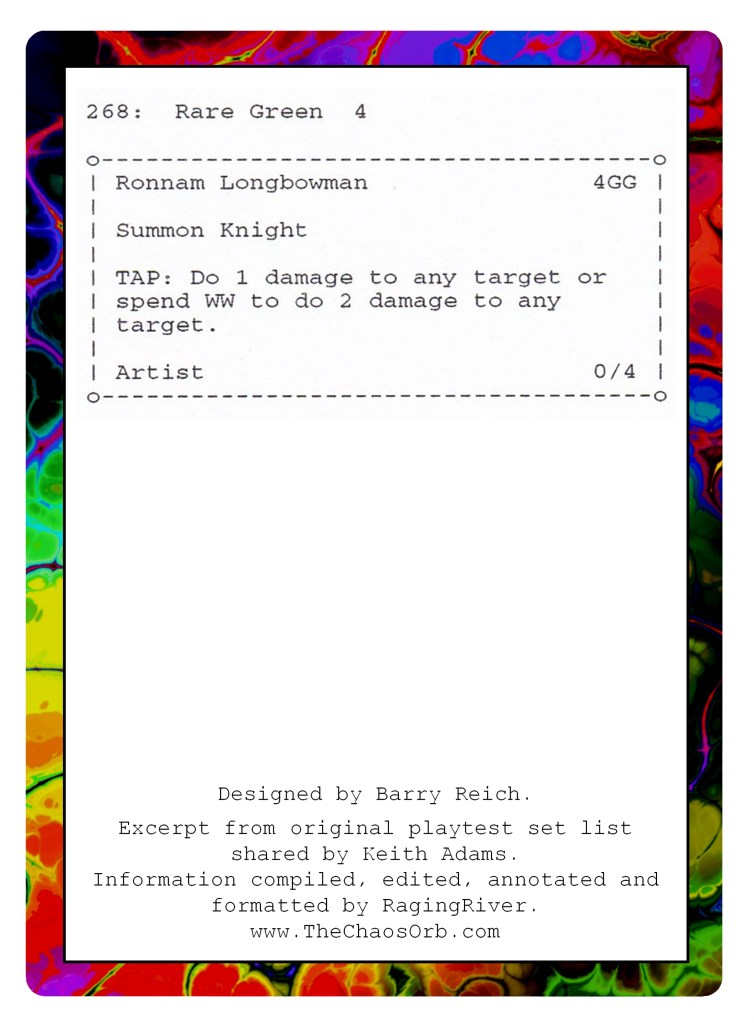
Original Playtest 
Realized
Ronnam Longbowman – {4}{G}{G}
Creature – Human Knight
{T}: Ronnam Longbowman deals 1 damage to any target.
{W}{W}, {T}: Ronnam Longbowman deals 2 damage to any target.
0/4
ChaosHistory: Ronnam is an anagram of the name of Barry’s brother Norman.
269 – Highland Eagle
(Rare Creature (Green))

Original Playtest 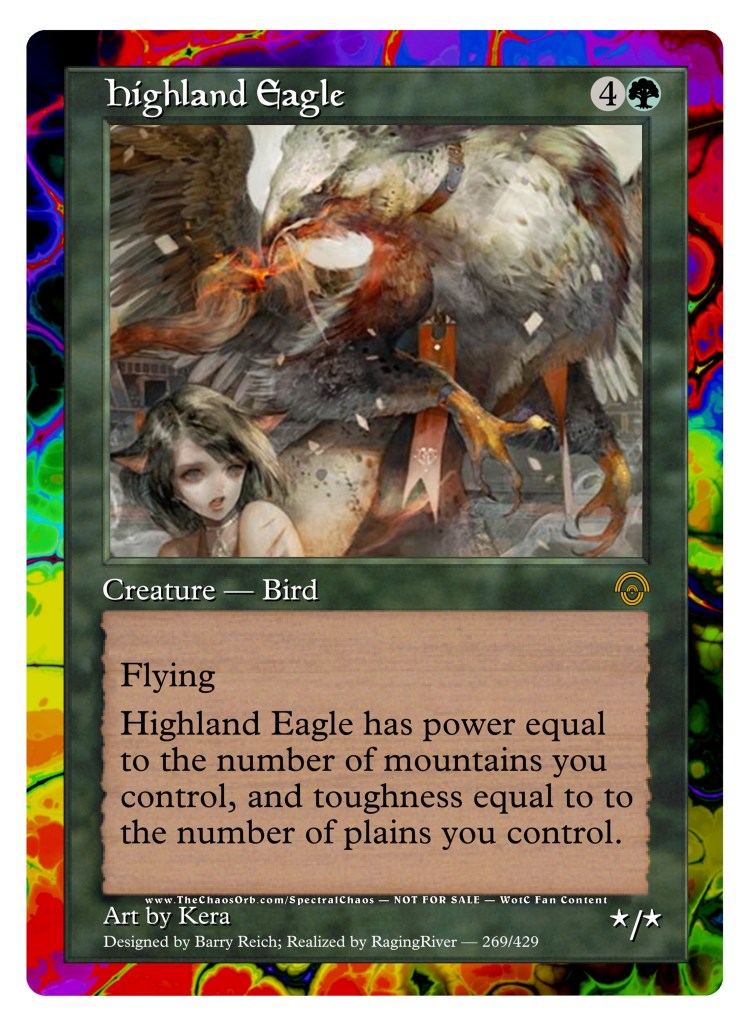
Realized
Highland Eagle – {4}{G}
Creature – Bird
Flying
Highland Eagle has power equal to the number of mountains you control, and toughness equal to the number of plains you control.
*/*
270 – King of the Jungle
(Rare Creature (Green))
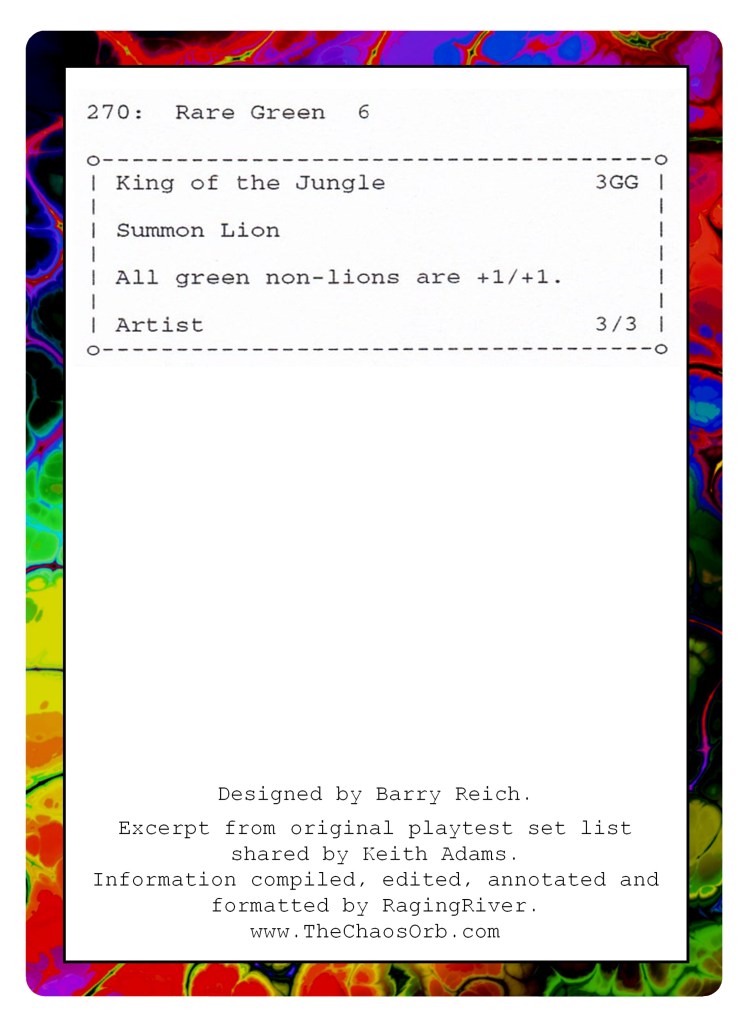
Original Playtest 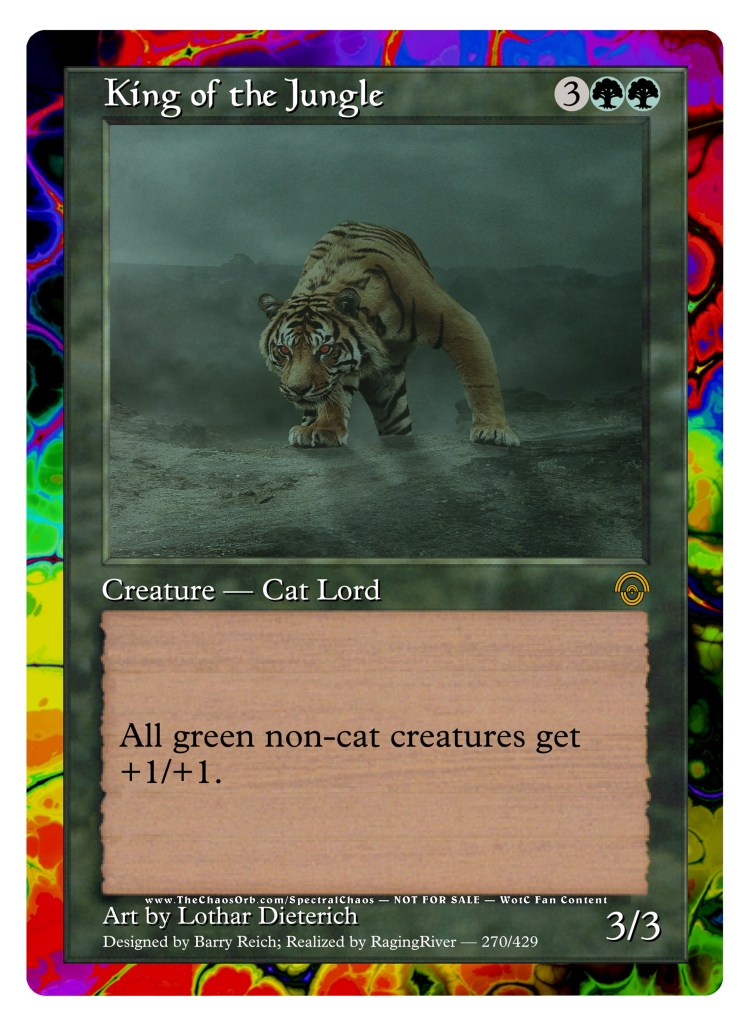
Realized
King of the Jungle – {3}{G}{G}
Creature – Cat Lord
All green non-cat creatures get +1/+1.
3/3
271 – Spectral Growth
(Rare Enchantment (Green))

Original Playtest 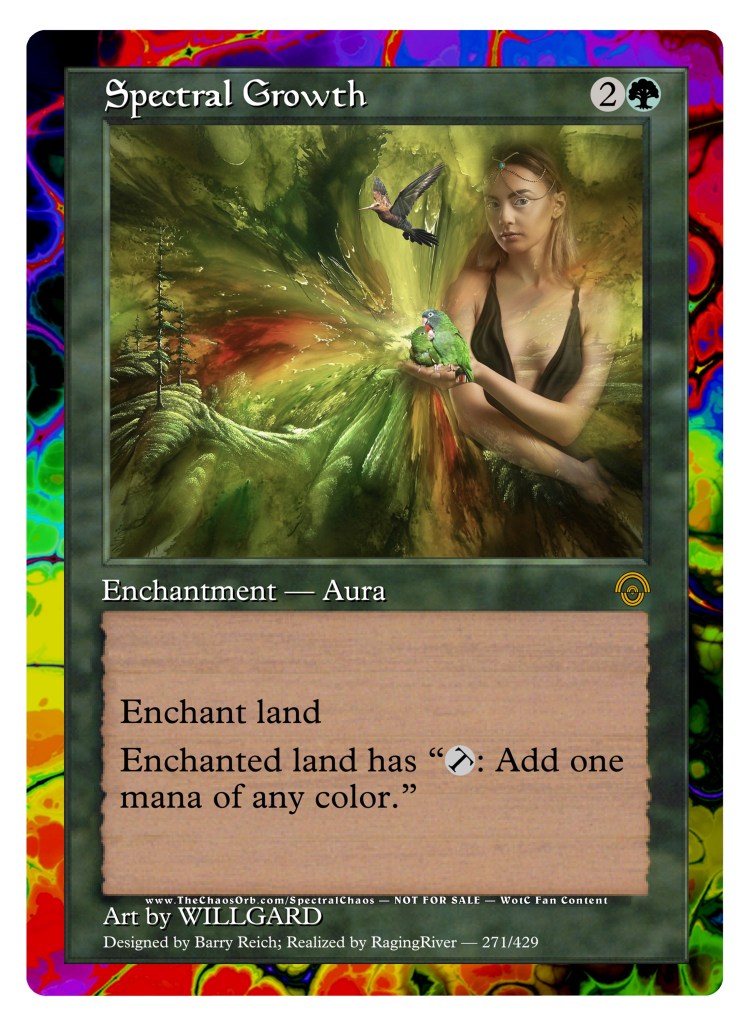
Realized
Spectral Growth – {2}{G}
Enchantment – Aura
Enchant Land
Enchanted land has “{T}: Add one mana of any color.”
272 – Alter Land
(Rare Sorcery (Green))

Original Playtest 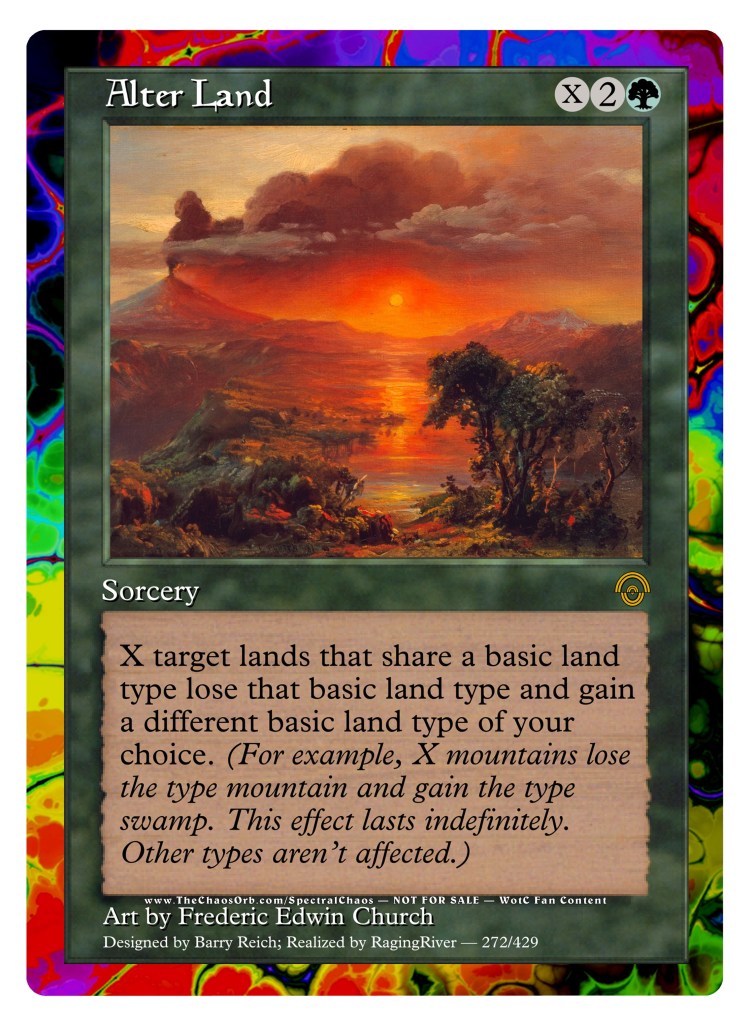
Realized
Alter Land – {X}{2}{G}
Sorcery
X target lands that share a basic land type lose that basic land type and gain a different basic land type of your choice. (For example, X mountains lose the type mountain and gain the type swamp. This effect lasts indefinitely. Other types aren’t affected.)
- You don’t decide what the new basic land type will be until Alter Land resolves.
- The gaining of the new basic land type is permanent, even if the targeted lands only temporarily shared a basic land type (for example, they were only mountains until end of turn) when targeted.
- A land could still regain the basic land type that was lost, if some other effect grants that basic land type back to the land later in the game.
273 – Wild Joker
(Rare Creature (Green))

Original Playtest 
Realized
Wild Joker – {1}{G}
Creature – Rogue Wizard
{T}, sacrifice Wild Joker: Copy target instant or sorcery spell, except that the copy is green. (Note that the copy has the same modes, values and targets as the original. This is different from other effects like Fork or Copy Spell.)
0/2
- Copying a spell with an X in the cost will have the same X value.
- If mana or other costs need to be spent at resolution of the spell, the copy’s controller would still be responsible for paying that cost.
- You need not (and may not) pay any additional mana or other costs (like sacrifices) to use the spell which is copied. You get control over a complete copy but can change nothing about the copy (not even the targets).
- If you copy a spell for which Buyback has been paid, you get nothing back since the copied spell does not have a card to give you.
- The copy that is placed on the stack is not considered to have been “cast”.
- The Wild Joker card goes to the graveyard when you sacrifice it as part of the cost of the activated ability, before the ability resolves and leaves the copy of the spell on the stack. There is no card representing the copy on the stack.
- The copy will have the same mana cost (with the same mana symbols in the mana cost) as the card it is copying, but it will be green rather than whatever color that mana cost would have made it.
- If you copy a Spliced spell, the spliced text is added during the announcement of the original spell, and therefore is fully copied by Wild Joker‘s ability.
- If the targeted spell was kicked, then the copy will be kicked as well. If the targeted spell was not kicked, then the copy will not be (and may not be) kicked.
- If the targeted spell was chaotic, legendary or had other subtypes or supertypes, these types are copied as well.
274 – Supernatural Power
(Rare Enchantment (Green))
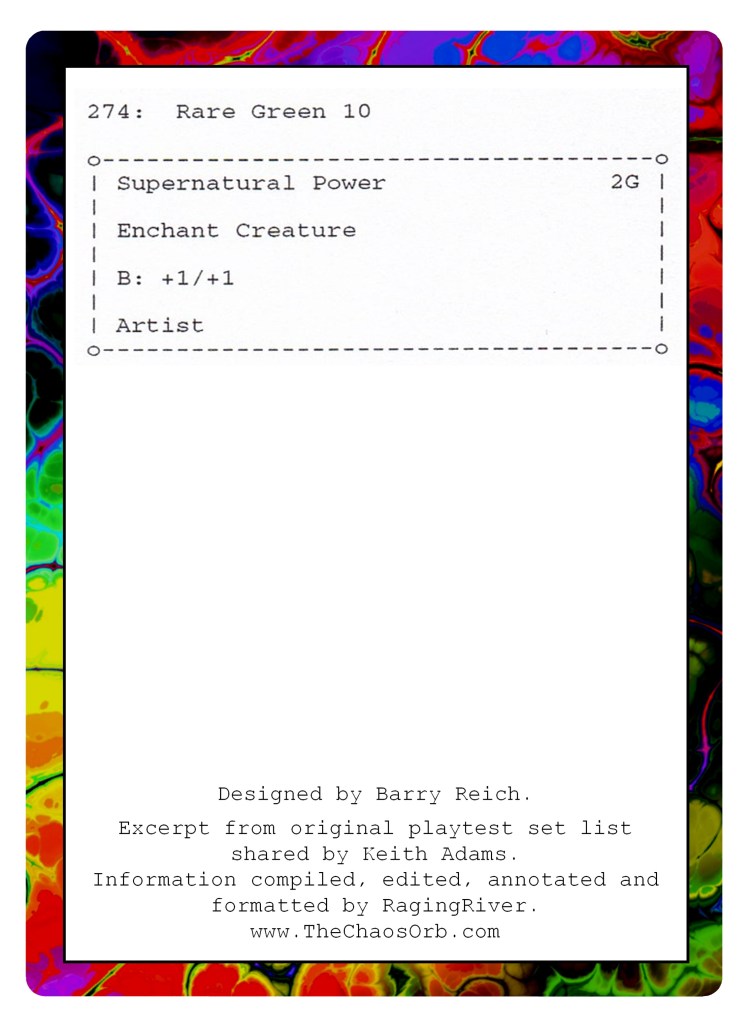
Original Playtest 
Realized
Supernatural Power – {2}{G}
Enchantment – Aura
Enchant creature
{B}: Enchanted creature gets +1/+1 until end of turn.
275 – Tree Herder
(Rare Creature (Green))
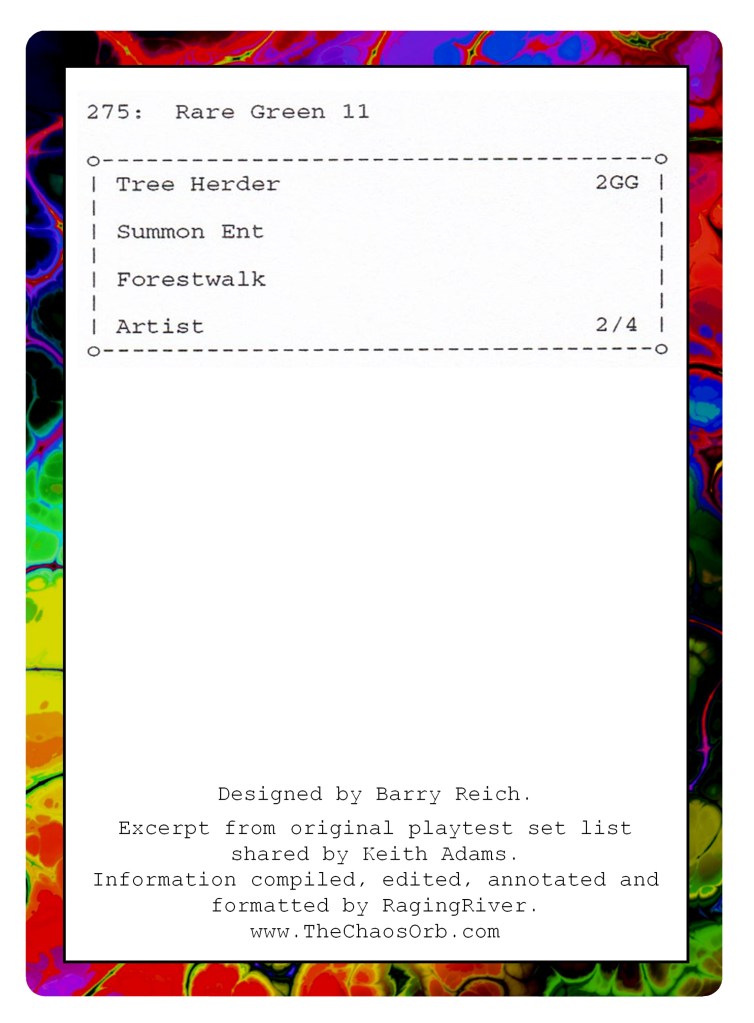
Original Playtest 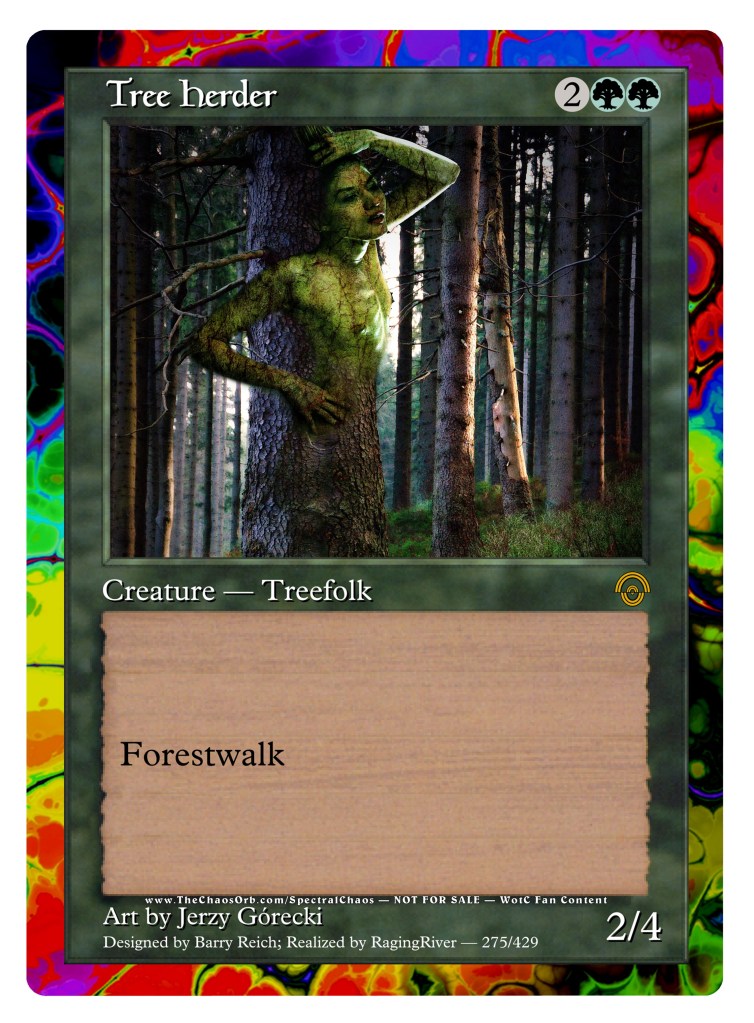
Realized
Tree Herder – {2}{G}{G}
Creature – Treefolk
Forestwalk
2/4
276 – Army Ants
(Rare Creature (Multicolor))
Original Playtest 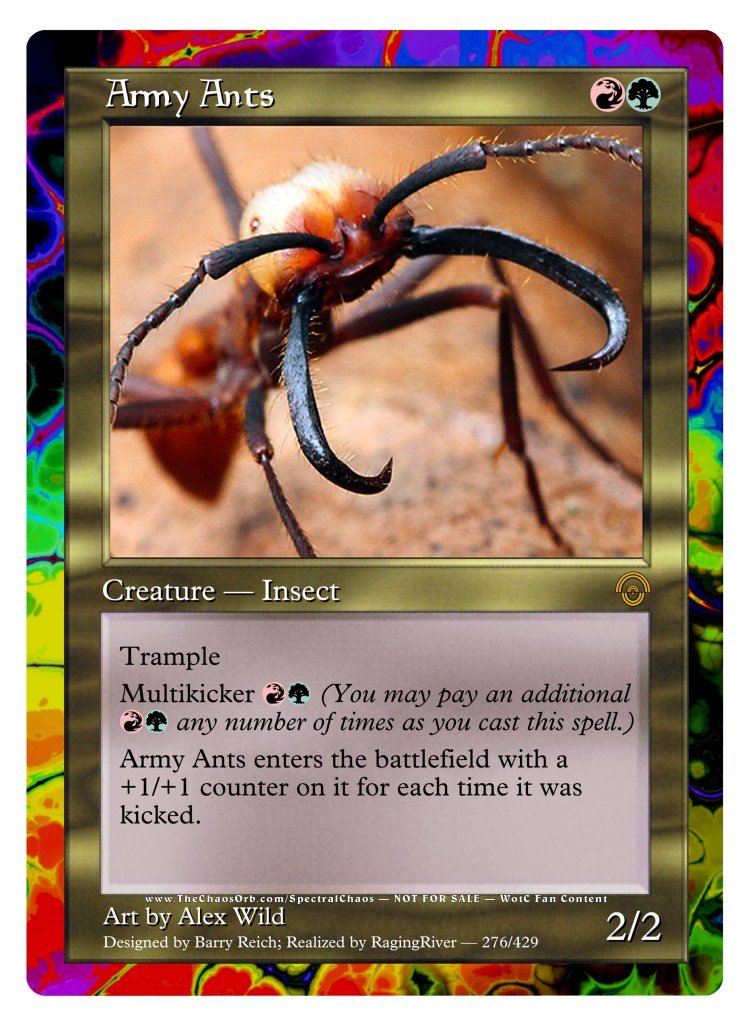
Realized
Army Ants – {R}{G}
Creature – Insect
Multikicker {R}{G}
Army Ants enters the battlefield with a +1/+1 counter on it for each time it was kicked.
2/2
277 – Frenzy
(Rare Enchantment (Multicolor))
Original Playtest 
Realized
Frenzy – {1}{G}{U}
Chaotic Enchantment
All creatures attack each turn if able.
- If there are multiple combat phases in a turn, creatures attack in each of those combat phases if able.
278 – Gremlin
(Rare Creature (Multicolor))
Original Playtest 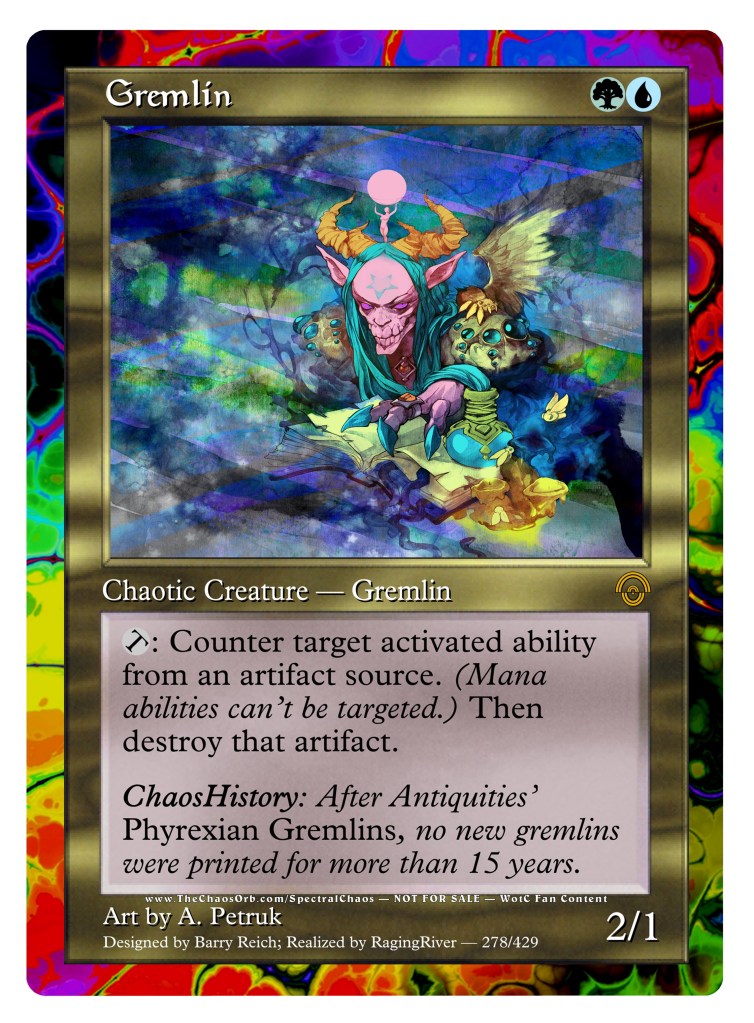
Realized
Gremlin – {G}{U}
Chaotic Creature – Gremlin
{T}: Counter target activated ability from an artifact source. (Mana abilities can’t be targeted.) Then destroy that artifact.
2/1
ChaosHistory: After Antiquities’ Phyrexian Gremlins, no new gremlins were printed for more than 15 years.
- You can’t use this activated ability to target an artifact unless and until that artifact has a non-mana activated ability on the stack. The ability is targeted, not the artifact itself.
- Attacking isn’t an ability, activated or otherwise. Gremlin can’t target an artifact creature simply for attacking. The creature would need to activate an ability.
- If for some reason the artifact can’t be destroyed, its activated ability will still be countered. If for some reason the artifact’s ability can’t be countered, the artifact will still be destroyed.
279 – Green-Blue Antimana
(Rare Instant (Multicolor))

Original Playtest 
Realized
Green-Blue Antimana – {0}
Chaotic Instant
Green-Blue Antimana is green and blue.
Add {G} for each tapped island you control.
Add {U} for each tapped forest you control.
- The amount of mana you get is determined based on how many of the lands are tapped when this resolves. If a tapped land has both basic land types, it will add one of each type of mana.
280 – Lucky Number
(Rare Enchantment (Multicolor))

Original Playtest 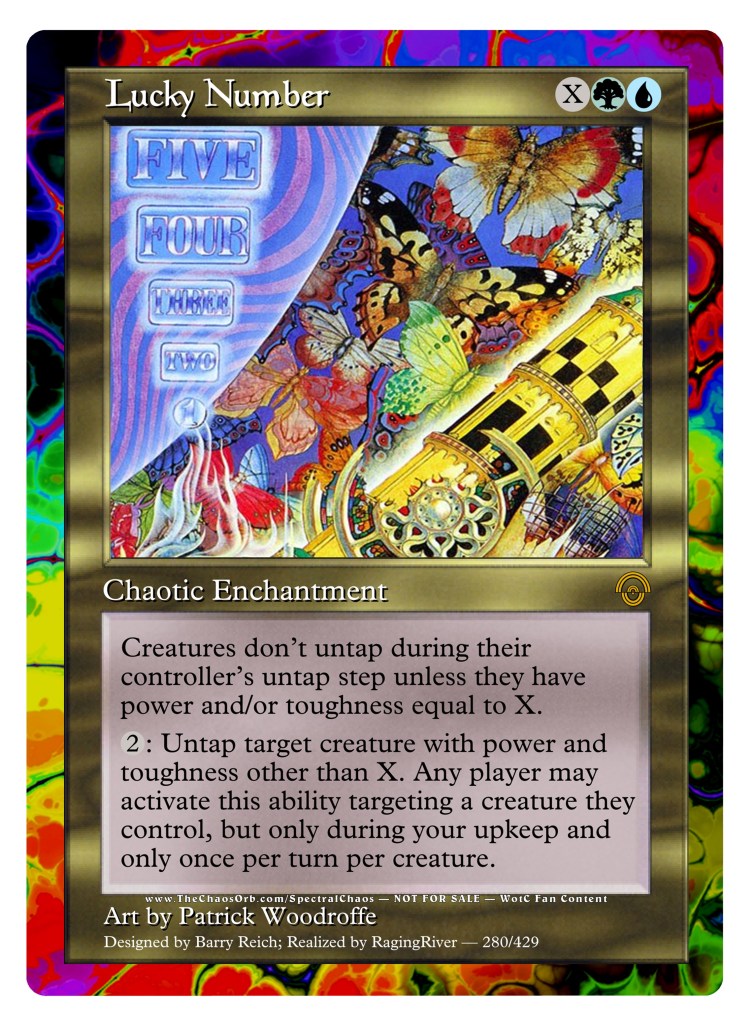
Realized
Lucky Number – {X}{G}{U}
Chaotic Enchantment
Creatures don’t untap during their controller’s untap step unless they have power and/or toughness equal to X.
{2}: Untap target creature with power and toughness other than X. Any player may activate this ability targeting a creature they control, but only during your upkeep and only once per turn per creature.
- Lucky Number‘s activated ability may only be activated during your upkeep, not any other player’s upkeep. Any player can untap their creatures with the ability, but only when they have priority during your upkeep. The power and touchness are checked when a player activates the ability and again when it resolves. The activated ability will work only if neither the power nor the toughness are equal to X.
281 – Changeling
(Rare Creature (Multicolor))
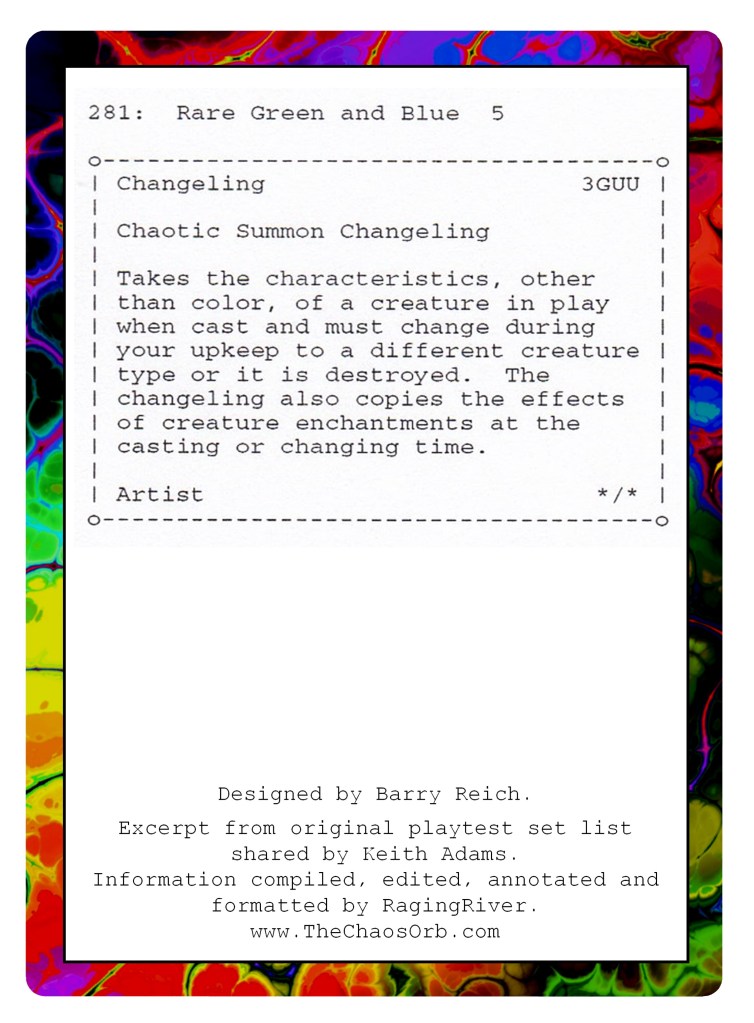
Original Playtest 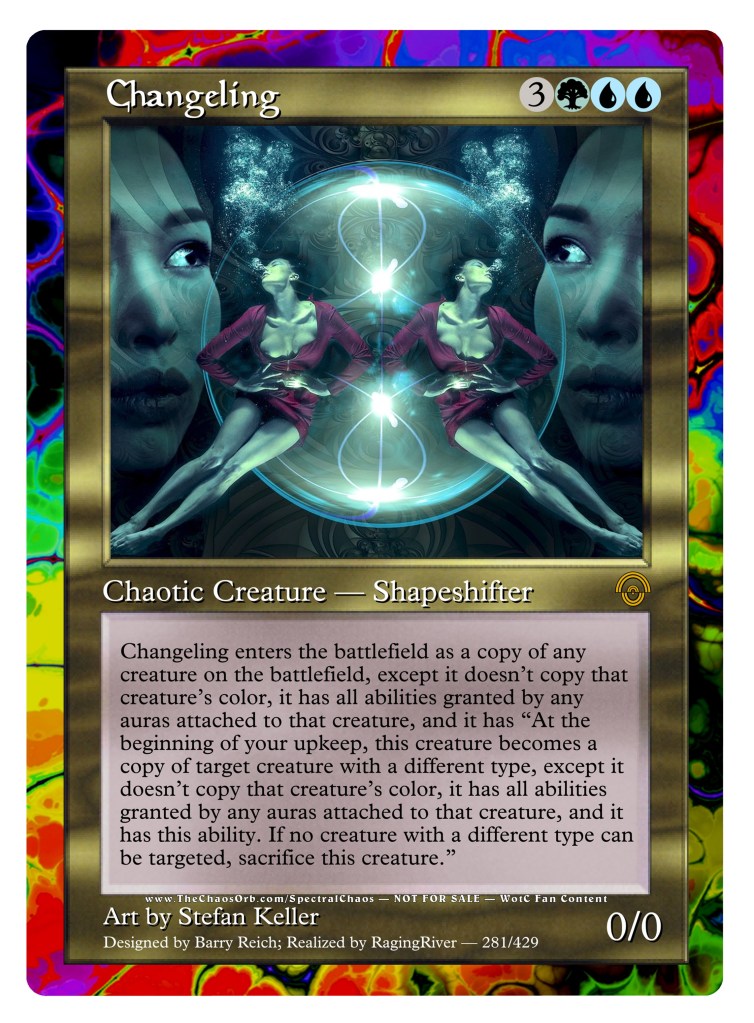
Realized
Changeling – {3}{G}{U}{U}
Chaotic Creature – Shapeshifter
Changeling enters the battlefield as a copy of any creature on the battlefield, except it doesn’t copy that creature’s color, it has all abilities granted by any auras attached to that creature, and it has “At the beginning of your upkeep, this creature becomes a copy of target creature with a different type, except it doesn’t copy that creature’s color, it has all abilities granted by any auras attached to that creature, and it has this ability. If no creature with a different type can be targeted, sacrifice this creature.”
- Changeling copies the printed values of the chosen creature, plus any copy effects that have been applied to it, plus abilities granted to that creature by auras. Changeling won’t copy counters on that creature or effects that have changed its color.
- Only effects granted to the creature from auras attached to it will be copied. Such an aura is worded that the enchanted creature “has,” “gains” or “gets” something. Other abilities of the aura that aren’t granted to the creature are not copied by Changeling‘s ability. For example, if the copied creature is enchanted by Holy Armor, Changeling would get the benefit of +0/+2 from the “enchanted creature gets +0/+2” part, but you won’t be able to pay mana for the “{W}: Enchanted creature gets +0/+1 until end of turn” part because that is an activated ability of the aura, not the creature it enchants. Only abilities from auras enchanting the creature at the time it is copied are included; if the copied creature later dies, its auras are destroyed or it gets new auras on it, that won’t affect Changeling.
- When Changeling switches creatures, the creature it used to be is not considered to have left the battlefield.
- If Changeling copies a creature that is itself copying something else, it will become whatever that creature was copying.
- If the copied creature has an effect that triggers when it leaves the battlefield, it will trigger when Changeling leaves the battlefield.
- Damage is not removed when it changes forms.
- When Changeling’s triggered ability triggers, you must choose a target for it that is a creature of a different type than it currently is, even if the only option is a creature on the battlefield that you don’t like. A creature with a different type is what matters, not a different name (although creatures with the same name nearly always have the same types). You cannot decline and keep Changeling as the same creature, or change to another creature of the same type. It’s ok if one or more of the creature types are the same, but at least one must be different or additional. For example, if Changeling is a goblin, it could change to a goblin wizard; if it’s a goblin wizard, it cannot change to a goblin or a wizard, but it could change to a human wizard.
- When it takes on the characteristics of the other creature, it is no longer of the creature type shapeshifter.
- When changing forms, any text changes that exist on the Changeling are applied to the new text, if appropriate.
- If Changeling is flipped, and it copies a flip card in any state, it will copy both “sides” of that card but use the flipped side. If Changeling is unflipped, and it copies a flip card in any state, it will copy both “sides” of that card but use the unflipped side. In the second case, if it ever meets the flip conditions of its new ability, it will flip and used the flipped side of what it is copying.
- Changeling copies the mana cost of the creature it’s copying (just the creature, not any auras attached to it) but doesn’t copy its color.
- If another creature copies Changeling, the new creature will become a copy of whatever Changeling is copying except for its color, will copy Changeling‘s color, and will gain Changeling‘s triggered ability.
- Changeling’s triggered ability can’t cause it to become a copy of itself, but it could theoretically cause it to become a copy of another Changeling that has a different creature type at the time. In that situation, it would gain another instance of its triggered ability. Each instance of that ability will trigger during its controller’s upkeep. They’ll all be put on the stack and resolve one at a time. The last one to resolve determines the Changeling’s characteristics for the rest of the turn.
- If Changeling copies a face-down creature, it becomes a face-up 2/2 blue-green creature with no name and no abilities other than the one it gives itself (and from any auras that were attached to the face-down creature).
- Although Changeling’s triggered ability is targeted, its “enters the battlefield” ability is not.
282 – Hyperactivity
(Rare Enchantment (Multicolor))

Original Playtest 
Realized
Hyperactivity– {1}{G}{U}{U}
Chaotic Enchantment – Aura
Enchant creature
{G}{U}: Untap enchanted creature, and Hyperactivity deals 1 damage to it.
- You can activate this ability even if the enchanted creature is already untapped. Hyperactivity will still deal 1 damage to the enchanted creature if you do.
283 – Resonance
(Rare Sorcery (Multicolor))

Original Playtest 
Realized
Resonance – {X}{1}{G}{U}{U}
Chaotic Sorcery
Destroy all non-token, non-land permanents with converted mana cost X.
284 – Stunt Double
(Rare Instant (Multicolor))

Original Playtest 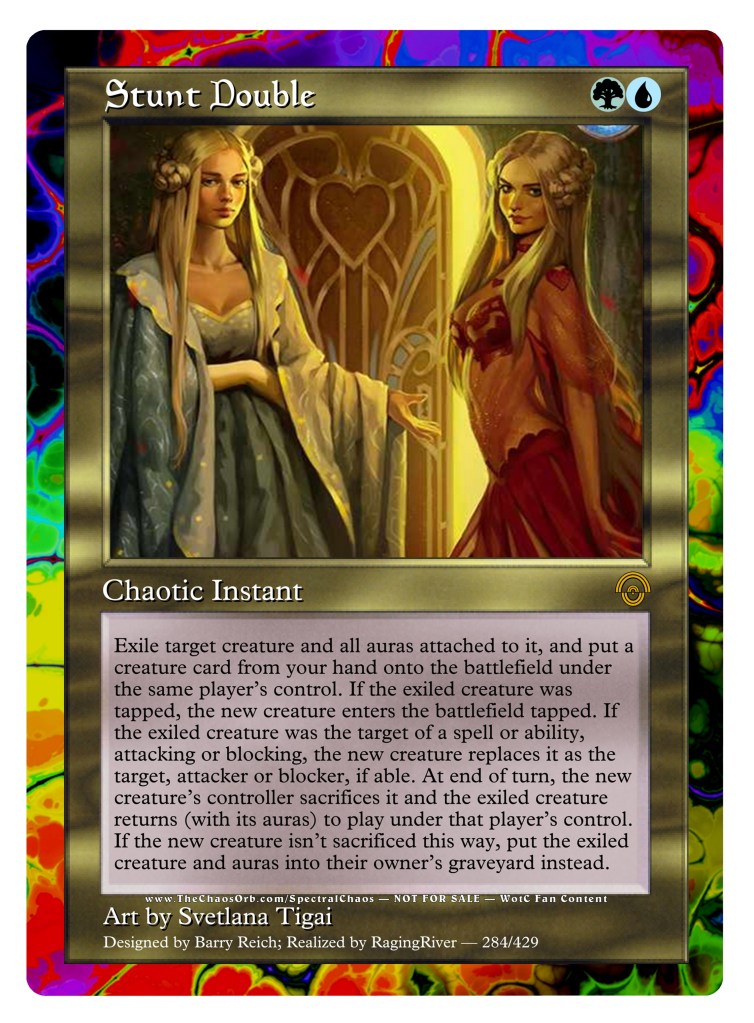
Realized
Stunt Double – {G}{U}
Chaotic Instant
Exile target creature and all auras attached to it, and put a creature card from your hand onto the battlefield under the same player’s control. If the exiled creature was tapped, the new creature enters the battlefield tapped. If the exiled creature was the target of a spell or ability, attacking or blocking, the new creature replaces it as the target, attacker or blocker, if able. At end of turn, the new creature’s controller sacrifices it and the exiled creature returns (with its auras) to play under that player’s control. If the new creature isn’t sacrificed this way, put the exiled creature and auras into their owner’s graveyard instead.
- Because the new stunt double creature wasn’t controlled by its controller since the beginning of that turn, it will have summoning sickness. So the new creature can’t be declared as an attacker (unless it has haste). However, if you use Stunt Double to swap a creature that was already attacking, then the new creature will also be attacking.
- The new stunt double creature won’t be affected by anything that affected the creature it swapped with that has already resolved. For example, if the target creature had been pumped by Giant Growth already this turn, the new creature won’t get +3/+3. If, however, you cast Stunt Double in response to Giant Growth on the stack targeting the creature you swap, then the new creature will become the target of Giant Growth, thus getting +3/+3 when Giant Growth resolves.
- Stunt Double‘s “end of turn” ability will trigger no matter what. When that trigger resolves, it looks to see if the new creature is still on the battlefield, and puts the exiled creature (with its auras) either back on the battlefield or in a graveyard, as applicable. Whether the stunt double creature is still on the battlefield, and (if so) who is controlling it, are checked only when the trigger resolves.
- If the exiled creature has an ability that triggers at the beginning of an end step (like Crystal Golem), it won’t trigger when it returns to the battlefield, since it didn’t return until after the end step already started.
- The exiled creature won’t “remember” anything that had affected it when it was on the battlefield previously. For example, if the creature had been Berserk‘d before you cast Stunt Double, when it returns its power won’t be doubled and it won’t be destroyed.
- If the targeted creature is a token, it will cease to exist after being exiled. Any auras that were attached to it will remain exiled forever.
- When the exiled creature and auras return to the battlefield, they are considered to be entering the battlefield again. If the exiled creature is returned to the battlefield and, for some reason, it now can’t be enchanted by an aura that was also exiled by Stunt Double, that aura will remain exiled.
- It doesn’t matter why the new creature (the “stunt double”) isn’t sacrificed at the end of turn – whether because it has already died or otherwise isn’t on the battlefield for some other reason. If the stunt double creature is sacrificed, the exiled creature (with its auras) returns to play; if not, the exiled creature (with its auras) will be put into their owner’s graveyard. Either way, the original exiled creature card won’t stay exiled.
- Stunt Double checks whether the target creature is tapped when it finishes resolving. If it is, the new stunt double creature enters the battlefield already tapped. The new creature doesn’t enter the battlefield untapped, and then become tapped.
- If the targeted creature is the target of a spell or ability on the stack when Stunt Double finishes resolving, the new stunt double creature will enter the battlefield already the target of that spell or ability. If the new creature isn’t a legal target of that spell or ability, it will still enter the battlefield, but it won’t be a target of that spell or ability.
- The “swap back” ability triggers at the beginning of the next end step. If you cast Stunt Double during an end step, the swap would continue until the end of the following turn.
- Auras on the target creature are exiled with it, but not counters on it. This is different from Tawnos’s Coffin and Oubliette.
285 – Viscous Blob
(Rare Artifact Creature)

Original Playtest 
Realized
Viscous Blob – {X}
Artifact Creature – Ooze Wall
Defender
Viscous Blob enters the battlefield with X morph counters on it.
Remove a morph counter from Viscous Blob: Viscous Blob gets +1/+0 or +0/+1 until end of turn.
{3}: Put a morph counter on Viscous Blob. Activate this ability only during your upkeep.
0/2
286 – Lunar Ring
(Rare Artifact)

Original Playtest 
Realized
Lunar Ring – {0}
Artifact
{T}: Add {3}. Activate this ability only if it’s not your turn.
287 – Holy Grail
(Rare Artifact)

Original Playtest 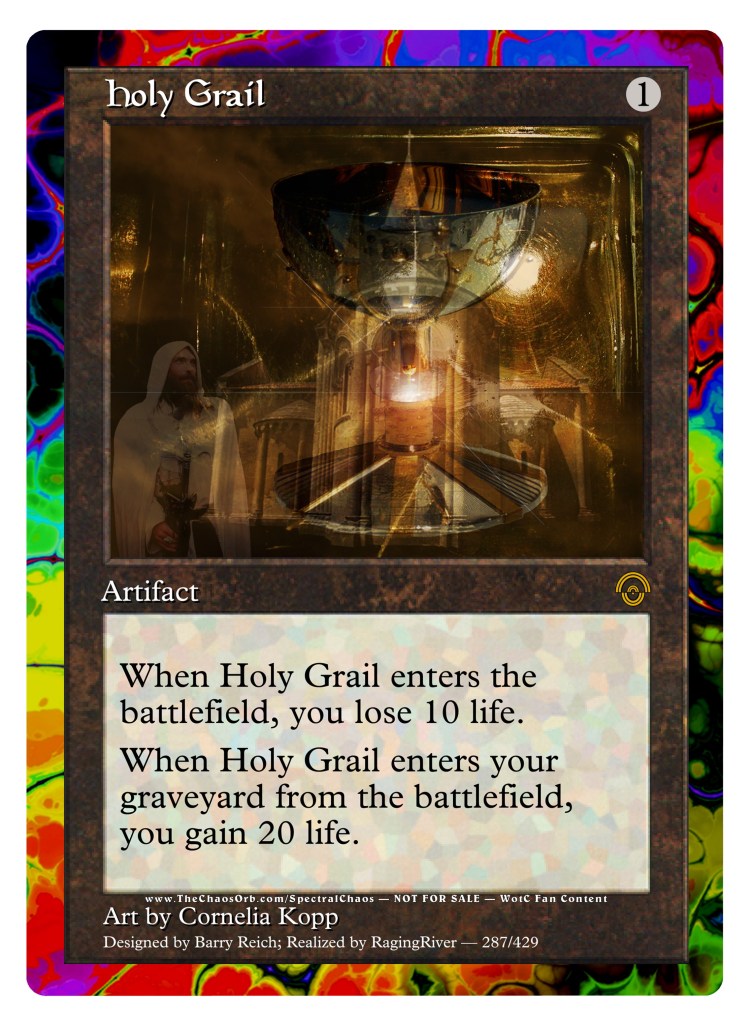
Realized
Holy Grail – {1}
Artifact
When Holy Grail enters the battlefield, you lose 10 life.
When Holy Grail enters your graveyard from the battlefield, you gain 20 life.
288 – Orcish Canal
(Rare Artifact Land)

Original Playtest 
Realized
Orcish Canal
Artifact Land
{T}: Add one mana of any color or no color. Put a tide counter on Orcish Canal. Activate this ability only if there is no tide counter on Orcish Canal.
{T}, remove a tide counter, sacrifice Orcish Canal: Add {U}{U}{U}{U}.
ChaosHistory: This was the first design for an artifact land, a concept not revealed until Mirrodin in 2003.
- Although Orcish Canal is an artifact, it can’t be cast as a spell. Playing it follows the normal rules for playing a land.
289 – Mystical Runes
(Rare Artifact)

Original Playtest 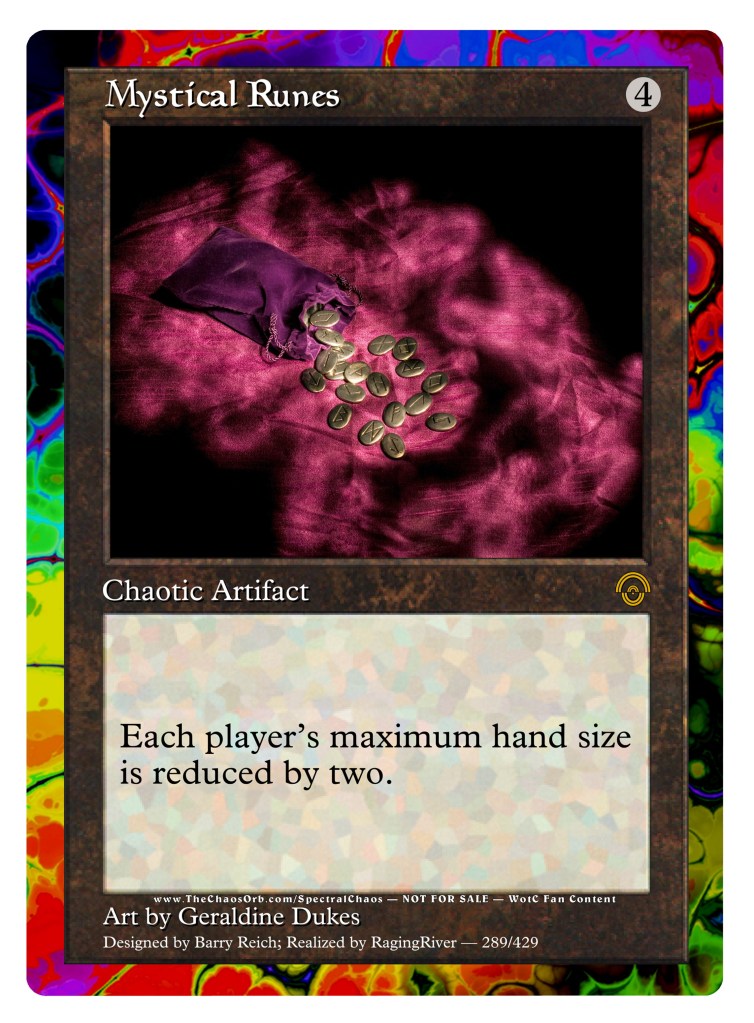
Realized
Mystical Runes – {4}
Chaotic Artifact
Each player’s maximum hand size is reduced by two.
290 – Antiredundancy Coil
(Rare Artifact)

Original Playtest 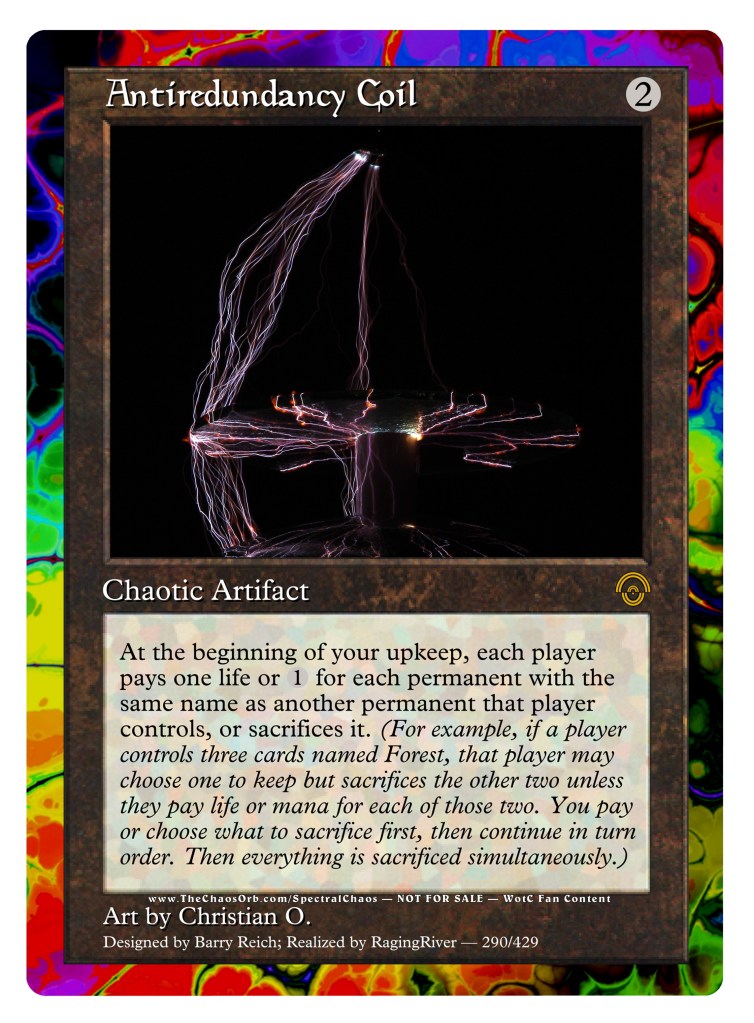
Realized
Antiredundancy Coil – {2}
Chaotic Artifact
At the beginning of your upkeep, each player pays one life or {1} for each permanent with the same name as another permanent that player controls, or sacrifices it. (For example, if a player controls three cards named Forest, that player may choose one to keep but sacrifices the other two unless they pay life or mana for each of those two. You pay or choose what to sacrifice first, then continue in turn order. Then everything is sacrificed simultaneously.)
- If there are multiple permanents with the same name, the player first announces which one they will keep, then announces which (if any) of the remaining duplicates they will pay for and whether they will pay life or mana, then the player pays the life or mana. Each player may decide in which order they look at all their permanents, but they must complete the entire process before moving on to the next player. The process of each player choosing permanents and paying mana and/or life is all part of resolving Antiredundancy Coil‘s single triggered ability. Once the ability starts to resolve, nobody will get priority (and state-based actions won’t be checked) in the middle of this process.
- A player can pay mana or life for each individual permanent that’s affected, paying mana for some and life for others if desired. A player with 0 life cannot pay any life; they would have to pay mana or sacrifice the duplicates.
- Because duplicate permanents that aren’t paid for are all sacrificed simultaneously as the final part of resolving Antiredundancy Coil‘s triggered ability, those duplicate permanents could still be used to generate mana during resolution of the ability.
291 – Wand of Resurrection
(Rare Artifact)
Original Playtest 
Realized
Wand of Resurrection – {1}
Artifact
{11}: Return target creature card from your graveyard to the battlefield.
292 – Ring of Unsummoning
(Rare Artifact)
Original Playtest 
Realized
Ring of Unsummoning – {3}
Artifact
{4}, {T}: Return target creature you both own and control to your hand. Activate this ability only during your turn, and not during the declare blockers step.
293 – Annihilator Orb
(Rare Artifact)

Original Playtest 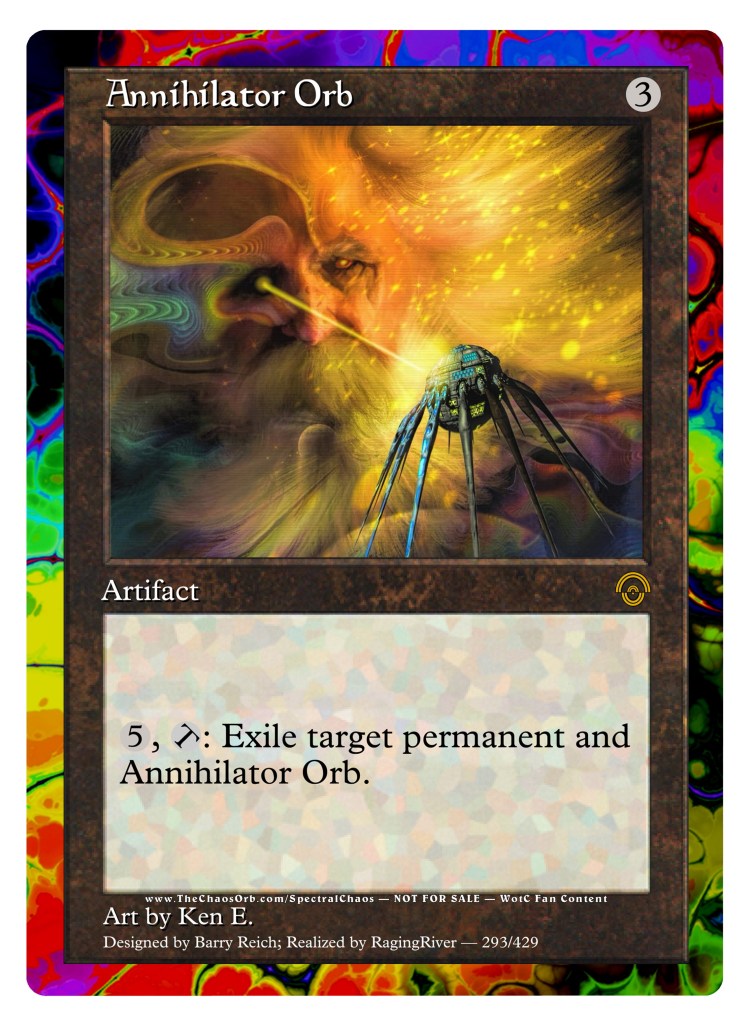
Realized
Annihilator Orb – {3}
Artifact
{5}, {T}: Exile target permanent and Annihilator Orb.
- Exiling Annihilator Orb is part of the resolution of the ability, not its cost. If the activated ability is countered, nothing gets exiled. However, if either the target permanent or Annihilator Orb is no longer on the battlefield when the ability resolves, the other will still get exiled.
294 – Paxin’s Winged Boots
(Rare Artifact)

Original Playtest 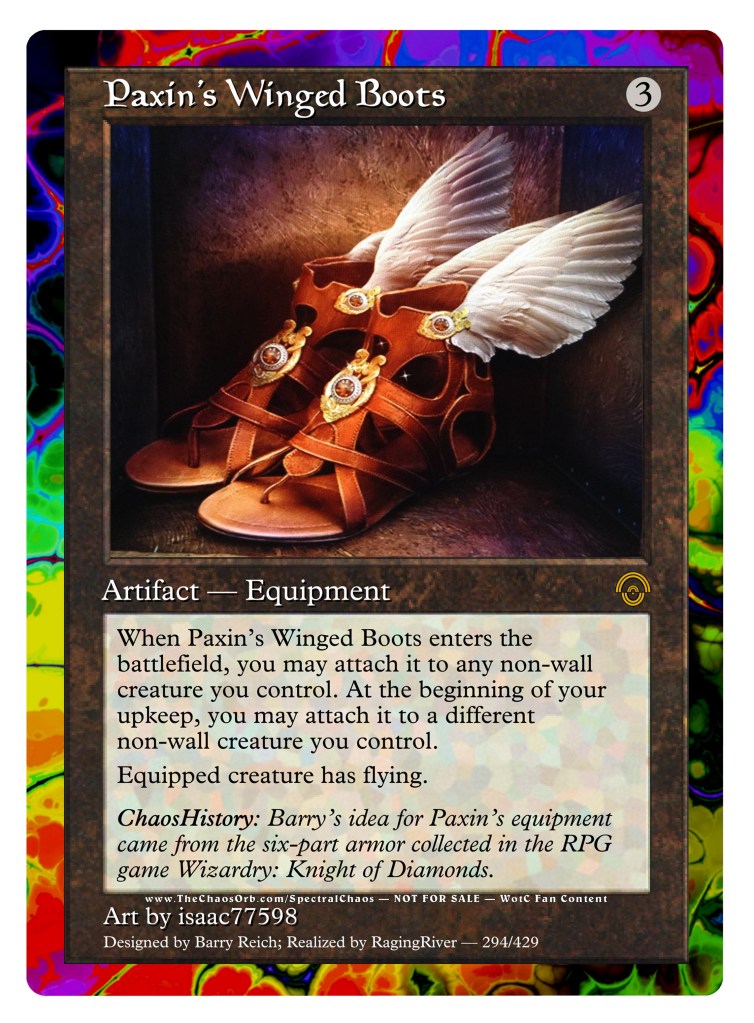
Realized
Paxin’s Winged Boots – {3}
Artifact – Equipment
When Paxin’s Winged Boots enters the battlefield, you may attach it to any non-wall creature you control. At the beginning of your upkeep, you may attach it to a different non-wall creature you control.
Equipped creature has flying.
ChaosHistory: Barry’s idea for Paxin’s equipment came from the six-part armor collected in the RPG game Wizardry: Knight of Diamonds.
- This equipment has no “equip” ability, because Barry Reich conceived of this over 10 years before equipment was first printed by Wizards of the Coast.
295 – Paxin’s Helm
(Rare Artifact)

Original Playtest 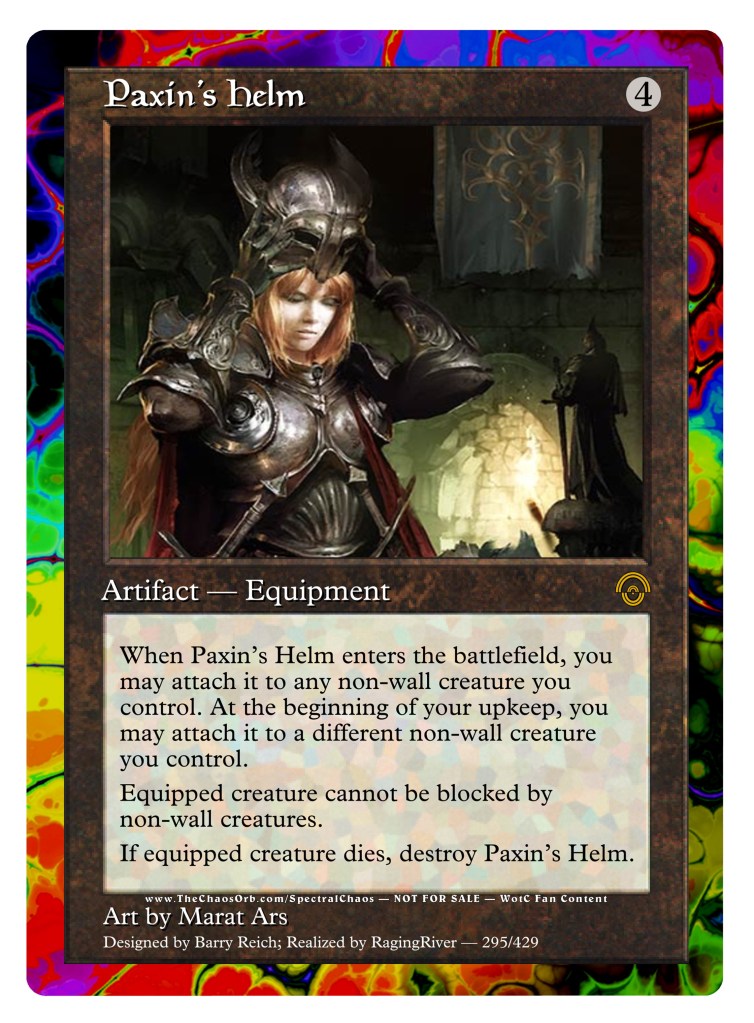
Realized
Paxin’s Helm – {4}
Artifact – Equipment
When Paxin’s Helm enters the battlefield, you may attach it to any non-wall creature you control. At the beginning of your upkeep, you may attach it to a different non-wall creature you control.
Equipped creature cannot be blocked by non-wall creatures.
If equipped creature dies, destroy Paxin’s Helm.
- This equipment has no “equip” ability, because Barry Reich conceived of this over 10 years before equipment was first printed by Wizards of the Coast.
296 – Jayellem Tome
(Rare Artifact)
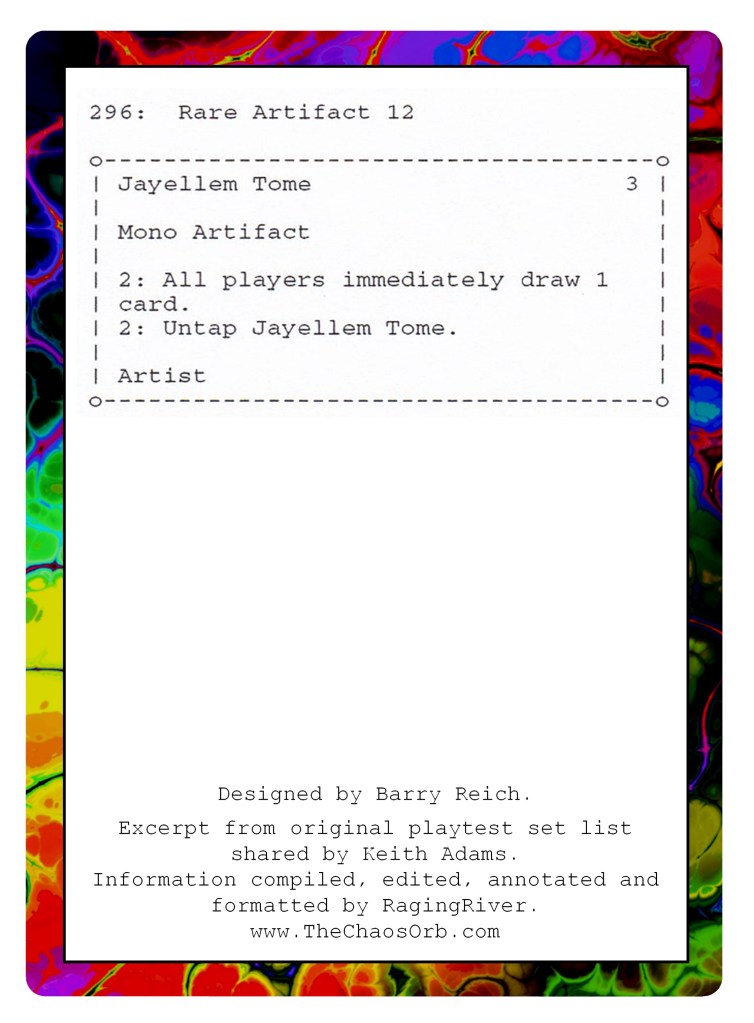
Original Playtest 
Realized
Jayellem Tome – {3}
Artifact
{2}, {T}: Each player draws a card.
{2}: Untap Jayellem Tome.
297 – The Hill
(Rare Artifact)

Original Playtest 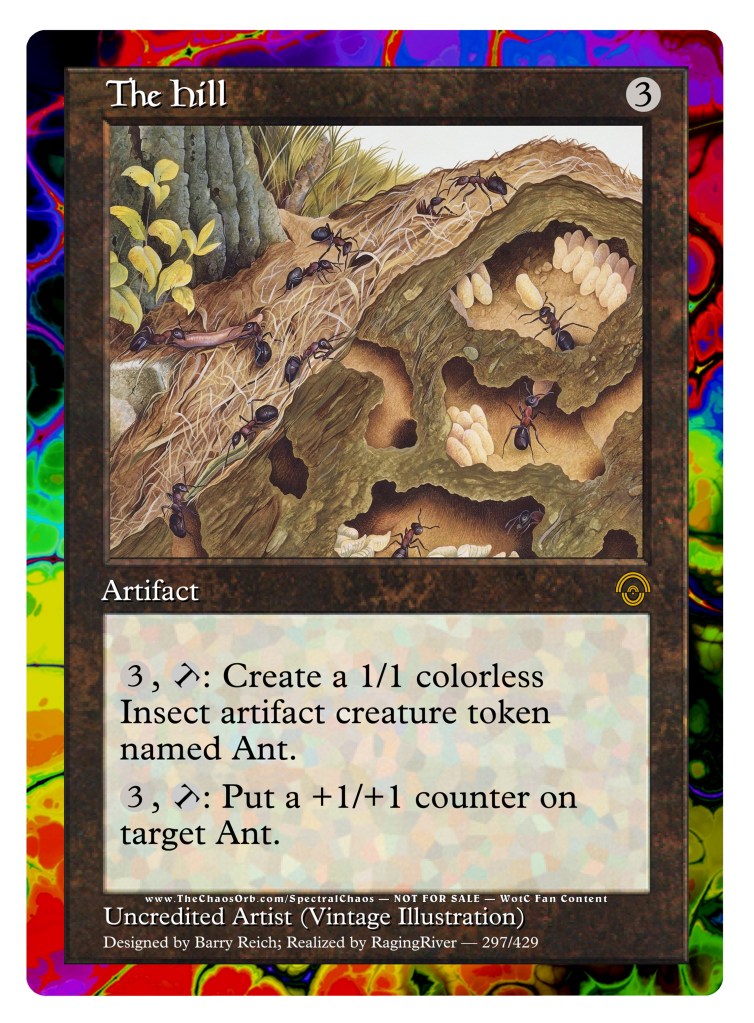
Realized 
Ant Token
The Hill – {3}
Artifact
{3}, {T}: Create a 1/1 colorless Insect artifact creature token named Ant.
{3}, {T}: Put a +1/+1 counter on target Ant.
298 – Mirror
(Rare Artifact)
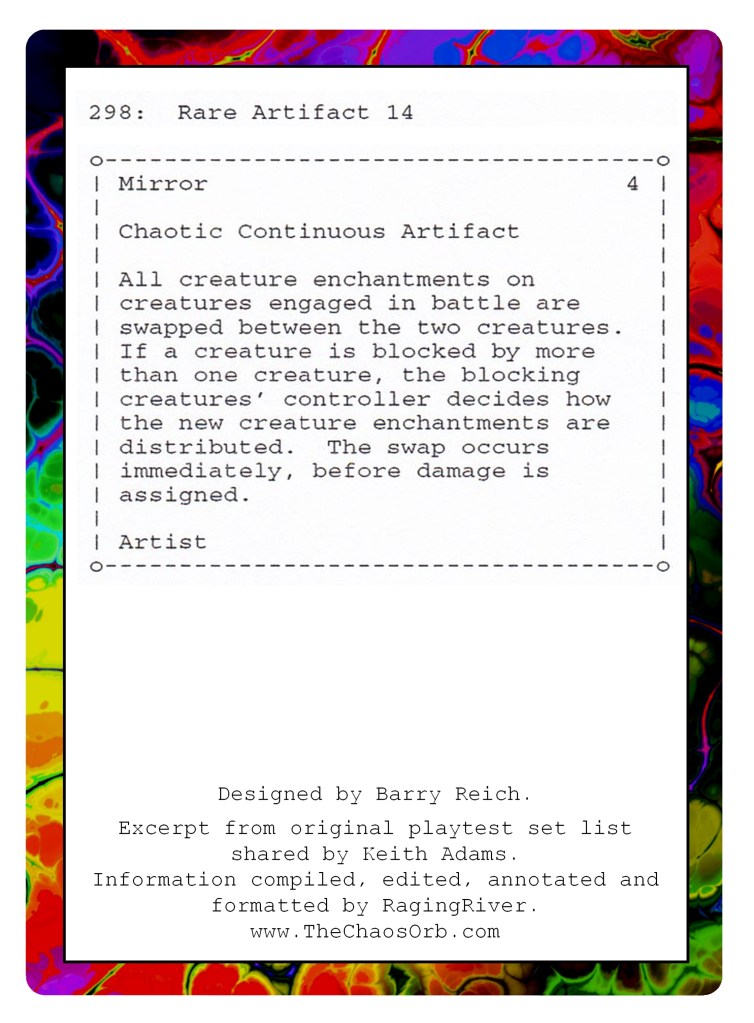
Original Playtest 
Realized
Mirror – {4}
Chaotic Artifact
Whenever an enchanted creature blocks or becomes blocked, all auras attached to that creature attach to the creature it’s blocking or being blocked by instead, if possible. (Control of the auras doesn’t change. If both attacker and blocker are enchanted, the swap occurs simultaneously. If an attacking enchanted creature is blocked by more than one creature, the defending player chooses which blocker is enchanted by each aura.)
- Mirror has a single triggered ability, which will trigger and resolve exactly once when blockers are declared during the declare blockers step, regardless of how many attackers or blockers are involved during that step. The only way Mirror would trigger more than once during a combat phase is if a creature is newly blocked or newly becomes blocked by some other means later in that combat phase (for example, because of Flash Foliage).
- No creatures are targeted as part of this effect. However, creatures are becoming newly “enchanted” by the switched aura(s). If a creature with an aura blocks or is blocked by a creature with an aura, the switch is simultaneous; this means that both of the already-enchanted creatures would never stop being “enchanted,” even for a moment.
- If for some reason a creature that would otherwise become enchanted is no longer on the battlefield when Mirror‘s effect resolves (for example, it was killed or exiled in response to Mirror‘s trigger) or cannot be enchanted for some other reason (for example, it has protection from the aura’s color), then that aura will simply stay on the original creature, and won’t switch onto the new creature. Basically, the auras will always switch if possible, and if it isn’t possible for any reason, then they will just stay on their original creatures as though Mirror had no effect.
- If an attacking enchanted creature is blocked by more than one creature, and one of the blocking creatures has protection or another effect preventing it from being chosen to receive the attacker’s aura, then the defending player must choose a different blocker to receive the attacker’s aura. The inverse would be true in the (exceedingly rare) case where multiple attacking creatures are blocked by one enchanted blocker.
- Multiple copies of Mirror will have their effects stack. As long as an even number of copies of Mirror are on the battlefield, usually the auras will simply switch and then switch back, thus cancelling each other out, once all the triggered abilities resolve.
299 – Weakstone
(Rare Artifact)
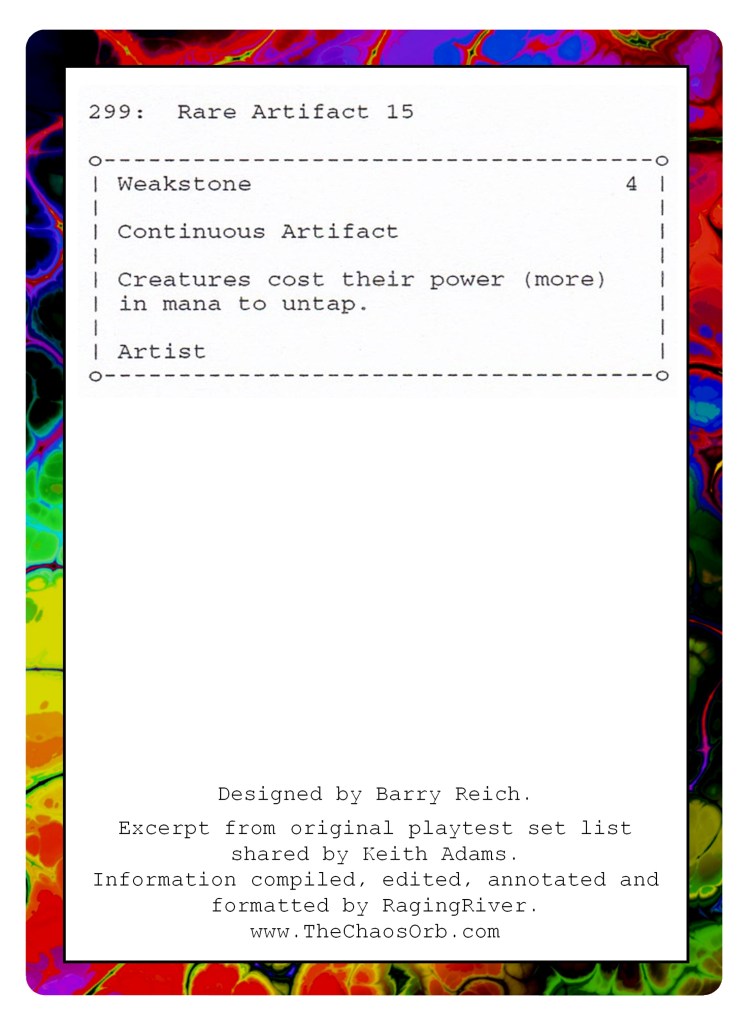
Original Playtest 
Realized
Weakstone – {4}
Artifact
Creatures do not untap during their controller’s untap step.
At the beginning of each player’s upkeep, that player may pay {X}, where X is equal to the sum of the powers of any number of tapped creatures they control. If that player does, untap those creatures.
300 – Symbol of Protection
(Rare Artifact)

Original Playtest 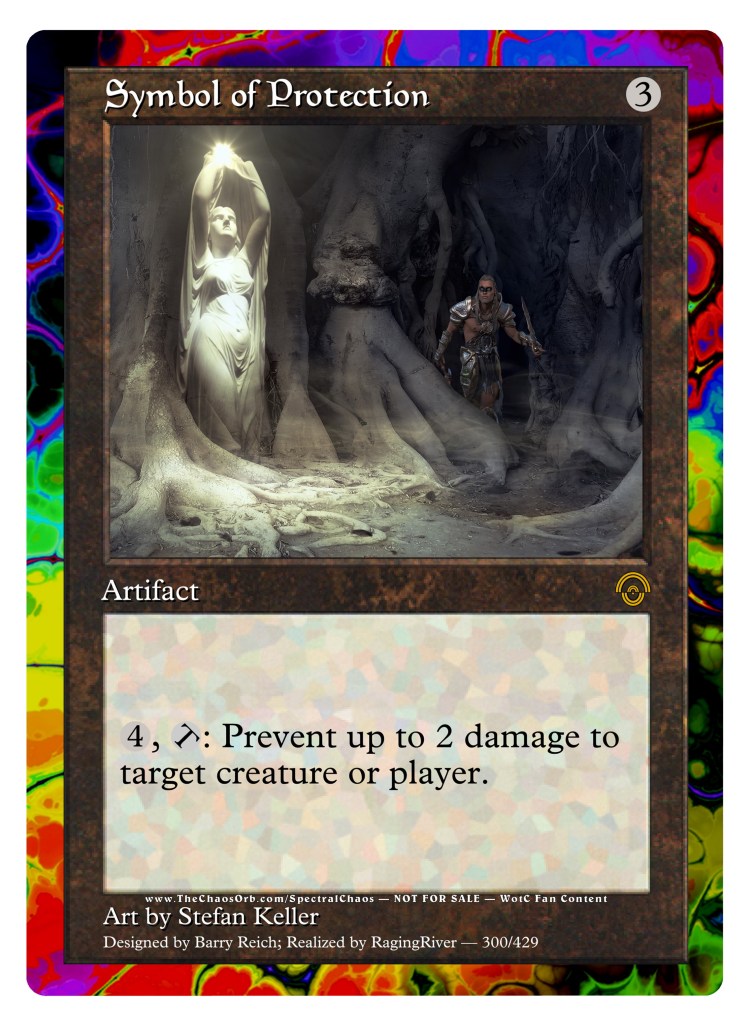
Realized
Symbol of Protection – {3}
Artifact
{4}, {T}: Prevent up to 2 damage to target creature or player.
301 – Time Bomb
(Rare Artifact)
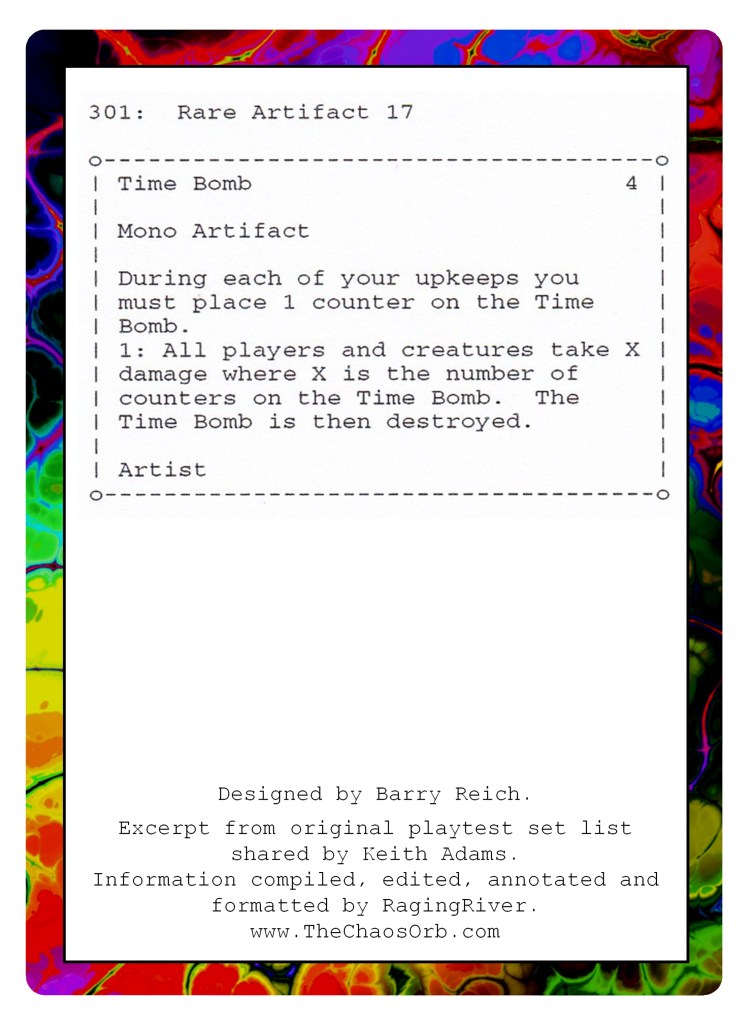
Original Playtest 
Realized
Time Bomb – {4}
Artifact
At the beginning of your upkeep, put a time counter on Time Bomb.
{1}, {T}, sacrifice Time Bomb: Time Bomb deals damage equal to the number of time counters on it to each creature and each player.
ChaosHistory: Originally designed by Barry in his early days of playtesting Ice Age, Time Bomb would end up printed there first, in 1995. He would have reprinted it in Spectral Chaos.
302 – Segalasaurus
(Rare Artifact Creature)
Original Playtest 
Realized
Segalasaurus – {5}
Chaotic Artifact Creature – Dinosaur
As Segalasaurus enters the battlefield, choose an opponent. Segalasaurus has base power equal to the number of cards in the chosen player’s hand, and base toughness equal to the number of cards in your hand.
*/*
303 – Hot Potato
(Rare Artifact)
Original Playtest 
Realized
Hot Potato – {1}
Chaotic Artifact
Hot Potato enters the battlefield with a charge counter on it.
At the beginning of your end step, target opponent gains control of Hot Potato and puts a charge counter on it.
At the beginning of your upkeep, unless you pay {X} where X is equal to the number of charge counters on Hot Potato, it deals X damage to you and is destroyed.
ChaosHistory: A similar design would be used for Jinxed Choker, released in Mirrodin.
- “You” is always Hot Potato’s controller.
- If for some reason Hot Potato cannot be destroyed when its last ability triggers, it will still deal the damage; similarly, if its damage is prevented, it will still be destroyed.
304 – Perimeterradactyl
(Rare Artifact Creature)

Original Playtest 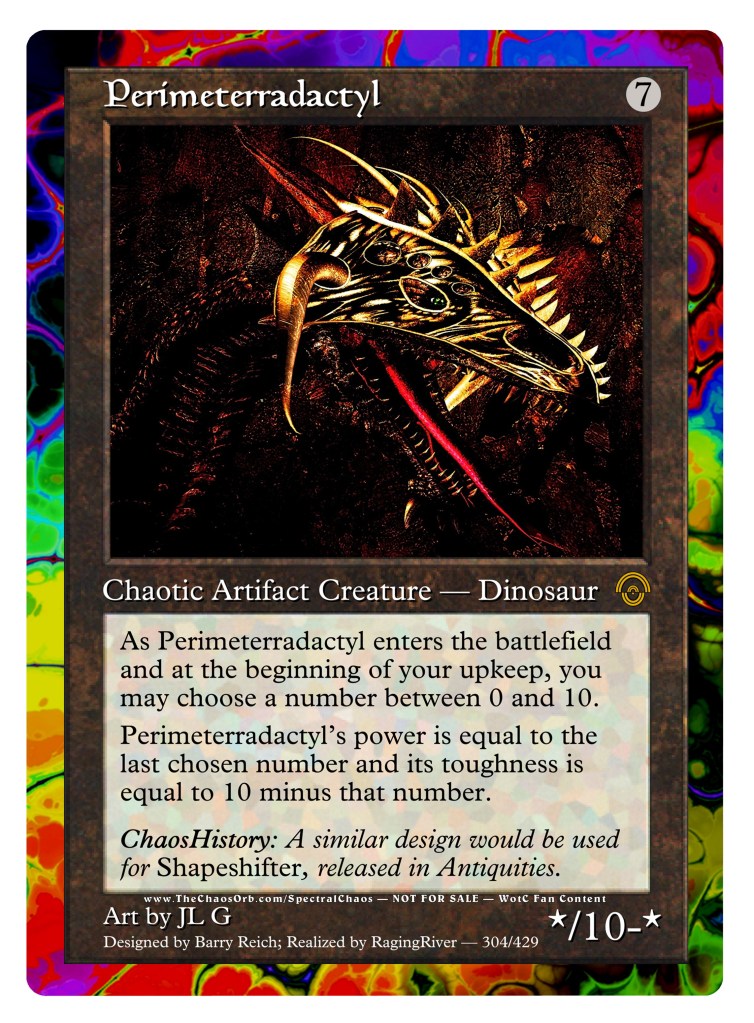
Realized
Perimeterradactyl – {7}
Chaotic Artifact Creature – Dinosaur
As Perimeterradactyl enters the battlefield and at the beginning of your upkeep, you may choose a number between 0 and 10.
Perimeterradactyl’s power is equal to the last chosen number and its toughness is equal to 10 minus that number.
*/10-*
ChaosHistory: A similar design would be used for Shapeshifter, released in Antiquities.
- The ability that sets its power and toughness is a characteristic-defining ability. This means it applies before any other effects that modify power and/or toughness.
- The ability that lets you choose a new number is a triggered ability that triggers only once each upkeep.
305 – Kaleidescope Beast
(Rare Artifact Creature)
Original Playtest 
Realized
Kaleidescope Beast – {8}
Artifact Creature – Beast
{1}: Kaleidescope Beast gets +2/+2 until end of turn. Only activate this ability using colored mana generated from basic lands, and no more than once per color per turn.
1/1
306 – Undo
(Rare Instant (Multicolor))

Original Playtest 
Realized
Undo – {1}{R}{W}{U}{U}
Chaotic Instant
Counter target spell. If that spell is countered this way, put it into its owner’s hand instead of into that player’s graveyard, and put Undo into your hand instead of your graveyard.
(Note: Rulings added Feb. 11, 2021.)
- You could target a spell on the stack that isn’t represented by a card (for example, a copy of a spell that had been created by Copy Spell). If you counter a spell this way, then there is no card to put back in that spell’s controller’s hand; Undo would still go back into your hand.
307 – Great Bearded Hulker
(Rare Creature (Multicolor))
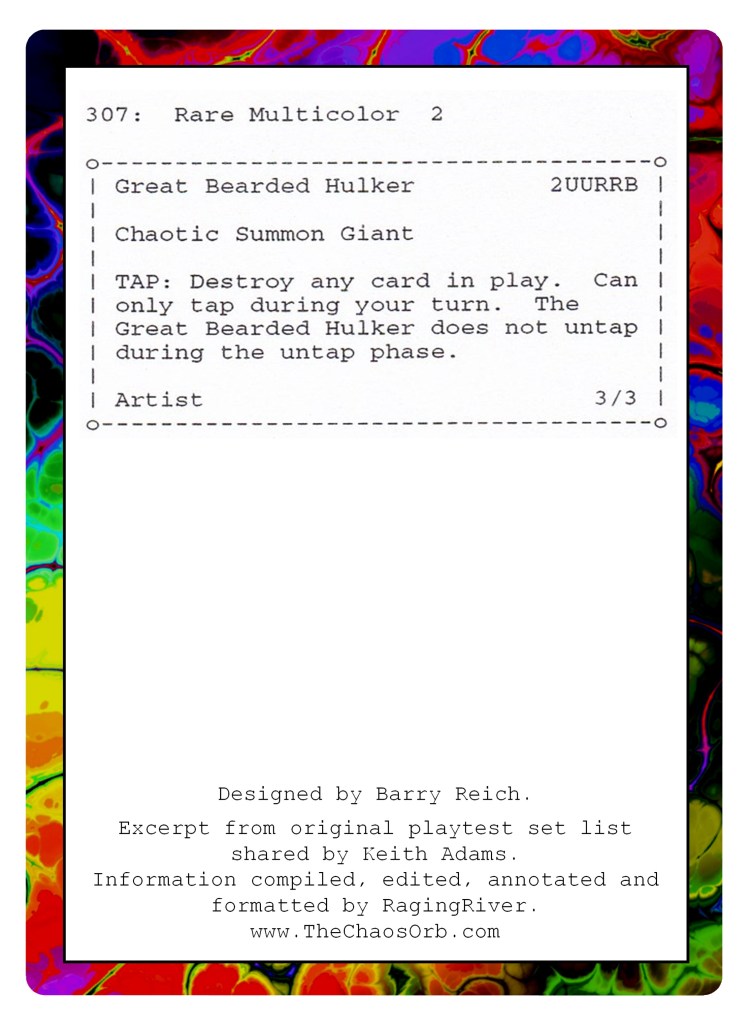
Original Playtest 
Realized
Great Bearded Hulker – {2}{U}{U}{B}{R}{R}
Chaotic Creature – Giant
{T}: Destroy target permanent. Activate this ability only during your turn. Great Bearded Hulker doesn’t untap during your next untap step.
3/3
308 – Life Leech
(Rare Creature (Multicolor))
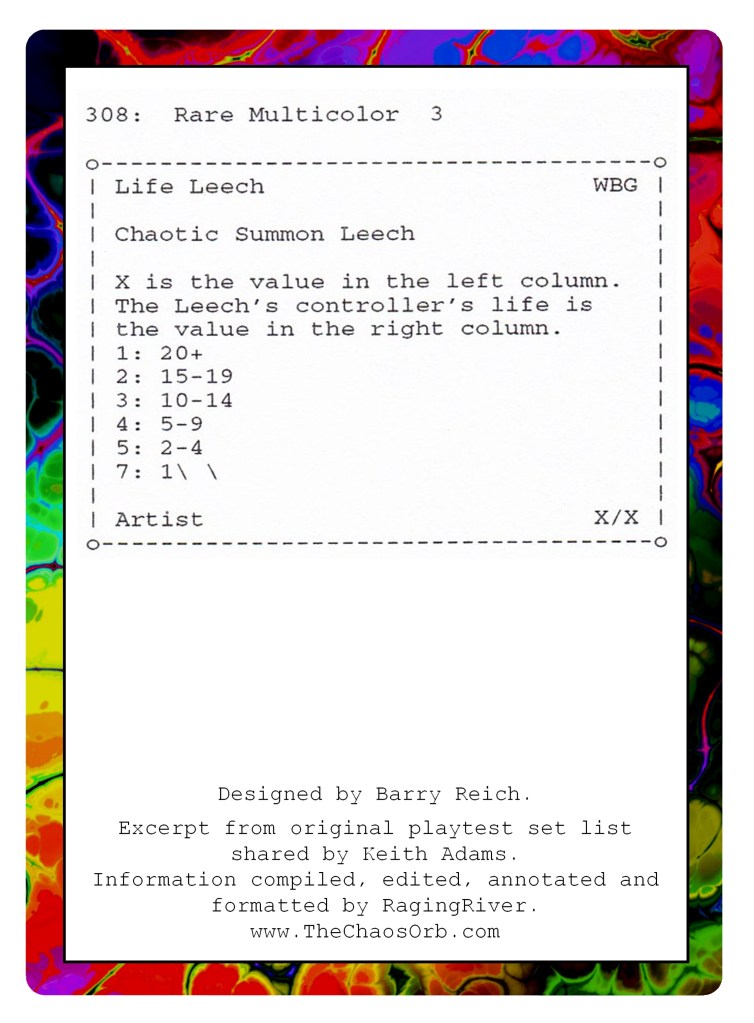
Original Playtest 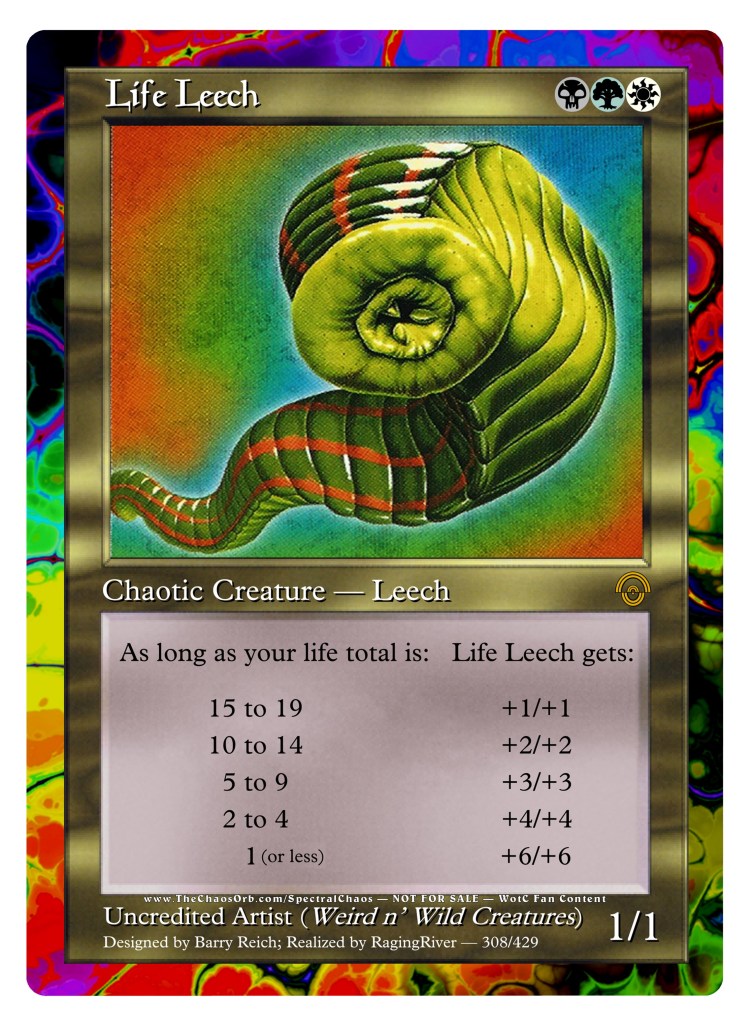
Realized
Life Leech – {B}{G}{W}
Chaotic Creature – Leech
As long as your life total is: -> Life Leech gets:
– 15 to 19 -> +1/+1
– 10 to 14 -> +2/+2
– 5 to 9 -> +3/+3
– 2 to 4 -> +4/+4
– 1 (or less) -> +6/+6
1/1
(Note: Text and rulings updated Jan. 31, 2021.)
- Life Leech‘s power and toughness are constantly updated as your life total changes, even if your life changes in the middle of resolving a spell or ability. However, it typically won’t matter if Life Leech’s toughness temporarily dips to 0 or less, as long as its toughness is greater than 0 by the time state-based actions are next checked.
VERY RARES (121):
Click here to download high-resolution copies of the Spectral Chaos Very Rares at Ko-fi.
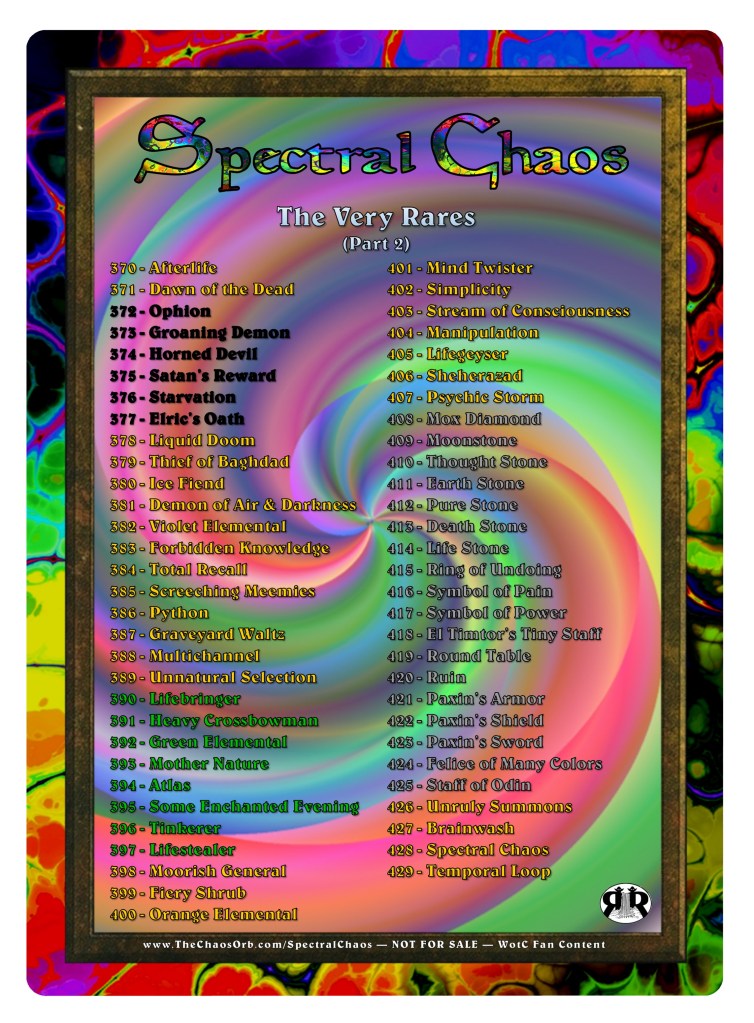
309 – Dale
(Very Rare Land)

Original Playtest 
Realized
Dale
Chaotic Land
You can’t play lands.
{T}: Add {R/G/W}{R/G/W}.
{T}: Sacrifice Dale.
ChaosHistory: The first printed Naya land was Homelands’ An-Havva Township, followed by Invasion’s Tinder Farm.
310 – Moor
(Very Rare Land)

Original Playtest 
Realized
Moor
Chaotic Land
You can’t play lands.
{T}: Add {W/B/U}{W/B/U}.
{T}: Sacrifice Moor.
ChaosHistory: The first printed Esper land was Homelands’ Wizards’ School, followed by Invasion’s Ancient Spring.
311 – Village in the Clouds
(Very Rare Land)

Original Playtest 
Realized
Village in the Clouds
Chaotic Land
{T}: Add {1}.
{0}: Village in the Clouds becomes a 0/1 wall creature with flying and defender until end of turn. It can only block creatures with flying. It’s still a land. Prevent all damage that would be dealt to Village in the Clouds.
312 – Undiscovered Country
(Very Rare Land)
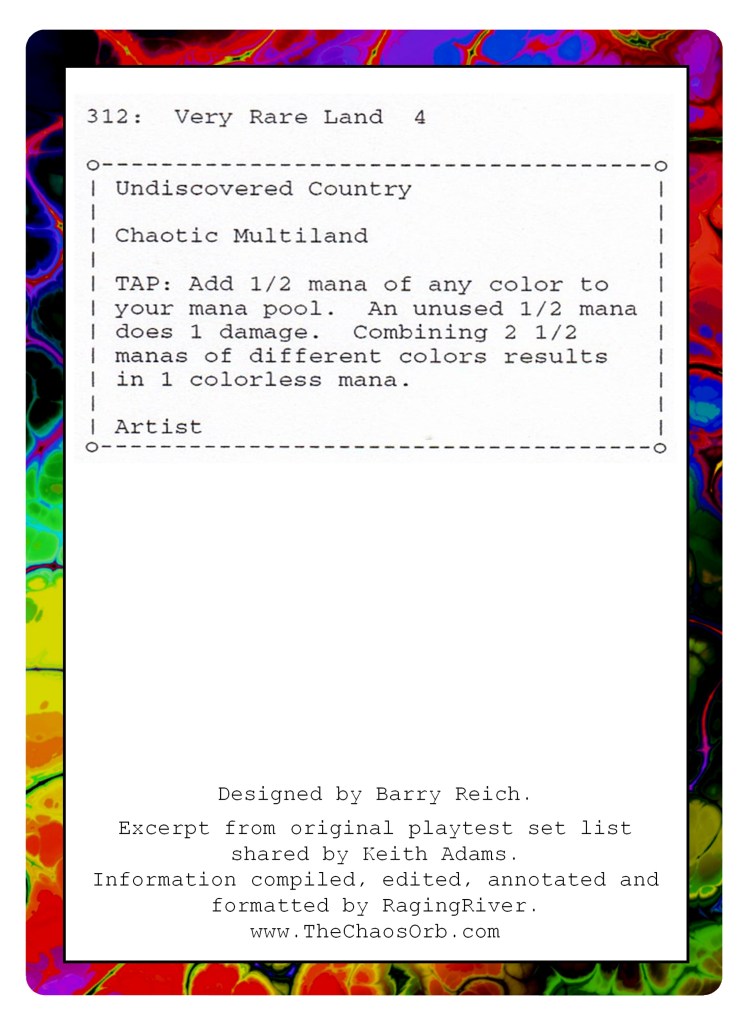
Original Playtest 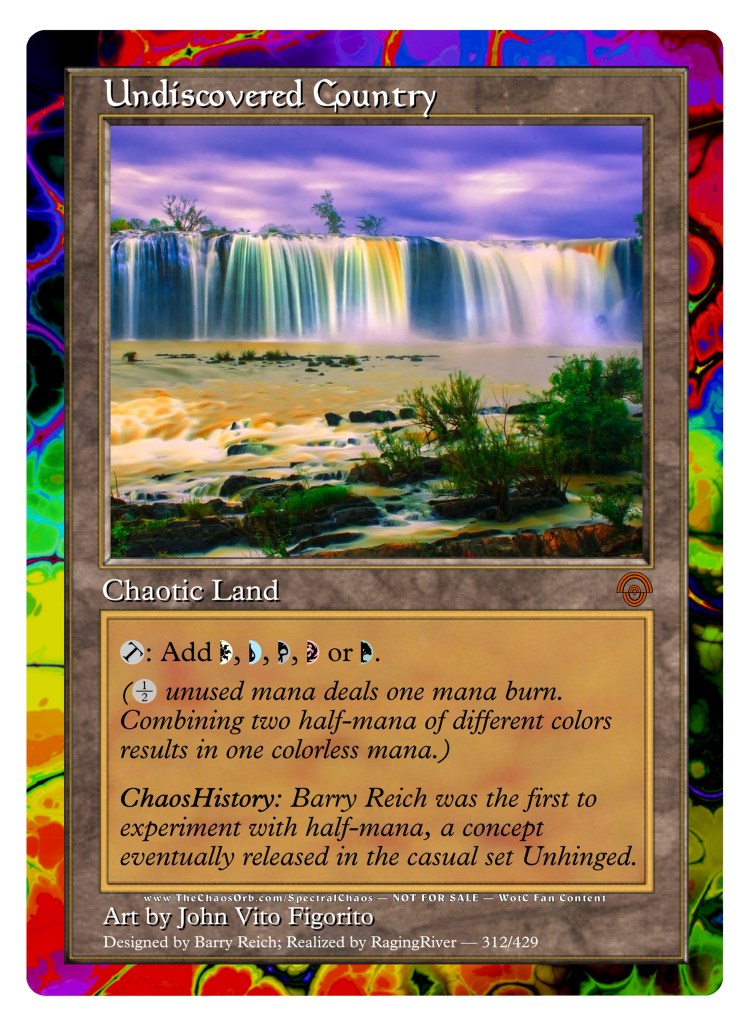
Realized
Undiscovered Country
Chaotic Land
{T}: Add one-half mana of any color. (One-half unused mana deals one mana burn. Combining two half-mana of different colors results in one colorless mana.)
ChaosHistory: Barry Reich was the first to experiment with half-mana, a concept eventually released in the casual set Unhinged.
313 – Discovered Country
(Very Rare Land)

Original Playtest 
Realized
Discovered Country
Chaotic Land
As Discovered Country enters the battlefield, choose an opponent.
{Untap}: The chosen opponent adds one mana of a color of their choice. Only the chosen opponent may activate this ability.
{T}: Add one mana of any color.
- The first ability is a mana ability activated only by the chosen opponent. The opponent can activate it any time Discovered Country is tapped and that opponent could activate a mana ability.
- If you and the opponent could both activate mana abilities at the same time (for example, if a single spell or ability requires or allows players to pay mana as part of resolving), theoretically you and the opponent could go back and forth, each adding as much mana as desired, all without anyone having priority even in the middle of resolving a spell or ability, until one of you decides to stop activating Discovered Country’s ability (thus stopping the other from doing so).
314 – Magic Marker
(Very Rare Instant (Blue))

Original Playtest 
Realized
Magic Marker – {U}
Chaotic Sorcery
Choose one –
– Remove up to two counters from target permanent.
– Choose target permanent with at least one counter on it. Put up to two counters of the same type on that permanent.
- You can only target a permanent. You can’t target an exiled card like All Hallow’s Eve or a card that has been suspended with time counters.
- You announce the choice and the target as part of casting the spell, but you don’t decide how many counters to remove (if you chose the first mode) or add (if you chose the second mode) from that permanent until Magic Marker resolves. You can decide to add/remove zero counters.
315 – Mnemosyne
(Very Rare Creature (Blue))

Original Playtest 
Realized
Mnemosyne – {6}{U}
Legendary Creature – Titan
You have no maximum hand size.
5/5
316 – Enqueue
(Very Rare Enchantment (Blue))

Original Playtest 
Realized
Enqueue – {2}{U}
Legendary Enchantment
When Enqueue enters the battlefield, each player arranges the cards in their hand face-up in the order of their choice, forming a queue.
Players play with their hands revealed, and may not rearrange the queue. Each newly drawn card goes at the bottom of that player’s queue. (Players can discard from anywhere in the queue like normal.)
A non-land, non-instant card can only be cast if there isn’t a non-land, non-instant card higher in that player’s queue.
- If a player needs to discard at random, roll dice or use another method that randomizes the card chosen but otherwise preserves the queue.
- If a card is put into a player’s hand for any reason without being drawn (for example, as a result of Boomerang or Undo), that player may put it anywhere in the queue they choose, but once it’s placed in the queue it cannot be rearranged.
- If a second Enqueue enters the battlefield, players can rearrange their queue when its “enters the battlefield” trigger resolves. If somehow multiple Enqueues are in play (despite the Legend Rule), the second and third abilities of multiple Enqueues are redundant. Each player will always have just one hand, arranged in just one queue.
317 – Blue Whale
(Very Rare Creature (Blue))

Original Playtest 
Realized
Blue Whale – {2}{U}{U}
Creature – Whale
{U}: +1/+0 until end of turn.
Whenever a creature blocks or is blocked by Blue Whale, exile it at the end of combat until Blue Whale leaves the battlefield.
1/4
ChaosHistory: A similar design would be used for Colossal Whale, released in the 2014 core set (M14).
- Blue Whale’s ability causes a zone change with a duration. It is a single ability that triggers and resolves during the declare blockers step, but creates two one-shot effects: one that exiles the creature at the beginning of the end of combat step, and another that returns the exiled card to the battlefield immediately after Blue Whale leaves the battlefield.
- If Blue Whale leaves the battlefield before its triggered ability resolves, the target creature won’t be exiled. But if the ability resolves and then Blue Whale leaves the battlefield before the creature is exiled at end of combat (importantly, if Blue Whale dies from combat damage but the other creature survives), the creature will still get exiled and it will stay exiled forever.
- Auras attached to the exiled creature will be put into their owners’ graveyards. Equipment attached to the exiled creature will become unattached and remain on the battlefield. Any counters on the exiled creature will cease to exist.
- If a creature token is exiled, it ceases to exist. It won’t be returned to the battlefield.
- The exiled card returns to the battlefield immediately after Blue Whale leaves the battlefield. Nothing happens between the two events, including state-based actions. The two creatures aren’t on the battlefield at the same time. For example, if the returning creature is a Clone, it can’t enter the battlefield as a copy of Blue Whale.
- In a multiplayer game, if Blue Whale’s owner leaves the game, the exiled card will return to the battlefield. Because the one-shot effect that returns the card isn’t an ability that goes on the stack, it won’t cease to exist along with the leaving player’s spells and abilities on the stack.
318 – Mimic
(Very Rare Creature (Blue))

Original Playtest 
Realized
Mimic – {4}{U}{U}{U}
Creature – Shapeshifter
You may have Mimic enter the battlefield as a copy of any non-creature land or non-creature artifact on the battlefield, except it’s also still a blue 2/4 creature and it has “At the beginning of your upkeep, you may have this creature become a copy of target non-creature land or non-creature artifact, except it’s also still a blue 2/4 creature and it has this ability.”
2/4
- Mimic copies the printed values of the chosen permanent, plus any copy effects that have been applied to it. It won’t copy counters on that permanent or effects that have changed its types, color, or so on.
- When Mimic switches creatures, the creature it used to be is not considered to have left the battlefield.
- If Mimic copies a permanent that’s copying something else, it will become whatever that permanent was copying.
- If the copied permanent has an effect that triggers when it leaves the battlefield, it will trigger when Mimic leaves the battlefield.
- Damage is not removed when it changes forms.
- Can switch to the same permanent it is currently a copy of.
- When it takes on the characteristics of the other card, it retains its creature subtype Shapeshifter.
- When changing forms, any text changes that exist on the Mimic are applied to the new text, if appropriate.
- If Mimic is flipped, and it copies a flip card in any state, it will copy both “sides” of that card but use the flipped side. If Mimic is unflipped, and it copies a flip card in any state, it will copy both “sides” of that card but use the unflipped side. In the second case, if it ever meets the flip conditions of its new ability, it will flip and used the flipped side of what it is copying.
- When Mimic’s triggered ability triggers, you must choose a target for it. You determine whether to have Mimic become a copy of that target when the ability resolves.
- Mimic copies the mana cost of the permanent it’s copying but doesn’t copy its color.
- If another creature copies Mimic, the new creature will become a copy of whatever Mimic is copying except it will be a blue 2/4 creature with Mimic‘s triggered ability.
- Although Mimic’s triggered ability is targeted, its “enters the battlefield” ability is not.
- Can become a copy of equipment, but a creature can’t be attached to another creature. Its other (non-equip) abilities would continue to apply.
319 – Blue Elemental
(Very Rare Creature (Blue))
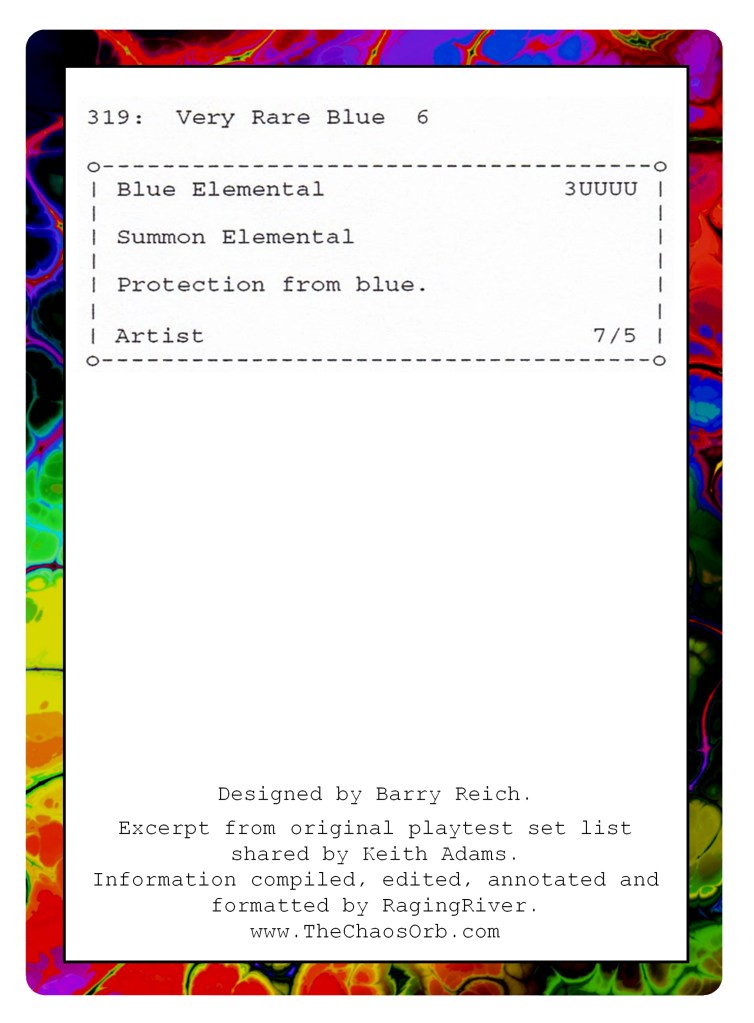
Original Playtest 
Realized
Blue Elemental – {3}{U}{U}{U}{U}
Creature – Elemental
Protection from blue
7/5
ChaosHistory: Barry studied math, physics and computer science. Astronomy and astrophysics have always been keen interests of his.
320 – King Snake
(Very Rare Creature (Blue))

Original Playtest 
Realized
King Snake – {5}{U}{U}{U}
Creature – Snake Lord
Mountainhome
8/9
321 – Illusions of Grandeur
(Very Rare Enchantment (Blue))

Original Playtest 
Realized
Illusions of Grandeur – {U}
Enchantment
Cumulative upkeep {U}
When Illusions of Grandeur enters the battlefield, you gain 20 life.
When Illusions of Grandeur leaves the battlefield, you lose 20 life.
ChaosHistory: This alternate version of the powerful Ice Age enchantment of the same name was easier to cast, but harder to keep in play.
- If a player takes control of this card away from you, you do not lose 20 life because the loss of 20 life is a separate ability. That player is now subject to the loss.
322 – Kraken
(Very Rare Creature (Blue))
Original Playtest 
Realized
Kraken – {4}{U}{U}{U}{U}{U}
Creature – Kraken
Islandhome
10/10
323 – The North Wind
(Very Rare Creature (Blue))
Original Playtest 
Realized
The North Wind – {8}{U}
Creature – Elemental Spirit
Flying
7/7
324 – Mass Unsummon
(Very Rare Sorcery (Blue))

Original Playtest 
Realized
Mass Unsummon – {2}{U}{U}
Chaotic Sorcery
Return each creature to its owner’s hand.
325 – Mass Twiddle
(Very Rare Sorcery (Blue))
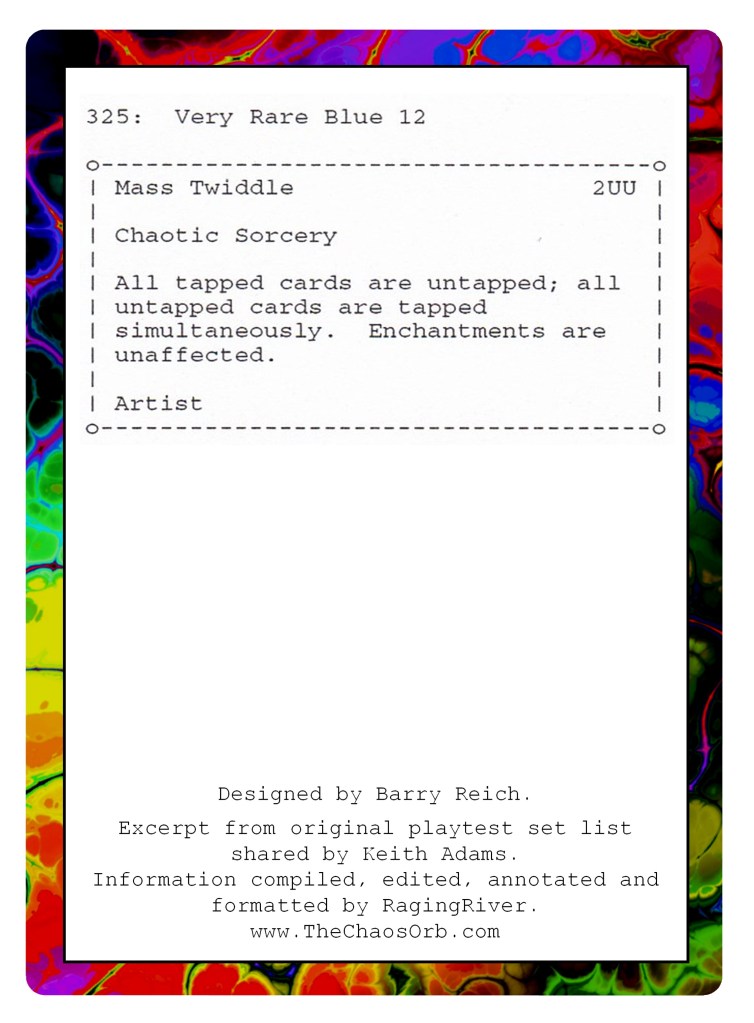
Original Playtest 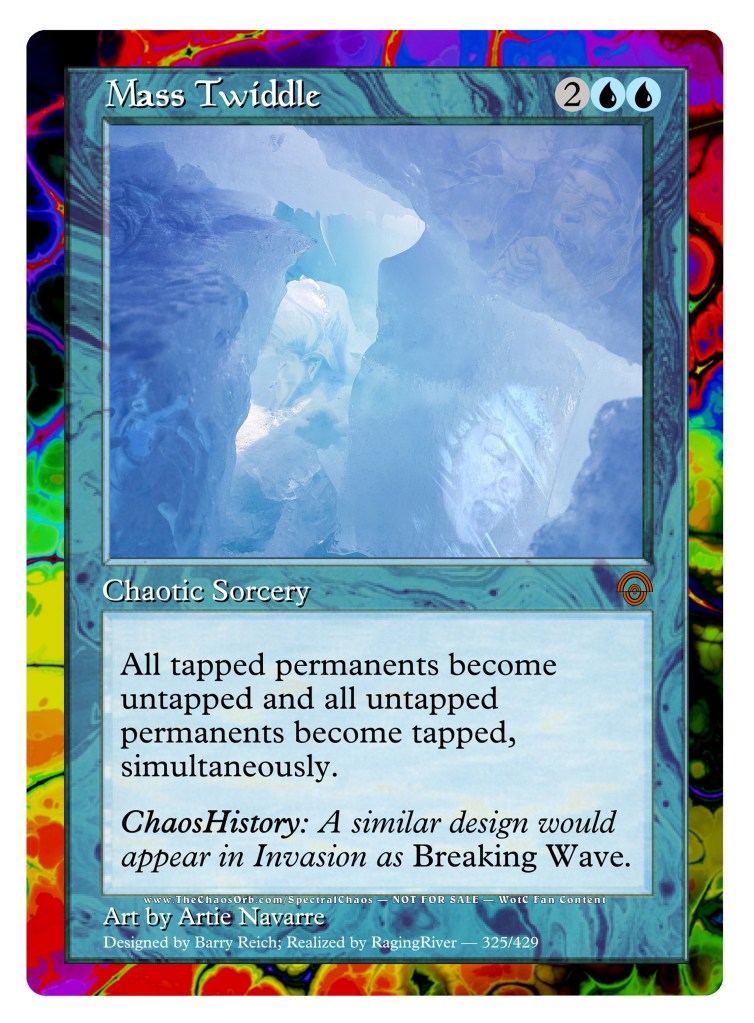
Realized
Mass Twiddle – {2}{U}{U}
Chaotic Sorcery
All tapped permanents become untapped and all untapped permanents become tapped, simultaneously.
ChaosHistory: A similar design would appear in Invasion as Breaking Wave.
326 – Copy Spell
(Very Rare Instant (Blue))
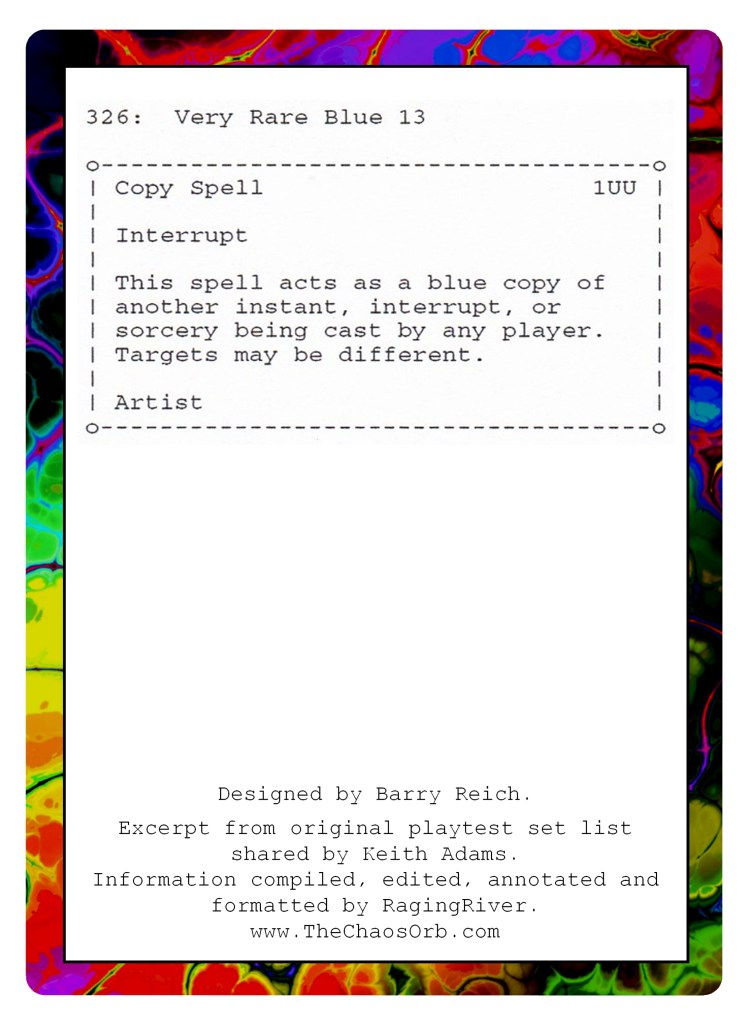
Original Playtest 
Realized
Copy Spell – {1}{U}{U}
Copy target instant or sorcery spell, except that the copy is blue. You may choose new targets for the copy.
ChaosHistory: A color-shifted version of Alpha’s Fork; players wouldn’t see a blue spell design like this until Saviors of Kamigawa’s Twincast in 2005.
- For spells that can have a variable number of targets, the controller of the copy must use the same number of targets the original spell did.
- Copying a spell with an X in the cost requires you to use the same X value.
- Copy Spell will not copy changes made by modifying effects to the spell prior to the use of Copy Spell, such as text-changing effects.
- If mana or other costs need to be spent at resolution of the spell, the player of Copy Spell would still be responsible for paying that cost.
- You need not (and may not) pay any additional mana or other costs (like sacrifices) to use the spell which is copied. You get control over a complete copy but can change nothing except the targets.
- Copy Spell does not let you make non-targeting choices about the spell.
- If the spell being copied targets a spell on the stack, it is possible to target Copy Spell itself since Copy Spell is still on the stack when you pick the target(s) for the copy. Note that the copy’s target will be illegal when it resolves.
- If you copy a spell for which Buyback has been paid, you get nothing back since the copied spell does not have a card to give you.
- The copy that is placed on the stack is not considered to have been “cast”.
- The Copy Spell card goes to the graveyard when it resolves and leaves the copy on the stack. There is no card representing the copy on the stack.
- The copy will have the same mana cost (with the same mana symbols in the mana cost) as the card it is copying, but it uses its own color definition and not the one from those mana symbols. This is so it maintains its blue color just like the text says.
- If you copy a Spliced spell, the spliced text is added during the announcement of the original spell, and therefore is fully copied by Copy Spell.
- If the targeted spell was kicked, then the copy will be kicked as well. If the targeted spell was not kicked, then the copy will not be kicked.
- If the targeted spell was chaotic, legendary or had other subtypes or supertypes, these types are copied as well.
327 – Frost Fiend
(Very Rare Creature (Multicolor))
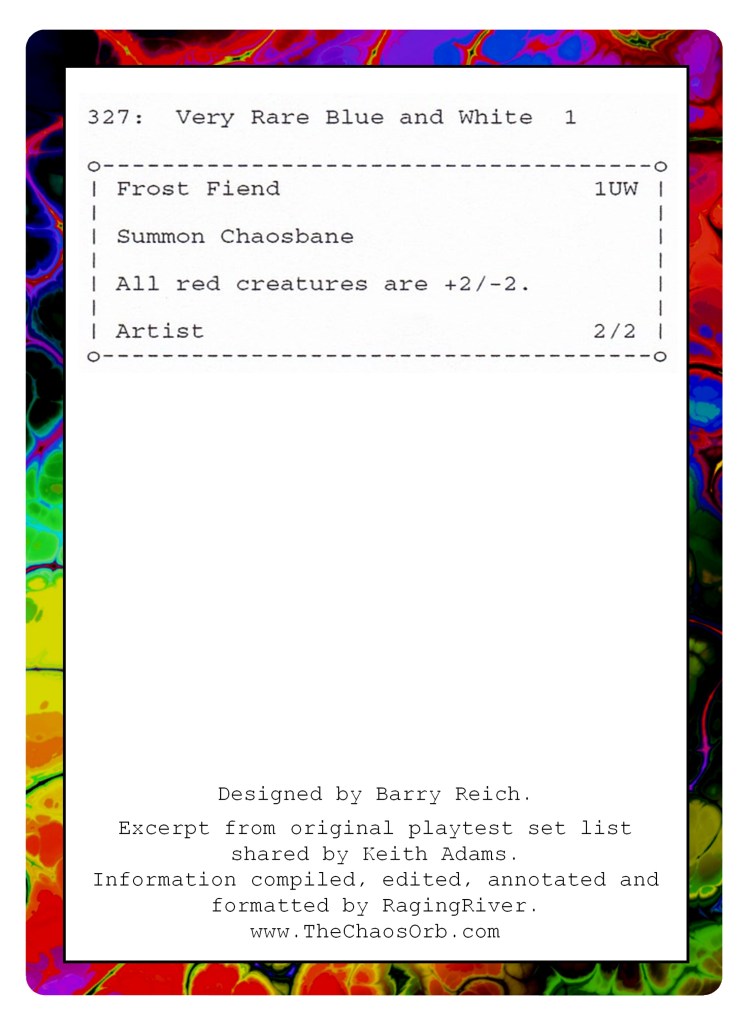
Original Playtest 
Realized
Frost Fiend – {1}{W}{U}
Snow Creature – Orc Deserter
All red creatures get +2/-2.
2/2
328 – Gybe’s Spell Freeze
(Very Rare Instant (Multicolor))

Original Playtest 
Realized
Gybe’s Spell Freeze – {1}{W}{U}
Instant
Counter target spell.
ChaosHistory: Many of the early playtesters were concerned that Counterspell was too powerful. Barry thought this multicolor version made sense for Spectral Chaos.
329 – Convert Land
(Very Rare Enchantment (Multicolor))
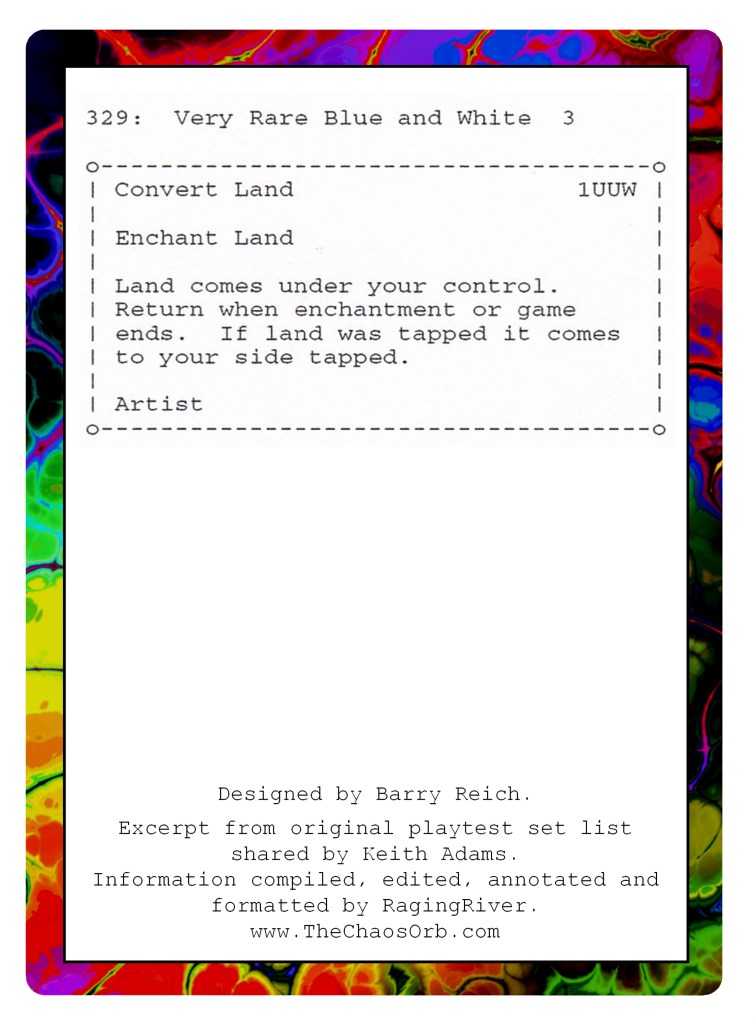
Original Playtest 
Realized
Convert Land – {1}{W}{U}{U}
Enchantment – Aura
Enchant land
Gain control of enchanted land.
ChaosHistory: Mono-colored auras like this were released in Ice Age as Conquer (red) and in Onslaught as Annex (blue).
330 – Fusion
(Very Rare Enchantment (Multicolor))

Original Playtest 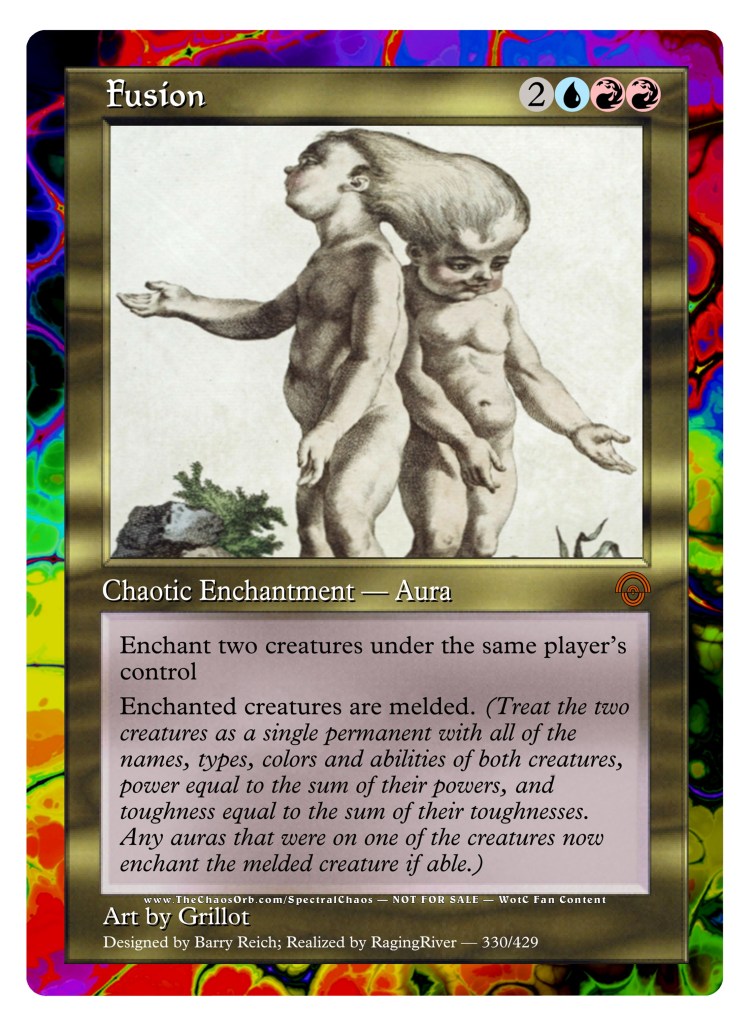
Realized
Fusion – {2}{U}{R}{R}
Chaotic Enchantment – Aura
Enchant two creatures under the same player’s control
Enchanted creatures are melded. (Treat the two creatures as a single permanent with all of the names, types, colors and abilities of both creatures, power equal to the sum of their powers, and toughness equal to the sum of their toughnesses. Any auras that were on one of the creatures now enchant the melded creature if able.)
(Note: Rulings last updated April 19, 2021.)
- The melded creature counts as a single creature, single target, single permanent, for as long as it’s enchanted by Fusion. If you need to count the number of permanents on the battlefield, the melded creature counts as one permanent (but would immediately become two permanents if at any time Fusion is no longer enchanting it). The original component creatures aren’t “leaving the battlefield” and the new melded creature isn’t “entering the battlefield.”
- All abilities are shared. If one of the creatures had defender and the other had trample, the melded creature has both defender and trample. If both creatures had different upkeep costs, the melded creature requires both upkeep costs to be paid. Even if it appears that there’s a conflict between two abilities, there probably isn’t. For example, if Fusion enchanted Goblin Brigand (which attacks each turn if able) and Peacekeeper (which says creatures cannot attack), that isn’t actually a conflict. In most situations, “can’t” will supersede “must.”
- Calculate the base power of each of the creatures separately, as though they weren’t melded, then add them together. Do the same to calculate the base toughness. This calculation is done at the time Fusion resolves, using the base power of each component creature at that time. If something was temporarily affecting one of the component creature’s base power or toughness (for example, with Sorceress Queen‘s effect), then the “until end of turn” effect will technically wear off at the end of the turn, but because the creatures have been melded with a new base power and toughness, there is no old base power or toughness for the creature to revert to, so nothing will happen. Be careful to distinguish temporary resets of base power/toughness (like Singing Tree‘s ability), which will be “locked in” to the new base power/toughness of the melded creature, from temporary increases or decreases to power/toughness (like Howl from Beyond), which won’t be factored into the melded creature’s base power/toughness (but will continue to affect the melded creature and then wear off). If one of the component creatures had its power and toughness switched until end of turn, then calculate the base power/toughness as it exists when Fusion resolves, and the melded creature will then have its power and toughness switched when the turn ends.
- Fusion must be able to legally enchant both creatures, and all normal rules about auras apply. For example, Fusion must be able to target and enchant both creatures, so if one or both creatures have protection from red or from blue, Fusion won’t be able to enchant them. However, note that protection doesn’t matter vis-a-vis the enchanted creatures as between the two of them. For example, Fusion can enchant both a white creature and a creature with protection from white.
- Whether the two targeted creatures are both controlled by the same player is checked upon Fusion being cast, and again upon resolution.
- If one or both of the enchanted creatures was legendary, the melded creature is legendary. (The same is true of snow, chaotic or any other super-types.) However, because it has the names of both enchanted creatures, it will have a different name any other un-fused legendary creatures.
- Any “until end of turn” effects that affected one of the enchanted creatures will affect the melded creature until end of turn. Because the fused creature will remember effects impacting both of its original component creatures, if one or both of those creatures was only temporarily under your control at the time you enchanted them with Fusion (for example, you stole it with Preacher or Ray of Command), then the melded creature will become controlled by your opponent when that effect wears off. If there are multiple lingering effects on the melded creature, then deal with each one in sequence as it resolves. For example, let’s say you use Ray of Command to steal an opponent’s creature until end of turn, then use Shallow Grave to resurrect one of your creatures until end of turn, then enchant both with Fusion. The melded creature will have two effects trigger at the beginning of the end step: Ray of Command‘s effect will return it to the opponent’s control, and Shallow Grave‘s effect will exile it. Since you control both effects, you will determine the order in which the effects resolve, but both will happen.
- If both of the original component creatures were only creatures “until end of turn” at the time Fusion resolves, then the melded creature will cease to be a creature at end of turn and Fusion will be put in its owner’s graveyard as a state-based action. Similarly, if, after being melded, anything were to cause the melded creature to cease being a creature, Fusion would be put in its owners’ graveyard as a state-based action, just like any other “enchant creature” aura would. If one of the original component creatures was only a creature “until end of turn,” but the other creature was a regular creature card, then the “until end of turn” effect will technically wear off at the end of the turn, but because the game still sees Fusion enchanting a single melded creature, it will continue to enchant both cards. For example, if you animate Mishra’s Factory, then enchant it and another creature with Fusion, the melded creature will include the assembly worker’s 2/2 in its calculation of the melded creature’s base power and toughness, it would include all of Mishra’s Factory‘s printed abilities (and it would have the type land), but it would stop being an artifact and an assembly worker at end of turn. You could still use its ability to turn the melded creature into a 2/2 artifact land assembly-worker creature, just like any other ability.
- If Fusion leaves the battlefield, the creatures revert to being two separate creatures. If the melded creature had auras or equipment attached to it, the melded creature’s controller chooses which of the un-melded creatures stays enchanted or equipped by each. Those auras won’t be treated as having newly entered the battlefield, and those auras and equipment won’t be treated as having been newly attached.
- If the melded creature is exiled without the Fusion aura enchanting it, it becomes two exiled creature cards. If something would put the melded creature on top, on the bottom, or in a specific place in a library, the owner of each creature card chooses their relative order. If something would put the melded creature back in its owner’s hand, each of the two creature cards are put back in their owner’s hand. If the melded creature dies, put each of the two creature cards in its owner’s graveyard. Basically, as soon as the melded creature would leave the battlefield and go to a different game zone for any reason, it reverts to being two creature cards and anything that performs actions on the cards after they leave the battlefield does so on both cards. The only exception is in the rare case that the melded creature is phased out or exiled with Fusion still enchanting it (like for Oubliette, Tawnos’s Coffin or Stunt Double); in this case, the melded creature is still being enchanted by Fusion, so it stays melded while phased out or exiled, and will (if applicable) phase in or return to play melded.
331 – Chain Reaction
(Very Rare Enchantment (Multicolor))
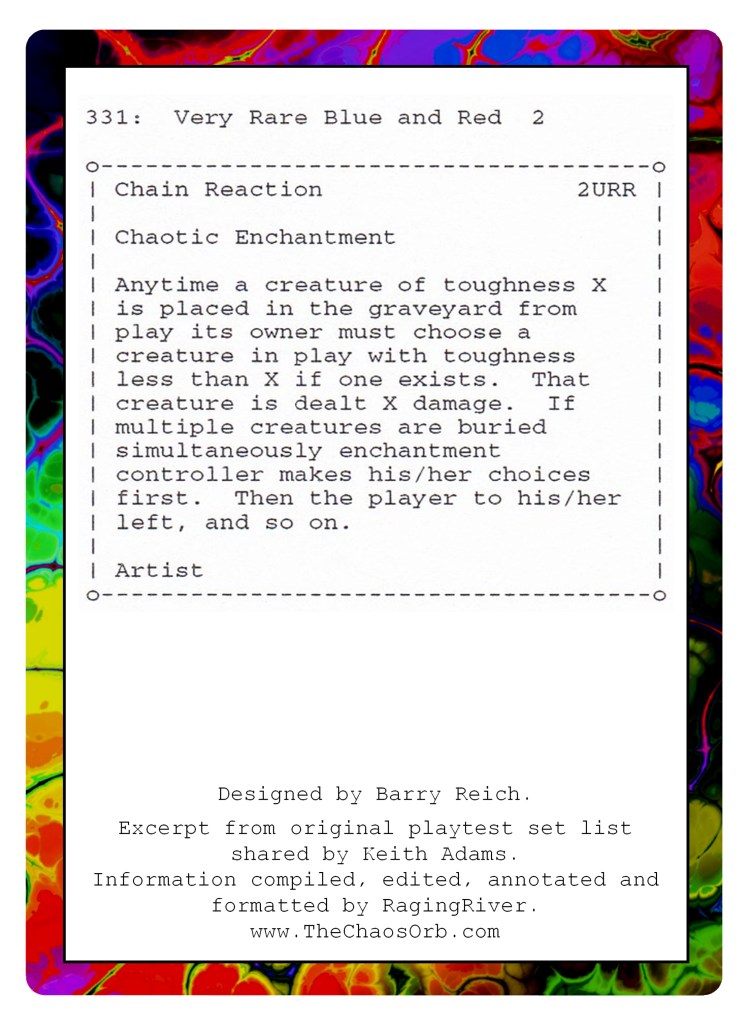
Original Playtest 
Realized
Chain Reaction – {2}{U}{R}{R}
Chaotic Enchantment
Whenever a creature dies, that creature’s controller chooses a target creature on the battlefield with toughness less than X, where X is the toughness of the creature that died. Chain Reaction deals X damage to the target creature. (If multiple creatures die simultaneously, this ability triggers for each one, with Chain Reaction’s controller choosing how to stack the triggers.)
332 – Animate Lands
(Very Rare Enchantment (Multicolor))
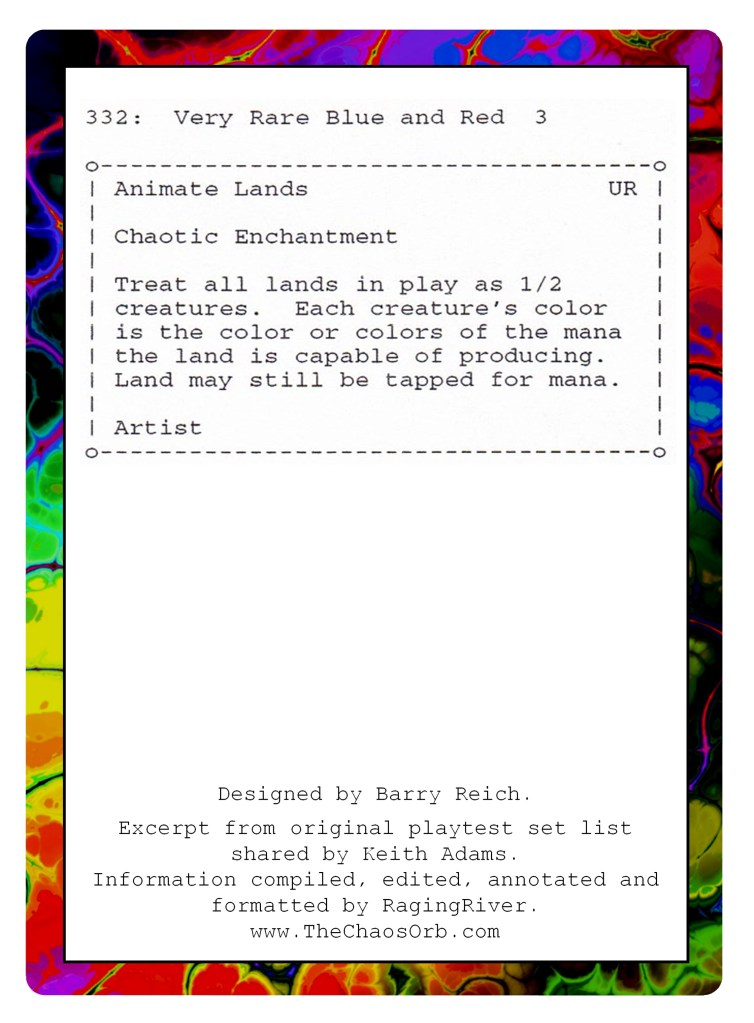
Original Playtest 
Realized
Animate Lands – {U}{R}
Chaotic Enchantment
Each land is a 1/2 creature of the color(s) of the mana that land could generate. It’s still a land.
- A noncreature permanent that turns into a creature can attack, and its tap abilities can be activated, only if its controller has continuously controlled that permanent since the beginning of their most recent turn. It doesn’t matter how long the permanent has been a creature.
- Land cards in your hand are still colorless land cards, they don’t gain color(s) or become creatures until they enter the battlefield. Zone-change replacement abilities that care about a color or creatures (like “[color] permanents enter the battlefield tapped” or “creatures enter the battlefield tapped”) won’t apply because those effects are applied as the card is entering its new zone. Zone-change triggered abilities that care about the color(s) or creatures (like “when a [color] permanent enters the battlefield” or “when a creature enters the battlefield”) will apply because those effects apply after the card is already in its new zone. Playing a land still isn’t “casting a [color] spell” or “casting a creature spell.”
- In determining color(s), check the effects of all mana-producing abilities of the land, but not its costs. Take into account any applicable replacement effects that would apply to the land’s mana abilities (such as Contamination‘s effect, for example). If there are more than one, consider them all and in any possible order. Restrictions or riders that the land puts on mana it generates (such as Ancient Ziggurat or Hall of the Bandit Lord) don’t matter; only the colors of mana matter.
333 – Gahchgah One-Eye
(Very Rare Creature (Red))
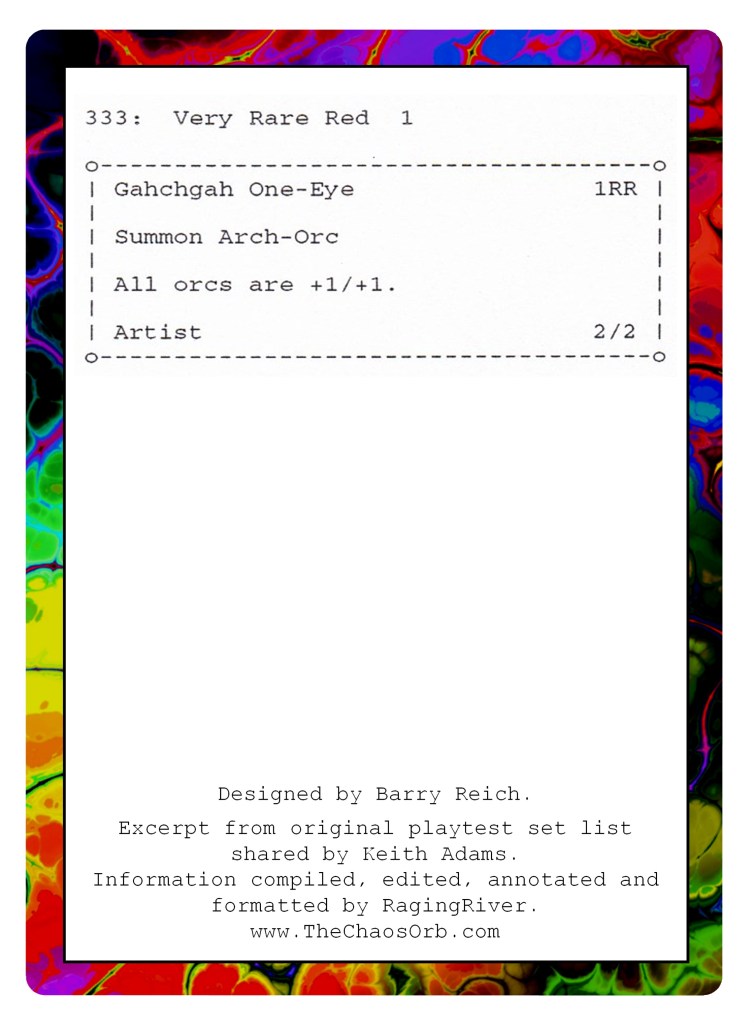
Original Playtest 
Realized
Gahchgah One-Eye – {1}{R}{R}
Legendary Creature – Orc Lord
All orcs get +1/+1.
2/2
ChaosHistory: No inside joke here – Barry just made this name up.
334 – Starburst
(Very Rare Instant (Red))
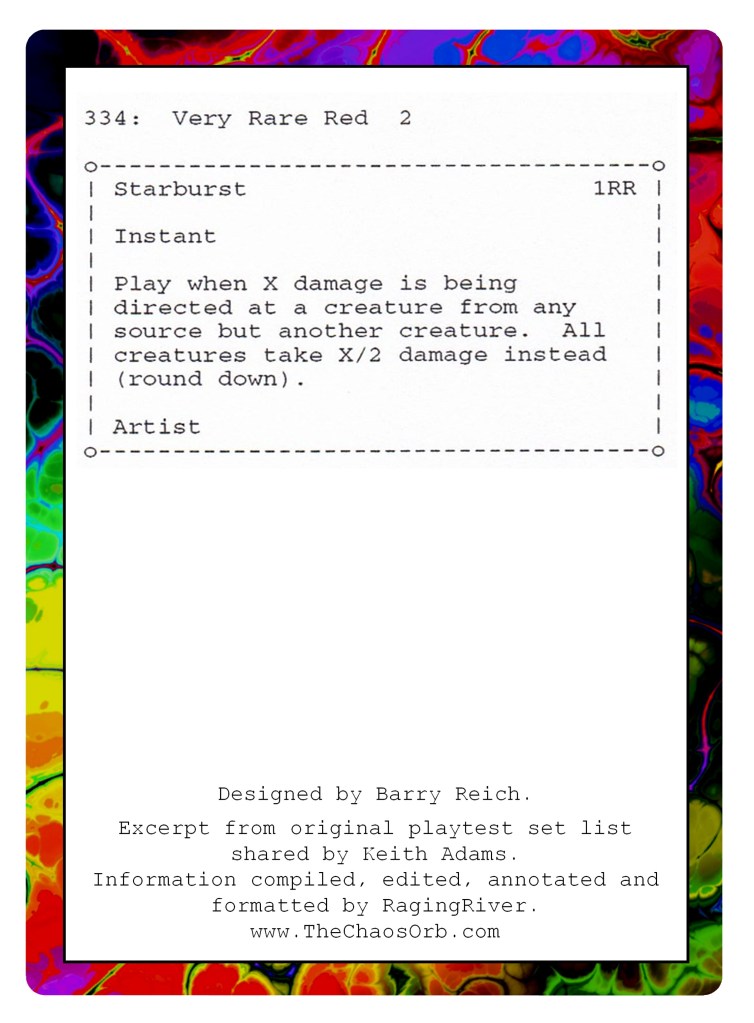
Original Playtest 
Realized
Starburst – {1}{R}{R}
Instant
The next time a non-creature source of your choice would deal damage to target creature this turn, prevent that damage. Starburst deals damage to each creature equal to half the damage prevented this way, rounded down.
- For example, if you choose a Lightning Bolt about to deal 3 damage to a target creature, Starburst would prevent that damage and deal 1 damage to all creatures (including that target creature).
- Starburst only cares about damage the chosen source would deal to the target creature. If the source would deal damage to multiple creatures, Starburst would only prevent the damage that would be dealt to the target creature. The source would still deal its damage to the other creatures.
- Starburst targets a creature, but it doesn’t target a source. You may choose a non-creature source with hexproof or shroud. You choose the target as you cast Starburst, but you don’t choose the source of damage you want to prevent until Starburst resolves.
- If the source you choose doesn’t deal damage to the creature, or if that damage is prevented in another way, Starburst will have no effect.
335 – Swordsman Lord
(Very Rare Creature (Red))

Original Playtest 
Realized
Swordsman Lord – {5}{R}{R}{R}
Creature – Human Knight Lord
First strike
5/6
336 – Red Elemental
(Very Rare Creature (Red))
Original Playtest 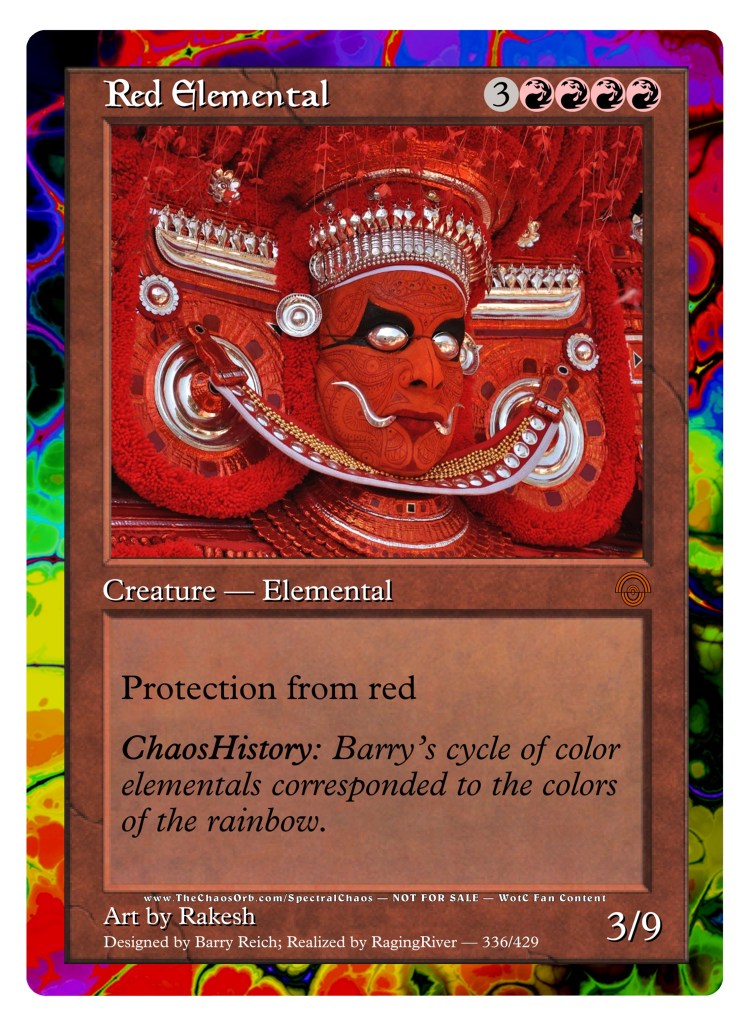
Realized
Red Elemental – {3}{R}{R}{R}{R}
Creature – Elemental
Protection from red
3/9
ChaosHistory: Barry’s cycle of color elementals corresponded to the colors of the rainbow.
337 – Koskite Wyvern
(Very Rare Creature (Red))

Original Playtest 
Realized
Koskite Wyvern – {6}{R}{R}{R}{R}
Creature – Dragon
{U}: Flying until end of turn.
{G}: +2/+0 until end of turn.
4/4
ChaosHistory: Spectral Chaos featured a total of four red dragons, one at each rarity level. None of them had flying as a static ability.
338 – Spirit of Excalibur
(Very Rare Enchantment (Red))

Original Playtest 
Realized
Spirit of Excalibur – {2}{R}{R}
Enchantment
All knights get +1/+1.
339 – Polymorph
(Very Rare Instant (Red))
Original Playtest 
Realized
Polymorph – {2}{R}{R}
Instant
Target permanent becomes a copy of another permanent on the battlefield. (Only the card is copied, not any counters on it. You may copy an aura only if the new copy could enchant a legal target. If you copy an aura, attach the new copy to a legal target as part of resolving this spell.)
- You announce what permanent you’re targeting when you cast Polymorph, but not what you want it to become a copy of. You don’t decide what it will become a copy of until Polymorph resolves. You don’t target the permanent you want your targeted permanent to become a copy of.
- You can’t make the target become a copy of itself. You have to choose a different permanent. (But you could choose a different permanent with the same name as the one you targeted.)
- You can make the permanent become a copy of a legendary permanent, but the Legend Rule will apply.
- The target permanent doesn’t enter or leave the battlefield. It simply becomes a copy of the other permanent.
- You have to target a permanent in order to cast Polymorph, but technically it could be the only permanent on the battlefield at that time. However, by the time Polymorph resolves there must be at least one other permanent in play. If there is no other permanent by the time Polymorph resolves, it will have no effect.
- All copiable values are copied, including color and mana cost.
- If the target permanent had auras or equipment attached to it and once it’s copied those can’t legally be attached to it anymore, they will “fall off” once Polymorph resolves as a state-based action.
- If you choose an aura, you also choose a legal permanent for the new copy of it to enchant. The copy doesn’t target that permanent, however, so it can be attached to a permanent with shroud or hexproof.
340 – Prometheus
(Very Rare Creature (Red))
Original Playtest 
Realized
Prometheus – {6}{R}
Legendary Creature – Titan
{T}: Look at the top card of target player’s library, then place that card on top of their library or in their graveyard.
5/5
341 – Stream of Destruction
(Very Rare Sorcery (Red))
Original Playtest 
Realized
Stream of Destruction – {X}{R}{R}{R}
Sorcery
{X} is equal to the number of artifacts on the battlefield as you cast this spell.
Destroy all artifacts.
ChaosHistory: The much easier to cast Shatterstorm was released in Antiquities.
342 – Moaning Banshee
(Very Rare Creature (Multicolor))

Original Playtest 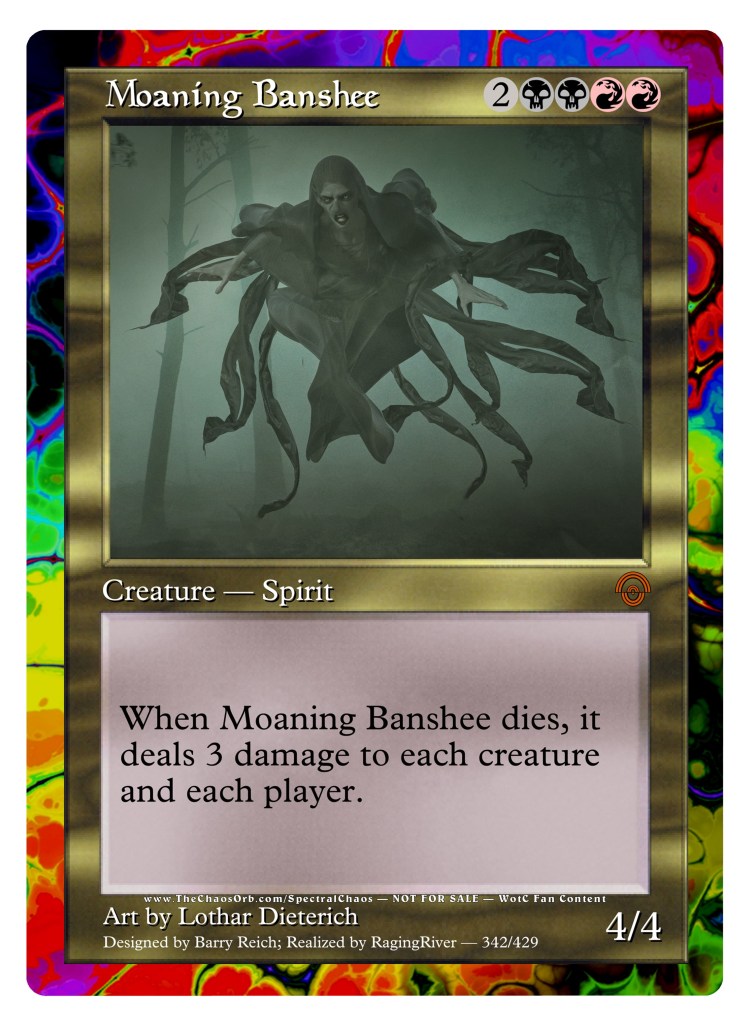
Realized
Moaning Banshee – {2}{B}{B}{R}{R}
Creature – Spirit
When Moaning Banshee dies, it deals 3 damage to each creature and each player.
4/4
343 – Harpy
(Very Rare Creature (Multicolor))
Original Playtest 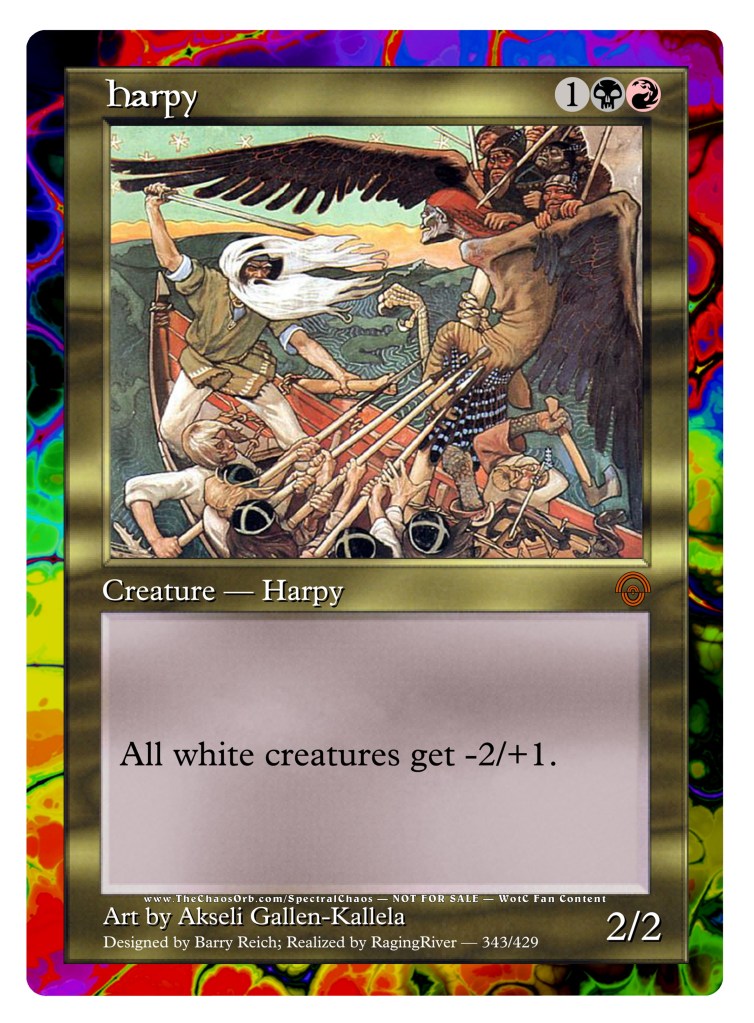
Realized
Harpy – {1}{B}{R}
Creature – Harpy
All white creatures get -2/+1.
2/2
344 – Swamp Hydra
(Very Rare Creature (Multicolor))

Original Playtest 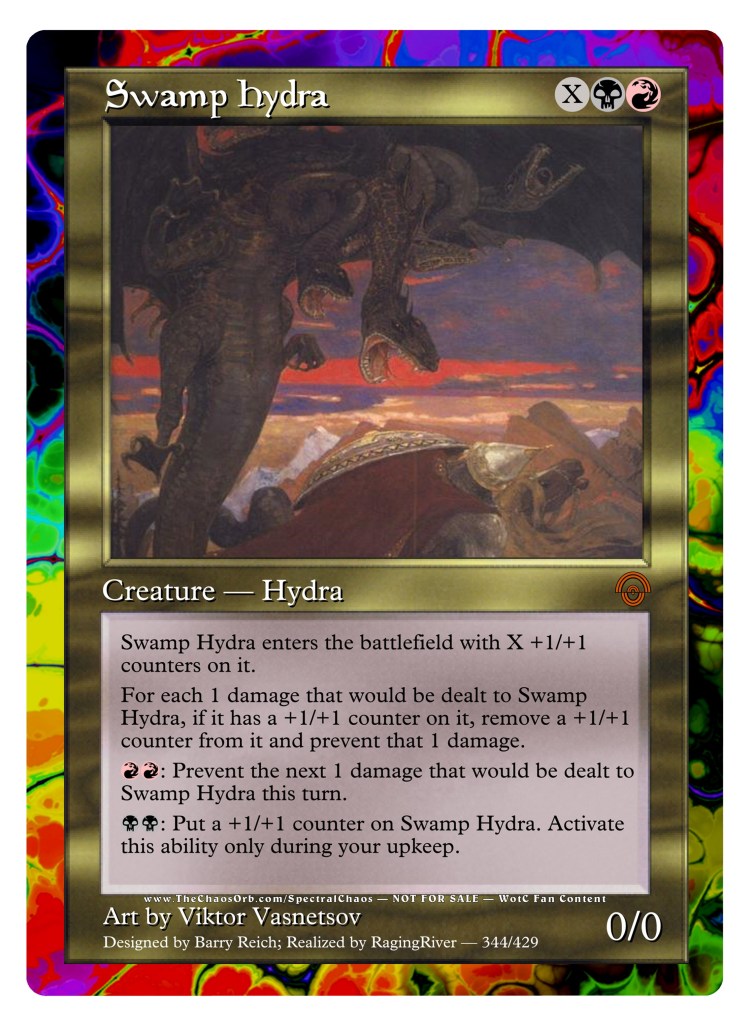
Realized
Swamp Hydra – {X}{B}{R}
Creature – Hydra
Swamp Hydra enters the battlefield with X +1/+1 counters on it.
For each 1 damage that would be dealt to Swamp Hydra, if it has a +1/+1 counter on it, remove a +1/+1 counter from it and prevent that 1 damage.
{R}{R}: Prevent the next 1 damage that would be dealt to Swamp Hydra this turn.
{B}{B}: Put a +1/+1 counter on Swamp Hydra. Activate this ability only during your upkeep.
0/0
- If put onto the battlefield without casting it from your hand, X will be zero.
- Once on the battlefield, the X is considered to be zero when calculating its mana cost.
- You can activate the activated ability that prevents damage any time, even if no source seems likely to deal damage to you in the near future. It will prevent the next 1 damage that would be dealt this turn, even if that turns out to be much later in the turn.
- If damage that would be dealt to Swamp Hydra can’t be prevented, you still remove a +1/+1 counter from it for each 1 damage dealt.
345 – Indigo Elemental
(Very Rare Creature (Multicolor))

Original Playtest 
Realized
Indigo Elemental – {3}{B}{B}{R}{R}
Creature – Elemental
Protection from black and from red
8/4
ChaosHistory: Isaac Newton believed for superstitious reasons that white light must be made up of 7 colors, so he decided to add indigo as a 7th color between blue and violet.
346 – Greater Demon
(Very Rare Creature (Multicolor))

Original Playtest 
Realized
Greater Demon – {4}{B}{B}{R}{R}
Creature – Demon Lord
Trample
All other Demons get +1/+1.
At the beginning of your upkeep, Greater Demon deals 11 damage to you unless you sacrifice a land and a creature. (You must sacrifice two permanents in order to avoid damage.)
11/11
- If a permanent is both a land and a creature, you can count it as whichever you like for this purpose. You may also sacrifice only one land or one creature and then fail to sacrifice a permanent from the other category. However, Greater Demon will deal 11 damage to you unless you sacrifice two separate permanents, one a land (which may have other types), and one a creature (which may have other types).
347 – Hellfire & Damnation
(Very Rare Sorcery (Multicolor))

Original Playtest 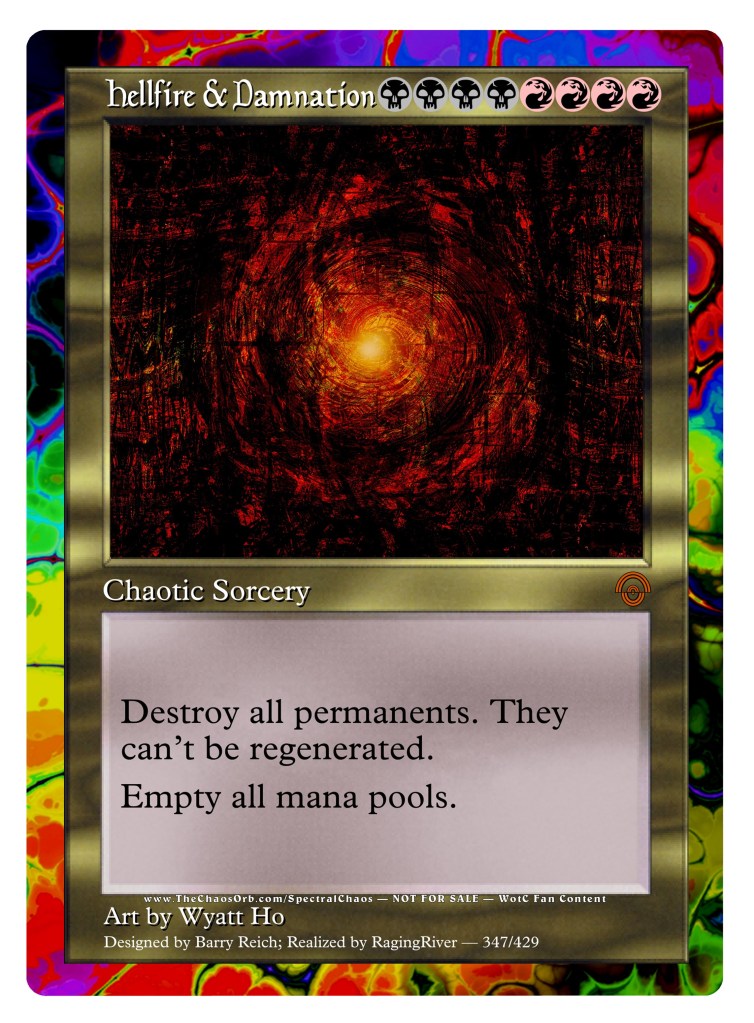
Realized
Hellfire & Damnation – {B}{B}{B}{B}{R}{R}{R}{R}
Chaotic Sorcery
Destroy all permanents. They can’t be regenerated.
Empty all mana pools.
348 – Soulitude
(Very Rare Enchantment (Multicolor))

Original Playtest 
Realized
Soulitude – {B}{R}
Enchantment
Whenever a creature dies, that creature’s controller may pay {G}. If they do, destroy target enchantment of that player’s choice. (If multiple creatures die simultaneously, this ability triggers for each one, with Soulitude’s controller choosing how to stack the triggers.)
349 – Homesickness
(Very Rare Enchantment (Multicolor))
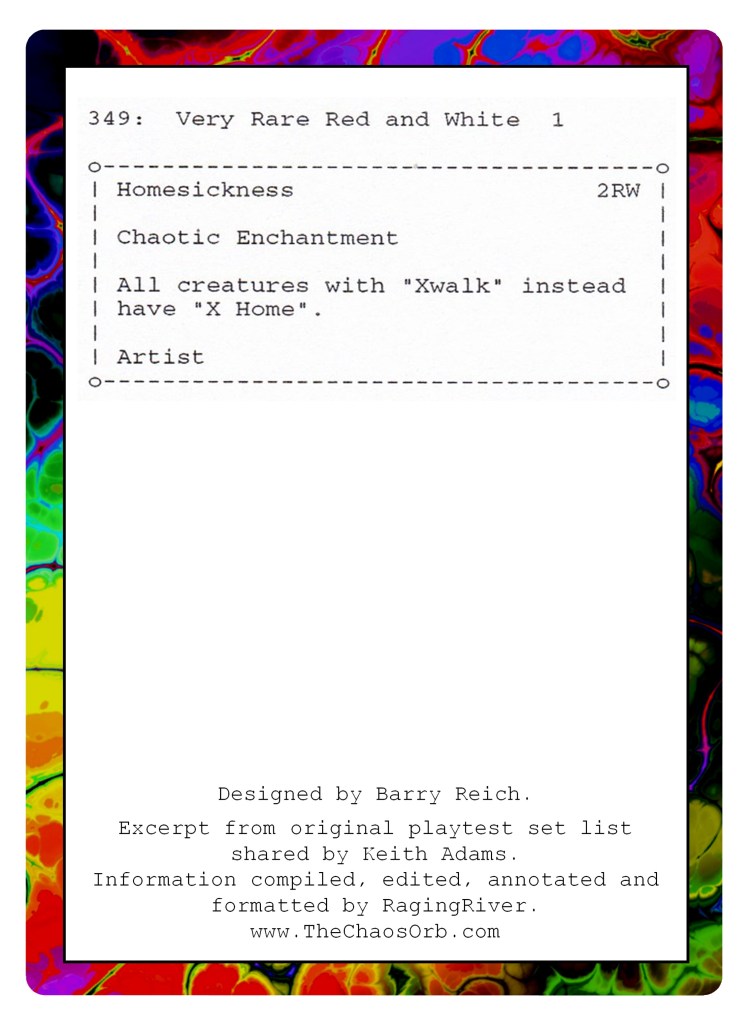
Original Playtest 
Realized
Homesickness – {2}{R}{W}
Chaotic Enchantment
Creatures lose landwalk abilities. Each creature that loses a landwalk ability this way gains the corresponding landhome ability. (For example, a creature with forestwalk loses forestwalk and gains foresthome. A creature with landhome can’t attack unless defending player controls a land of that type, and when the creature’s controller controls no land of that type, they sacrifice the creature.)
350 – Bricklayer
(Very Rare Creature (Multicolor))
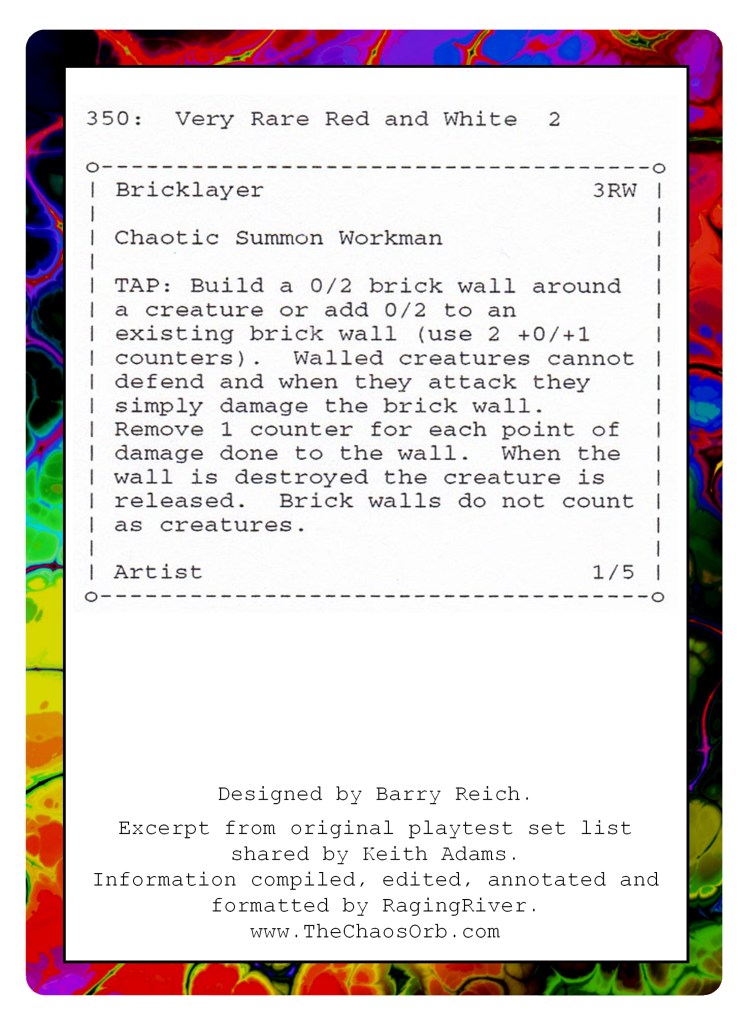
Original Playtest 
Realized
Bricklayer – {3}{R}{W}
Chaotic Creature – Human
{T}: Put two brick counters on target creature.
A creature with any brick counters on it can’t block or be blocked. If a creature with any brick counters on it attacks, prevent all combat damage it would deal and instead its controller removes up to one brick counter from it for each point of combat damage prevented this way.
1/5
- The concept here is that the Bricklayer builds a brick “wall” around the creature that it has to break through by attacking into it. A small creature of power 1 or less will take multiple turns to break through; a creature of power 2 or greater can break through two bricks in a single attack.
- Multiple Bricklyers do not mean the brick walls get broken through faster. If multiple Bricklayers are in play, an attacking creature with brick counters on it will still only remove one brick counter per point of combat damage prevented. This is because the creature’s combat damage can only be prevented once, thus only one Bricklayer‘s ability can apply and remove brick counters.
- If Bricklayer leaves the battlefield, any brick counters will remain where they are. However, without a Bricklayer on the battlefield, creatures with brick counters on them can attack, block and be blocked as normal. If another Bricklayer enters the battlefield, its ability will affect all creatures with brick counters on them, including the ones that received counters from a different Bricklayer.
- Creatures with brick counters on them can’t be declared as blockers. However, if a brick counter is put on a creature that’s already been declared as a blocker, that creature will continue to block that combat.
351 – Ion Storm
(Very Rare Enchantment (Multicolor))

Original Playtest 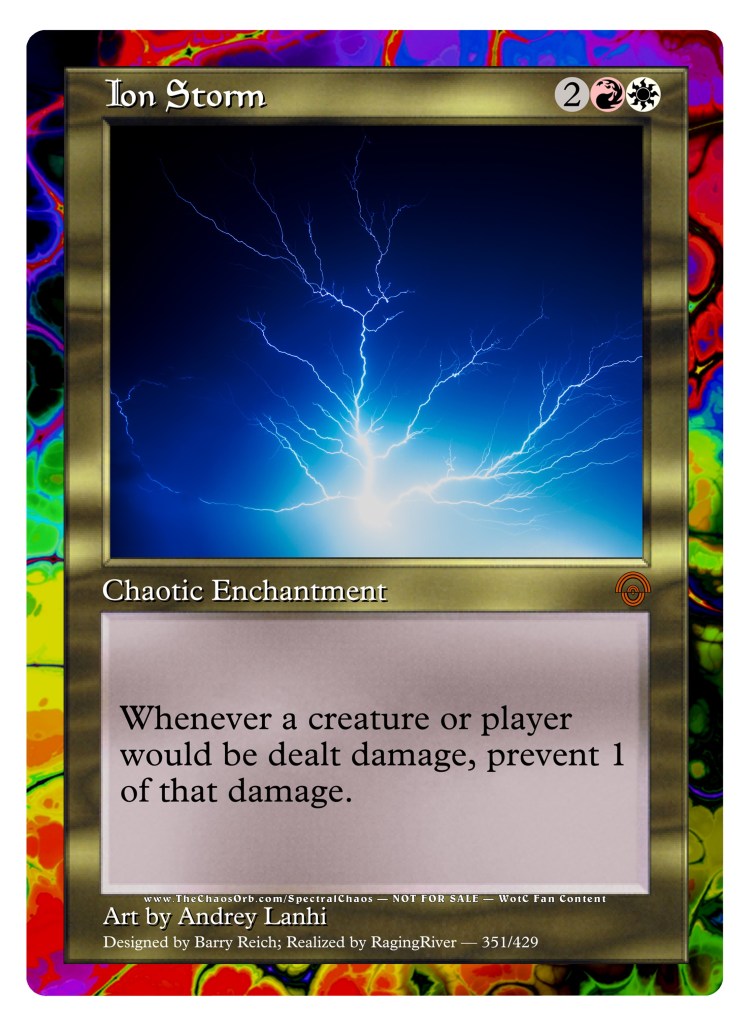
Realized
Ion Storm – {2}{R}{W}
Chaotic Enchantment
Whenever a creature or player would be dealt damage, prevent 1 of that damage.
- If multiple Ion Storms are in play, the effect will be cumulative.
352 – Telmarian Acolyte
(Very Rare Creature (White))

Original Playtest 
Realized
Telmarian Acolyte – {1}{W}{W}{W}
Creature – Cleric Shaman Lord
Protection from colorless
{T}: Target creature gains protection from colorless until end of turn.
All other clerics get +1/+1.
3/3
353 – Great Cat Armand
(Very Rare Creature (White))

Original Playtest 
Realized
Great Cat Armand – {W}
Legendary Creature – Cat Knight
3/2
ChaosHistory: The original Alpha playtesters often played at the home of Bill Rose. Once during playtesting, Bill’s cat Armand nearly bit through his finger. Barry wanted to “break every rule” in Spectral Chaos, including giving white this overpowered 1-drop. The ferocious house cat Armand seemed like a perfect name.
354 – Archangel
(Very Rare Creature (White))

Original Playtest 
Realized
Archangel – {4}{W}{W}{W}
Creature – Angel
Flying, vigilance
5/5
ChaosHistory: This exact design (with a slightly different casting cost) would be released in Visions.
355 – Shiva the Destroyer
(Very Rare Creature (White))
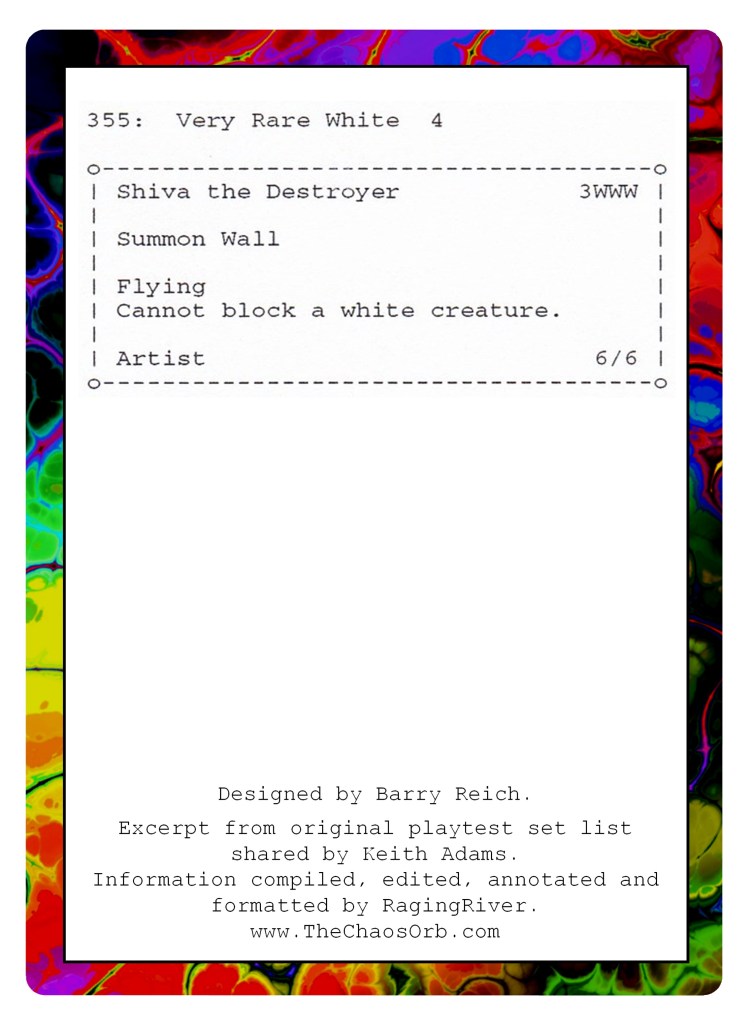
Original Playtest 
Realized
Shiva the Destroyer – {3}{W}{W}{W}
Legendary Creature – Wall God
Flying, defender
Shiva the Destroyer can’t block white creatures.
6/6
356 – Medical Training
(Very Rare Enchantment (White))

Original Playtest 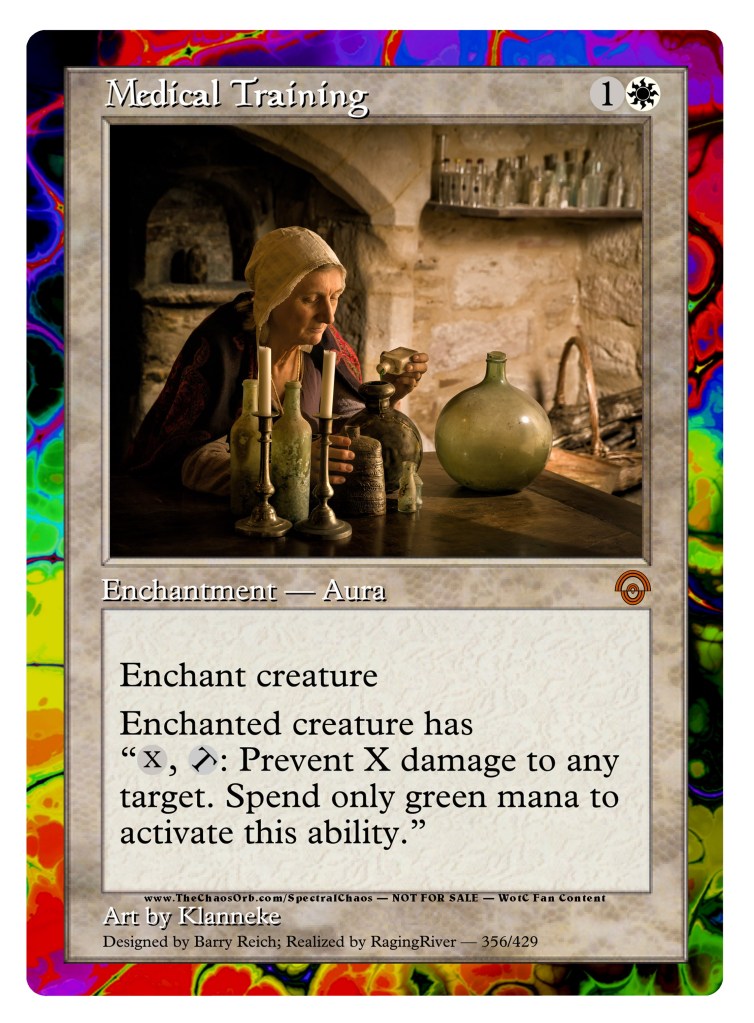
Realized
Medical Training – {1}{W}
Enchantment – Aura
Enchant creature
Enchanted creature has “{X}, {T}: Prevent X damage to any target. Spend only green mana to activate this ability.”
357 – Purification
(Very Rare Enchantment (White))
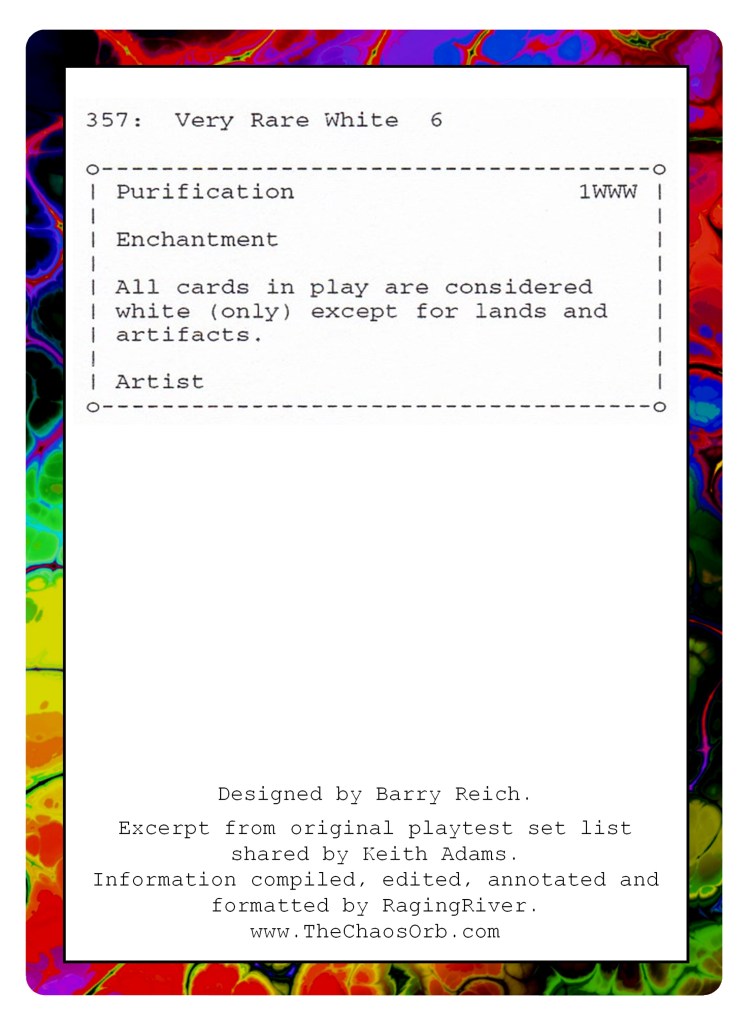
Original Playtest 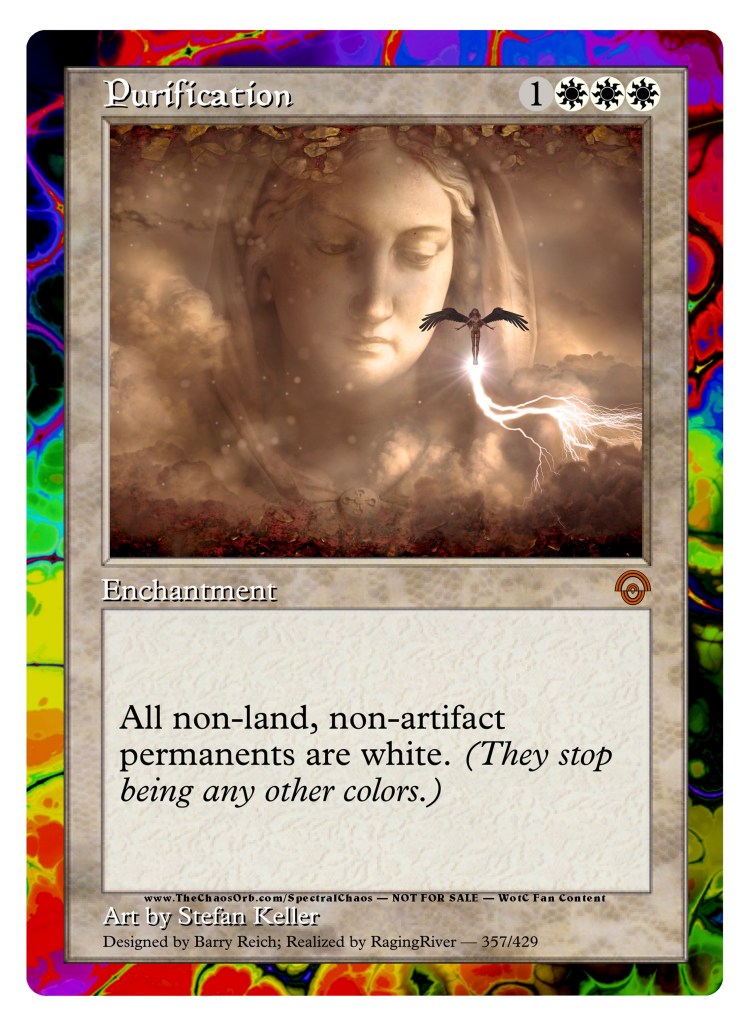
Realized
Purification – {1}{W}{W}{W}
Enchantment
All non-land, non-artifact permanents are white. (They stop being any other colors.)
- This effect is a static ability. Thus, a color change on a permanent prior to Purification entering the battlefield will be overridden by Purification’s effect.
- If a permanent enters the battlefield while Purification is on the battlefield, and then Purification leaves the battlefield, the permanent’s color will revert to the colors in its mana cost.
- Purification won’t affect any permanents that have the land or artifact type, even if they have other types too. If a non-land, non-artifact permanent becomes a land or an artifact, it will revert to the colors in its mana cost, until it’s a non-land, non-artifact permanent again.
358 – Animate Walls
(Very Rare Enchantment (White))

Original Playtest 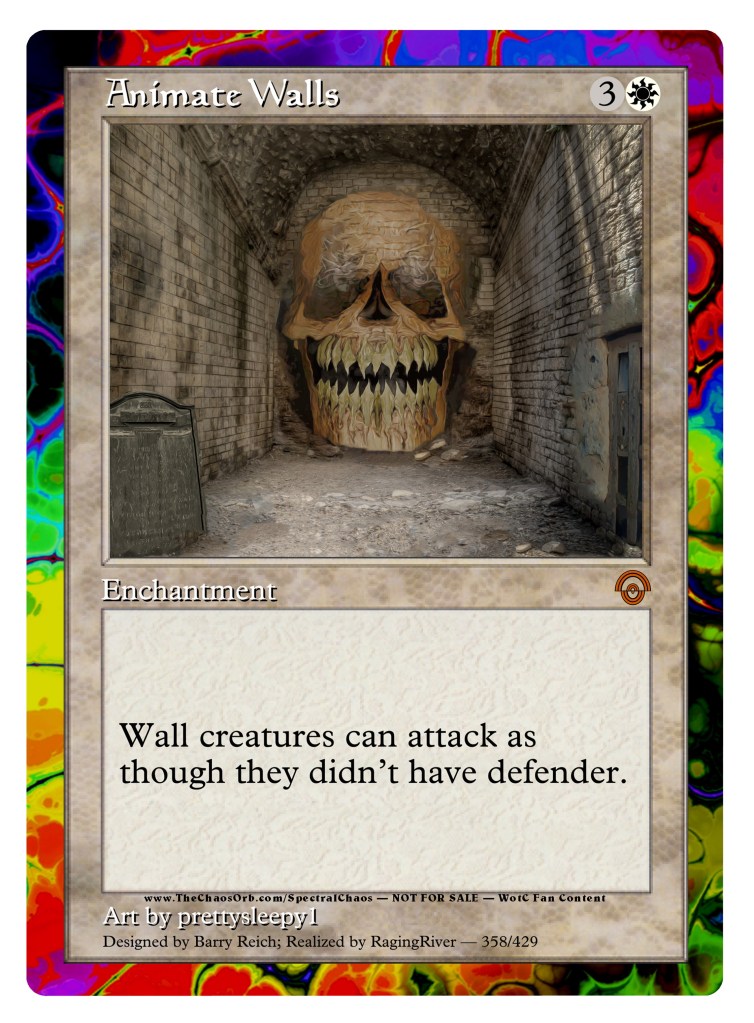
Realized
Animate Walls – {3}{W}
Enchantment
Wall creatures can attack as though they didn’t have defender.
359 – Faded Circle of Protection
(Very Rare Enchantment (White))
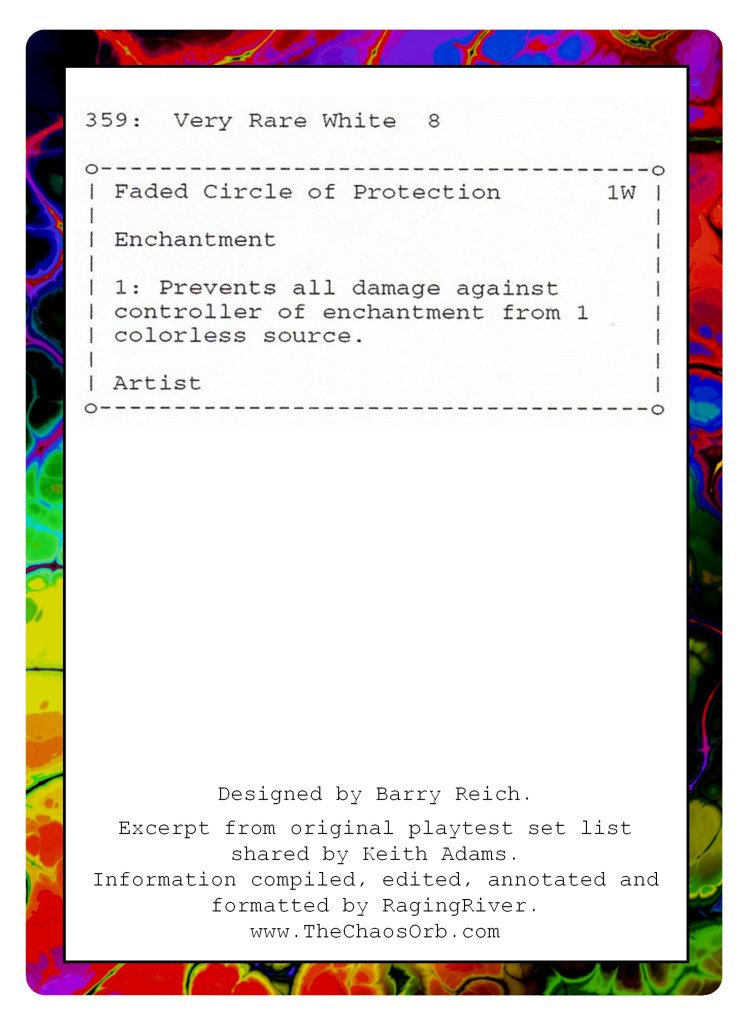
Original Playtest 
Realized
Faded Circle of Protection – {1}{W}
Enchantment
{1}: The next time a colorless source of your choice would deal damage to you this turn, prevent that damage.
ChaosHistory: This sixth Circle of Protection would have “completed” the C.o.P. cycle. It was never printed, but C.o.P.: Artifacts was, in Antiquities.
360 – Page’s Ward
(Very Rare Enchantment (White))

Original Playtest 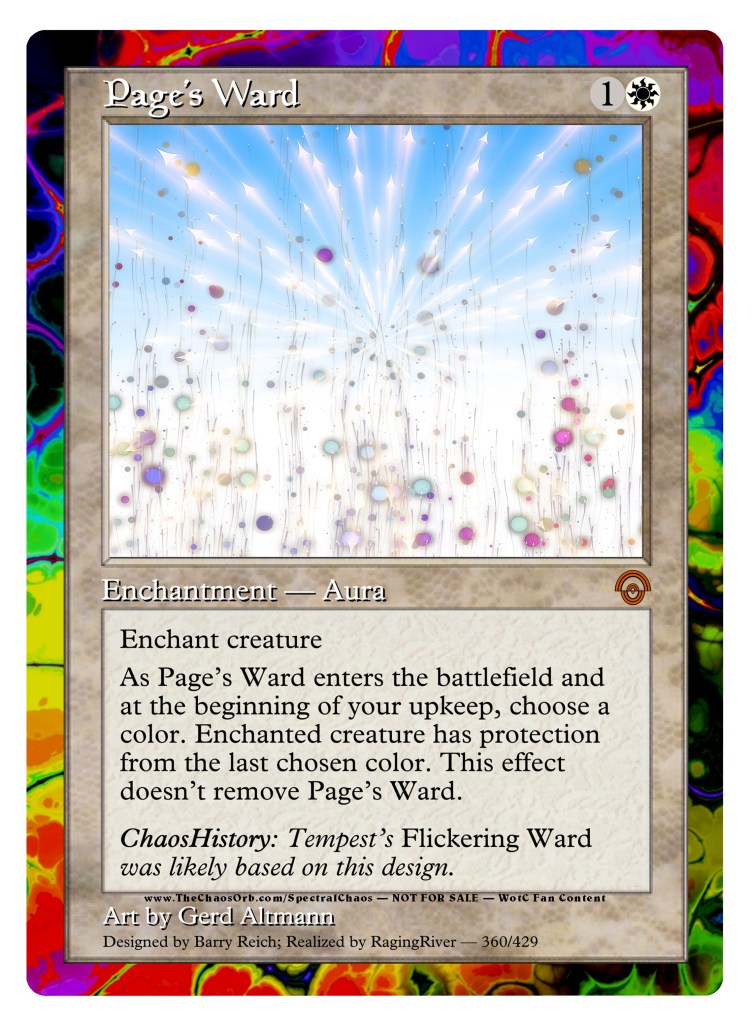
Realized
Page’s Ward – {1}{W}
Enchantment – Aura
Enchant creature
As Page’s Ward enters the battlefield and at the beginning of your upkeep, choose a color. Enchanted creature has protection from the last chosen color. This effect doesn’t remove Page’s Ward.
ChaosHistory: Tempest’s Flickering Ward was likely based on this design.
361 – Colorless Ward
(Very Rare Enchantment (White))

Original Playtest 
Realized
Colorless Ward – {W}
Enchantment – Aura
Enchant creature
Enchanted creature has protection from colorless and +1/+1.
362 – Hyperion
(Very Rare Creature (White))

Original Playtest 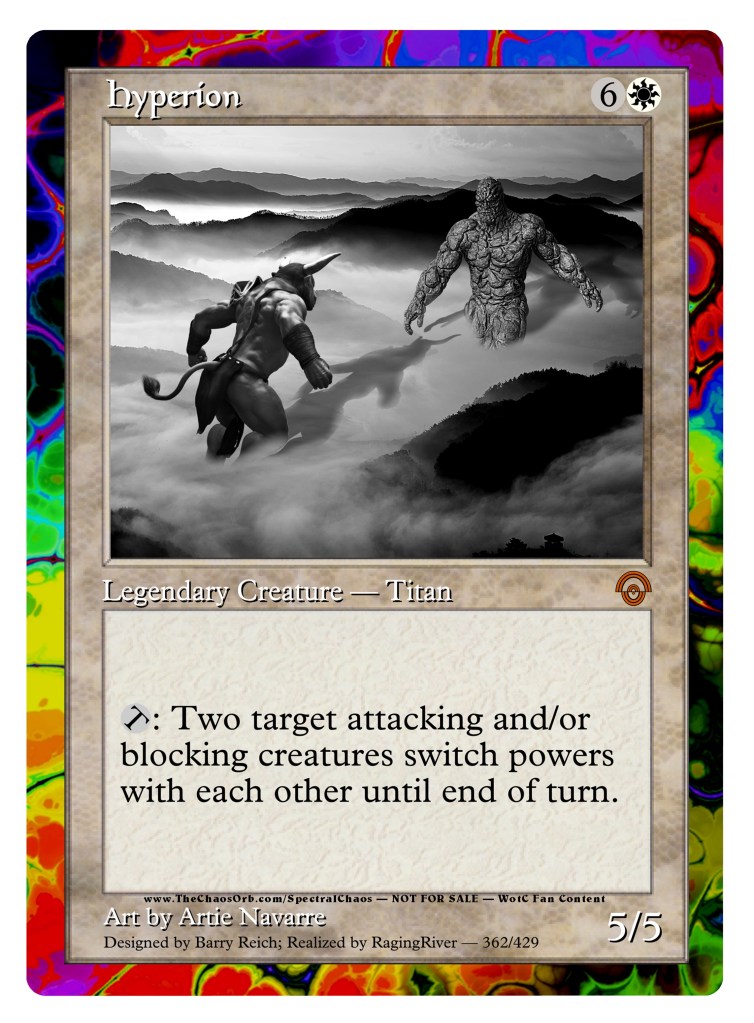
Realized
Hyperion – {6}{W}
Legendary Creature – Titan
{T}: Two target attacking and/or blocking creatures switch powers with each other until end of turn.
5/5
- Could target two attacking creatures, two blocking creatures, or one of each. Could target an attacker and a creature blocking it, or a creature blocking a different attacker.
- Does not undo any abilities which triggered due to the declaration of attackers or blockers. A creature whose power is switched this way is still attacking or blocking, as the case may be, and any triggered abilities will still resolve on it.
- Only the base powers are switched. This switch is applied in layer 7b. This means that the switch occurs before you apply abilities or effects that pump a creature’s power (since those are applied in Layer 7c). So if you cast Giant Growth on Creature A and Hyperion‘s ability switches Creature A’s power with Creature B’s power, Creature A will still get the pumped power from Giant Growth (regardless of whether it resolved before or after Hyperion‘s ability).
- Effects that switch a creature’s power with its toughness apply in Layer 7d, after all other effects that change power and/or toughness, regardless of which effect was created first. This means that if Creature A has its power switched with its toughness, and Hyperion‘s ability is activated switching Creature A’s power with Creature B’s power, Creature A’s power will become Creature B’s power first (Layer 7b), and then that will become Creature A’s toughness once Layer 7d is applied. Creature B’s power, determined in Layer 7b, would become the power that Creature A had in Layer 7b (ignoring the fact that Creature A’s power ultimately gets switched with its toughness).
363 – Reflection
(Very Rare Instant (White))
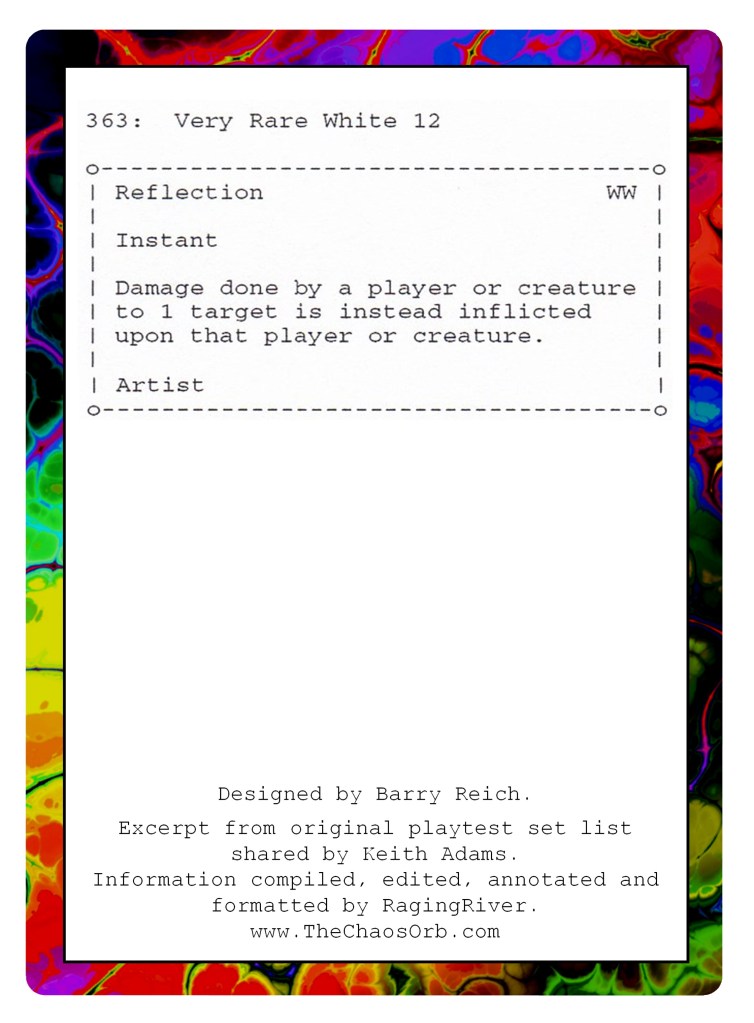
Original Playtest 
Realized
Reflection – {W}{W}
Instant
The next time a source of your choice would deal damage this turn, that damage is instead dealt to that source (if the source is a creature) or to that source’s controller (if the source is a spell or other non-creature source).
- You choose the source when Reflection resolves. Reflection doesn’t target anything.
- If you choose a creature as the source, whatever damage it deals next will be redirected to it. It doesn’t matter whether its combat damage or other damage the creature deals.
- The damage is still being dealt by the original source, not by Reflection.
364 – Sanctuary
(Very Rare Enchantment (White))
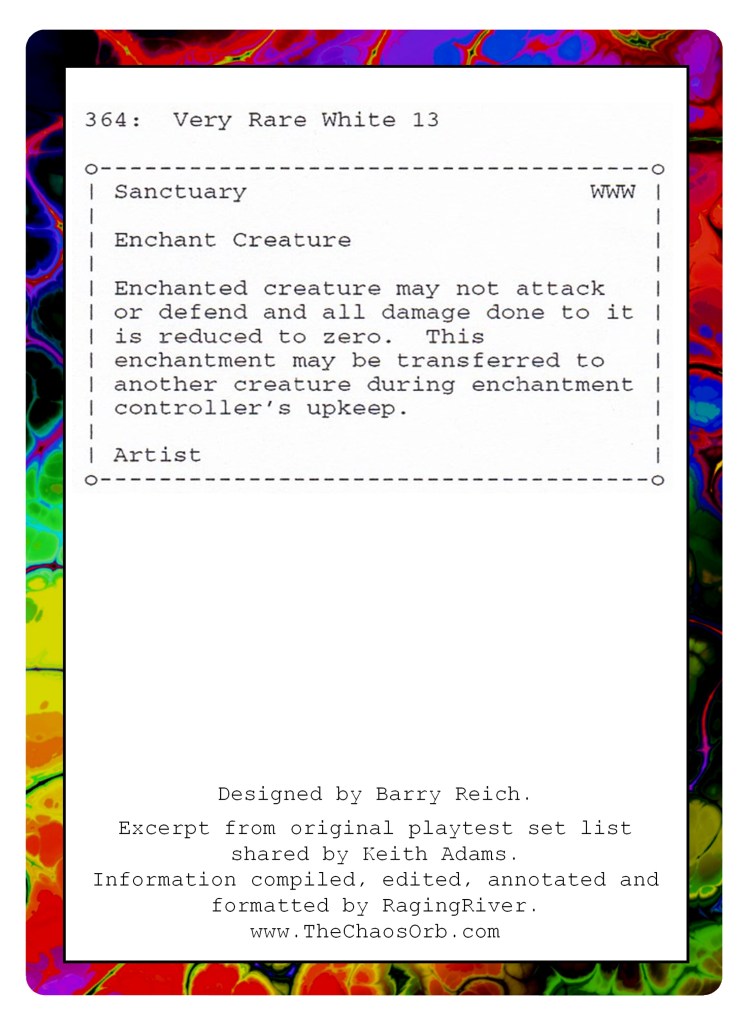
Original Playtest 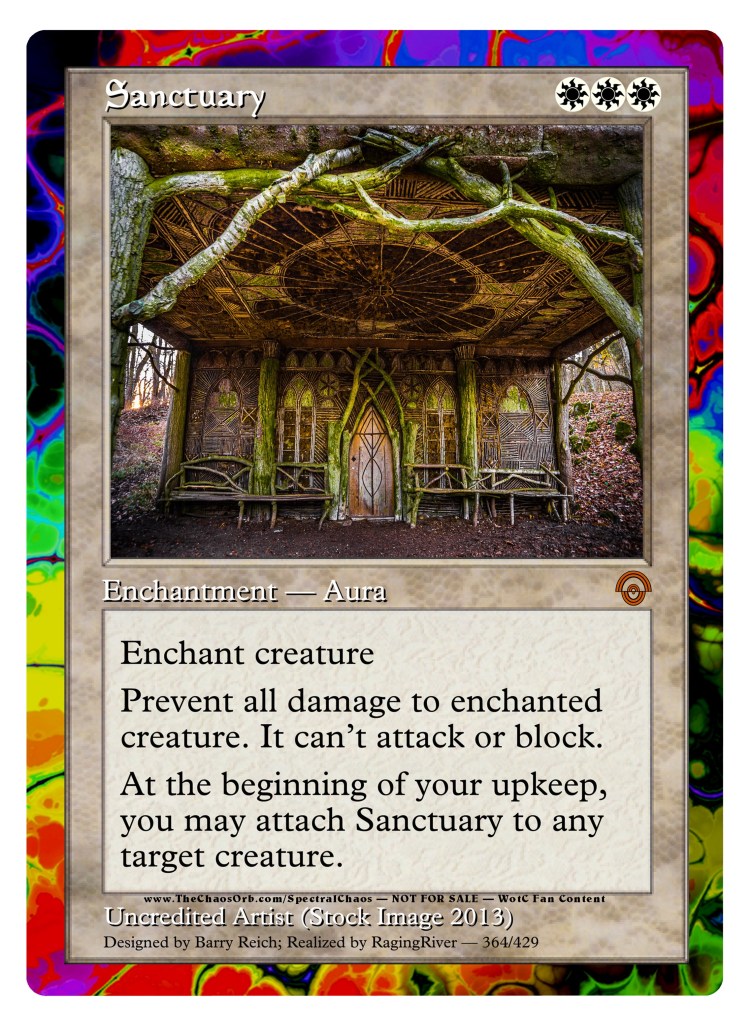
Realized
Sanctuary – {W}{W}{W}
Enchantment – Aura
Enchant creature
Prevent all damage to enchanted creature. It can’t attack or block.
At the beginning of your upkeep, you may attach Sanctuary to any target creature.
- As Sanctuary‘s optional ability begins to resolve, you target a creature and attach Sanctuary to it. No one will get priority between the target being chosen and Sanctuary being attached to it. If someone wants to kill a potential target creature, they’ll have to do so before this ability begins to resolve (before the creature is targeted).
365 – Mass Resurrection
(Very Rare Sorcery (Multicolor))

Original Playtest 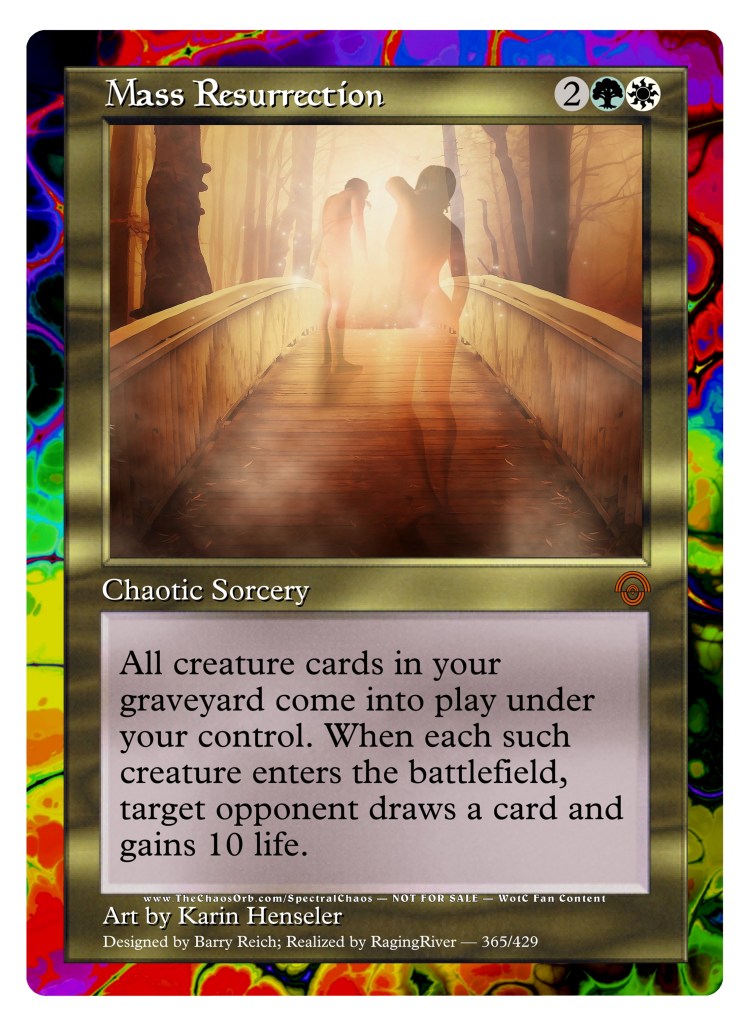
Realized
Mass Resurrection – {2}{G}{W}
Chaotic Sorcery
All creature cards in your graveyard come into play under your control. When each such creature enters the battlefield, target opponent draws a card and gains 10 life.
- All creature cards in your graveyard will be resurrected when this resolves. You can’t pick and choose only certain creatures to resurrect.
- Each creature resurrected will result in a separate trigger. All creatures enter the battlefield simultaneously, and you stack the triggers however you want. You can target a different opponent (to draw the card and gain the life) for each trigger. If for some reason you can’t target any opponent, the triggers will just fail to resolve and nobody will draw cards or gain life after those creatures come into play.
366 – Yellow Elemental
(Very Rare Creature (Multicolor))

Original Playtest 
Realized
Yellow Elemental – {3}{G}{G}{W}{W}
Creature – Elemental
Protection from green and from white
5/7
ChaosHistory: Each of the seven rainbow elementals had a converted mana cost of 7 (the original number of colors in the rainbow).
367 – Eosian Stag
(Very Rare Creature (Multicolor))

Original Playtest 
Realized
Eosian Stag – {2}{G}{G}{W}
Creature – Elk
All black creatures get -1/-1.
2/3
368 – Efficiency
(Very Rare Enchantment (Multicolor))
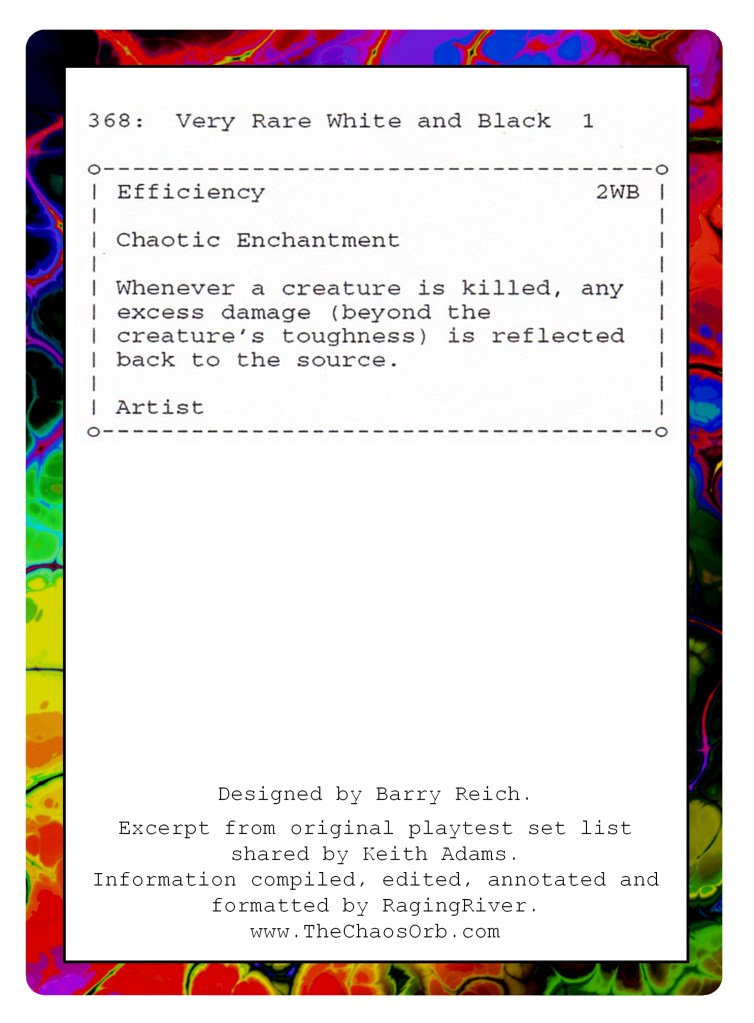
Original Playtest 
Realized
Efficiency – {2}{W}{B}
Chaotic Enchantment
If a creature dies with more than lethal damage marked on it (for example, a source deals 3 damage to kill a creature with toughness of 1, leaving 2 excess damage marked on it), Efficiency deals damage equal to such excess damage to the source of such excess damage (if the source was a creature) or to that source’s controller (if the source was a spell or other non-creature source).
5/7
- If damage to a creature was prevented, that means it wasn’t marked on the creature.
- If combat damage from an attacker with trample was assigned through to the defending player, that means it wasn’t marked on the blocking creature.
- If multiple creatures die simultaneously with excess damage marked on them, Efficiency will trigger once for each such creature, with Efficiency‘s controller choosing how to stack the triggers. For example, if a player casts Earthquake for X=3, killing a 1/1, a 2/2 and a 3/3, Efficiency would trigger once for the 1/1 (dealing 2 damage to Earthquake‘s caster) and once for the 2/2 (dealing 1 damage to Earthquake‘s caster), with Efficiency‘s controller choosing how those triggers resolve.
- Efficiency‘s ability checks (and triggers) when the creature dies, and looks to the sorce of the damage marked on that creature. If a source deals damage that isn’t lethal when dealt, but later became lethal (for example, because the damaged creature’s toughness is later reduced), the last source of damage is deemed the source of lethal damage for purposes of Efficiency.
- In nearly every situation, there will only be one source of lethal damage, and it will be the source of the damage that was most recently marked onto the creature, causing it to die. For example, if a creature takes combat damage but survives combat, and then later in that turn that creature is damaged with Lightning Bolt and dies, the source of the excess damage is the Lightning Bolt, not the creature that caused the combat damage taken earlier in the turn. In the rare situation that there are multiple simultaneous sources of lethal damage, Efficiency will deal damage based on how much of that excess damage came from each source. If it’s impossible to tell which source simultaneously dealt the “excess” damage (an extraordinarily rare situation), then Efficiency‘s controller chooses one of them to receive Efficiency‘s damage, but Efficiency cannot deal more damage in total than the aggregate amount of the excess damage.
369 – Vicarious Entity
(Very Rare Enchantment (Multicolor))
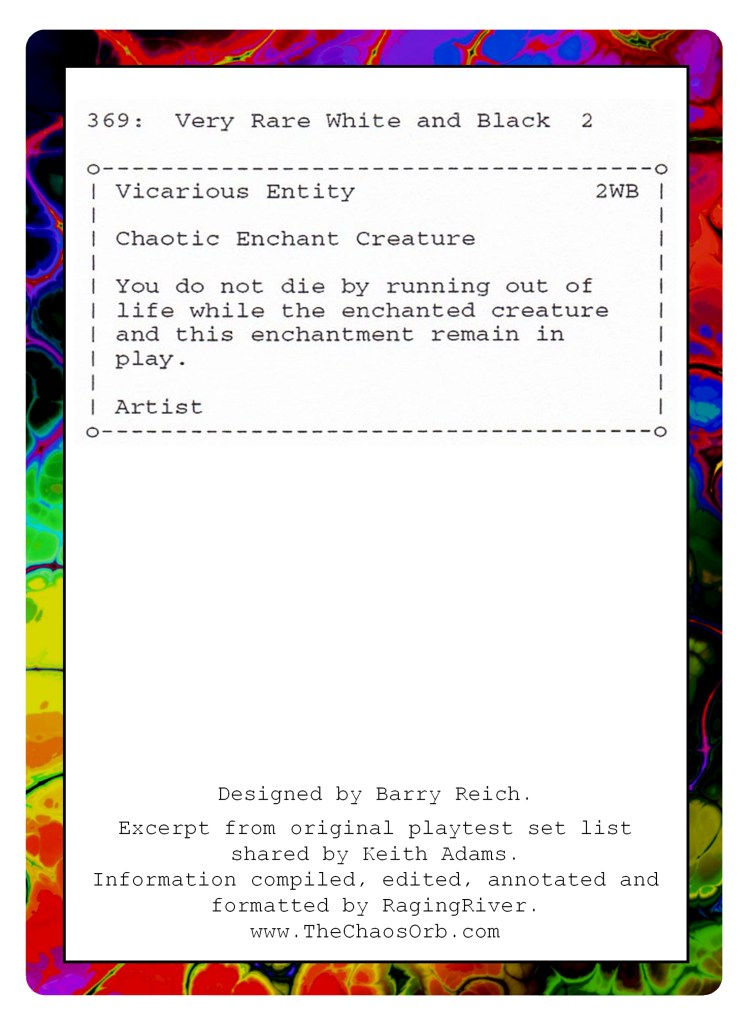
Original Playtest 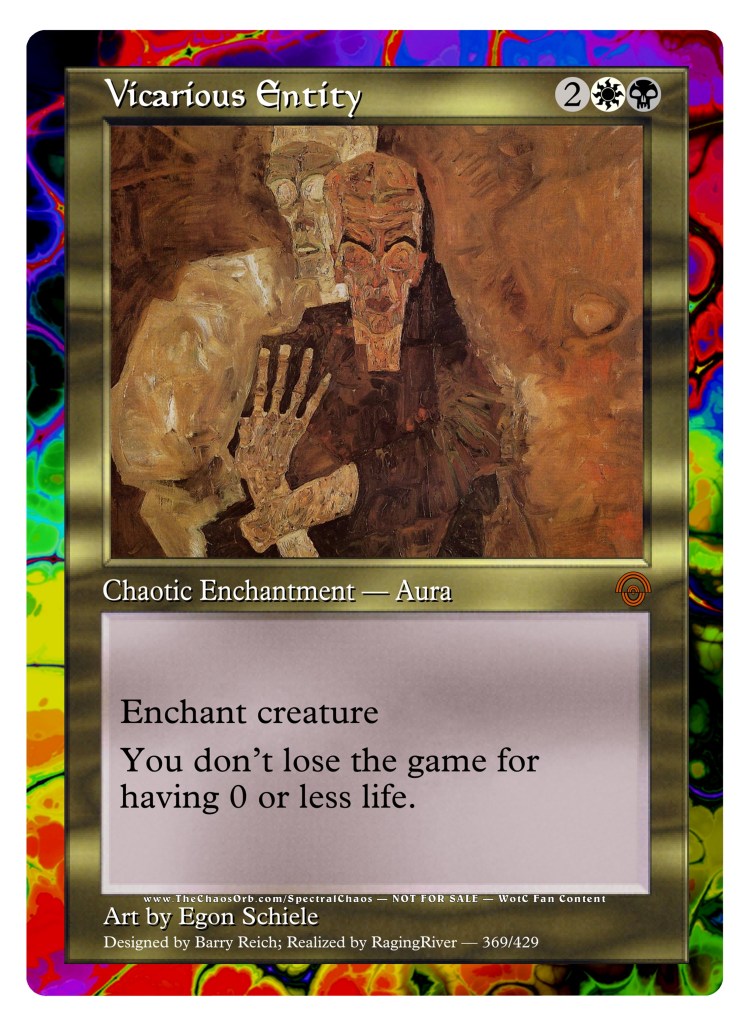
Realized
Vicarious Entity – {2}{W}{B}
Chaotic Enchantment – Aura
Enchant creature
You don’t lose the game for having 0 or less life.
- If you’re at 0 or less life and Vicarious Entity leaves the battlefield for any reason, you’ll lose the game (unless some other effect keeps you from losing) as a state based action.
- You can still be dealt damage, lose life and gain life as normal while Vicarious Entity is in play. You simply won’t lose the game for having 0 or less life. You can still lose the game other ways.
- A player with 0 or less life can’t pay life.
370 – Afterlife
(Very Rare Sorcery (Multicolor))

Original Playtest 
Realized
Afterlife – {3}{W}{B}
Chaotic Sorcery
Each player exiles all creature cards from their graveyard, then sacrifices all creatures they control, then puts all cards they exiled this way onto the battlefield.
ChaosHistory: This exact design (with a different casting cost) would be released in Tempest as Living Death.
- As Afterlife resolves, all players exile their creature cards from graveyards at the same time. Then all players sacrifice all creatures they control at the same time. Then all players put all creatures they exiled onto the battlefield at the same time.
- Only cards exiled by Afterlife‘s first instruction are put onto the battlefield. If a replacement effect (such as that of Leyline of the Void) causes any of the sacrificed creatures to be exiled instead of put into a graveyard, those cards aren’t returned to the battlefield.
371 – Dawn of the Dead
(Very Rare Sorcery (Multicolor))

Original Playtest 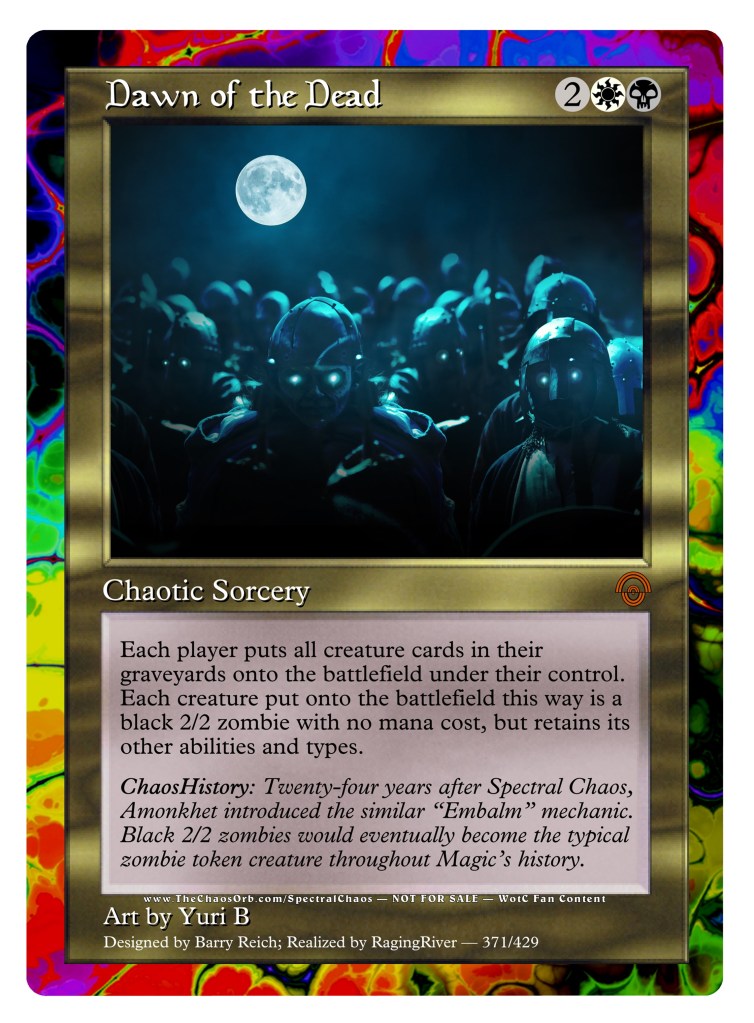
Realized
Dawn of the Dead – {2}{W}{B}
Chaotic Sorcery
Each player puts all creature cards in their graveyard onto the battlefield under their control. Each creature put onto the battlefield this way is a black 2/2 zombie with no mana cost, but retains its other abilities and types.
ChaosHistory: Twenty-four years after Spectral Chaos, Amonkhet introduced the similar “Embalm” mechanic. Black 2/2 zombies would eventually become the typical zombie token creature throughout Magic’s history.
- Creatures put into play this way are zombies in addition to their original types.
- Creatures put into play this way aren’t tokens, even though they now have no mana cost.
- Creatures put into play this way are black. This includes artifact creatures. They lose their original color identity (remember, they have no mana cost anymore to give them a color).
- If a creature has an ability that determines its base power and/or toughness (such as Gaea’s Liege or Pestilence Rats), ignore that ability. It’s a 2/2 now. However, if that creature has an ability that boosts its power and/or toughness (such as Kird Ape), that ability will continue to apply.
372 – Ophion
(Very Rare Creature (Black))
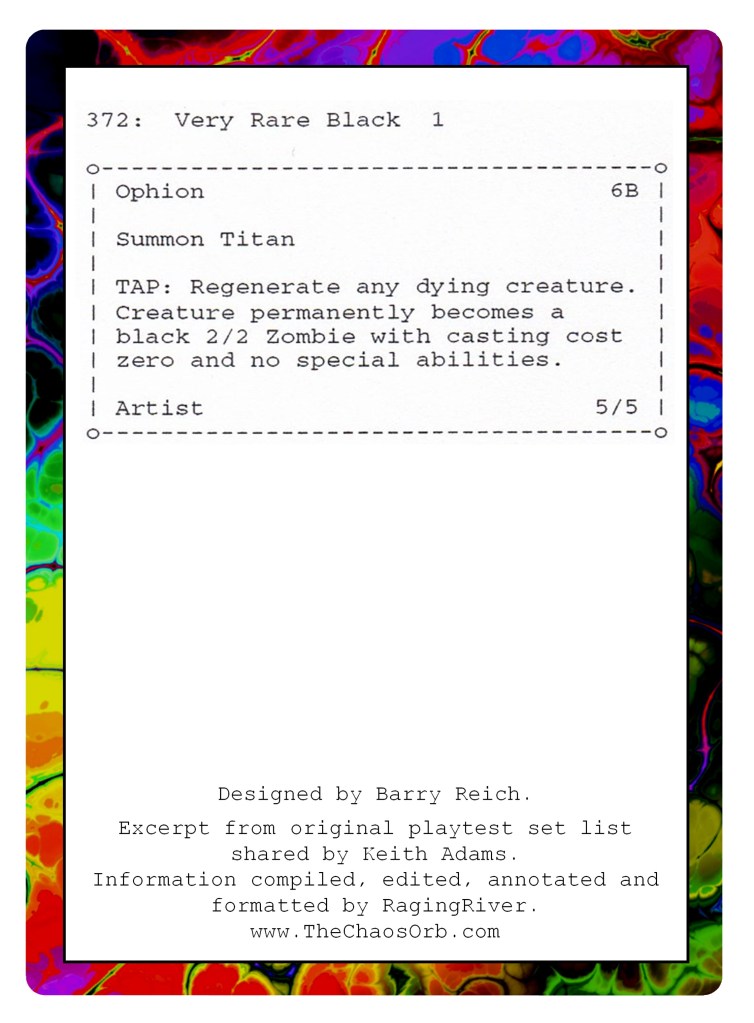
Original Playtest 
Realized 
Zombie Token
Ophion – {6}{B}
Legendary Creature – Titan
{T}: The next time target creature would die, instead exile that creature and its controller creates a 2/2 black Zombie creature token. When that token dies, put the creature from exile into its owner’s graveyard.
5/5
ChaosHistory: Spectral Chaos was the first set to contemplate 2/2 black zombie tokens. They would be introduced in Alliances and eventually become the standard zombie token.
373 – Groaning Demon
(Very Rare Creature (Black))

Original Playtest 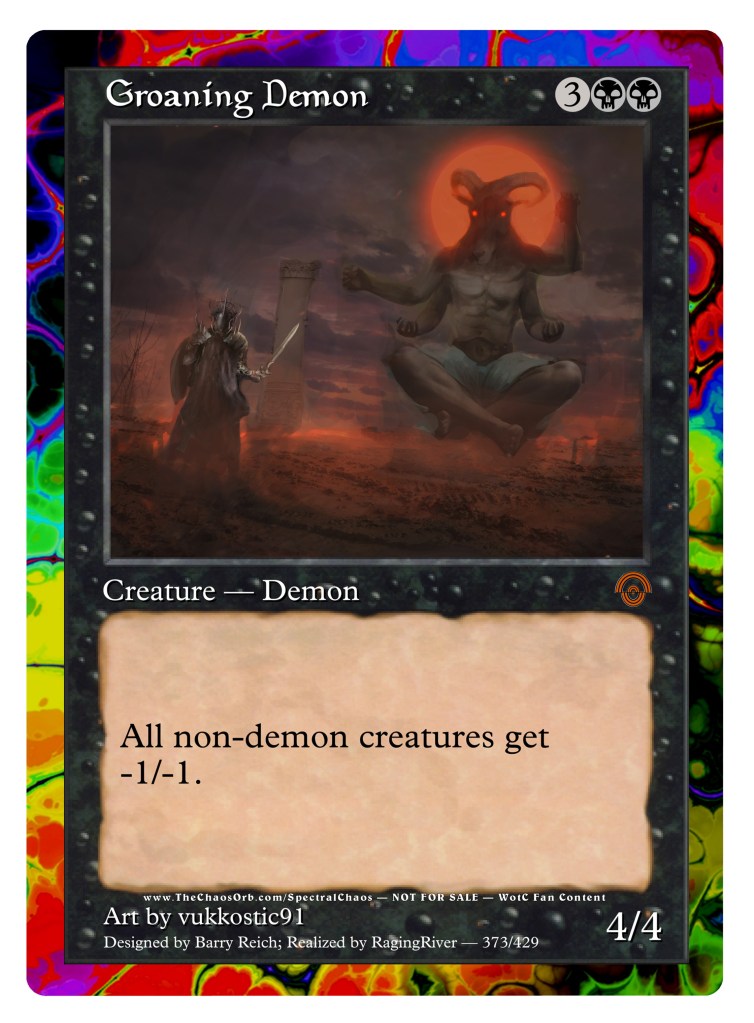
Realized
Groaning Demon – {3}{B}{B}
Creature – Demon
All non-demon creatures get -1/1.
4/4
374 – Horned Devil
(Very Rare Creature (Black))
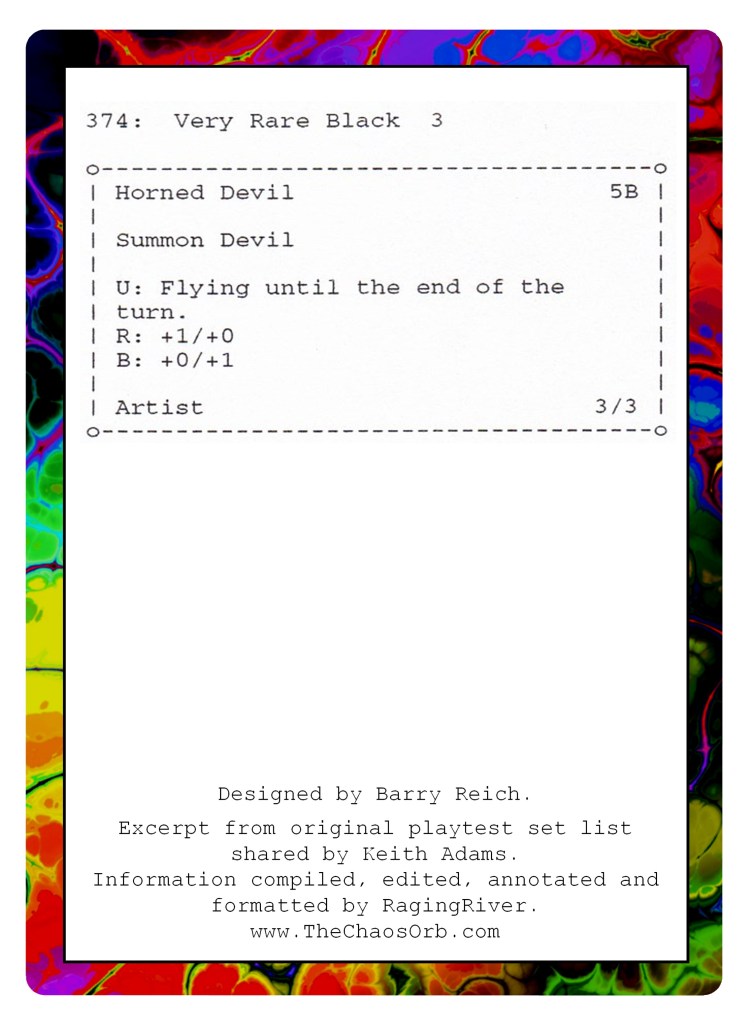
Original Playtest 
Realized
Horned Devil – {5}{B}
Creature – Devil
{U}: Flying until end of turn.
{R}: +1/+0 until end of turn.
{B}: +0/+1 until end of turn.
3/3
375 – Satan’s Reward
(Very Rare Sorcery (Black))

Original Playtest 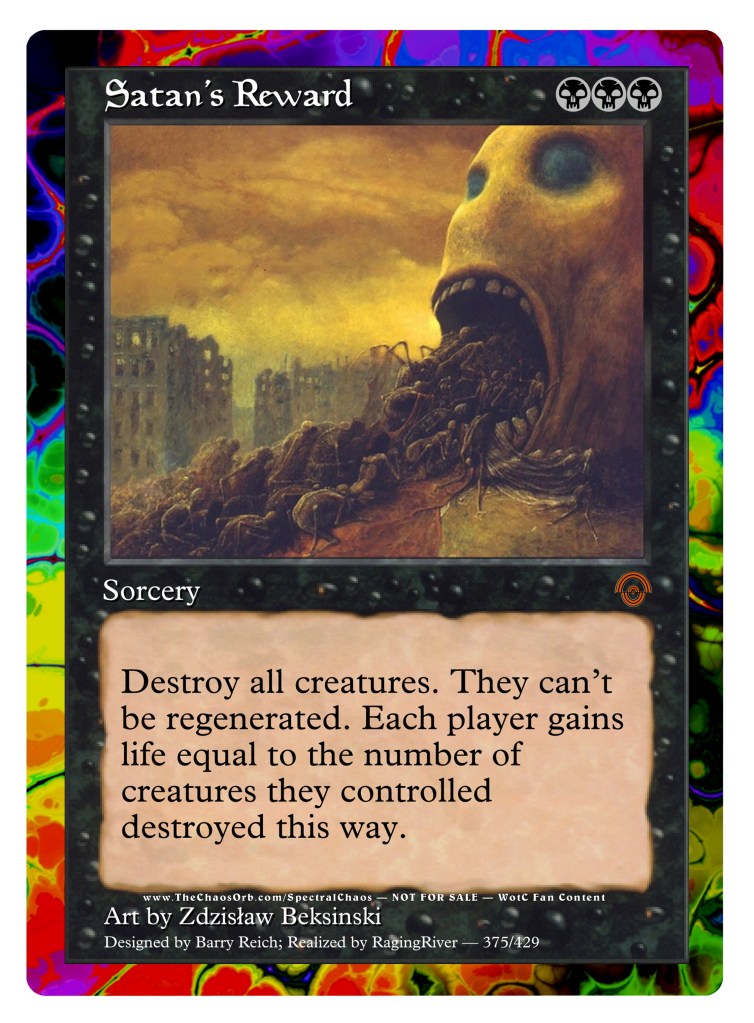
Realized
Satan’s Reward – {B}{B}{B}
Sorcery
Destroy all creatures. They can’t be regenerated. Each player gains life equal to the number of creatures they controlled destroyed this way.
376 – Starvation
(Very Rare Enchantment (Black))
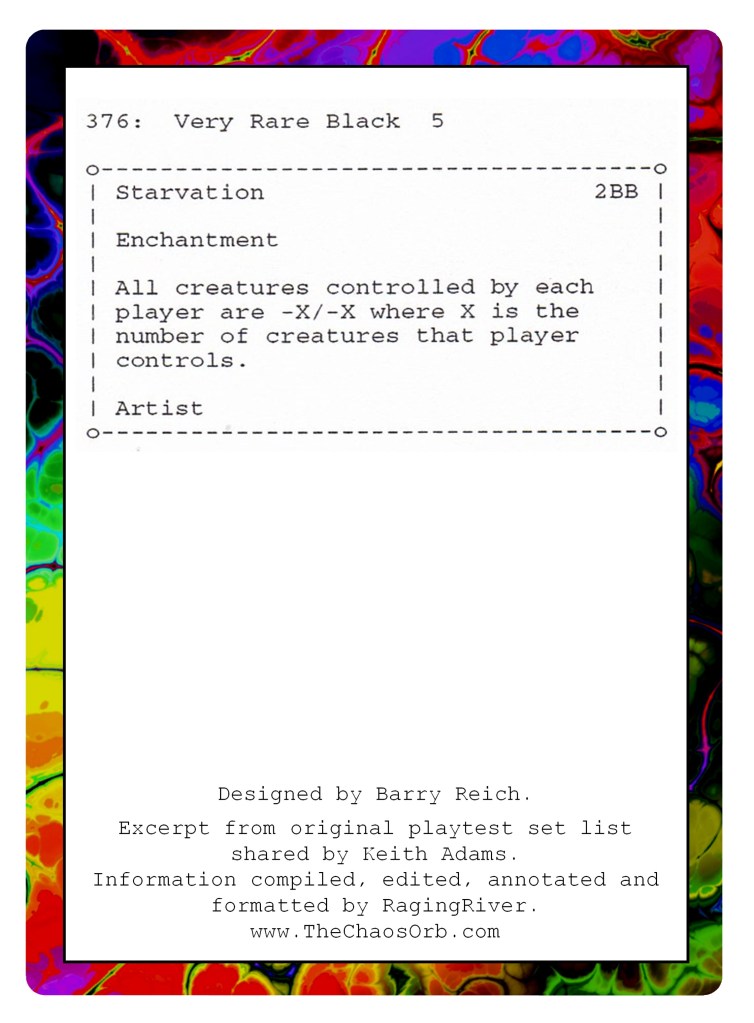
Original Playtest 
Realized
Starvation– {2}{B}{B}
Enchantment
Each creature gets -X/-X, where X is the number of creatures controlled by that creature’s controller.
377 – Elric’s Oath
(Very Rare Enchantment (Black))

Original Playtest 
Realized
Elric’s Oath – {B}{B}{B}{B}
Enchantment
As Elric’s Oath enters the battlefield, you lose life equal to your life total, and draw that many cards.
You have no maximum hand size.
You don’t lose the game for having 0 or less life. You can’t gain life.
Whenever you’re dealt damage, sacrifice that many non-token permanents. If you can’t, you lose the game.
- If there is an effect that prevents you from drawing cards (like Omen Machine) or replaces your draws with some other action (like Chains of Mephistopheles or Uba Mask), you still lose your life.
- You can’t decline to draw the cards. If you don’t have enough cards left in your library to draw them all, you will lose the game. (Remember, Elric’s Oath only says you don’t lose the game for having 0 or less life. You can still lose the game other ways.)
- If you have multiple Elric’s Oath on the battlefield, you must sacrifice a permanent for each damage done to you for each Elric’s Oath.
- If you take more than one damage at a time, sacrifice the permanents for that damage simultaneously. This allows you to sacrifice both a creature and any aura that is on it all at once.
- You can’t pay life, just like any player at less than one life can’t pay life. You can pay zero life if you want.
- If an opponent steals control of Elric’s Oath and no other effect prevents you from losing with a life total of zero, you will lose the game due to a zero life total as a State-Based Action before you can take any actions.
- If an opponent steals control of Elric’s Oath, their life total does not change and they don’t draw any cards. The life total changes for a player only when it enters the battlefield under that player’s control.
- You can lose life and take damage, and thereby have a negative life total, while Elric’s Oath is on the battlefield.
- Elric’s Oath doesn’t have the clause that Lich does which says you lose when it goes to the graveyard from the battlefield. This means that you can survive Elric’s Oath being destroyed…so long as some other game effect continues to keep you alive while you are at 0 or less life.
378 – Liquid Doom
(Very Rare Creature (Multicolor))
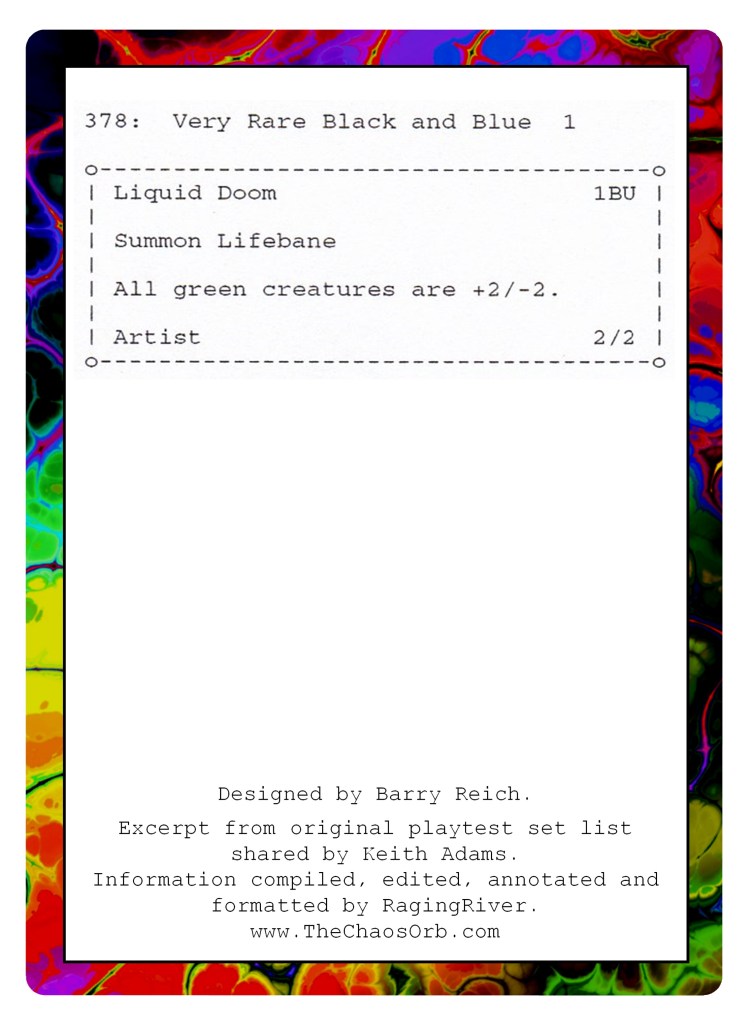
Original Playtest 
Realized
Liquid Doom – {1}{U}{B}
Creature – Nightmare Ooze
All green creatures get +2/-2.
2/2
379 – Thief of Baghdad
(Very Rare Creature (Multicolor))
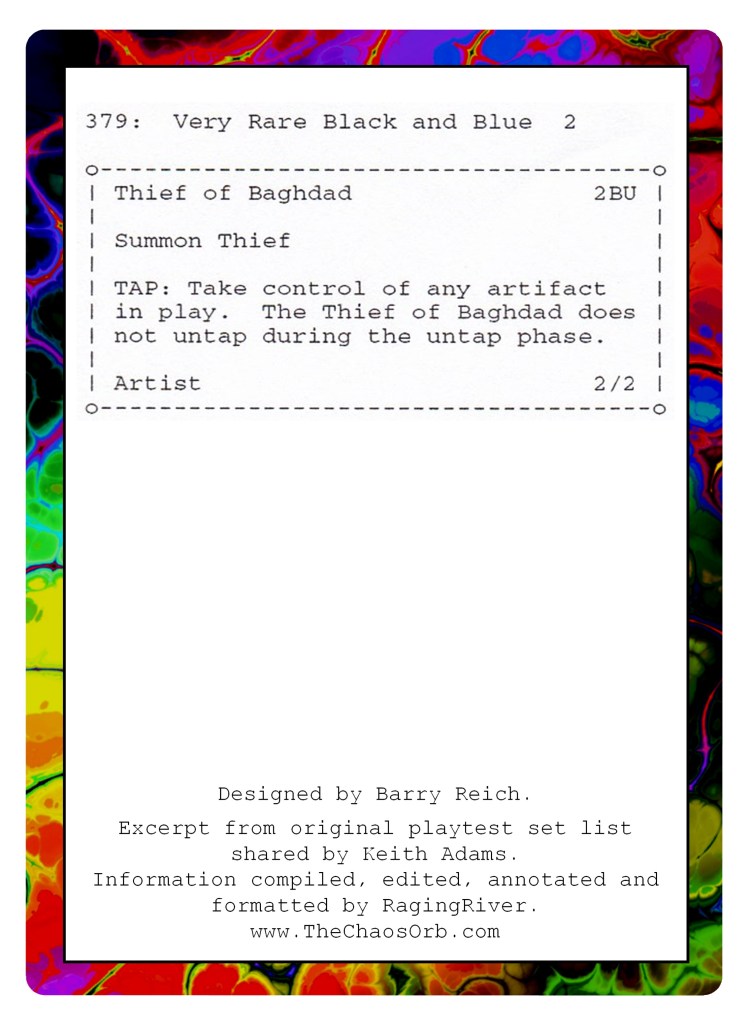
Original Playtest 
Realized
Thief of Baghdad – {2}{U}{B}
Creature – Human Rogue
{T}: Gain control of target artifact. Thief of Baghdad doesn’t untap during your untap step as long as you control that artifact.
2/2
ChaosHistory: This was Barry’s original design, though Aladdin was a similar card from Arabian Nights.
- You gain control of the artifact permanently. You’ll still control the artifact if Thief of Baghdad somehow becomes untapped, but Thief of Baghdad won’t untap during your untap step as long as you control the artifact.
- Thief of Baghdad won’t untap during your untap step as long as you control that artifact, provided the reason you control that artifact is Thief of Baghdad‘s ability. If you later gain control of the same artifact using some other effect, then Thief of Baghdad would resume untapping like normal.
380 – Ice Fiend
(Very Rare Creature (Multicolor))
Original Playtest 
Realized
Ice Fiend – {4}{U}{B}
Snow Creature – Elemental Devil
Trample
Ice Fiend gets +1/+1 for each other creature you control.
Other creatures you control get -1/-1.
3/3
381 – Demon of Air & Darkness
(Very Rare Creature (Multicolor))

Original Playtest 
Realized
Demon of Air & Darkness – {2}{U}{U}{B}{B}
Creature – Demon
Flying
At the beginning of your upkeep, Demon of Air & Darkness deals 3 damage to you.
7/4
382 – Violet Elemental
(Very Rare Creature (Multicolor))
Original Playtest 
Realized
Violet Elemental – {3}{U}{U}{B}{B}
Creature – Elemental
Protection from blue and from black
9/3
ChaosHistory: Each rainbow elemental had a combined power and toughness of 12, starting with Red Elemental‘s 3/9 and ending with Violet Elemental‘s 9/3.
383 – Forbidden Knowledge
(Very Rare Enchantment (Multicolor))
Original Playtest 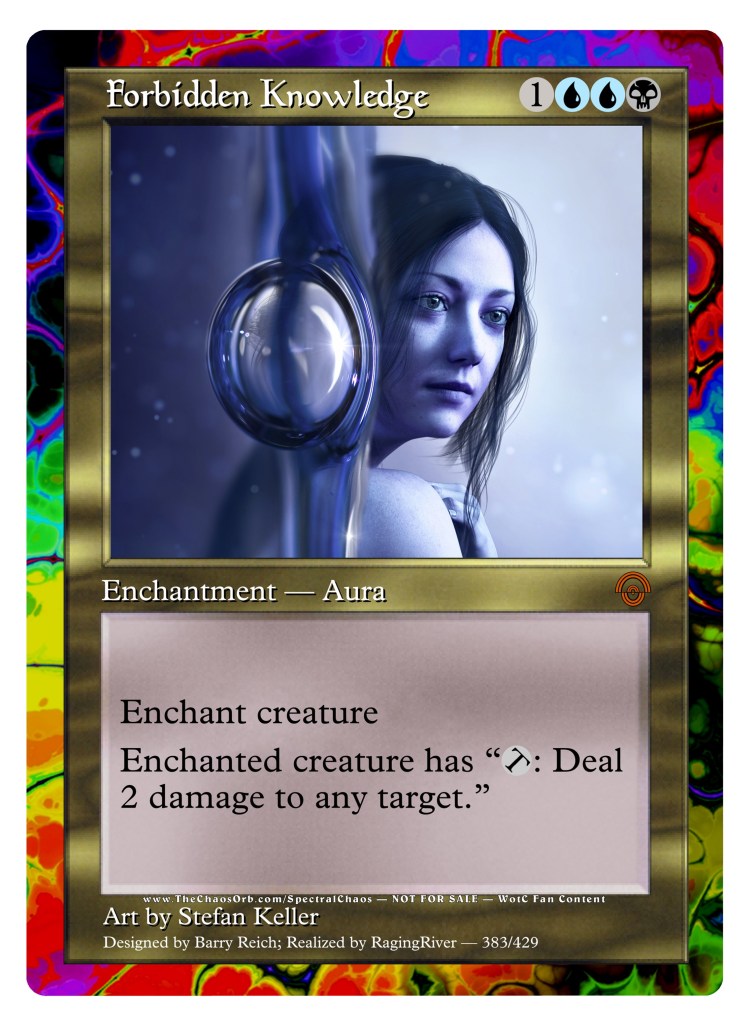
Realized
Forbidden Knowledge – {1}{U}{U}{B}
Enchantment – Aura
Enchant creature
Enchanted creature has “{T}: Deal 2 damage to any target.”
384 – Total Recall
(Very Rare Sorcery (Multicolor))
Original Playtest 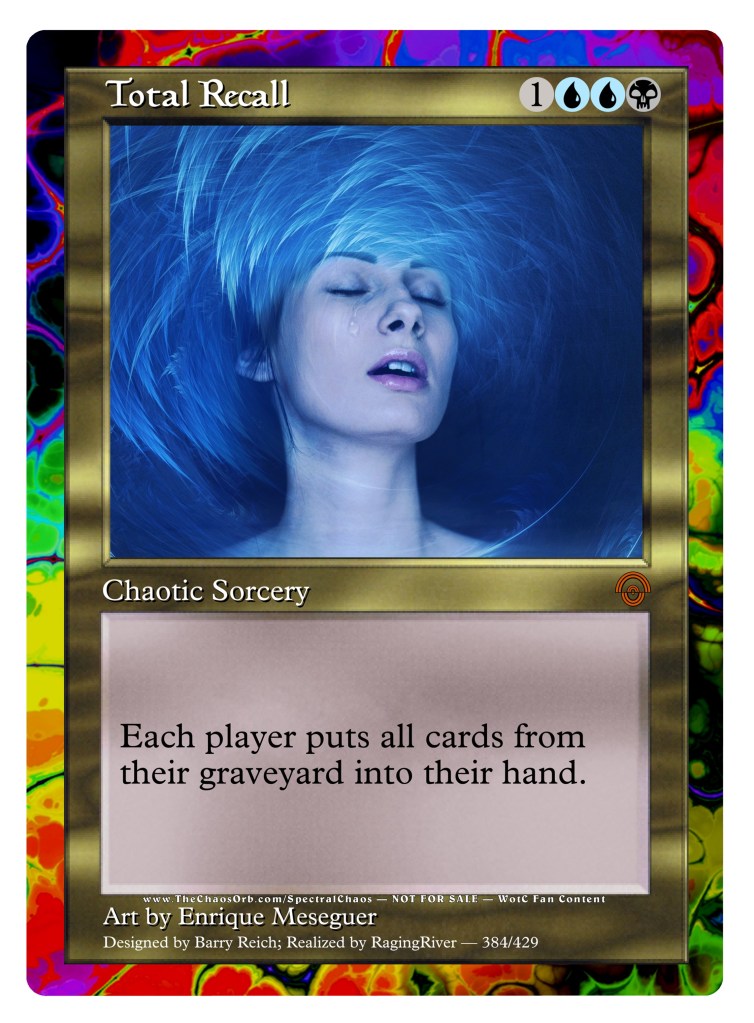
Realized
Total Recall – {1}{U}{U}{B}
Chaotic Sorcery
Each player puts all cards from their graveyard into their hand.
- Cards on the stack as this is resolving aren’t in the graveyard yet, so you won’t get them back. This means Total Recall will end up in your graveyard when it resolves, not back in your hand.
385 – Screeching Meemies
(Very Rare Creature (Multicolor))
Original Playtest 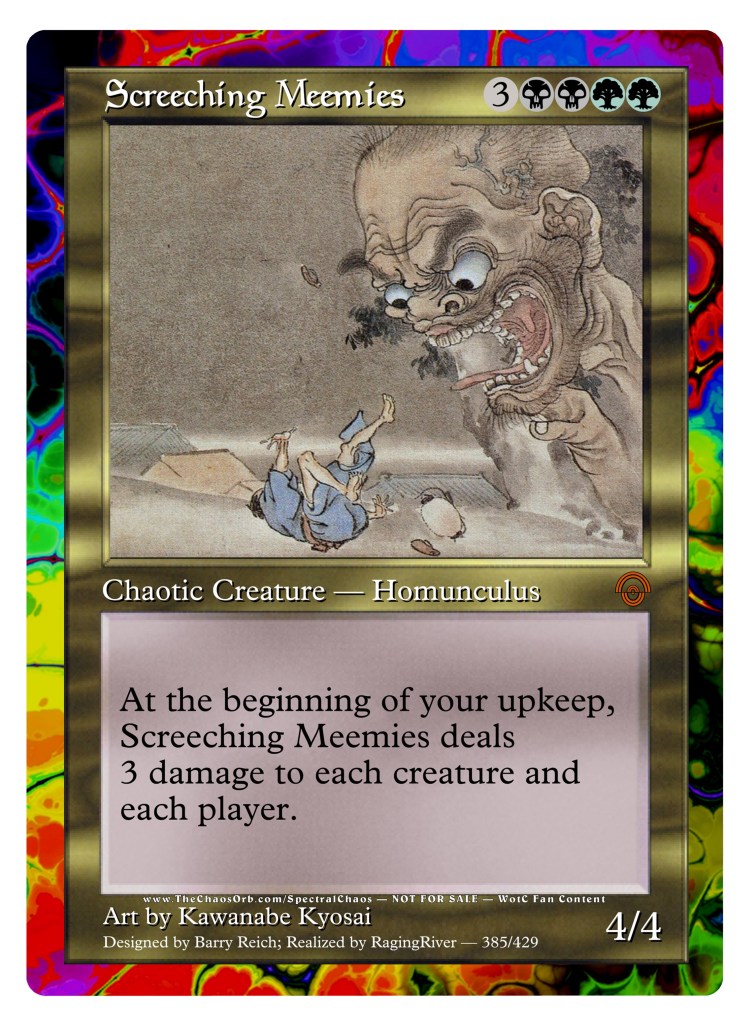
Realized
Screeching Meemies – {3}{B}{B}{G}{G}
Chaotic Creature – Homunculus
At the beginning of your upkeep, Screeching Meemies deals 3 damage to each creature and each player.
4/4
386 – Python
(Very Rare Creature (Multicolor))

Original Playtest 
Realized
Python – {B}{G}{G}
Chaotic Creature – Snake
Whenever Python blocks a creature, tap that creature and put a strangle counter on it, and tap Python. A creature is considered “prey” so long as it has any strangle counters on it. A prey doesn’t untap during its controller’s untap step. Python doesn’t untap during your untap step if any prey are on the battlefield.
At the beginning of your upkeep, add a strangle counter to each prey, then each prey deals damage equal to its power to Python and Python deals damage to each prey equal to Python’s power multiplied by the number of the strangle counters on that prey (the damage is dealt simultaneously).
1/5
- The amount of damage dealt by the second ability is determined based on the power of Python and each prey when that ability resolves. If a creature has negative power, treat it as 0 for this purpose.
- Prey are specific to each Python on the battlefield. If a Python has no prey, it will untap as normal during your untap step, even if a different Python has prey on the battlefield. If two Pythons both manage to somehow have the same prey, keep track of the strangle counters separately. That creature would take damage from (and deal to) each Python separately, when each respective Python‘s second ability resolves.
387 – Graveyard Waltz
(Very Rare Enchantment (Multicolor))
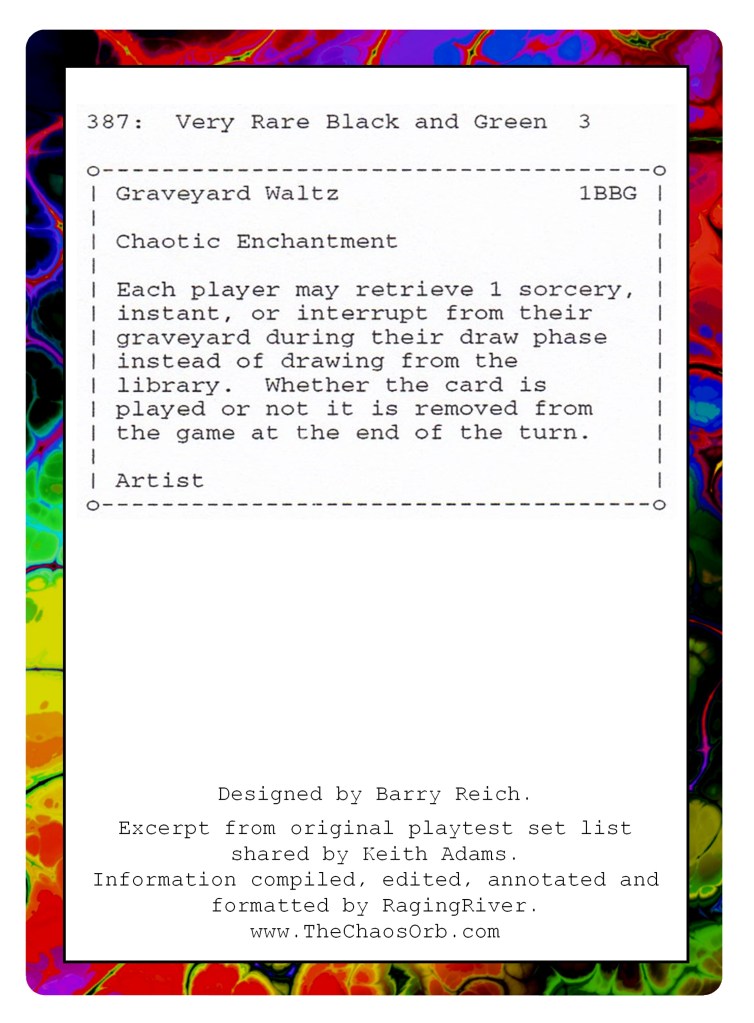
Original Playtest 
Realized
Graveyard Waltz – {1}{B}{B}{G}
Chaotic Enchantment
If a player would draw a card during their draw step and hasn’t used this ability that turn, they may exile target instant or sorcery card from their graveyard instead.
Each player may cast the card they exiled with Graveyard Waltz that turn. If the card is cast this way and would enter a graveyard, exile it instead.
- The first ability is a replacement effect. This means that once the player chooses to replace the draw, they target a card in their graveyard and exile it. Nobody will get priority to respond between the time the card is targeted and when it is exiled. If you wanted to exile a card from a graveyard (for example, with Coffin Purge) to stop a player from targeting it with Graveyard Waltz‘s ability, you would have to do so before the player is supposed to draw a card (i.e. before they replace the draw with Graveyard Waltz‘s effect).
- A player can choose to use this ability to replace any card drawn during their draw step; it doesn’t have to be the natural draw. But only one draw may be replaced this way.
- The player still has to follow normal timing restrictions and pay the mana cost for the card they choose to exile.
388 – Multichannel
(Very Rare Sorcery (Multicolor))
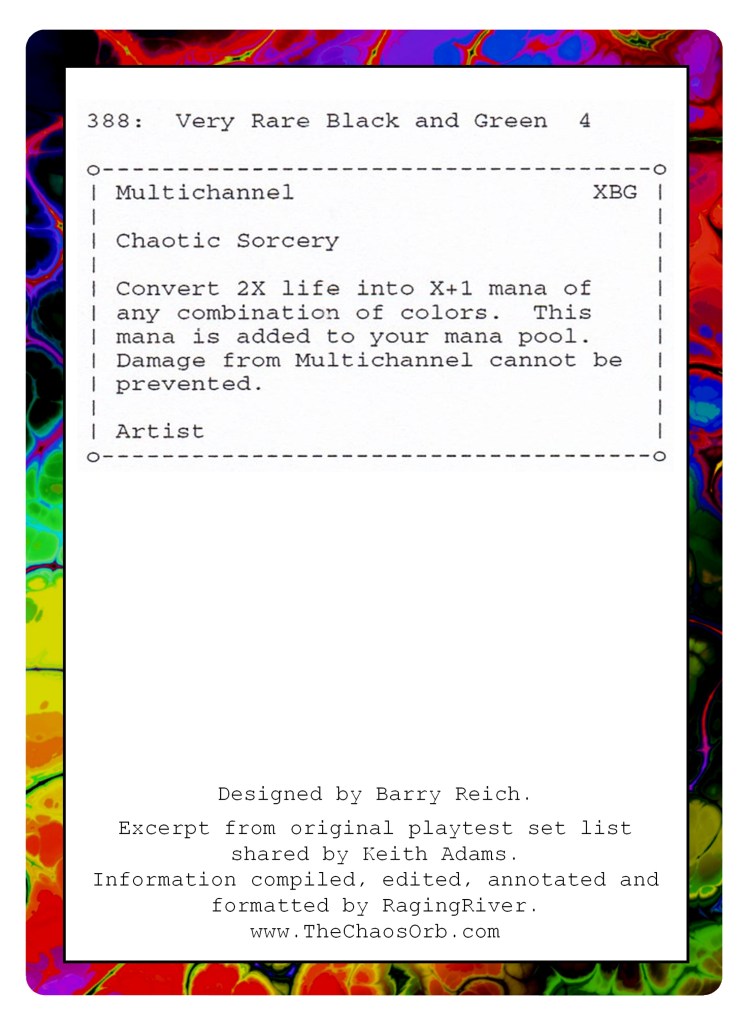
Original Playtest 
Realized
Multichannel – {B}{G}
Chaotic Sorcery
Until end of turn, any time you could activate a mana ability, you may pay 0 life the first time this turn, then 2 life any number of additional times this turn. For each time you do, add 1 mana of any color.
ChaosHistory: A multicolor variant of Alpha’s powerful Channel.
- You can’t pay more life than you have, even if you somehow wouldn’t lose the game for having 0 or less life. You can’t pay 2 life if you only have 1 life left, and you can’t pay any amount of life (other than 0) if you have 0 or less life.
389 – Unnatural Selection
(Very Rare Instant (Multicolor))
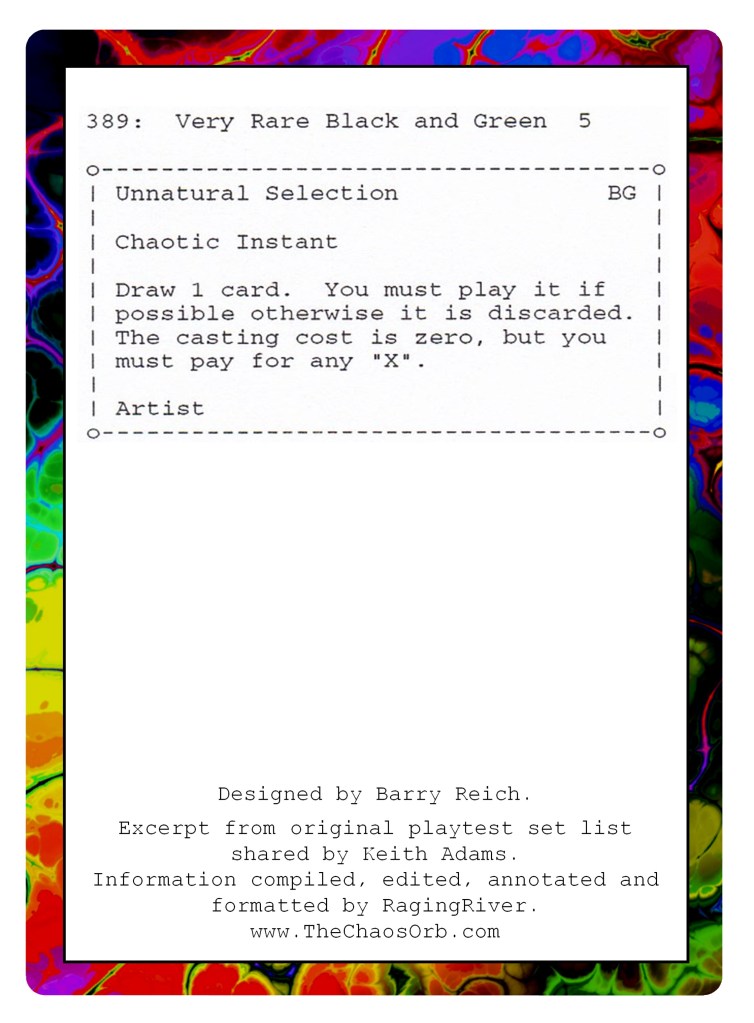
Original Playtest 
Realized
Unnatural Selection – {B}{G}
Chaotic Instant
Reveal the top card of your library. Play that card if possible. If the card is a spell, you may cast it without paying its mana cost. If it is a spell with {X} in its mana cost, you may pay additional mana for {X} when you cast it. If you can’t play it, put that card into your graveyard.
(Note: Rulings last updated March 10, 2021.)
- You ignore normal timing restrictions and must play that card immediately if possible, or put it in your graveyard if you can’t. If the spell requires a target, and no valid targets exist, put it in your graveyard. If the spell can legally be cast (without paying its mana cost), and no additional costs are required, you must cast the spell, even if you don’t like the result. If the spell has different modes or other choices to be made, you must make those choices. For example, if the revealed card is Cryptic Command, and only two modes are legally possible, you must choose those two modes. You can’t make a choice that requires additional costs or targets unless you pay those costs or have those targets available (for example, you can’t declare you want to pay a kicker cost and then fail to pay it). However, you could make choices that result in the spell having no effect for reasons other than invalid targets or a failure to pay additional costs, if you wish. For example, if the revealed card was Breaking & Entering, you could choose to cast Entering even if there are no creature cards in any graveyard (because Entering doesn’t target anything). If the spell requires additional costs in order to be cast (such as Goblin Grenade), you may (but do not have to) pay those additional costs when you cast it.
- If for some reason you want to cast the card by paying its full mana cost, you may still do so.
- If the card that is revealed is a land card and it’s your turn, you can play it only if you haven’t already played a land yet this turn (or you are somehow otherwise permitted to play an additional land). This works even if you’re resolving Unnatural Selection during your turn in a phase that isn’t your main phase. However, you can’t play a land (for any reason) during another player’s turn (see C.R. 305.3), so if you reveal a land card with Unnatural Selection when it isn’t your turn, you’ll have to put it in your graveyard.
390 – Lifebringer
(Very Rare Creature (Green))
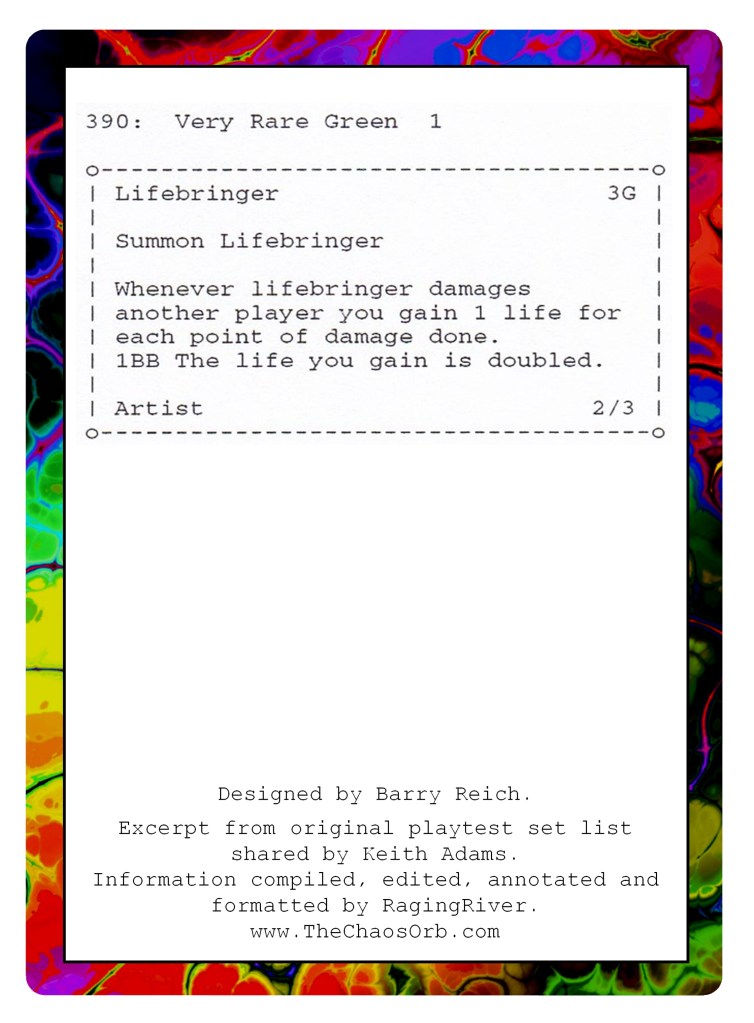
Original Playtest 
Realized
Lifebringer – {3}{G}
Creature – Elf Druid
Whenever Lifebringer deals damage to an opponent, you gain that much life.
{1}{B}{B}: Until end of turn, whenever you would gain life, you gain twice that much life instead. (If you activate this ability multiple times, the effect will multiply each time.)
2/3
391 – Heavy Crossbowman
(Very Rare Creature (Green))
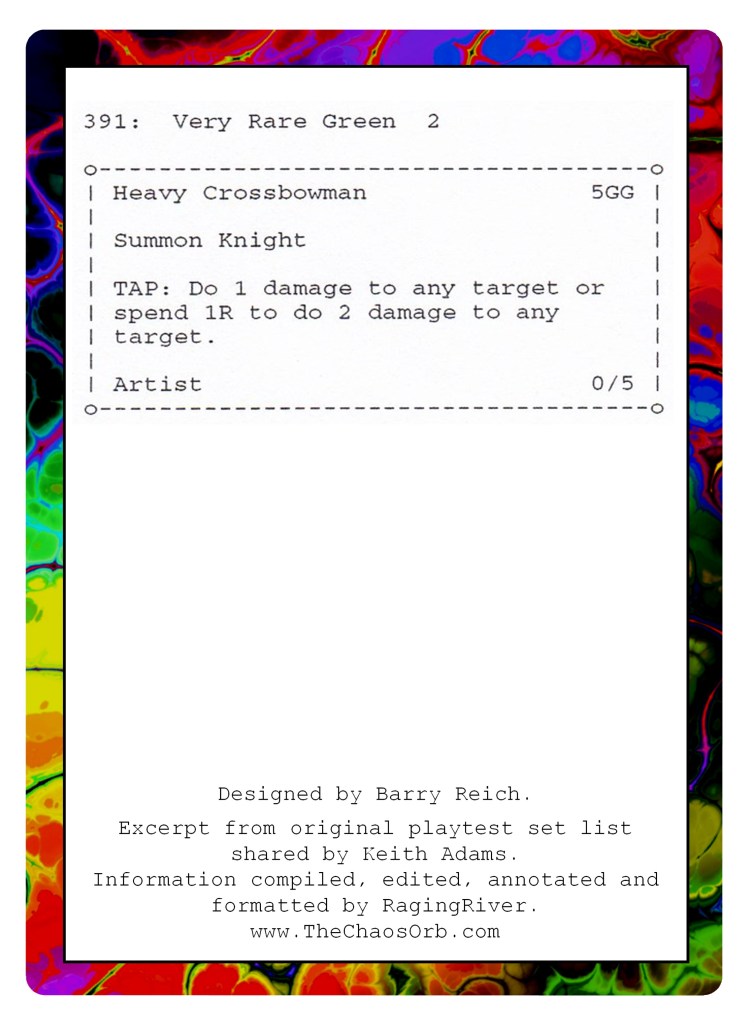
Original Playtest 
Realized
Heavy Crossbowman – {5}{G}{G}
Creature – Human Knight
{T}: Heavy Crossbowan deals 1 damage to any target.
{1}{R}, {T}: Heavy Crossbowman deals 2 damage to any target.
0/5
392 – Green Elemental
(Very Rare Creature (Green))

Original Playtest 
Realized
Green Elemental – {3}{G}{G}{G}{G}
Creature – Elemental
Protection from green
6/6
ChaosHistory: A creature having protection from its own color(s) is a very rare occurence in Magic‘s history.
393 – Mother Nature
(Very Rare Creature (Green))

Original Playtest 
Realized
Mother Nature – {2}{G}{G}{G}{G}
Creature – Elemental Spirit
All other green creatures get +1/+1.
{G}: +1/+0 until end of turn.
0/9
394 – Atlas
(Very Rare Creature (Green))
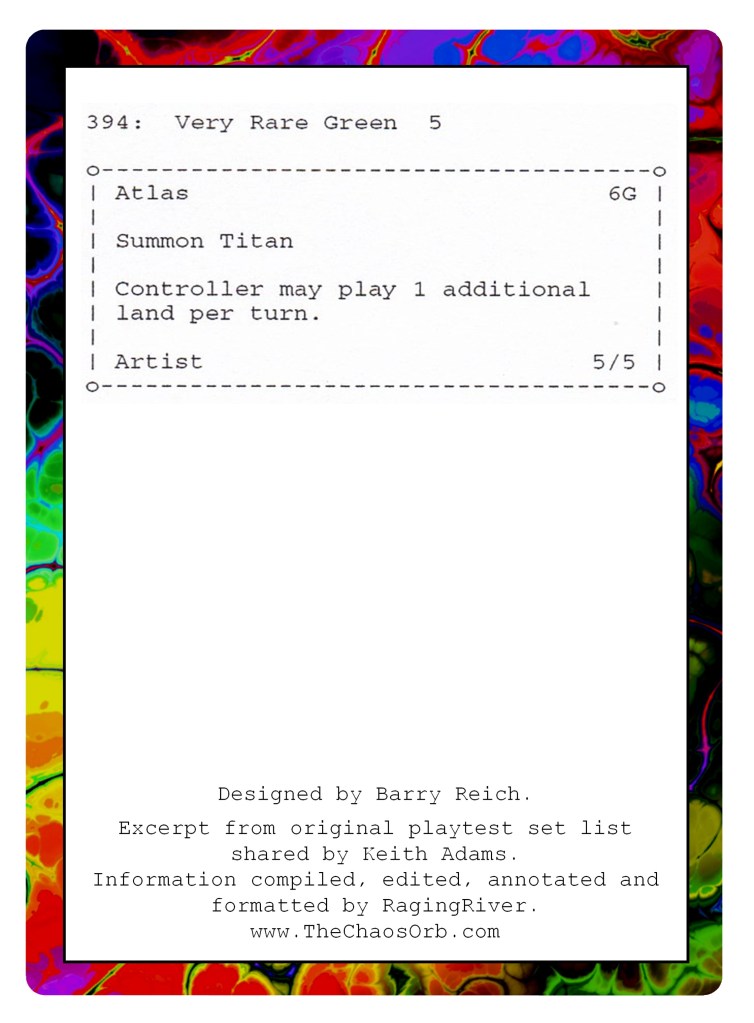
Original Playtest 
Realized
Atlas – {6}{G}
Legendary Creature – Titan
You may plan an additional land on each of your turns.
5/5
395 – Some Enchanted Evening
(Very Rare Enchantment (Green))

Original Playtest 
Realized
Some Enchanted Evening – {2}{G}{G}
Enchantment
Change the text of each enchantment by doubling all numerals and number words in the text. (For example, “+2/+1” becomes “+4/+2,” “pay 1 life” becomes “pay 2 life,” “draw two cards” becomes “draw four cards,” etc. Ignore words like “a” and “the.” This effect doesn’t change values of X, numbers in generic mana symbols, targets already previously chosen, or enchantment spells while they’re on the stack.)
- Always refer to the current oracle wording in determining how to apply Some Enchanted Evening‘s effect. The distinction between text like “one counter” and “one permanent” being doubled, whereas text like “a counter” and “a permanent” is not doubled, does seem somewhat arbitrary, understood. But the implications of doubling words like “a” and “the” are just too far-reaching and too complicated to allow that interpretation.
- The term “number words” for this purpose only refers to cardinals (one, two, six, etc.) and the adverbials (once, twice, six times, etc.). Some Enchanted Evening will not double other variants such as ordinals (first, second, sixth, etc.) or multipliers (single, double, sextuple, etc.). Some Enchanted Evening thus does not double its own text, or any other instance of the word “double.” It won’t change “first strike” into “double strike” (and “quadruple strike” is definitely not a a thing).
- If more than one Some Enchanted Evening is in play, the effect will not multiply. Each enchantment’s text will double only once no matter how many Some Enchanted Evenings are in play. In addition to the prior clarification that multipliers don’t count as “number words” for this purpose, the even simpler reason is because Barry Reich specifically clarified this on his playtested design submission.
- Power and toughness aren’t considered part of the “text” of the card, so the printed power and toughness of enchantment creatures won’t be doubled. However, an enchantment that uses numerals or number words set a creature’s power or toughness (like Humility or Simplicity) will be doubled, thus doubling the resulting power and toughness of the affected creatures.
- It doesn’t really matter how an aura is worded: it might contain a number directly in its effect text (like Holy Strength) or it might instead say that the thing it’s enchanting now has certain text containing a number (like Claim of Erebos); either way, the numbers or number words appear in the enchantment’s text and thus will be doubled. For example, for Decomposition, “Cumulative Upkeep-Pay 1 Life” would become “Cumulative upkeep-Pay 2 life” and also, when the enchanted creature dies, its controller would lose 4 life instead of 2 life.
- Although this won’t change the converted mana cost of anything, it will double references to converted mana costs in the text of an enchantment (such as Aluren).
396 – Tinkerer
(Very Rare Creature (Green))

Original Playtest 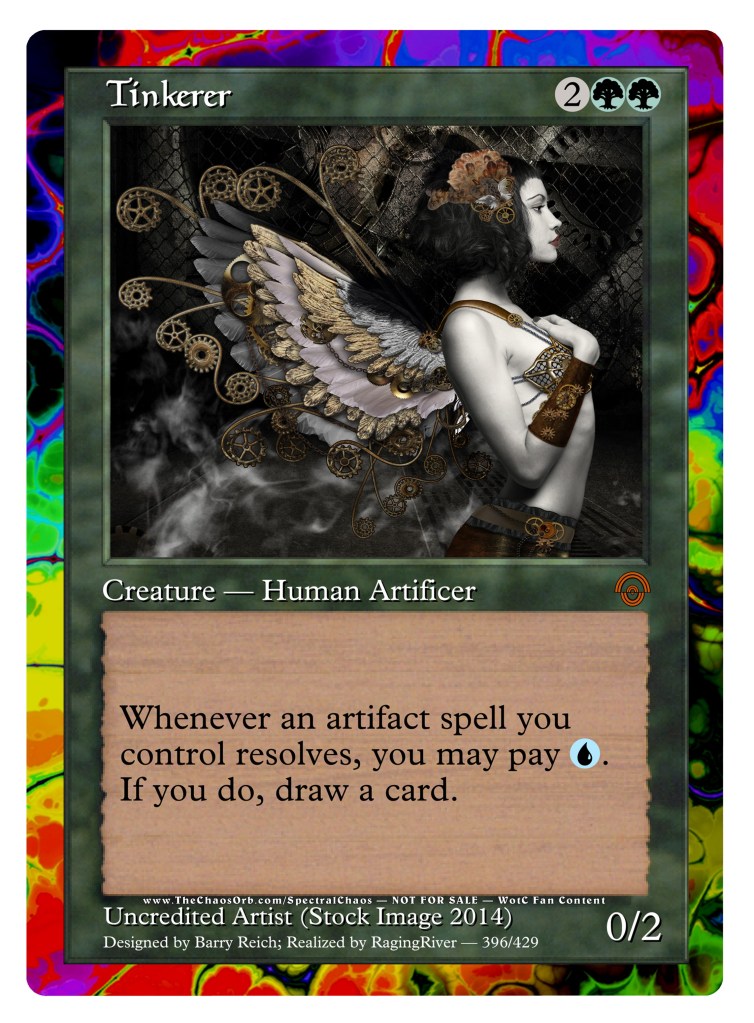
Realized
Tinkerer – {2}{G}{G}
Creature – Human Artificer
Whenever an artifact spell you control resolves, you may pay {U}. If you do, draw a card.
0/2
- You choose whether to pay {U} (and, if you do, you’ll draw a card) after the artifact spell finishes resolving, but before that artifact enters the battlefield. Basically, this trigger will go onto the stack after all “cast” triggers have resolved, but before any “enters the battlefield” triggers are placed on the stack. This is weird, but it’s the closest way to approximate the original wording of the playtest card, which was based on when you “successfully cast an artifact.” The concept of a spell being “successfully cast” is a relic of the pre-5th edition rules, during the era of interrupts and spells resolving in “batches.” Essentially, “successfully cast” meant the spell hadn’t been countered (and there was no remaining way it could be countered), but it hadn’t resolved yet. There’s not a perfect way to recreate this concept in the wording of modern rules. Most cards originally written this way were errata’d to simply trigger upon being “cast,” but I chose to instead word it as triggering upon resolution, as this will more closely recreate how this would have worked under the pre-5th edition rules in most circumstances.
- As long as Tinkerer was on the battlefield when that artifact spell started resolving, Tinkerer‘s ability will still trigger (and you’ll still be able to pay {U} to draw a card) when that spell finishes resolving even if Tinkerer is no longer on the battlefield (for example, if Tinkerer was destroyed as part of resolving that artifact spell).
397 – Lifestealer
(Very Rare Creature (Green))

Original Playtest 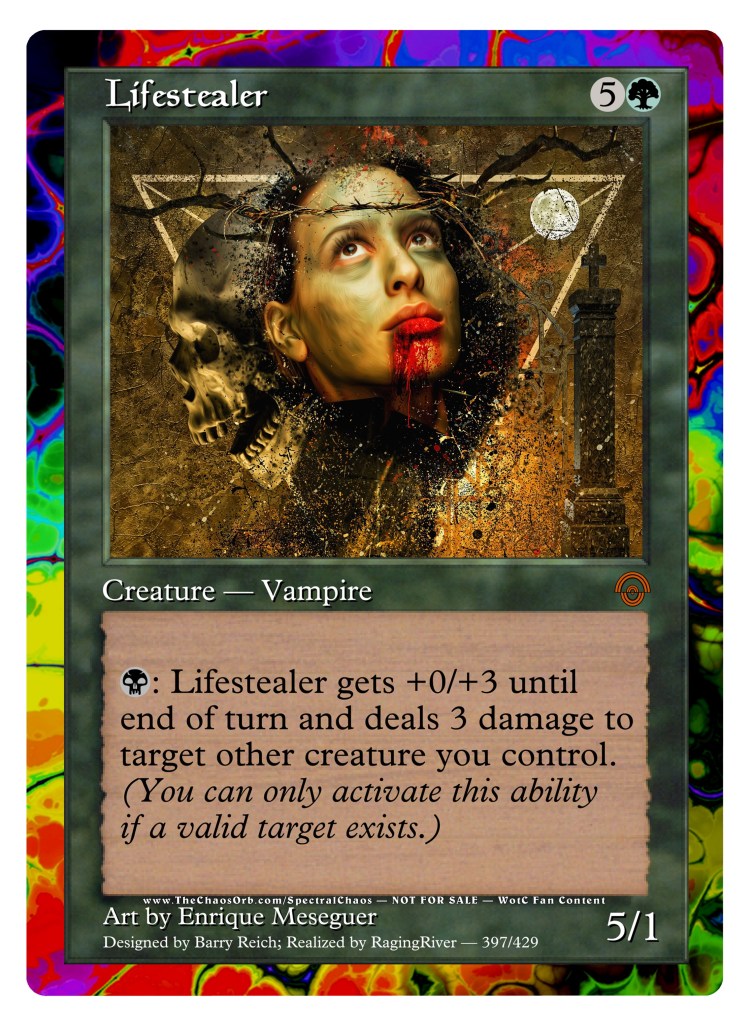
Realized
Lifestealer – {5}{G}
Creature – Vampire
{B}: Lifestealer gets +0/+3 until end of turn and deals 3 damage to target other creature you control. (You can only activate this ability if a valid target exists.)
5/1
- You can maintain priority and use Lifestealer‘s ability and target any of your other creatures as many times as you wish, even if the resulting damage will be far more than lethal to those creatures once all those activated abilities finally resolve.
- Lifestealer will get +0/+3 when the ability resolves, even if the damage to the target creature was reduced or prevented somehow.
398 – Moorish General
(Very Rare Creature (Multicolor))

Original Playtest 
Realized
Moorish General – {3}{R}{R}{G}{G}
Creature – Human Knight Lord
All knights get +1/+1.
As long as you control at least two plains, Moorish General has banding.
3/4
399 – Fiery Shrub
(Very Rare Creature (Multicolor))

Original Playtest 
Realized
Fiery Shrub – {1}{R}{G}
Creature – Plant
All blue creatures get -2/+1.
2/2
400 – Orange Elemental
(Very Rare Creature (Multicolor))

Original Playtest 
Realized
Orange Elemental – {3}{R}{R}{G}{G}
Creature – Elemental
Protection from red and from green
4/8
ChaosHistory: Each of the rainbow elementals had protection from its own color(s).
401 – Mind Twister
(Very Rare Sorcery (Multicolor))

Original Playtest 
Realized
Mind Twister – {2}{G}{U}
Chaotic Sorcery
Randomly assign control of all non-enchanted creatures, and tap them. (Exile all non-enchanted creatures face down, shuffle them, then deal each player the same number of cards as creatures they controlled that were exiled this way. Then reveal those creatures and tap them. They are not treated as entering the battlefield.)
- If a creature was face down or otherwise hidden before, Mind Twister won’t change that.
- The creatures aren’t considered to have left the battlefield or entered the battlefield at any point during resolution of Mind Twister.
- “Non-enchanted creatures” includes enchantment creatures, so long as they don’t have any auras on them.
402 – Simplicity
(Very Rare Enchantment (Multicolor))

Original Playtest 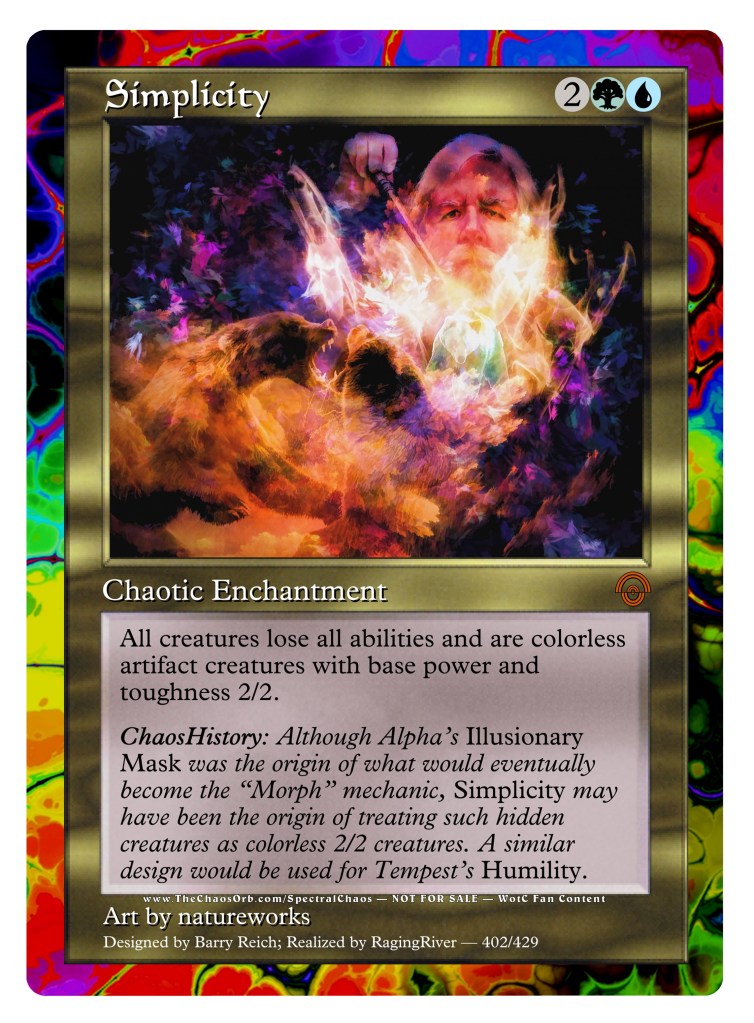
Realized
Simplicity – {2}{G}{U}
Chaotic Enchantment
All creatures lose all abilities and are colorless artifact creatures with base power and toughness 2/2.
ChaosHistory: Although Alpha’s Illusionary Mask was the origin of what would eventually become the “Morph” mechanic, Simplicity may have been the origin of treating such hidden creatures as colorless 2/2 creatures. A similar design would be used for Tempest’s Humility.
- Removes all creature abilities. This includes mana abilities. Animated lands will also lose the ability to tap for mana.
- If a permanent is or becomes a creature only until end of turn (such as Mishra’s Factory), Simplicity doesn’t change that. It will lose all its abilities while it’s a creature, but then it will have all its abilities again once it stops being a creature at the end of turn.
- You apply power/toughness changing effects in Layer 7. This card’s effect is always applied in sublayer 7b, which means that effects applied in later sublayers will not be overwritten; they will be applied to the new value. If you get into a complicated layers situation (such as with Opalescence, Humility and Simplicity all in play at the same time), take a tylenol and figure it out using rulings for Humility as a guide.
403 – Stream of Consciousness
(Very Rare Enchantment (Multicolor))
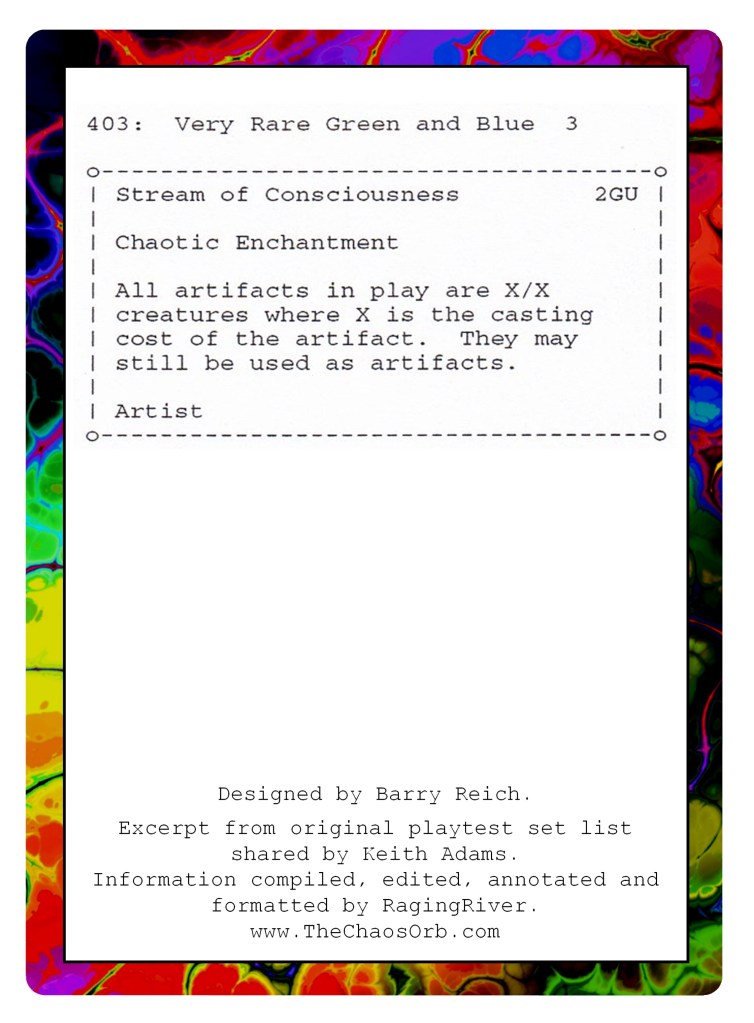
Original Playtest 
Realized
Stream of Consciousness – {2}{G}{U}
Chaotic Enchantment
Each artifact is an artifact creature with base power and toughness each equal to its converted mana cost. (This includes artifacts that were already creatures. The artifacts retain their abilities.)
ChaosHistory: A similar design appeared in Antiquities as Titania’s Song.
- An equipment that becomes a creature can’t be attached to a creature. Its other (non-equip) abilities would continue to apply.
- Artifacts that were already creatures have base power and toughness each equal to their converted mana cost. Abilities that set an artifact creature’s base power and toughness (like Beast of Burden) would no longer apply, but abilities that affect its power or toughness (like Otarian Juggernaut) would continue to apply.
404 – Manipulation
(Very Rare Sorcery (Multicolor))

Original Playtest 
Realized
Manipulation – {1}{G}{G}{U}{U}
Chaotic Sorcery
For each aura attached to a creature, you may attach that aura to another creature controlled by the same player. (Control of the auras doesn’t change.)
- For each aura, you can either leave it unchanged or attach it to another creature controlled by the same player that controls that enchanted creature. Manipulation cares about who controls the creatures, not who controls the aura. You can’t choose to attach an aura to nothing. You may move each aura exactly once as part of resolving Manipulation.
- You may rearrange any auras, including an aura with hexproof or shroud, because you aren’t targeting the auras.
- This doesn’t target any creatures, so you can attach auras to creatures with hexproof or shroud. However, you can only attach an aura if it’s legal to do so. So for example, you can’t move a red aura onto a creature that has protection from red.
- Moving all the auras is done in whichever order you desire, all as part of resolving Manipulation. Anything that triggers during the resolution of this will wait to be put on the stack until you finish rearranging auras and resolution is complete. When Manipulation has finished resolving, you will put all of your triggered abilities on the stack in any order, then each other player in turn order will do the same with any triggered abilities that they control that triggered during Manipulation‘s resolution. (The last ability put on the stack will be the first one that resolves.)
405 – Lifegeyser
(Very Rare Sorcery (Multicolor))
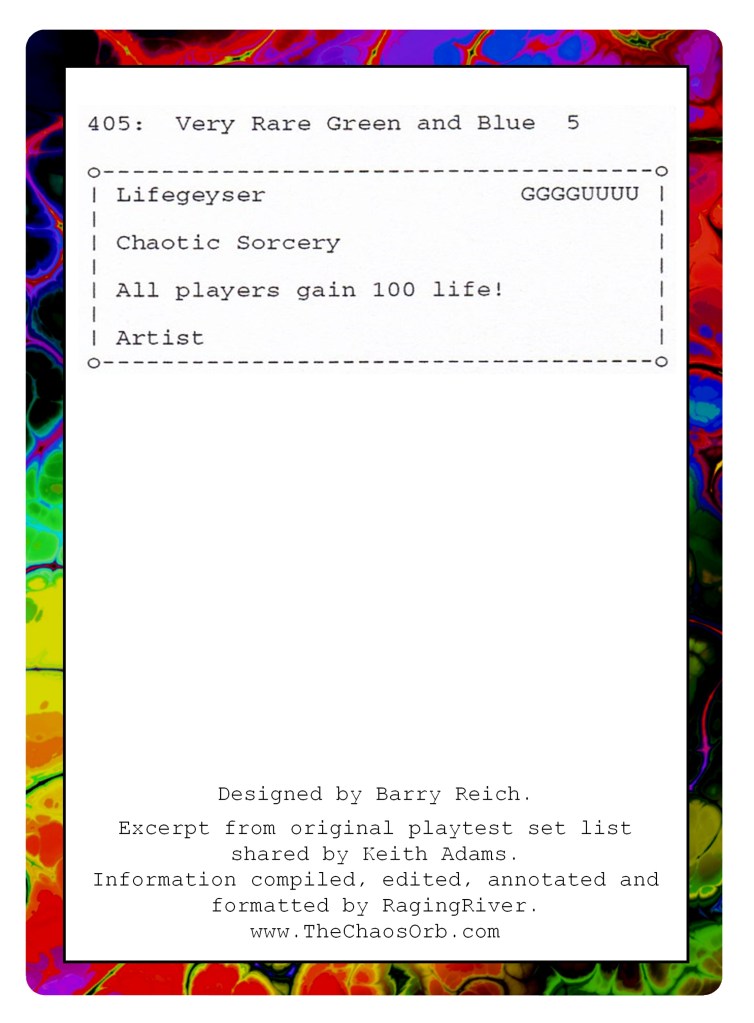
Original Playtest 
Realized
Lifegeyser – {G}{G}{G}{G}{U}{U}{U}{U}
Chaotic Sorcery
Each player gains 100 life!
ChaosHistory: Yes, the exclamation point was actually part of the original card text.
406 – Sheherazad
(Very Rare Sorcery (Multicolor))
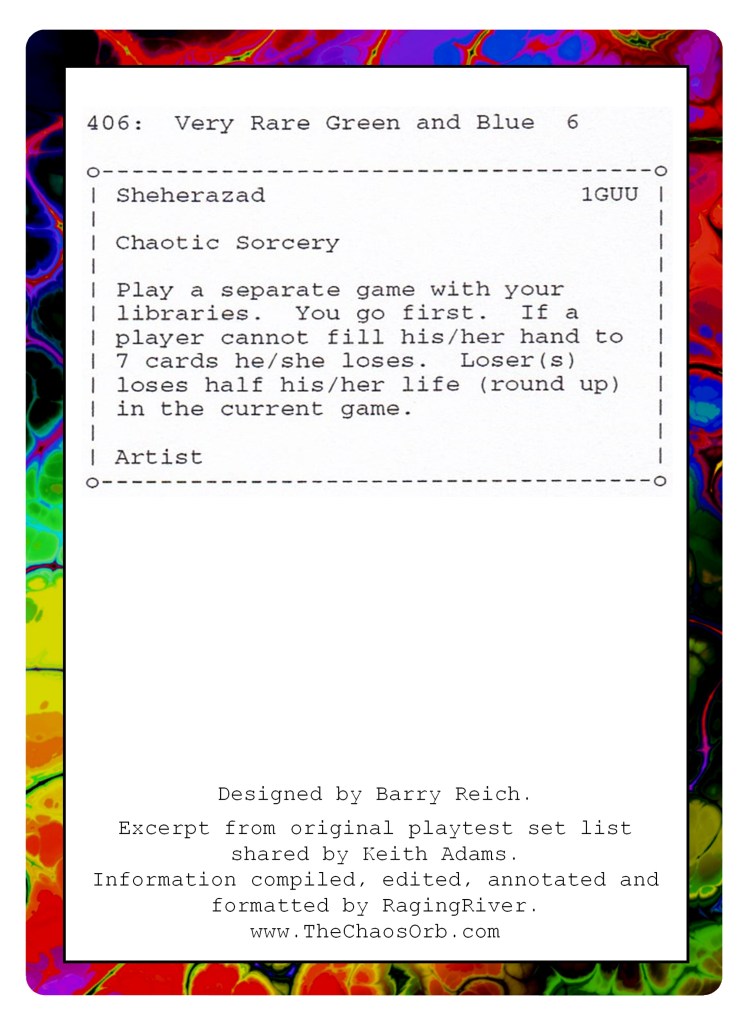
Original Playtest 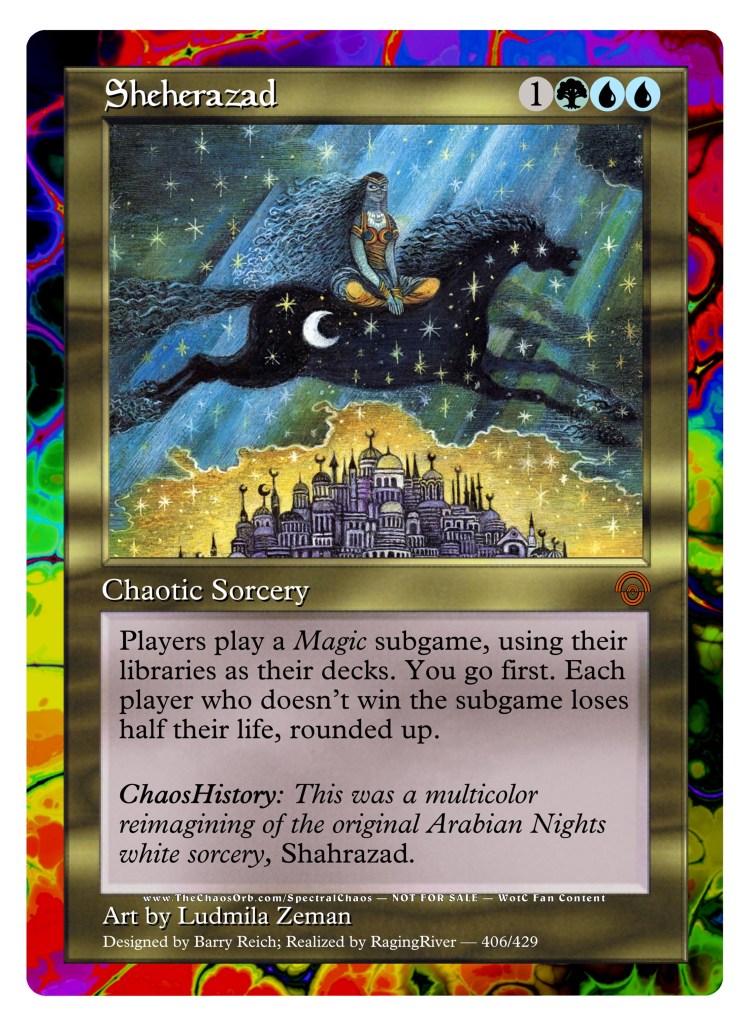
Realized
Sheherazad – {1}{G}{U}{U}
Chaotic Sorcery
Players play a Magic subgame, using their libraries as their decks. You go first. Each player who doesn’t win the subgame loses half their life, rounded up.
ChaosHistory: This was a multicolor reimagining of the original Arabian Nights white sorcery, Shahrazad.
- Play this card exactly the same as Arabian Nights’ Shahrazad, with the only difference being that you play first in the subgame (instead of choosing randomly who plays first).
407 – Psychic Storm
(Very Rare Sorcery (Multicolor))

Original Playtest 
Realized
Psychic Storm – {1}{G}{G}{U}{U}
Chaotic Sorcery
Each player sacrifices half the permanents they control, rounded up. (You choose what to sacrifice first, then continue in turn order. Then everything is sacrificed simultaneously.)
408 – Mox Diamond
(Very Rare Artifact)

Original Playtest 
Realized
Mox Diamond – {0}
Chaotic Artifact
{T}: Add one-half mana of any color. (One-half unused mana deals one mana burn. Combining two half-mana of different colors results in one colorless mana.)
{3}: Untap Mox Diamond.
ChaosHistory: No relation to the powerful card of the same name released in Stronghold, Barry Reich was the first to experiment with half-mana, a concept eventually released in the casual set Unhinged.
409 – Moonstone
(Very Rare Artifact)
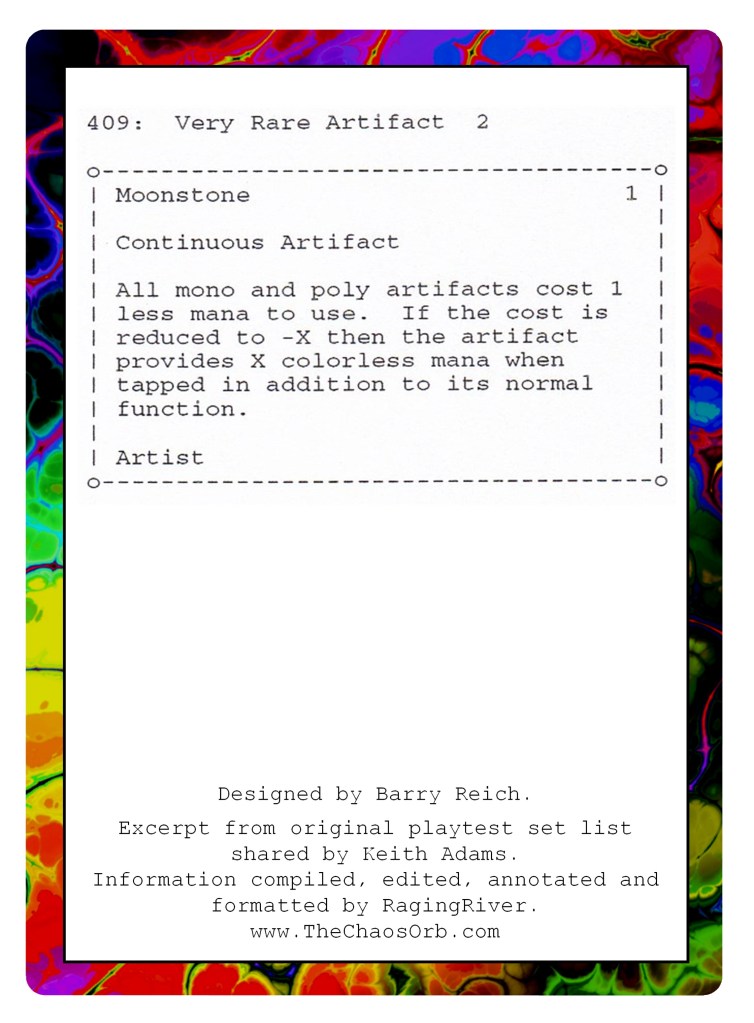
Original Playtest 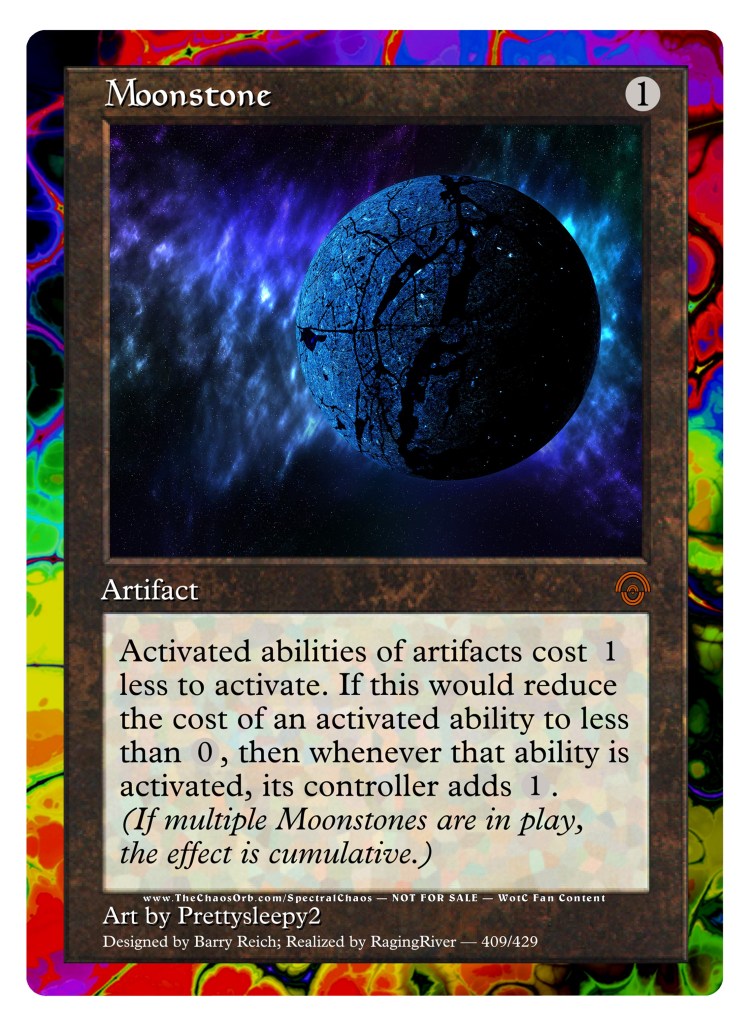
Realized
Moonstone – {1}
Artifact
Activated abilities of artifacts cost {1} less to activate. If this would reduce the cost of an activated ability to less than {0}, then whenever that ability is activated, its controller adds {1}. (If multiple Moonstones are in play, the effect is cumulative.)
- This will reduce artifact abilities that cost {1} down to {0}. If an ability costs {0} and doesn’t require the artifact to tap, then yes, this means the artifact’s controller could activate it as many times as they wish.
- This will reduce artifact abilities that cost {0} down to {-1}. This means that each time the ability is activated, its controller will add {1}. If two Moonstones are in play, then any artifact ability that costs {0} will be reduced to {-2} and the artifact’s controller will add {2} each time it is activated. This isn’t optional; the player cannot decline to add the mana to their mana pool.
- Because of how Rule 605.1b works, this triggered ability may or may not count as a mana ability. If the ability of the underlying artifact was an activated mana ability (such as Sol Ring), then the addition of mana by Moonstone would count as a mana ability. But if the ability of the underlying artifact wasn’t an activated mana ability (such as Tormod’s Crypt), then the addition of mana by Moonstone isn’t a mana ability.
410 – Thought Stone
(Very Rare Artifact)
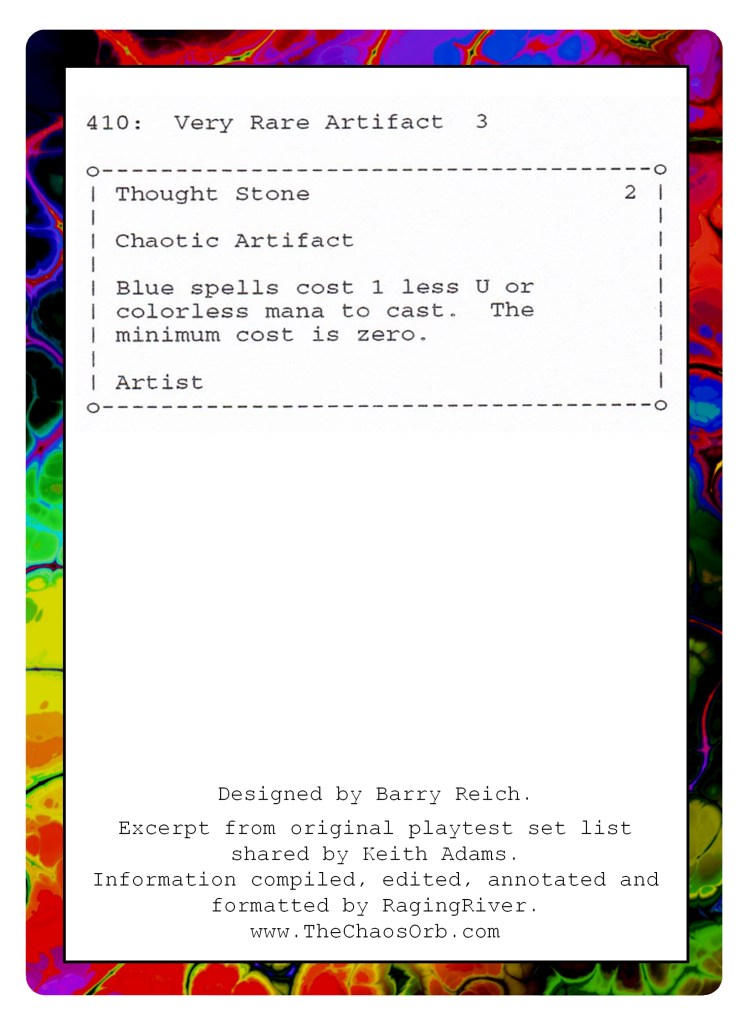
Original Playtest 
Realized
Thought Stone – {2}
Chaotic Artifact
Blue spells cost {1} less or {U} less.
ChaosHistory: The original design for what would become Tempest’s Sapphire Medallion.
- The caster of the spell can choose whether to reduce the colored mana or generic mana portion of the mana cost.
- Only the casting cost is reduced this way. If a spell has additional optional mana costs, those costs aren’t reduced.
- If a blue spell has a casting cost of only one mana, this means the spell costs {0} to cast. If you have multiple Thought Stones in play, the effect is cumulative, but in all events, the reduction from Thought Stone can’t reduce the cost of a spell to less than {0}.
411 – Earth Stone
(Very Rare Artifact)
Original Playtest 
Realized
Earth Stone – {2}
Chaotic Artifact
Red spells cost {1} less or {R} less.
ChaosHistory: The original design for what would become Tempest’s Ruby Medallion.
- The caster of the spell can choose whether to reduce the colored mana or generic mana portion of the mana cost.
- Only the casting cost is reduced this way. If a spell has additional optional mana costs, those costs aren’t reduced.
- If a red spell has a casting cost of only one mana, this means the spell costs {0} to cast. If you have multiple Earth Stones in play, the effect is cumulative, but in all events, the reduction from Earth Stone can’t reduce the cost of a spell to less than {0}.
412 – Pure Stone
(Very Rare Artifact)
Original Playtest 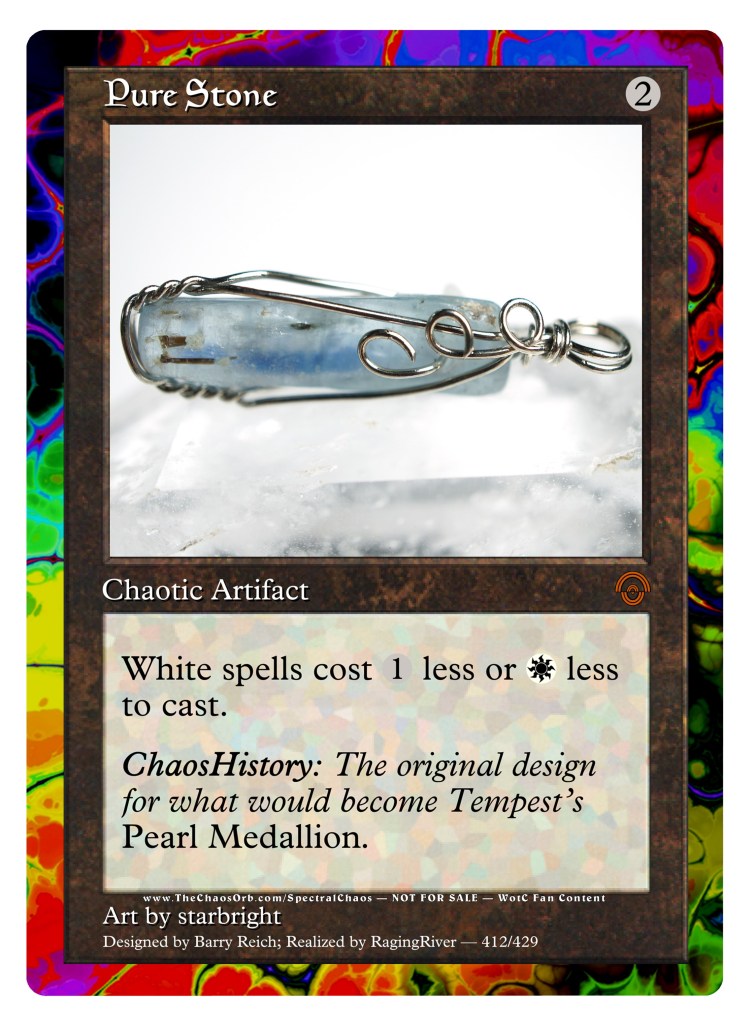
Realized
Pure Stone – {2}
Chaotic Artifact
White spells cost {1} less or {W} less.
ChaosHistory: The original design for what would become Tempest’s Pearl Medallion.
- The caster of the spell can choose whether to reduce the colored mana or generic mana portion of the mana cost.
- Only the casting cost is reduced this way. If a spell has additional optional mana costs, those costs aren’t reduced.
- If a white spell has a casting cost of only one mana, this means the spell costs {0} to cast. If you have multiple Pure Stones in play, the effect is cumulative, but in all events, the reduction from Pure Stone can’t reduce the cost of a spell to less than {0}.
413 – Death Stone
(Very Rare Artifact)
Original Playtest 
Realized
Death Stone – {2}
Chaotic Artifact
Black spells cost {1} less or {B} less.
ChaosHistory: The original design for what would become Tempest’s Jet Medallion.
- The caster of the spell can choose whether to reduce the colored mana or generic mana portion of the mana cost.
- Only the casting cost is reduced this way. If a spell has additional optional mana costs, those costs aren’t reduced.
- If a black spell has a casting cost of only one mana, this means the spell costs {0} to cast. If you have multiple Death Stones in play, the effect is cumulative, but in all events, the reduction from Death Stone can’t reduce the cost of a spell to less than {0}.
414 – Life Stone
(Very Rare Artifact)

Original Playtest 
Realized
Life Stone – {2}
Chaotic Artifact
Green spells cost {1} less or {G} less.
ChaosHistory: The original design for what would become Tempest’s Emerald Medallion.
- The caster of the spell can choose whether to reduce the colored mana or generic mana portion of the mana cost.
- Only the casting cost is reduced this way. If a spell has additional optional mana costs, those costs aren’t reduced.
- If a green spell has a casting cost of only one mana, this means the spell costs {0} to cast. If you have multiple Life Stones in play, the effect is cumulative, but in all events, the reduction from Life Stone can’t reduce the cost of a spell to less than {0}.
415 – Ring of Undoing
(Very Rare Artifact)

Original Playtest 
Realized
Ring of Undoing – {2}
Chaotic Artifact
{T}, sacrifice Ring of Undoing: Return two target other permanents you own to your hand. You can’t activate this ability during the combat phase.
(Note: Text updated Feb. 2, 2021.)
- It doesn’t matter whether you control the permanents or not. You can target any permanents you own.
- You have to target two valid permanents in order to activate the ability. If one of those targets is no longer on the battlefield when the ability resolves, the other one will still be returned to your hand.
416 – Symbol of Pain
(Very Rare Artifact)

Original Playtest 
Realized
Symbol of Pain – {4}
Artifact
{1}, {T}: Symbol of Pain deals 1 damage to each opponent.
417 – Symbol of Power
(Very Rare Artifact)

Original Playtest 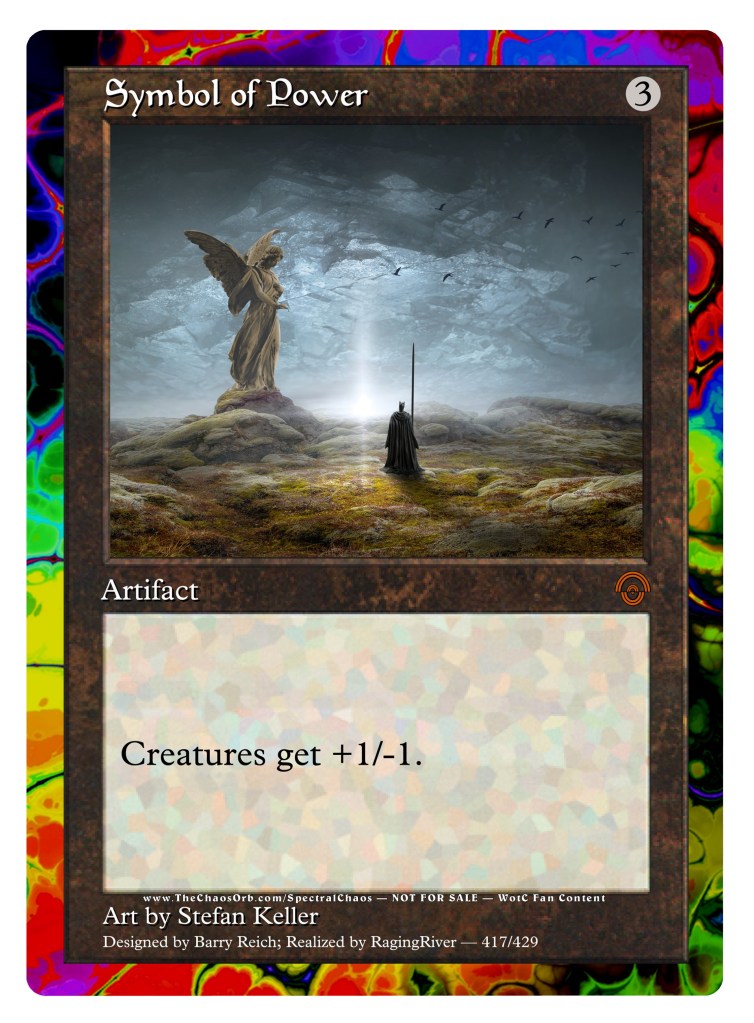
Realized
Symbol of Power – {3}
Artifact
Creatures get +1/-1.
418 – El Timtor’s Tiny Staff
(Very Rare Artifact)
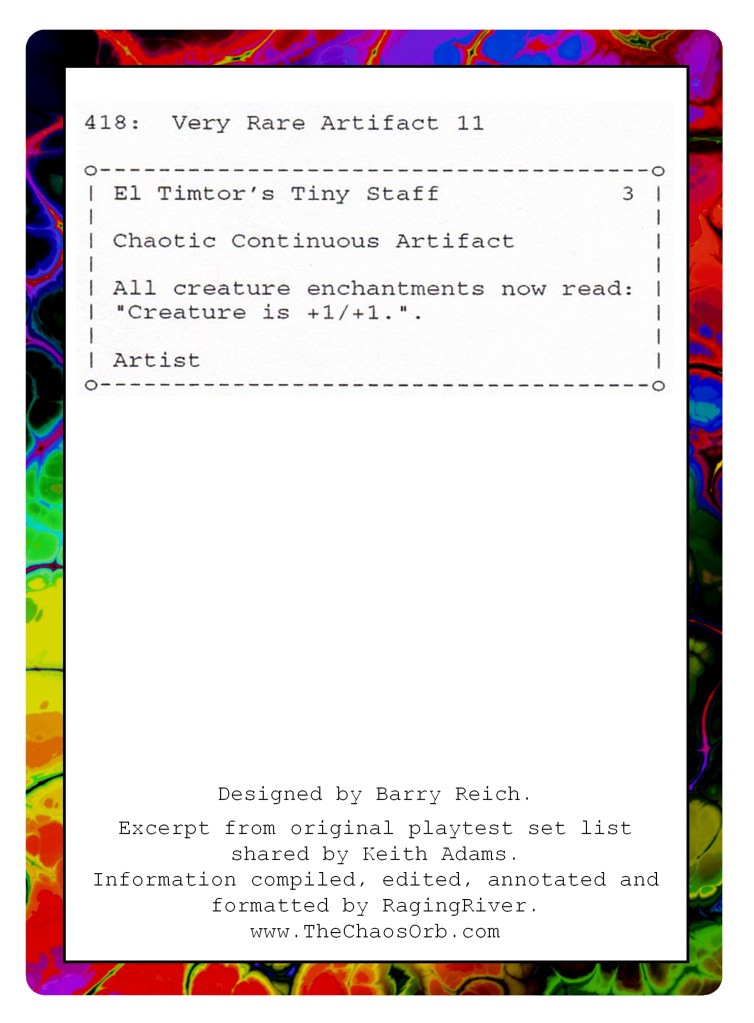
Original Playtest 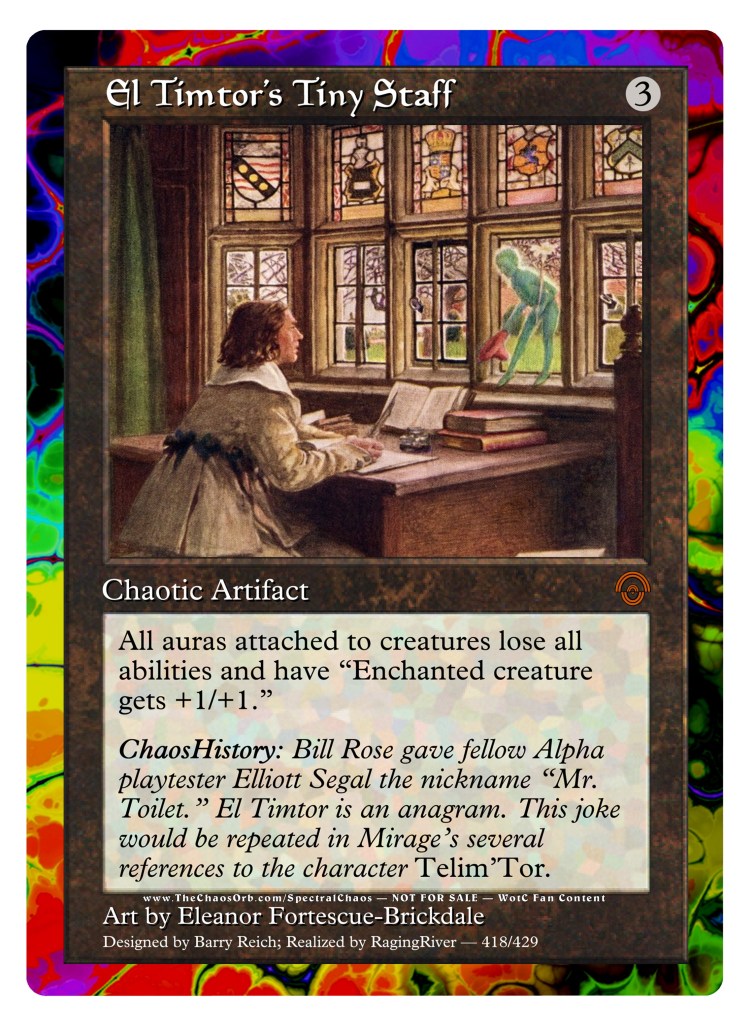
Realized
El Timtor’s Tiny Staff – {3}
Chaotic Artifact
All auras attached to creatures lose all abilities and have “Enchanted creature gets +1/+1.”
ChaosHistory: Bill Rose gave fellow Alpha playtester Elliott Segal the nickname “Mr. Toilet.” El Timtor is an anagram. This joke would be repeated in Mirage’s several references to the character Telim’Tor.
- This doesn’t change the text of aura cards in your hand, graveyard or anywhere else. This means that you’ll still need to satisfy any targeting requirements based on the original text of the aura. As soon as it becomes attached to a creature, El Timtor’s Tiny Staff will change the aura’s text.
- If an aura enchants a non-creature permanent that becomes a creature, assuming the aura continues to enchant that creature, El Timtor’s Tiny Staff will immediately change the aura’s text. If an aura enchants a creature that becomes a non-creature permanent, assuming the aura continues to enchant that permanent, the aura will immediately revert to its original text.
419 – Round Table
(Very Rare Artifact)
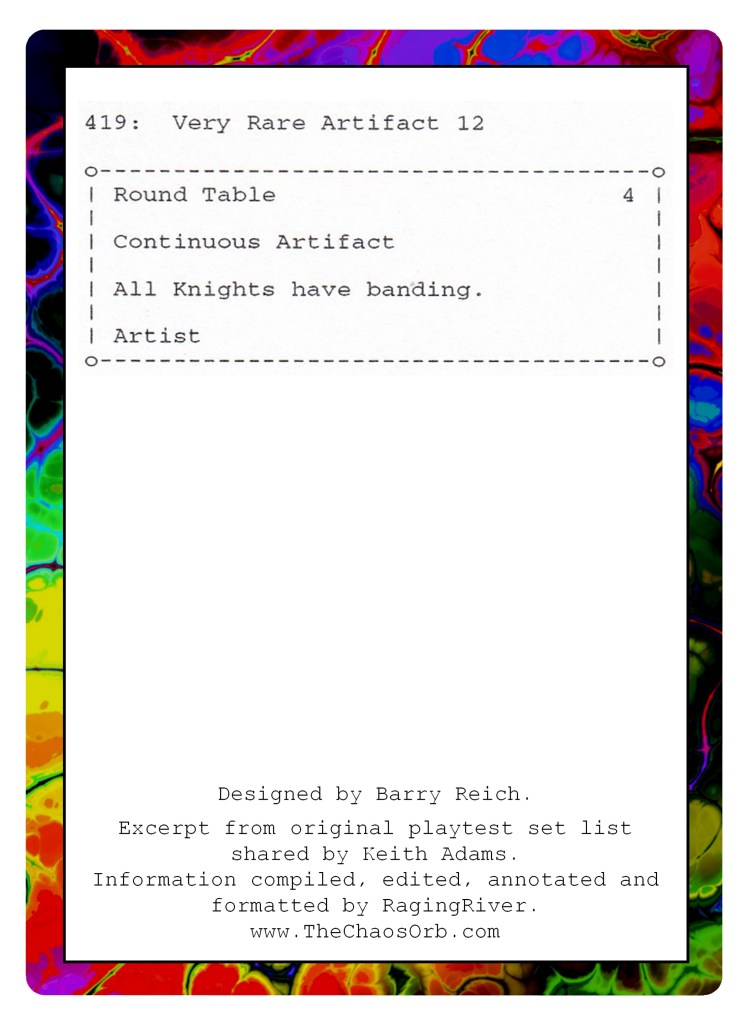
Original Playtest 
Realized
Round Table – {4}
Legendary Artifact
All knights have banding.
420 – Ruin
(Very Rare Artifact)

Original Playtest 
Realized
Ruin – {4}
Artifact
At the beginning of your upkeep, for each creature you control, you may place a ruin counter on it or remove a ruin counter from it. A creature can’t have more than one ruin counter on it.
If a source would deal damage to a creature with a ruin counter on it, prevent 1 of that damage. A creature with a ruin counter on it can’t attack or block.
- This is a triggered ability, not an activated ability. It triggers only once during your upkeep, and you add or remove a ruin counter from each of your creatures as part of resolving that ability. You can’t change your mind and add or remove a ruin counter later on in your upkeep.
- If an opponent gains control of one of your creatures with a ruin counter on it, it will keep the counter, Ruin‘s damage prevention effect will continue to apply to it, and it won’t be able to attack or block. But since you don’t control it anymore, you can no longer remove the ruin counter from it during your upkeep.
- If you control multiple Ruins, you need to keep track of the ruin counters separately. The ruin counters are specific to the Ruin that created them. When Ruin leaves the battlefield, remove the ruin counters from its creatures (they wouldn’t have any effect if left on the creatures anyway). If you control multiple Ruins and one is destroyed, only the ruin counters created by that instance of Ruin will be removed. The ruin counters created by other instances of Ruin won’t be affected.
- If you control multiple Ruins, each will trigger and resolve separately during your upkeep. During the triggered ability for a Ruin, only that Ruin‘s ruin counters may be removed. This means that, if you stack the triggers correctly, you could remove a ruin counter from a creature using the Ruin that placed it there, then put a ruin counter on the same creature using a different Ruin‘s ability during same upkeep. At no point in time can a creature have two ruin counters on it, whether from the same Ruin or two different Ruins.
421 – Paxin’s Armor
(Very Rare Artifact)
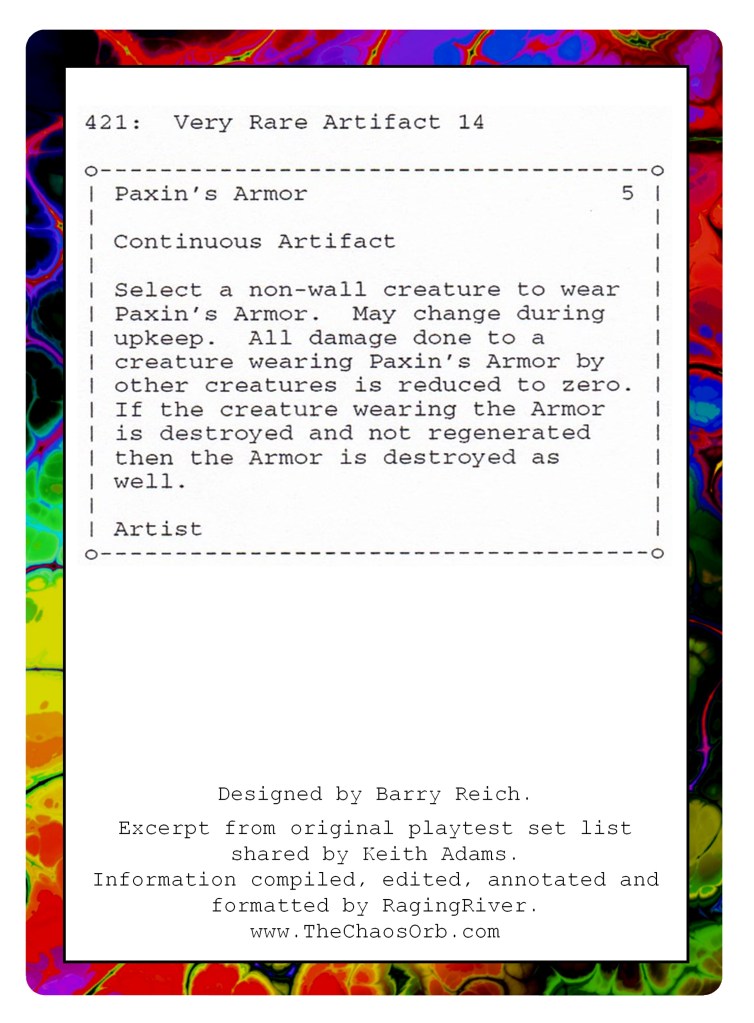
Original Playtest 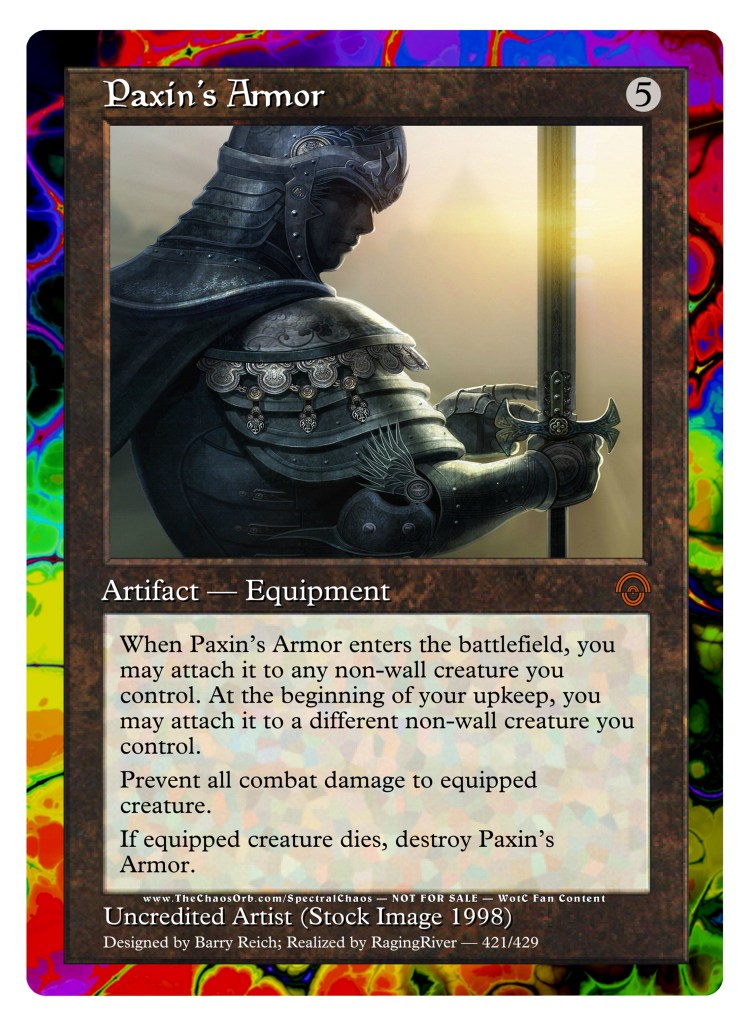
Realized
Paxin’s Armor – {5}
Artifact – Equipment
When Paxin’s Armor enters the battlefield, you may attach it to any non-wall creature you control. At the beginning of your upkeep, you may attach it to a different non-wall creature you control.
Prevent all combat damage to equipped creature.
If equipped creature dies, destroy Paxin’s Armor.
- This equipment has no “equip” ability, because Barry Reich conceived of this over 10 years before equipment was first printed by Wizards of the Coast.
422 – Paxin’s Shield
(Very Rare Artifact)

Original Playtest 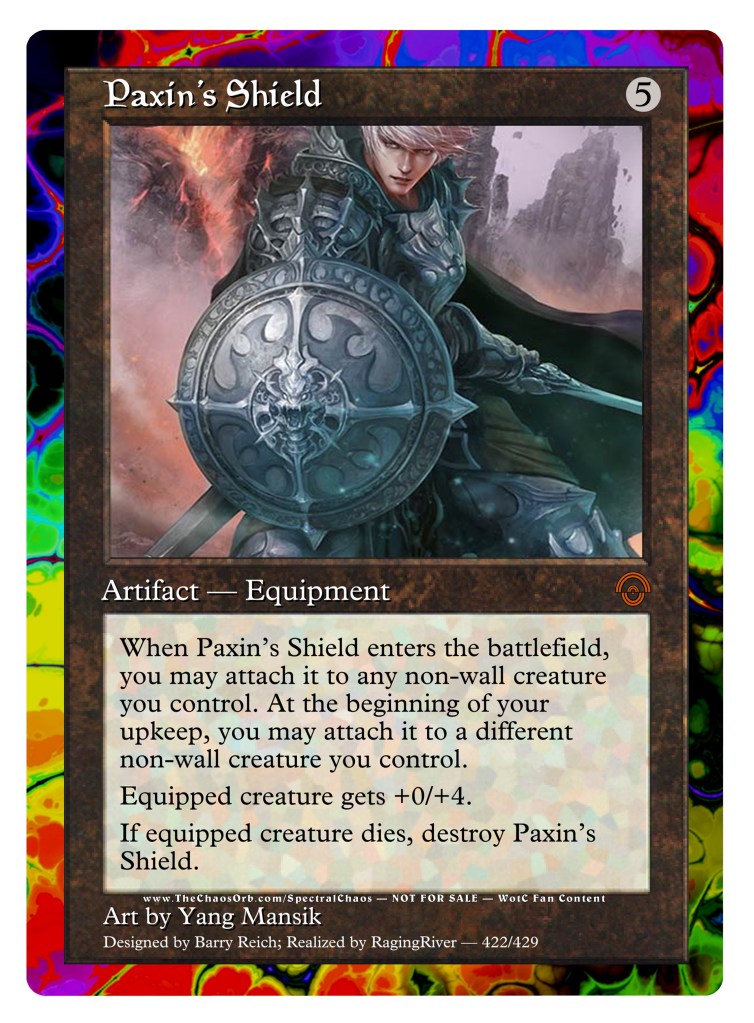
Realized
Paxin’s Shield – {5}
Artifact – Equipment
When Paxin’s Shield enters the battlefield, you may attach it to any non-wall creature you control. At the beginning of your upkeep, you may attach it to a different non-wall creature you control.
Equipped creature gets +0/+4.
If equipped creature dies, destroy Paxin’s Shield.
- This equipment has no “equip” ability, because Barry Reich conceived of this over 10 years before equipment was first printed by Wizards of the Coast.
423 – Paxin’s Sword
(Very Rare Artifact)

Original Playtest 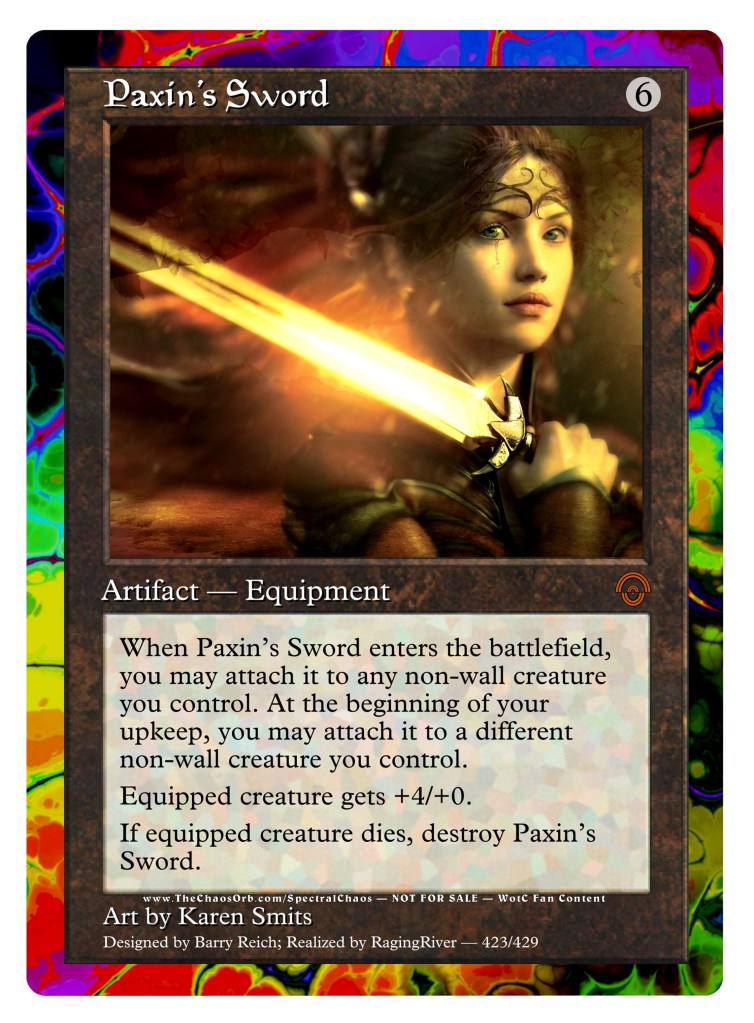
Realized
Paxin’s Shield – {6}
Artifact – Equipment
When Paxin’s Sword enters the battlefield, you may attach it to any non-wall creature you control. At the beginning of your upkeep, you may attach it to a different non-wall creature you control.
Equipped creature gets +4/+0.
If equipped creature dies, destroy Paxin’s Sword.
- This equipment has no “equip” ability, because Barry Reich conceived of this over 10 years before equipment was first printed by Wizards of the Coast.
424 – Felice of Many Colors
(Very Rare Artifact Creature)

Original Playtest 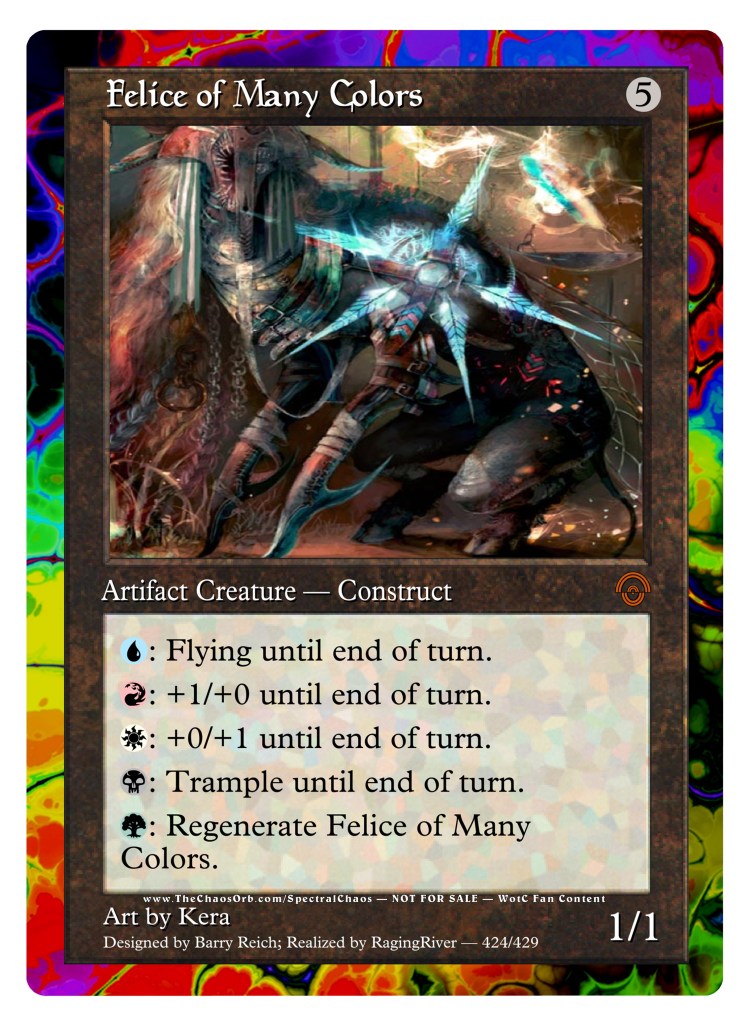
Realized
Felice of Many Colors – {5}
Artifact Creature – Construct
{U}: Flying until end of turn.
{R}: +1/+0 until end of turn.
{W}: +0/+1 until end of turn.
{B}: Trample until end of turn.
{G}: Regenerate Felice of Many Colors.
1/1
425 – Staff of Odin
(Very Rare Artifact)

Original Playtest 
Realized
Staff of Odin – {20}
Chaotic Artifact
{10}: The game is a draw.
ChaosHistory: Barry Reich proposed a new “very rare” rarity. Some, like Great Cat Armand, were significantly stronger than other rares at the time and would have pushed the limits of playability. Others, like Staff of Odin, were less playable but full of flavor. The first “mythic rares” would be introduced 15 years later, in Shards of Alara.
- When Staff of Odin’s ability resolves, the game ends immediately. The game is a draw, meaning neither player wins and neither player loses.
- In a multiplayer game played with the limited range of influence option, Staff of Odin‘s ability won’t necessarily end the entire game when it resolves. All players within range of Staff of Odin will leave the game. They’ll neither win nor lose; as far as they’re concerned, the result of the game is a draw. All other players will continue playing.
426 – Unruly Summons
(Very Rare Sorcery (Multicolor))

Original Playtest 
Realized
Unruly Summons – {2}{B}{R}{G}{G}
Chaotic Sorcery
Reveal the top 15 cards of target opponent’s library. If exactly one creature card is revealed, put that card onto the battlefield under your control. If two or more creature cards are revealed, put one onto the battlefield under your control and one onto the battlefield under that opponent’s control. Shuffle the remaining revealed cards into their owner’s library.
- If the library has fewer than 15 cards in it, reveal all its cards and choose from among them.
- If you reveal zero creature cards, the revealed cards simply get shuffled back into their owner’s library without further action.
- You can’t decline to put the creatures into play. If only one creature card is revealed, you must put it into play under your control. If two or more creature cards are revealed, you must put one into play under your control and one under that opponent’s control.
- The creature card or cards aren’t being cast, they are just put onto the battlefield. You can’t pay Kicker costs or other alternative costs, and if the mana cost includes {X}, {X}=0.
427 – Brainwash
(Very Rare Sorcery (Multicolor))
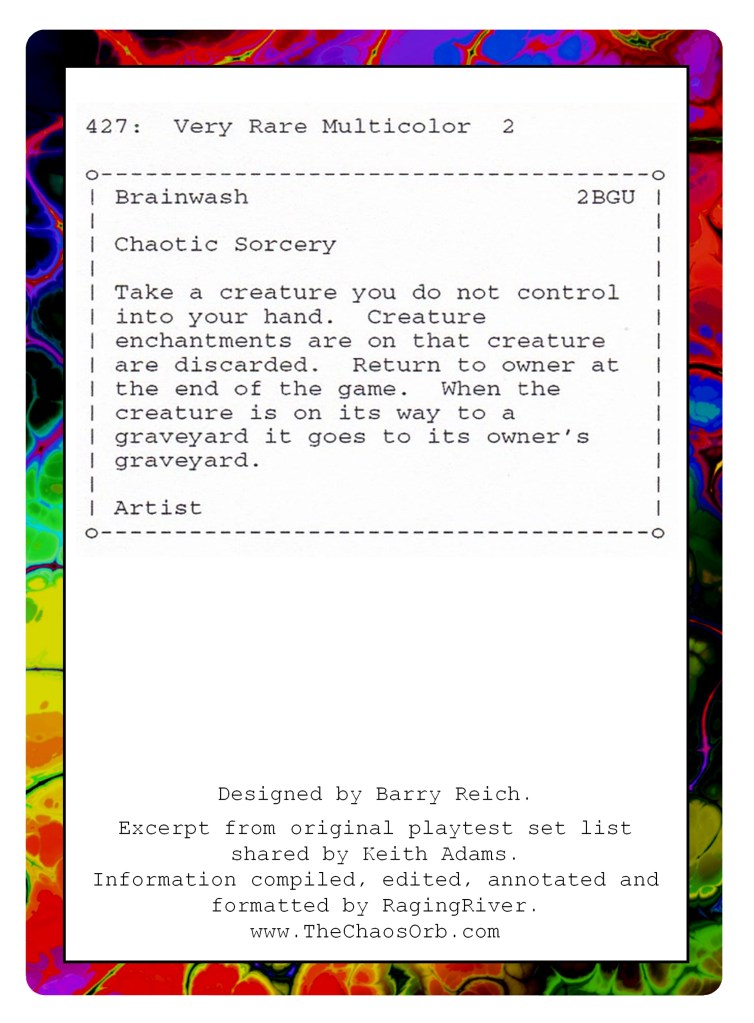
Original Playtest 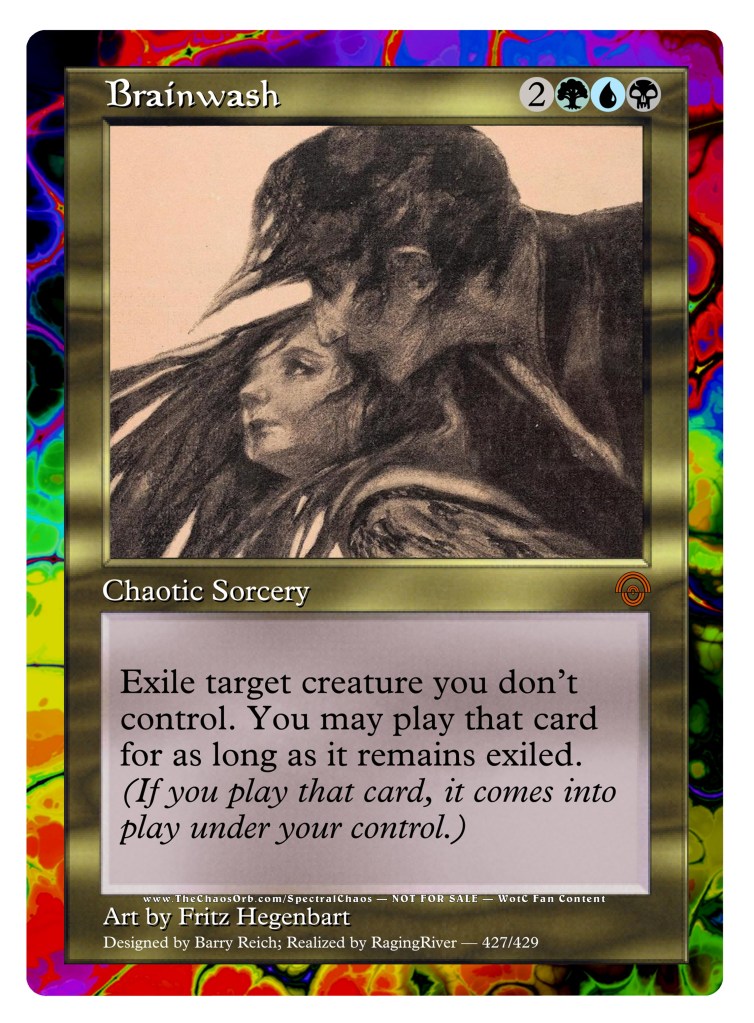
Realized
Brainwash – {2}{G}{U}{B}
Chaotic Sorcery
Exile target creature you don’t control. You may play that card for as long as it remains exiled. (If you play that card, it comes into play under your control.)
- You still have to follow normal timing restrictions and pay its mana cost in order to cast the creature card.
428 – Spectral Chaos
(Very Rare Sorcery (Multicolor))

Original Playtest 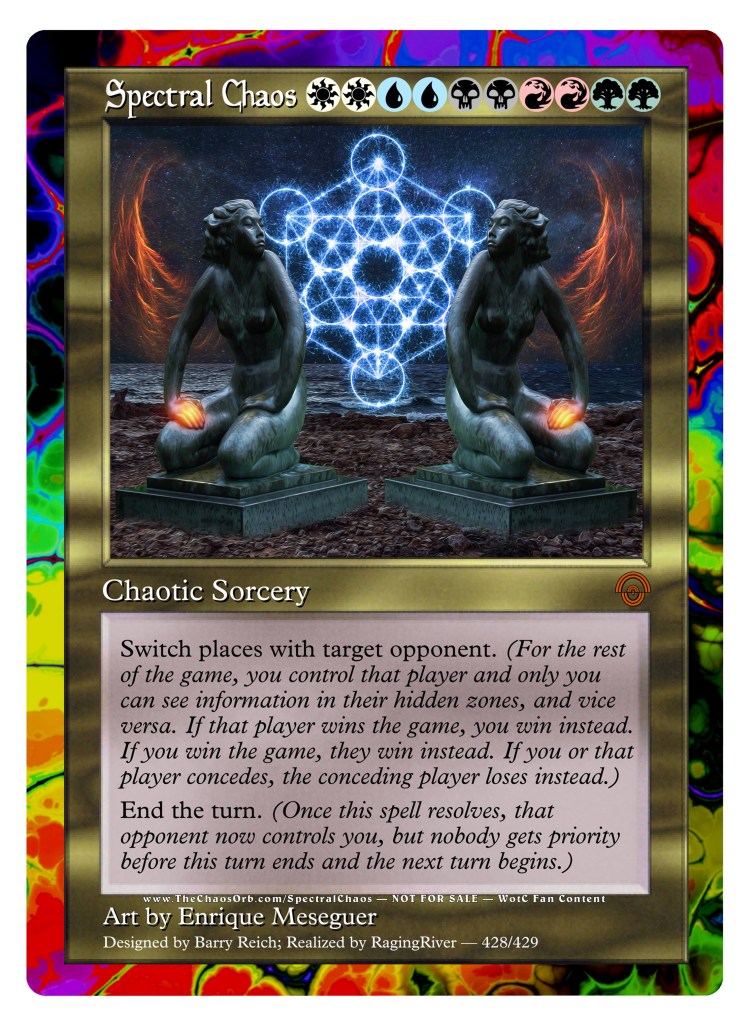
Realized
Spectral Chaos – {W}{W}{U}{U}{B}{B}{R}{R}{G}{G}
Chaotic Sorcery
Switch places with target opponent. (For the rest of the game, you control that player and only you can see information in their hidden zones, and vice versa. If that player wins the game, you win instead. If you win the game, they win instead. If you or that player concedes, the conceding player loses instead.)
End the turn. (Once this spell resolves, that opponent now controls you, but nobody gets priority before this turn ends and the next turn begins.)
- Once Spectral Chaos resolves, there is no way to “undo” its effect; you and that opponent have permanently switched places for the remainder of this game. You will control them, and they will control you, unless another effect later this game changes control of players again.
- Actual ownership of cards of course doesn’t change. If a spell or ability cares about who owns a card, use the actual ownership of the cards, disregarding Spectral Chaos‘s effect.
- This doesn’t change turn order. This means that in a 2-player game, after Spectral Chaos resolves, your opponent’s turn would immediately begin, with you controlling them. In a multiplayer game, it’s usually easiest to simply physically switch seats with the opponent you switched places with.
- If playing for ante, the anted cards won’t change. So if you win (i.e., your opponent won while you were controlling them), you’ll own the card your opponent anted at the beginning of the game, and if they win (i.e., you won while they were controlling you), they’ll own the card you anted at the beginning of the game.
429 – Temporal Loop
(Very Rare Sorcery (Multicolor))

Original Playtest 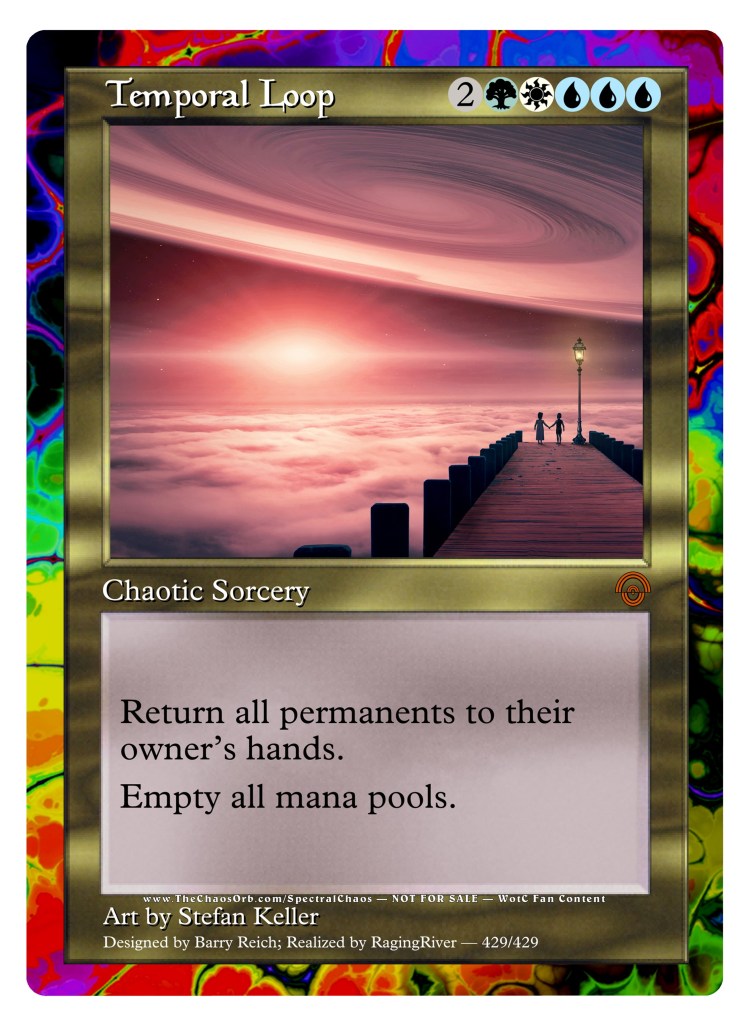
Realized
Temporal Loop – {2}{G}{W}{U}{U}{U}
Chaotic Sorcery
Return all permanents to their owner’s hands.
Empty all mana pools.
SPECIALS (9):
Click here to download high-resolution copies of the Spectral Chaos RagingRiver Specials at Ko-fi.
S1 – Barry’s Land
(Special Basic Land)

Barry’s Land
Basic Land
ChaosHistory: Mark Rosewater was fascinated by Barry Reich’s concepts in Spectral Chaos relating to the effects of controlling different basic land types. The concept was tested in several sets and eventually became the “Domain” mechanic in Invasion. MaRo wanted to find a way to boost the mechanic with a colorless basic land, nicknamed “Barry’s Land” by WotC R&D as a nod to Reich’s concept. The concept was almost implemented in Invasion, then Planeshift, then Conflux. It would take over 20 years for the concept to finally be released in 2016 with Oath of the Gatewatch’s new basic land: Wastes.
- Barry’s Land is a basic land, but it doesn’t have a basic land type. If you tap it, it will make one colorless mana.
S2 – Gratitude
(Special Enchantment (Multicolor) – Original RagingRiver Concept)
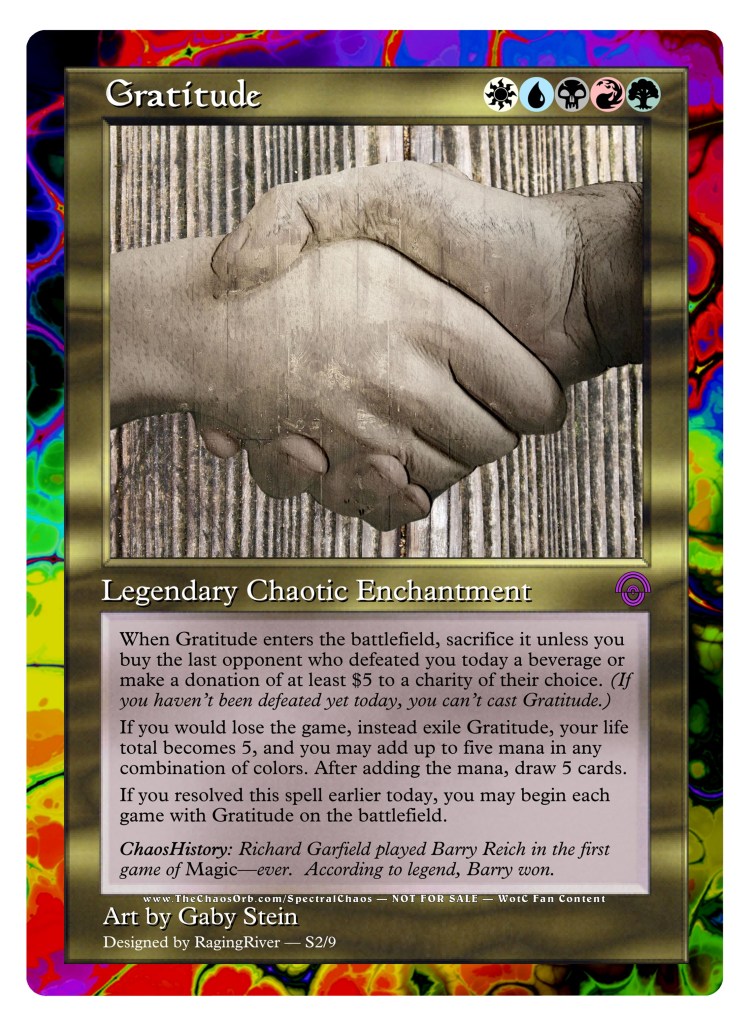
Gratitude – {W}{U}{B}{R}{G}
Legendary Chaotic Enchantment
When Gratitude enters the battlefield, sacrifice it unless you buy the last opponent who defeated you today a beverage or make a donation of at least $5 to a charity of their choice. (If you haven’t been defeated yet today, you can’t cast Gratitude.)
If you would lose the game, instead exile Gratitude, your life total becomes 5, and you may add up to five mana in any combination of colors. After adding the mana, draw 5 cards.
If you resolved this spell earlier today, you may begin each game with Gratitude on the battlefield.
ChaosHistory: Richard Garfield played Barry Reich in the first game of Magic – ever. According to legend, Barry won.
- If you don’t want to donate to that charity, you can buy them a drink instead. IOUs are ok if both that prior opponent and your current opponent(s) are cool with it.
- You have to have actually resolved this spell in a previous game today in order to start a game with it on the battlefield. If the spell was countered, or if you put it onto the battlefield without casting it, you won’t get to start a game with it in play. However, it just has to have resolved once, and it doesn’t matter if it was immediately destroyed or sacrificed after it resolved.
- If the last ability applies, you decide whether or not to start each game with it in play. This card is still part of your deck if you do so (you don’t get to replace it by adding another card to your deck); more specifically, it has to be part of your starting library (not your sideboard) in order to start a game this way in the first game of a match (i.e., in 60-card constructed, start the game with 59 cards in your library and this on the battlefield). If it’s only in your sideboard, you could start game 2 or 3 of a match with this on the battlefield. If you’re using this ability, you announce it before anyone shuffles and before any mulligans are taken. Your opponents will see this on the battlefield before they draw their opening hands and make decisions about mulligans. Starting with this on the battlefield won’t change your starting hand size or how you mulligan. If you decide not to start the game with this on the battlefield, just shuffle it into your main deck or include it in your sideboard as normal. It starts on the battlefield, not entering the battlefield, so the first ability won’t trigger at the start of the game – but don’t let that stop you from donating to charities or buying your opponents drinks!
- If you have more than one of these in your deck, you can choose to start a game with one or more of them on the battlefield and the rest shuffled into your library. However, because it’s legendary, if you start the game with more than one on the battlefield, you’ll place all but one of them in your graveyard as soon as state-based actions are checked at the beginning of the game.
S3 – Rainbow Connection
(Special Enchantment (Multicolor) – Original RagingRiver Concept)
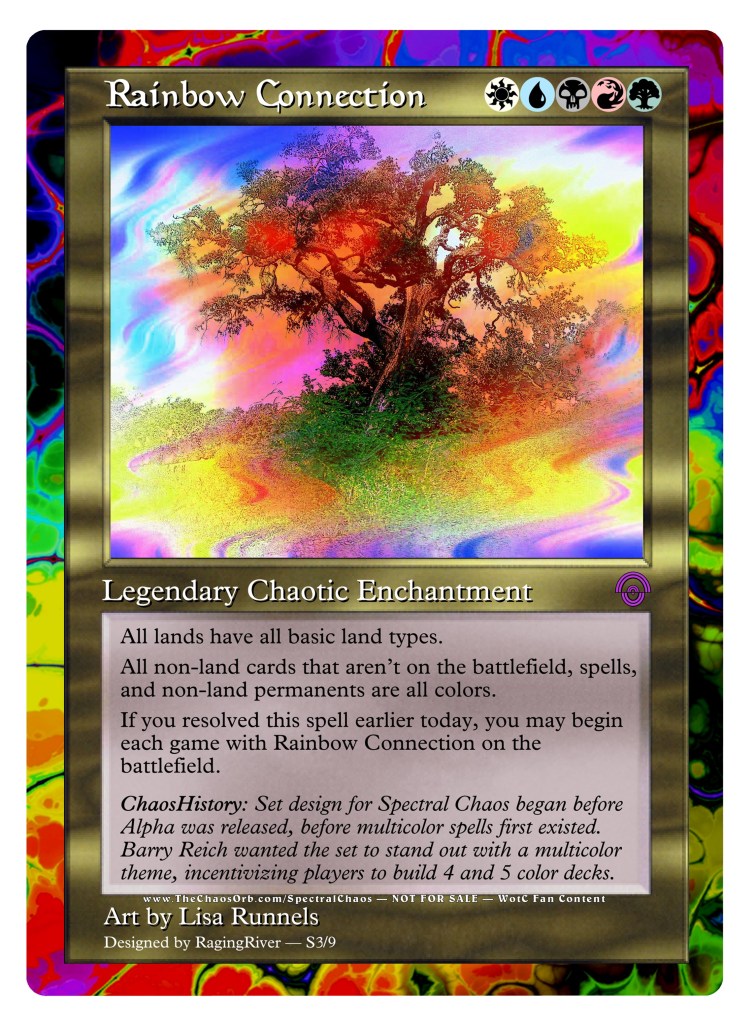
Rainbow Connection – {W}{U}{B}{R}{G}
Legendary Chaotic Enchantment
All lands have all basic land types.
All non-land cards that aren’t on the battlefield, spells, and non-land permanents are all colors.
If you resolved this spell earlier today, you may begin each game with Rainbow Connection on the battlefield.
ChaosHistory: Set design for Spectral Chaos began before Alpha was released, before multicolor spells first existed. Barry Reich wanted the set to stand out with a multicolor theme, incentivizing players to build 4 and 5 color decks.
- Land cards that aren’t on the battlefield aren’t affected by the first ability.
- The second ability means every non-land card is a multicolor card.
- The second ability affects every non-land card in every game zone, all tokens on the battlefield, and all spell copies on the stack, regardless of who controls them. While Rainbow Connection is on the battlefield, an effect that changes a non-land object’s colors will overwrite Rainbow Connection‘s ability.
- Each card becomes a new object as it changes zones, so the second ability will apply to it from scratch in the new zone. Zone-change replacement abilities that care about a color (like “[color] permanents enter the battlefield tapped”) won’t work (unless the card is actually that color without taking into account Rainbow Connection‘s ability) because those effects are applied as the card is entering its new zone. Zone-change triggered abilities that care about the new color (like “when a [color] permanent enters the battlefield” or “when you cast a [color] spell”) will work because those effects apply after the card is already in its new zone.
- If something affected by Rainbow Connection‘s second ability is normally colorless (like most artifact cards), it will be every color. It won’t be both colorless and every color.
- You have to have actually resolved this spell in a previous game today in order to start a game with it on the battlefield. If the spell was countered, or if you put it onto the battlefield without casting it, you won’t get to start a game with it in play. However, it just has to have resolved once, and it doesn’t matter if it was immediately destroyed or sacrificed after it resolved.
- If the last ability applies, you decide whether or not to start each game with it in play. This card is still part of your deck if you do so (you don’t get to replace it by adding another card to your deck); more specifically, it has to be part of your starting library (not your sideboard) in order to start a game this way in the first game of a match (i.e., in 60-card constructed, start the game with 59 cards in your library and this on the battlefield). If it’s only in your sideboard, you could start game 2 or 3 of a match with this on the battlefield. If you’re using this ability, you announce it before anyone shuffles and before any mulligans are taken. Your opponents will see this on the battlefield before they draw their opening hands and make decisions about mulligans. Starting with this on the battlefield won’t change your starting hand size or how you mulligan. If you decide not to start the game with this on the battlefield, just shuffle it into your main deck or include it in your sideboard as normal.
- If you have more than one of these in your deck, you can choose to start a game with one or more of them on the battlefield and the rest shuffled into your library. However, because it’s legendary, if you start the game with more than one on the battlefield, you’ll place all but one of them in your graveyard as soon as state-based actions are checked at the beginning of the game.
S4 – In the Heart of Chaos
(Special Enchantment (Multicolor) – Original RagingRiver Concept)
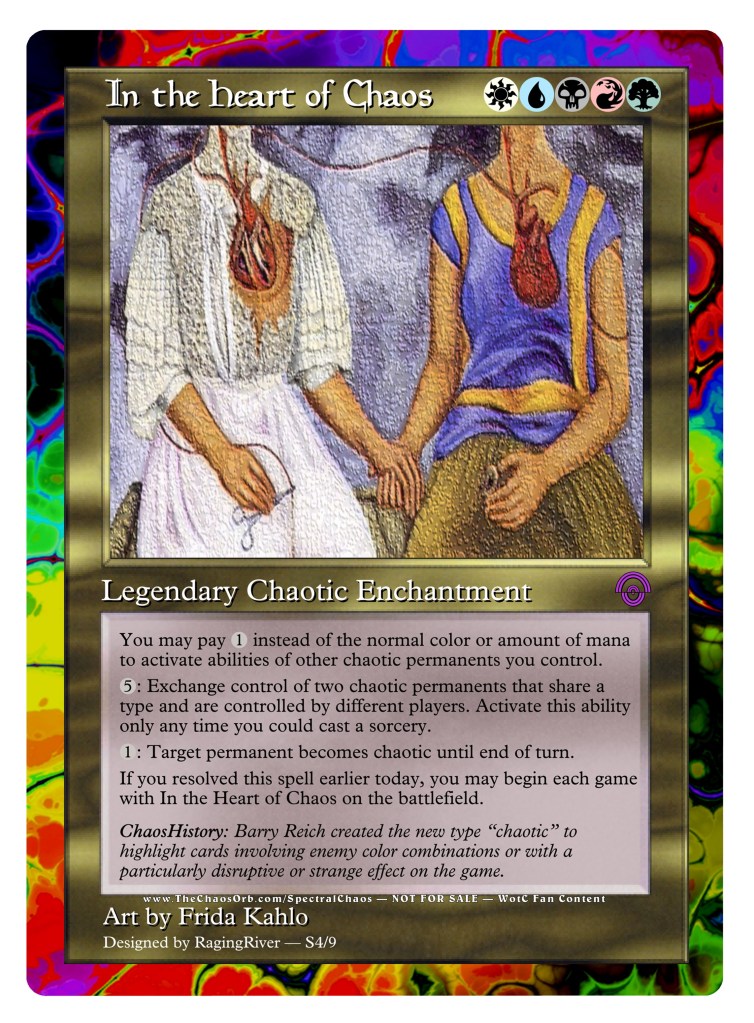
In the Heart of Chaos – {W}{U}{B}{R}{G}
Legendary Chaotic Enchantment
You may pay {1} instead of the normal color or amount of mana to activate abilities of other chaotic permanents you control.
{5}: Exchange control of two chaotic permanents that share a type and are controlled by different players. Activate this ability only any time you could cast a sorcery.
{1}: Target permanent becomes chaotic until end of turn.
If you resolved this spell earlier today, you may begin each game with In the Heart of Chaos on the battlefield.
ChaosHistory: Barry Reich created the new type “chaotic” to highlight cards involving enemy color combinations or with a particularly disruptive or strange effect on the game.
- The cost reduction effect doesn’t change or elimate other requirements of activating the ability of another chaotic permanent, such as tapping it, sacrificing something, paying life, choosing targets, etc. It simply means that instead of that activated ability requiring colored mana or more than {1} mana, it now only costs {1} mana instead. If the ability cares about the color of mana used to activate it, it will still see the color of mana you used to pay {1}.
- You can’t pay {1} for an ability only once and have that be deemed an infinite or arbitrarily large payment of mana. For this reason, if an activated ability includes a mana cost of {X} and you choose to use In the Heart of Chaos‘ reduction effect, the entire ability (including the {X}) will have a mana cost to activate of {1} and X will be deemed to equal 1.
- If an ability has a mana cost that can be paid for multiple times as part of a single activation (like Cleric of Amon-Ra), you may have the cost for each payment reduced to {1}.
- In the Heart of Chaos‘ first activated ability doesn’t target, and it isn’t an aura. Permanents with shroud or protection from a color and/or enchantments can still be chosen and exchanged using the ability.
- Note that you choose permanents (and players) only when the first activated ability resolves. When you activate this ability, you won’t announce which permanents you intend to exchange, or (in a multi-player game) even which players you intend to be involved. Your opponents not knowing is part of the chaotic fun.
- When the first activated ability resolves, you must choose two different chaotic permanents that share a type (e.g., both creatures, both enchantments) and that are controlled by different players, if possible. The two permanents could have other types, they just have to share at least one type. If there are no valid choices that can be made when this ability resolves, it will do nothing.
- In the Heart of Chaos is itself chaotic, so you can use the first activated ability to exchange control of it with another chaotic enchantment.
- The exchange of control is permanent, regardless of whether or not In the Heart of Chaos leaves the battlefield, or whether one or both those permanents ceases to be chaotic or share a type. For what happens to change-of-control effects in a multiplayer game when one player loses but the remaining players keep playing, see C.R. 800.4a.
- You have to have actually resolved this spell in a previous game today in order to start a game with it on the battlefield. If the spell was countered, or if you put it onto the battlefield without casting it, you won’t get to start a game with it in play. However, it just has to have resolved once, and it doesn’t matter if it was immediately destroyed or sacrificed after it resolved.
- If the last ability applies, you decide whether or not to start each game with it in play. This card is still part of your deck if you do so (you don’t get to replace it by adding another card to your deck); more specifically, it has to be part of your starting library (not your sideboard) in order to start a game this way in the first game of a match (i.e., in 60-card constructed, start the game with 59 cards in your library and this on the battlefield). If it’s only in your sideboard, you could start game 2 or 3 of a match with this on the battlefield. If you’re using this ability, you announce it before anyone shuffles and before any mulligans are taken. Your opponents will see this on the battlefield before they draw their opening hands and make decisions about mulligans. Starting with this on the battlefield won’t change your starting hand size or how you mulligan. If you decide not to start the game with this on the battlefield, just shuffle it into your main deck or include it in your sideboard as normal.
- If you have more than one of these in your deck, you can choose to start a game with one or more of them on the battlefield and the rest shuffled into your library. However, because it’s legendary, if you start the game with more than one on the battlefield, you’ll place all but one of them in your graveyard as soon as state-based actions are checked at the beginning of the game.
S5 – One-Man Show
(Special Enchantment (Multicolor) – Original RagingRiver Concept)
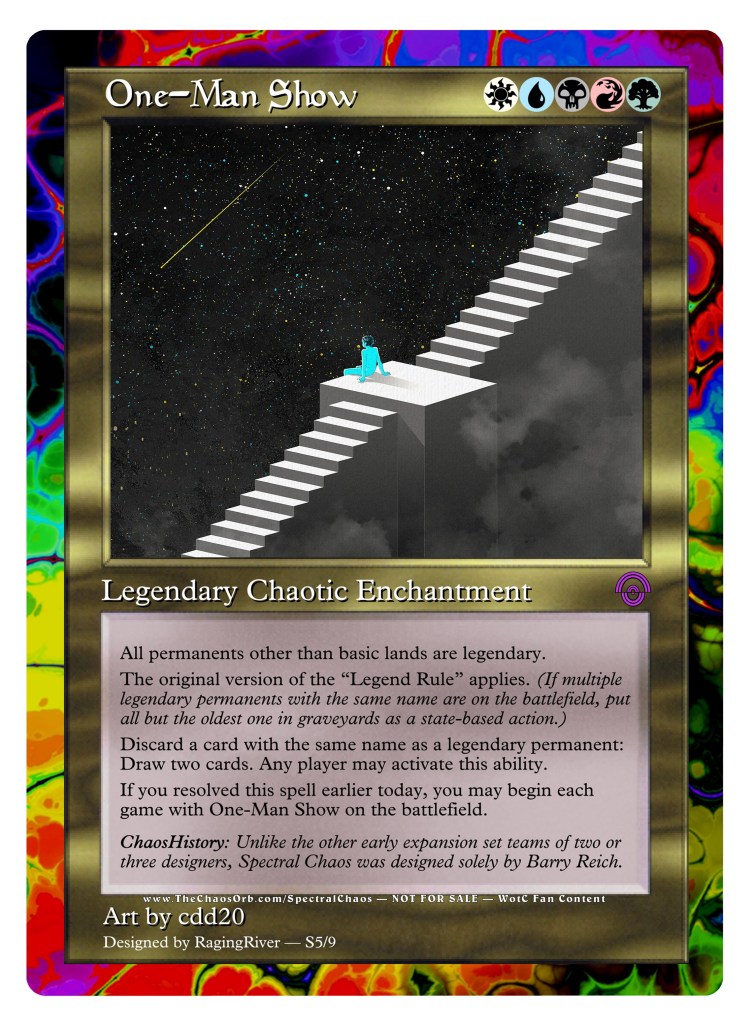
One-Man Show – {W}{U}{B}{R}{G}
Legendary Chaotic Enchantment
All permanents other than basic lands are legendary.
The original version of the “Legend Rule” applies. (If multiple legendary permanents with the same name are on the battlefield, put all but the oldest one in graveyards as a state-based action.)
Discard a card with the same name as a legendary permanent: Draw two cards. Any player may activate this ability.
If you resolved this spell earlier today, you may begin each game with One-Man Show on the battlefield.
ChaosHistory: Unlike the other early expansion set teams of two or three designers, Spectral Chaos was designed solely by Barry Reich.
- Only permanents are made legendary by the first ability, not cards in other game zones.
- The “Legend Rule” has changed many times during the history of the game. The current modern version allows each player to control a copy of the same legend; with One-Man Show, instead you follow the original version of the rule, which only allowed one copy of that legend anywhere on the battlefield. The current modern version says that if a card enters the battlefield with the same name as a legendary permanent you control, you get to choose which one to keep and which dies; with One-Man Show, instead you follow the original version of the rule, which says that the oldest copy anywhere on the battlefield always survives. If somehow multiple copies of a legendary permanent are put into play simultaneously, none of them is the oldest one so put all of them into their owners’ graveyards.
- One-Man Show won’t apply retroactively and look at time-stamps before it was put onto the battlefield. This means that as soon as One-Man Show is on the battlefield, if any permanents other than basic lands are duplicated anywhere on the battlefield (regardless of who controls them), they’ll all get put into their graveyards the next time state-based actions are performed.
- You have to have actually resolved this spell in a previous game today in order to start a game with it on the battlefield. If the spell was countered, or if you put it onto the battlefield without casting it, you won’t get to start a game with it in play. However, it just has to have resolved once, and it doesn’t matter if it was immediately destroyed or sacrificed after it resolved.
- If the last ability applies, you decide whether or not to start each game with it in play. This card is still part of your deck if you do so (you don’t get to replace it by adding another card to your deck); more specifically, it has to be part of your starting library (not your sideboard) in order to start a game this way in the first game of a match (i.e., in 60-card constructed, start the game with 59 cards in your library and this on the battlefield). If it’s only in your sideboard, you could start game 2 or 3 of a match with this on the battlefield. If you’re using this ability, you announce it before anyone shuffles and before any mulligans are taken. Your opponents will see this on the battlefield before they draw their opening hands and make decisions about mulligans. Starting with this on the battlefield won’t change your starting hand size or how you mulligan. If you decide not to start the game with this on the battlefield, just shuffle it into your main deck or include it in your sideboard as normal.
- If you have more than one of these in your deck, you can choose to start a game with one or more of them on the battlefield and the rest shuffled into your library. However, because it’s legendary and because the original version of the “Legend Rule” applies, if you start the game with more than one on the battlefield, none of them will be oldest so all of them will get put in your graveyard as soon as state-based actions are checked at the beginning of the game.
S6 – Barry Reich, Great Creator
(Special Creature (Multicolor) – Original RagingRiver Concept)
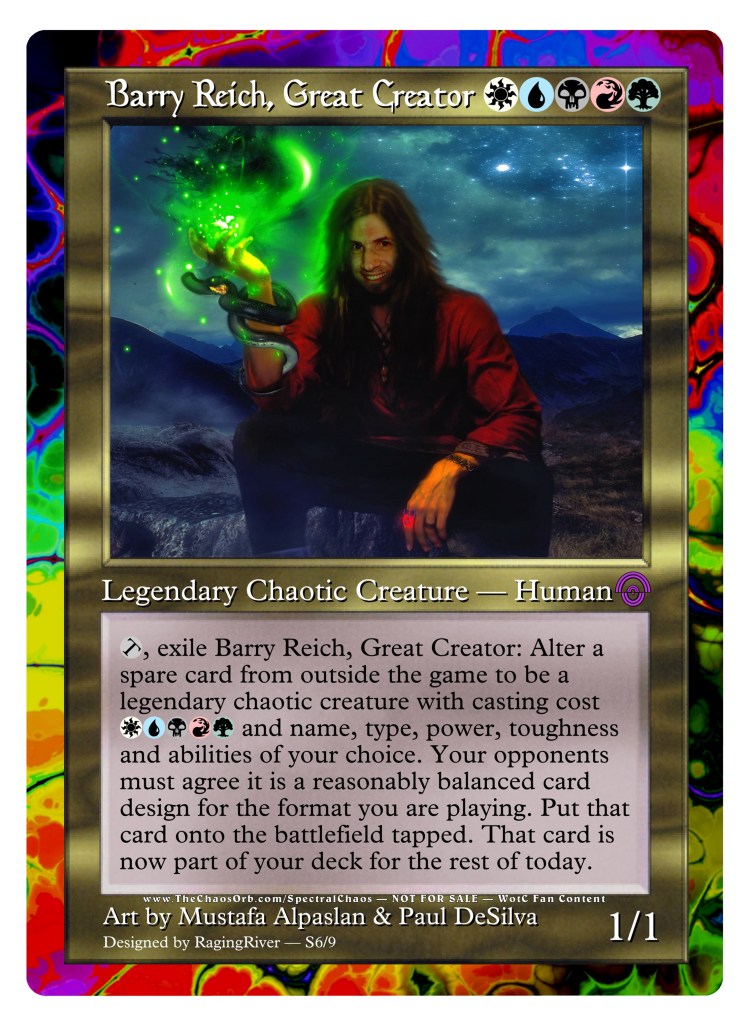

Barry Reich, Great Creator – {W}{U}{B}{R}{G}
Legendary Chaotic Creature – Human
{T}, exile Barry Reich, Great Creator: Alter a spare card from outside the game to be a legendary chaotic creature with casting cost {W}{U}{B}{R}{G} and name, type, power, toughness and abilities of your choice. Your opponents must agree it is a reasonably balanced card design for the format you are playing. Put that card onto the battlefield tapped. That card is now part of your deck for the rest of today.
1/1
- The newly-created card can have any name you want, but it can’t have the same name as any Magic card currently in existence. It can have any types you want, including supertypes (such as snow), other types (such as artifact, land or enchantment) and the creature’s tribe subtypes. It can have any abilities you want; be creative, not lame (don’t be like “umm, its ability is it can have any ability whenever it wants”). Your current opponents have to agree it is a reasonably balanced design for the format you’re playing generally, ignoring the particular specific board/game state at the time you create it. If you’re including Barry Reich, Great Creator in your deck, be courteous and think up a few creature designs in advance so you can quickly show something to your opponents. You could even get creature designs approved by your playgroup in advance, but you don’t have to.
- The newly-created card is not a token. It can be exiled, put in your graveyard, and otherwise is a creature card for all game purposes.
- The new creature is treated as entering the battlefield, and it has summoning sickness (you could include haste as one of its abilities, but note it must enter the battlefield tapped).
- The newly-created card gets added to your sideboard, not your main starting deck. If you’re playing multiple tournaments today or otherwise have the ability to change your starting deck, you could include it in your new starting deck if you want. You can ignore maximum deck or sideboard rules for purposes of adding your newly-created card.
- Barry Reich, Great Creator is still part of your deck too. The newly-created card doesn’t replace it.
S7 – Sage & Scion
(Special Enchantment (Multicolor) – Original RagingRiver Concept)

Sage & Scion – {W}{U}{B}{R}{G}
Legendary Chaotic Enchantment
When Sage & Scion enters the battlefield, each player’s life total becomes their age.
When Sage & Scion enters the battlefied, any player at least 18 years younger than their oldest opponent may choose up to 5 different cards they own from outside the game that are legal in the current Standard format, exile them in a face-down pile, and shuffle that pile. If that player would draw a card, they may instead put the top card of the exiled pile into their hand.
If you resolved this spell earlier today, you may begin each game with Sage & Scion entering the battlefield.
ChaosHistory: Barry Reich can sometimes be seen at Magic events and tournaments, trying not to lose to his son Andy.
- “Age” for this purpose means the number of birthdays experienced after the day of birth. If a player was born on leap day, count the number of complete years they’ve lived instead.
- If a second copy of Sage & Scion enters the battlefield under your control, the Legend Rule will require you to sacrifice one. Cards exiled with one Sage & Scion cannot be switched and used by the other Sage & Scion. Whichever cards were exiled with the Sage & Scion that is sacrificed will stay exiled forever.
- For the second ability, other players will not see the cards chosen. The cards chosen do not have to be legal in the format you are currently playing, they only have to be in the current Standard-legal card pool. You don’t have to use the specific printing from the Standard-legal sets, you could be another printing of a Standard-legal card. A player may choose any number of cards to exile with this ability from 0-5. Each of the chosen cards must be unique (i.e., have a different name). Your deck cannot violate deckbuilding rules (other than format legality and reprint rules). This means that for most formats (e.g., if you are playing Standard), you cannot choose a card that you already have 4 of in your deck, and if you are playing Commander, you cannot choose a card that you already have in your deck.
- If Sage & Scion leaves the battlefield, any cards exiled by it will stay exiled the rest of the game.
- You have to have actually resolved this spell in a previous game today in order to start a game with it entering the battlefield. If the spell was countered, or if you put it onto the battlefield without casting it, you won’t get to start a game with it in play. However, it just has to have resolved once, and it doesn’t matter if it was immediately destroyed or sacrificed after it resolved.
- If the last ability applies, you decide whether or not to start each game with it entering the battlefield. This card is still part of your deck if you do so (you don’t get to replace it by adding another card to your deck); more specifically, it has to be part of your starting library (not your sideboard) in order to start a game this way in the first game of a match (i.e., in 60-card constructed, start the game with 59 cards in your library and this entering the battlefield). If it’s only in your sideboard, you could start game 2 or 3 of a match with this entering the battlefield. If you’re using this ability, you announce it before anyone shuffles and before any mulligans are taken. Your opponents will see this entering the battlefield before they draw their opening hands and make decisions about mulligans. Starting with this entering the battlefield won’t change your starting hand size or how you mulligan. If you decide not to start the game with this entering the battlefield, just shuffle it into your main deck or include it in your sideboard as normal.
- If you have more than one of these in your deck, you can choose to start a game with one or more of them entering the battlefield and the rest shuffled into your library. However, because it’s legendary, if you start the game with more than one on the battlefield, you’ll place all but one of them in your graveyard as soon as state-based actions are checked at the beginning of the game.
- If you start the game with this entering the battlefield, its enter the battlefield triggers will go onto the stack as soon as anyone gets priority. So the life totals will adjust, and (if applicable) young players will make an exile pile, at the beginning of the first upkeep of the game. The adjusted life totals are not considered the “starting life total” even if you start the game this way.
S8 – Gabriel’s Horn
(Special Artifact (Multicolor) – Original RagingRiver Concept)

Gabriel’s Horn – {2/W}{2/U}{2/B}{2/R}{2/G}
Legendary Chaotic Artifact
Gabriel’s Horn is simultaneously colorless and all colors.
Pay 1 life, {T}, exile Gabriel’s Horn: Choose one:
– Target player takes an extra turn after this one. End the turn.
– Change the text of target permanent or spell by replacing all instances of one numeral or number word with ∞.
– Choose a card you own on the battlefield, on the stack or in your graveyard. You may begin each game today with that card on the stack. (If you don’t , shuffle it into your deck lke normal.)
ChaosHistory: Barry Reich, a Computer Science PhD at U.Penn with a perfect GPA, helped develop rarity/pack distributions, design the rules of drafting and address other Magic mathematics issues.
- Gabriel’s Horn is both colorless and all colors. It can be targeted by things requiring a colorless target, or requiring a target of any color or combination of colors. It isn’t monocolored. If something affects colorless cards in one manner and cards of a color in a different manner, Gabriel’s Horn is affected in both ways if possible. If the same effect treats colorless cards in one manner and colored cards in a different manner, and it’s truly impossible to treat Gabriel’s Horn both ways because they fundamentally conflict (this is extremely rare), flip a coin, and if it’s heads, treat Gabriel’s Horn as colorless for that effect only, and if it’s tails, treat Gabriel’s Horn as all colors for that effect only.
- The second mode will alter all occurrences of the chosen number in the text box of the given card. You can’t change values of X or numbers in generic mana symbols, it has to be a numeral or number word. It will only change a number printed on the card. It will not change any effects that are on the permanent. You target the card when you activate the ability, but you don’t choose which number to change in that card’s text until the ability resolves. If you change the text of a spell which is to become a permanent, the permanent will retain the text change. Printed power and toughness are not considered to be in the text box of a card; however, if there are numerals or number words in the text box that set or change power or toughness, you could change those with this effect.
- Infinite means, well, infinite. If a player would take infinite damage and a finite amount of it is prevented, they still take infinite damage. If a player has infinite life, they can pay any amount of life and take any amount of damage and their life total effectively can’t change, because losing a finite amount of life will still leave infinite life remaining.
- The third mode doesn’t target, so you don’t choose the card until the ability resolves. Because Gabriel’s Horn is exiled as a cost to activate the ability, you can’t choose Gabriel’s Horn itself. You may choose a permanent you own even if you don’t control it. Choosing the card with this third mode doesn’t impact that card at all in the current game, it only gives you the choice to start with that card on the stack in future games. Only a card may be chosen this way: for example, you can’t choose a token, or a copy of a spell on the stack that isn’t represented by a card. Once the ability resolves and the choice is made, you’ll be able to start future games with that card on the stack regardless of what happens to that card in this game.
- If you resolved the ability with the third mode, you decide whether or not to start each game with that card on the stack, as though you had just cast it. If that spell has X in its mana cost, X is 0. If the card requires targets, you’ll still need to target (and since the game is just starting, there probably isn’t anything you can target other than a player). If the card is a land, just start the game with it on the battlefield as if it had just been played, instead of on the “stack.” The card is still part of your starting library (not your sideboard) in order to start a game this way in the first game of a match (i.e., in 60-card constructed, start the game with 59 cards in your library and the card on the stack). If it’s only in your sideboard, you could start game 2 or 3 of a match with that card on the stack. If you’re using this ability, you announce it (including that spell’s targets, if any) before anyone shuffles and before any mulligans are taken. Your opponents will know the card will be on the stack before they draw their opening hands and make decisions about mulligans. Starting with the card on the stack won’t change your starting hand size or how you mulligan. The spell will resolve at the beginning of the first upkeep of the game, regardless of which player is taking the first turn of the game. If you decide not to start the game with the card on the stack, just shuffle it into your main deck or include it in your sideboard as normal.
S9 – Nostalgic Incantation
(Special Enchantment (Multicolor) – Original RagingRiver Concept)
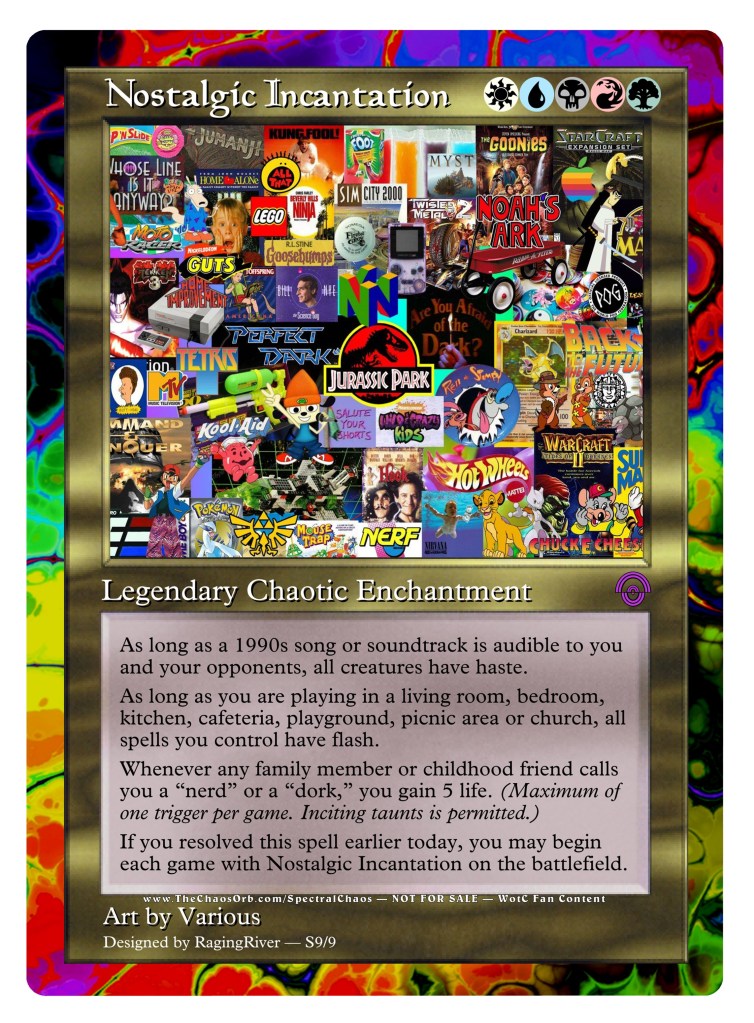
Nostalgic Incantation – {W}{U}{B}{R}{G}
Legendary Chaotic Enchantment
As long as a 1990s song or soundtrack is audible to you and your opponents, all creatures have haste.
As long as you are playing in a living room, bedroom, kitchen, cafeteria, playground, picnic area or church, all spells you control have flash.
Whenever any family member or childhood friend calls you a “nerd” or a “dork,” you gain 5 life. (Maximum of one trigger per game. Inciting taunts is permitted.)|
If you resolved this spell earlier today, you may begin each game with Nostalgic Incantation on the battlefield.
- I see you, Spike, and no: you can’t strategically use earplugs or headphones to make the first ability “turn off.” SMDH.
- If any of your opponents is deaf, the first ability won’t work unless they agree. Once that player consents, they can’t “take it back” later today.
- The second ability depends on where you are playing, not your opponents. If you’re playing a webcam game, you could be playing in a different place than they are.
- You have to have actually resolved this spell in a previous game today in order to start a game with it on the battlefield. If the spell was countered, or if you put it onto the battlefield without casting it, you won’t get to start a game with it in play. However, it just has to have resolved once, and it doesn’t matter if it was immediately destroyed or sacrificed after it resolved.
- If the last ability applies, you decide whether or not to start each game with it in play. This card is still part of your deck if you do so (you don’t get to replace it by adding another card to your deck); more specifically, it has to be part of your starting library (not your sideboard) in order to start a game this way in the first game of a match (i.e., in 60-card constructed, start the game with 59 cards in your library and this on the battlefield). If it’s only in your sideboard, you could start game 2 or 3 of a match with this on the battlefield. If you’re using this ability, you announce it before anyone shuffles and before any mulligans are taken. Your opponents will see this on the battlefield before they draw their opening hands and make decisions about mulligans. Starting with this on the battlefield won’t change your starting hand size or how you mulligan. If you decide not to start the game with this on the battlefield, just shuffle it into your main deck or include it in your sideboard as normal.
- If you have more than one of these in your deck, you can choose to start a game with one or more of them on the battlefield and the rest shuffled into your library. However, because it’s legendary, if you start the game with more than one on the battlefield, you’ll place all but one of them in your graveyard as soon as state-based actions are checked at the beginning of the game.
CYCLES:
Click here to download high-resolution copies of the Spectral Chaos Miscellaneous files at Ko-fi.
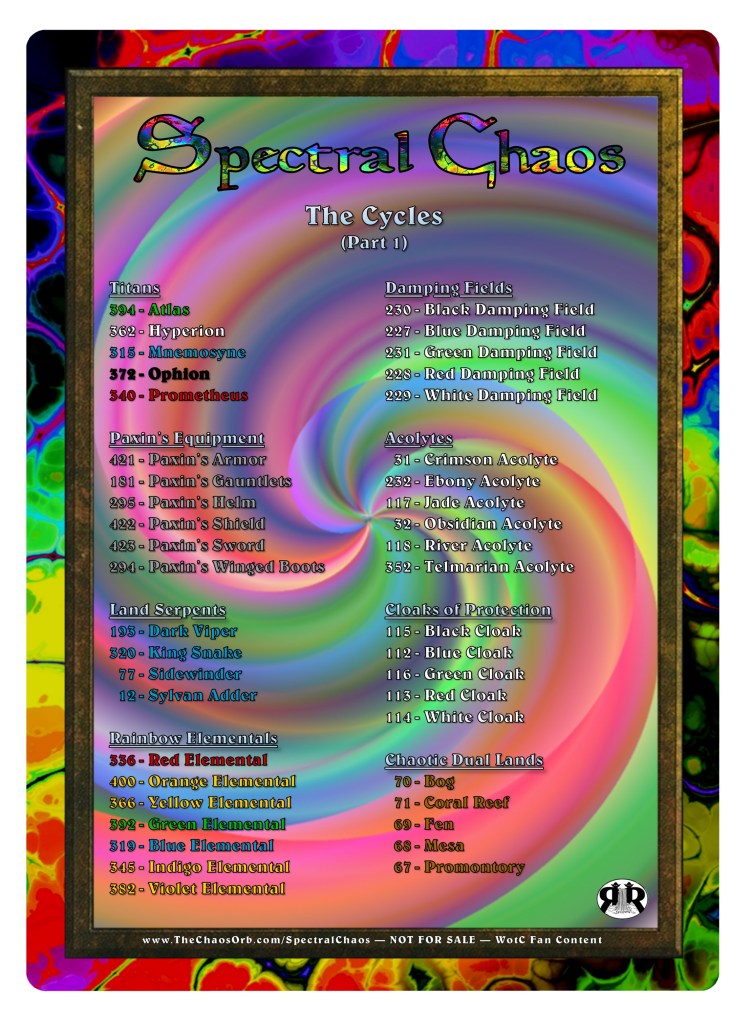

 TheChaosOrb.com